A discovery conversation should reduce the uncertainty that prevents a responsible estimate. Learn what problem needs solving, who is affected, which inputs exist and how the result will be accepted. The output is a clearer decision about the project, not a long questionnaire or an obligation to quote immediately. This step follows a genuine enquiry in how to find freelance clients.
Prepare a short question plan
Read the enquiry and any materials the client has deliberately supplied for review. Write what you already know, what you are assuming and the few questions that could change the work substantially. If the request is “make the registration process easier,” the important uncertainty may be whether the work concerns page wording, an existing form or an entirely new booking system.
Keep the service described in your proposal consistent with the conversation. The guide to write freelance proposal helps present a possible engagement; discovery tests the assumptions behind that offer. Do not turn a preliminary proposal into a fixed commitment while essential dependencies are unknown.
Agree who should attend, the purpose of the discussion and the way notes will be shared. Ask before recording and check the applicable consent, privacy and platform requirements. A written summary is often enough. Avoid collecting passwords, private customer records or unrelated personal information simply because a call provides an opportunity to ask.
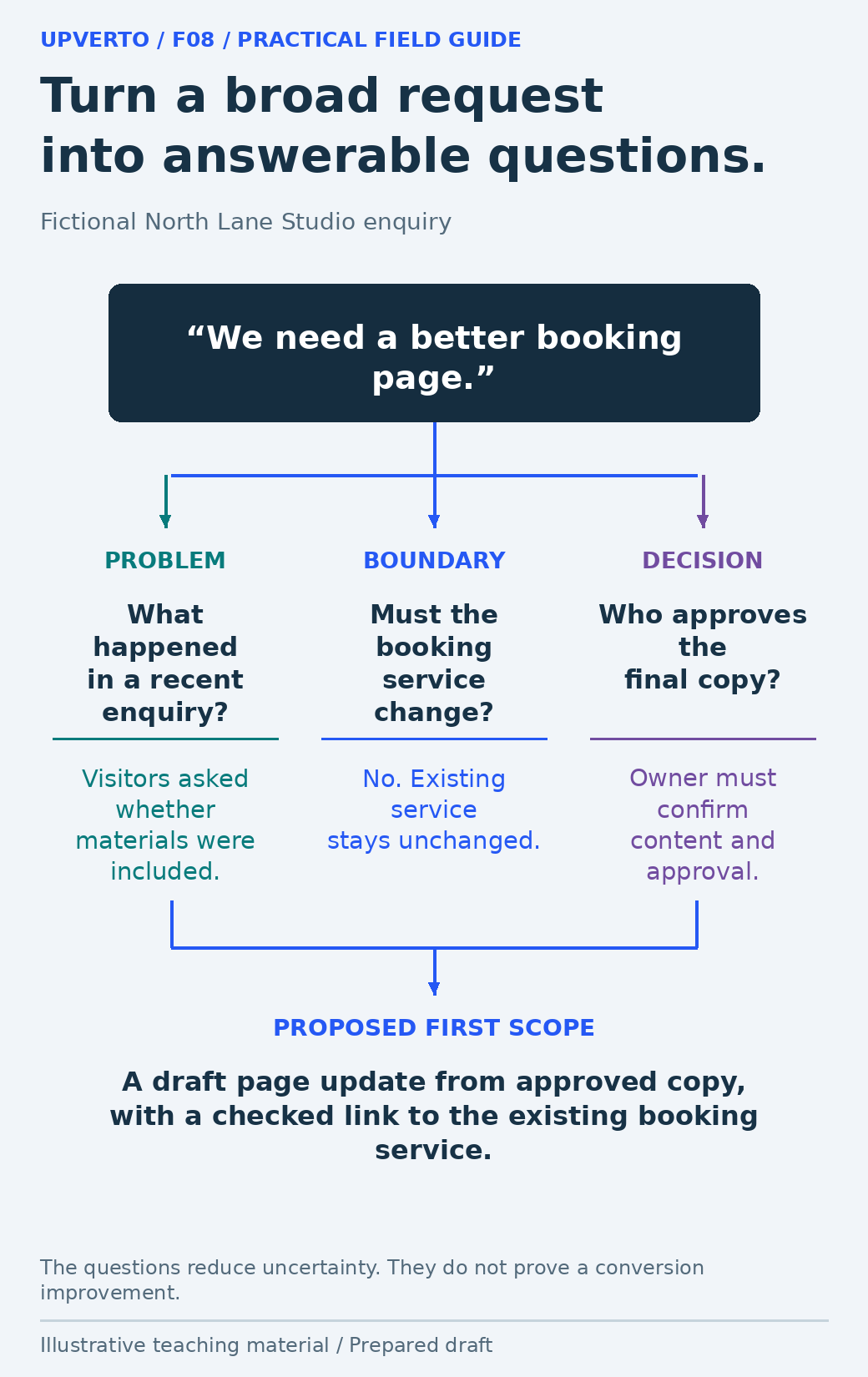
Read the text version: Clarify a broad booking-page request
North Lane Studio’s fictional request for a better booking page is investigated through three questions. A recent enquiry concerns whether materials are included. The existing booking service must remain. The owner must confirm approved copy and final approval. These answers support a proposed draft content/layout update with a checked link, not a booking-system rebuild or a promised sales improvement.
Ask about actual work before proposed features
The GOV.UK guidance on in-depth interviews focuses on people’s circumstances and experiences. For a small client project, an original practical adaptation is to ask for a recent example: “Talk me through the last registration you handled.” Concrete events can expose missing inputs and exceptions that an abstract wish list misses.
| Question | What the answer changes |
|---|---|
| What happens now, and where does it become difficult? | The problem definition and whether your service fits |
| Who uses the result, including people with different access needs? | Audience, formats and required checks |
| What would a satisfactory result allow them to do? | Observable acceptance conditions |
| Who supplies content and who approves the final version? | Dependencies and decision ownership |
| Which systems, files and permissions already exist? | Feasibility, access and discovery work |
| What date matters, and what is driving it? | Scheduling and consequences of delay |
| What budget range or approval process should the estimate respect? | Whether a suitable scope is possible |
Budget context is useful because it helps both sides choose a realistic scope. It is not a reason to pressure someone into a number or promise that any budget can support the same result. If they cannot state a range, explain the information you need to prepare options and what would remain uncertain.
Follow the answer and separate facts from assumptions
Listen for contradictions and unresolved owners. “The administrator can approve it” is not the same as an identified administrator agreeing to review a particular version. “The data is ready” may mean a file exists, not that the fields are accurate or suitable for the intended use. Ask to inspect a safe, representative sample through an authorised process when it is necessary to estimate the work.
Repeat your understanding in ordinary language: “You want the existing enquiry form explained more clearly; replacing the form service is not currently included.” Give the client a chance to correct it. Mark an assumption as provisional rather than silently treating it as a decision. A useful call can end with a smaller proposed scope or a decision not to proceed.
When uncertainty affects effort, use estimate freelance project scope to distinguish a bounded estimate from a guess. If a deeper investigation is needed, define that investigation as a separate piece of work with its own output. Do not quote an uninspected integration as if its compatibility were already proven.
Worked example: an event-registration enquiry
Fictional scenario: North Lane Studio asks for “a better booking page” before a new workshop series. During the conversation, the freelancer learns that the existing booking service must stay, the text is not approved, and two people believe they have final approval. No real call or implementation is claimed.
| Initial statement | Clarifying question | Recorded result |
|---|---|---|
| “The page is confusing.” | Which step caused difficulty in a recent enquiry? | Visitors asked whether materials were included; the cause is not yet independently tested |
| “Keep the booking system.” | Can we link to the existing service without changing its configuration? | Proposed boundary: page content and layout only |
| “The copy is ready.” | Who approves the final materials list and cancellation wording? | Studio owner supplies approved text |
| “Both of us will review.” | Who resolves conflicting instructions? | Name one final approver before scheduling |
| “Finish next week.” | When will approved content and access be available? | Delivery timing remains dependent on those inputs |
The resulting proposal is a draft page update with approved wording, a visible materials section and a checked link to the existing booking service. It excludes payment-system changes and any claim that the redesign will increase bookings. The freelancer still needs the actual approved copy, suitable access and confirmed review arrangements before committing to production.
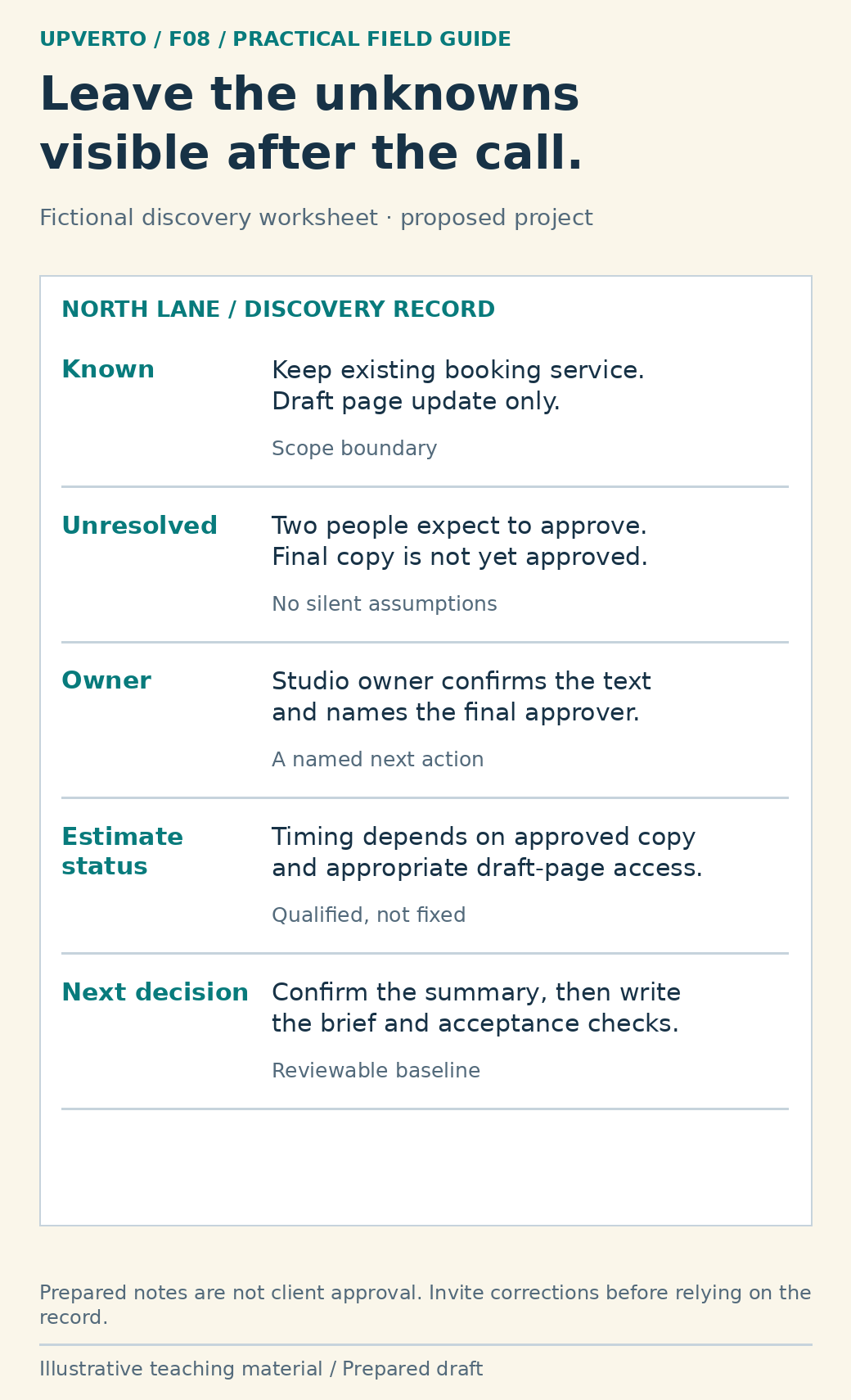
Read the text version: Keep discovery facts and unresolved decisions separate
The fictional worksheet confirms a draft page update with the existing booking service retained. Final copy and the final approver remain unresolved. The studio owner must confirm both. Timing depends on those inputs and suitable draft-page access. The next step is to confirm the summary and prepare the brief and acceptance checks. No response is not approval.
Copy the discovery worksheet
Use the following fields as a one-page note. Fill the “evidence or owner” column so that the record contains more than a list of aspirations. Leave missing information visible. The worksheet is an operational preparation tool, not a contract or a substitute for specialist review where the work requires it.
| Field | What to record |
|---|---|
| Problem and present workflow | A recent example, source and what remains unverified |
| Audience and intended use | Who uses the output and in what situation |
| Deliverables and exclusions | Named outputs, formats and work outside the proposal |
| Inputs and access | Required files, source of approval and access owner |
| Decision-maker | Who approves and resolves conflicting comments |
| Acceptance | What will be checked, by whom and in which final format |
| Timing and dependencies | Required dates, input deadlines and unresolved constraints |
| Commercial context | Budget process and questions to settle separately |
| Next decision | Quote, narrower option, investigation, referral or decline |
After the conversation, send a concise summary through the agreed route. Identify decisions, assumptions, missing information and who owns each next action. Ask for corrections to the summary before relying on it. A note saying “no response received” is more honest than marking an assumption approved because time has passed.
Decide whether you can quote responsibly
You can prepare a defined quote when the important outputs, dependencies, responsibilities and acceptance conditions are understood well enough for the commitment. If a material question remains open, state what it prevents you from estimating and propose the smallest useful way to resolve it. A range without assumptions is often just an unclear promise.
Use write project brief acceptance criteria to turn the confirmed understanding into a reviewable project baseline. Keep legal terms, payment arrangements and later changes in their appropriate agreements and guides. Discovery is successful when it improves the decision, including a well-explained decision to narrow or decline the task.
Frequently asked questions
Must every project have a video call?
No. A short, clear request may be resolved through an agreed written exchange. Use a call when discussion will reduce important uncertainty, and keep an accessible alternative available when needed.
Should I ask about budget early?
Ask enough to understand whether an appropriate scope is feasible and how approval works. Explain why the information matters. If the client cannot give a range, outline the unknowns and suitable options instead of forcing a premature quote.
Can I record a discovery call?
Only through an agreed process consistent with applicable consent, privacy and platform requirements. Explain the purpose, access and handling of the recording. Do not record silently; a written decision summary may be sufficient.
What if the client does not know what they need?
Ask about the present workflow, a recent problem and the result they want. You may propose a small investigation or a limited first step. Do not use uncertainty as permission to invent a large feature list.
Should I quote before seeing the files?
If the files can materially change effort or feasibility, inspect an authorised representative sample or make the dependency explicit. Avoid treating unknown file quality, missing content or unverified integrations as settled facts.
What should I send after the conversation?
A short summary of the proposed problem, outputs, exclusions, decisions, assumptions and next actions with owners. Invite corrections. Use the confirmed summary to prepare the brief or an appropriately qualified estimate.
Sources and scope
The worked examples, worksheets and diagrams are original fictional teaching materials. They are not reports of client results. Primary references were checked during preparation; verify current rules and account-specific features before acting.