A real practice project can teach useful collaboration when its responsibilities and limits are clear. Volunteering does not make the brief, review process, data handling or ending optional. It also does not create an obligation to keep supplying unpaid work.
You can build evidence through fictional projects as well. The guide to build freelance portfolio without clients offers that route. Choose a volunteer project because the specific work and relationship make sense, not because someone says unlimited free work is the required price of becoming a professional.

In this guide
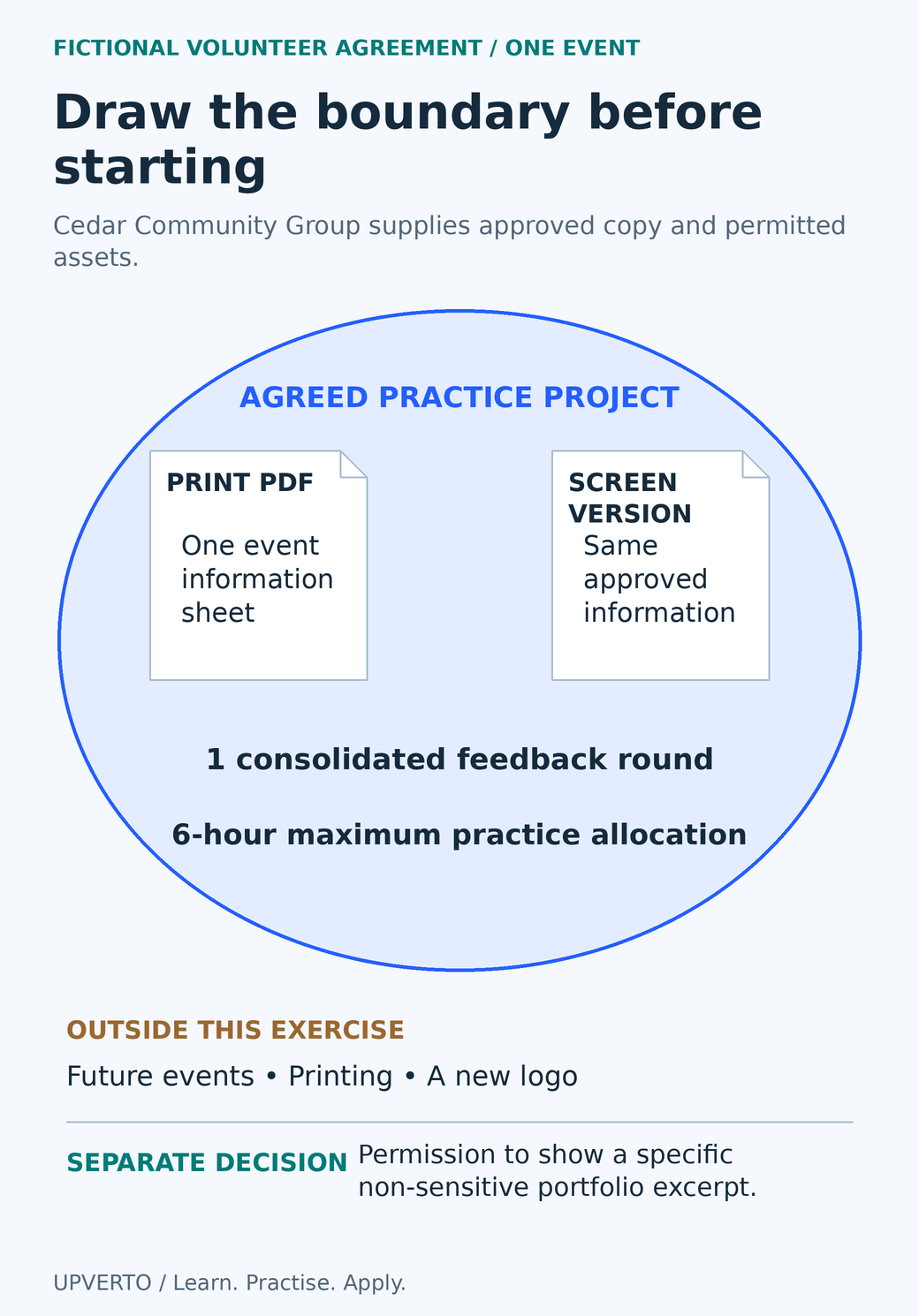
Read the text version: Separate a volunteer project boundary from portfolio permission
In this fictional Cedar Community Group agreement, the scope covers one event information sheet supplied as a printable PDF and a screen version, one consolidated feedback round and a six-hour maximum practice allocation. The group supplies approved copy and permitted assets. Future event updates, printing and a new logo are outside the exercise. Portfolio display is a separate decision covering a specific non-sensitive excerpt, attribution and any restrictions. The diagram is an operational example, not a universal legal contract.
Choose a contained task with a responsible contact
Look for a task small enough to understand and finish: one information sheet, a limited set of approved captions or a defined correction to a document. Avoid taking responsibility for an organisation’s entire website, marketing or data system just to obtain a sample.
Identify who can supply the inputs and approve the result. A volunteer coordinator may know the need but lack authority to approve wording, publish material or grant portfolio permission. Clarify those roles before production. If no one can make the necessary decisions, the project may not be ready to start.
Use choose portfolio projects for freelance services to assess relevance. A project can be worthwhile service to a community without being suitable portfolio evidence. Decide honestly which purpose you are pursuing and whether the scope fits your available capacity.
Write a limited practice-project agreement
| Part | What to agree |
|---|---|
| Purpose and status | The work is volunteer or practice support; state any payment or expense arrangement clearly. |
| Outputs | Named deliverables, quantities and formats |
| Inputs and access | Approved copy, permitted assets and the minimum access required |
| Time boundary | A limited allocation, start conditions and an agreed review date |
| Review | One decision-maker, consolidated feedback and defined revision limits |
| Permissions | What may be used in production and what may later be shown publicly |
| Handover and ending | Final files, dependencies, access removal and the point support ends |
This is an operational checklist, not a universal legal contract. Employment, volunteering, intellectual-property and data rules vary by place and circumstances. If a project creates responsibilities you do not understand, obtain appropriate local advice or choose a simpler task.
Write exclusions as concretely as inclusions. A flyer exercise might exclude copywriting, printing, photography, live publishing and future event updates. If the organisation needs those tasks, discuss who will handle them instead of silently assuming they belong to you.
Separate permission to do the work from permission to display it
An organisation can approve a deliverable without approving public screenshots of its internal drafts, staff details or participants. Ask separately what you may show, where, when and with which attribution. Keep a record of the answer. Avoid asking for a blanket endorsement as a condition of helping.
If you speak with people or observe how they use a draft, explain the activity and ask whether they agree to participate. The GOV.UK user-research consent guide is a useful primary operational reference for making purpose and use understandable. Its government context does not create a universal legal template for your project.
Minimise the information you collect. You usually do not need a real attendee list to practise layout. Use invented details for early examples, and restrict access to any real material necessary for the agreed work. Do not place private drafts or identifying feedback in a portfolio folder by default.
Worked example: one event information sheet
Fictional agreement: Cedar Community Group asks a learner to format an information sheet for one reading event. The group supplies approved copy and a permitted logo. The learner agrees to one printable PDF and one screen version, one consolidated feedback round and a six-hour maximum practice allocation.
The six hours are an illustrative boundary, not an estimate for all such work. The learner plans one hour for brief and setup, three for layout, one for review changes and one for export checks and handover. If the inputs are incomplete or the task cannot fit, the learner will discuss a smaller output before continuing.
The coordinator approves the copy. Another named representative decides whether the final non-sensitive excerpt may be shown in the learner’s portfolio. Publication of the actual event material remains with the group. Future event updates, printing and a new logo are outside the exercise.
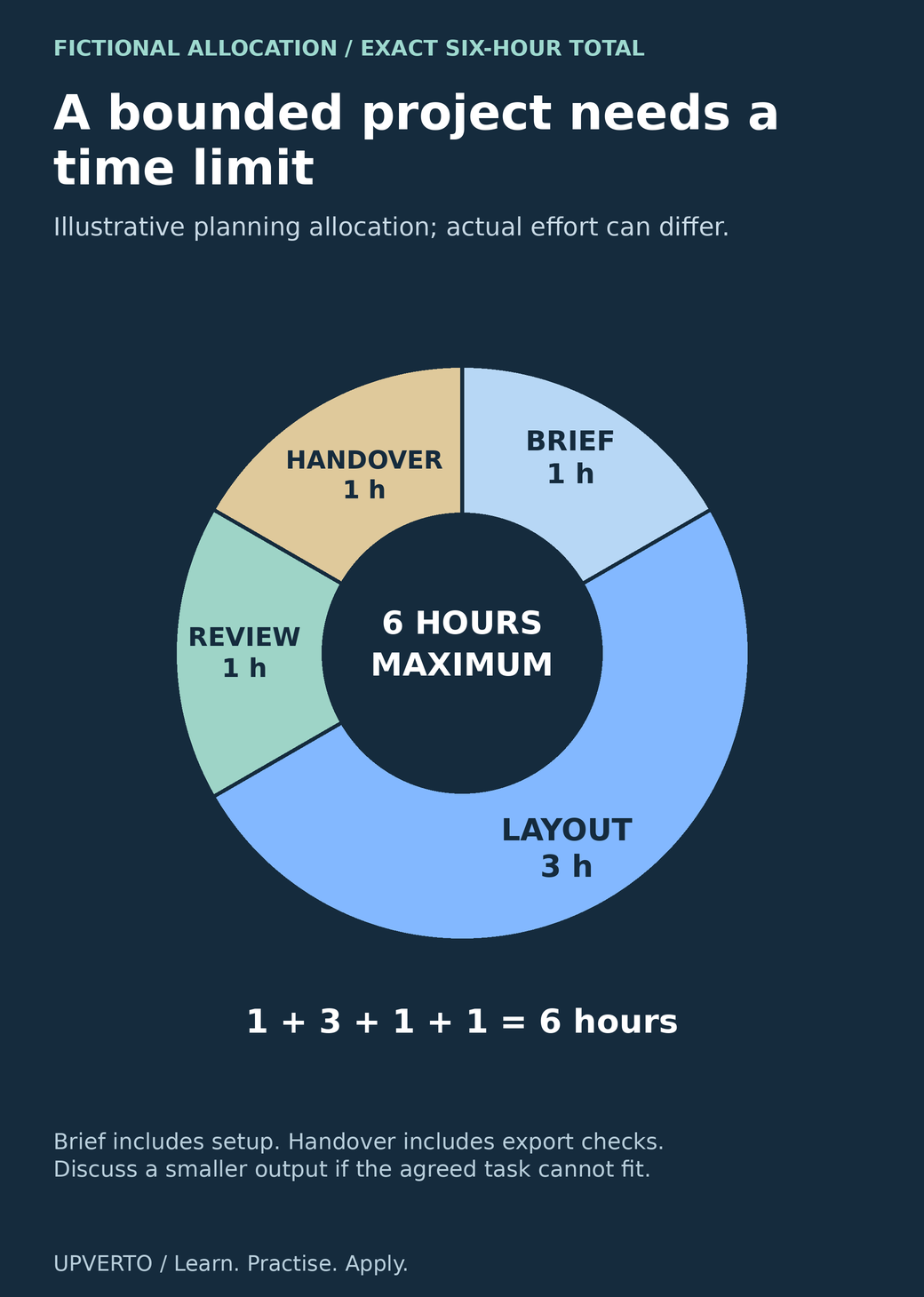
Read the text version: Allocate a fictional six-hour practice project
| Activity | Hours | Share of six hours |
|---|---|---|
| Brief and setup | 1 | 1/6; 60 degrees |
| Layout | 3 | 1/2; 180 degrees |
| Review changes | 1 | 1/6; 60 degrees |
| Export checks and handover | 1 | 1/6; 60 degrees |
The sum is 6 hours. The ring sectors are proportional to the stated hours. This is an invented practice boundary, not a benchmark for all information-sheet work. If inputs or outputs change, discuss a smaller scope or a new agreement before continuing.
When the group later asks for a second event, the learner can discuss a new agreement or decline. The initial promise has an ending. A useful response is: “The agreed reading-event files are handed over. The second event is a new task, so we need to discuss its scope and whether I have capacity.”
Handle changes and finish cleanly
If a request changes the output, stop and compare it with the agreement. A correction to your own error is different from a new campaign. Use estimate freelance project scope to define tasks and review limits before starting; do not wait until the relationship is strained to explain the boundary.
At handover, identify the final files and any dependencies. Confirm who owns the next operational step, such as printing or publishing. Remove access that is no longer needed through the appropriate authorised process, and follow the agreed handling of source material and backups.
| Closeout check | Record |
|---|---|
| Outputs checked and delivered | Final filenames, formats and acceptance notes |
| Responsibility transferred | Who will publish, print or maintain the material? |
| Support ends clearly | Agreed ending and any narrowly defined follow-up |
| Portfolio permission confirmed | Specific excerpt, attribution and limits, or no display |
| Learning captured | One decision, one difficulty and one improvement for next time |
Use show portfolio work honestly to describe the completed project. State that it was volunteer work, identify your contribution and include only supported observations. A real organisation’s involvement does not justify inventing testimonials, attendance figures or business results.
Frequently asked questions
Do I have to volunteer before charging for work?
No. A well-designed fictional project can provide useful evidence. Volunteering is one optional way to practise collaboration, and it should have a sensible purpose and boundary. It is not a requirement to supply indefinite unpaid work before you can offer a service.
Should the agreement mention that I am learning?
Yes, where that affects expectations. Be clear about your demonstrated capability, the task you can support and any need for review. Do not accept responsibility for high-consequence work that you cannot check simply because the arrangement is unpaid.
Can I use the project publicly because I did it for free?
No automatic permission follows from working without payment. Agree separately on display rights, confidentiality and attribution. The organisation may approve the output while restricting drafts, personal information or public use of its name and assets.
What if the organisation keeps asking for extras?
Refer to the agreed outputs and ending. Discuss a new scope, a smaller alternative or a referral, and decline if you lack capacity. Do not quietly expand the project while assuming the additional work will eventually produce a testimonial or paid opportunity.
Can the organisation reimburse expenses?
Clarify any expense arrangement before spending, including which costs are approved and how they will be documented. Rules and tax treatment depend on the circumstances and location. Do not assume that every cost you incur will be repaid.
What if portfolio permission is refused after completion?
Respect the permission you actually have. Keep a private learning record consistent with the agreement and applicable requirements. You can create a separate fictional sample using your own or permitted material, rather than exposing the restricted project.
Sources and review notes
Primary sources checked on 27 October 2026 (UTC). Check the current provider pages before relying on a changing feature, policy or price. Worked examples and worksheets are original teaching material; fictional examples are not evidence of client results.