Part of How to Make Money Online with Digital Skills: A Beginner’s Roadmap.
You can build a freelance portfolio without clients by completing realistic self-directed projects and explaining them honestly. Show the brief, your contribution, the finished work, and the checks you performed. Label practice work clearly so a reader can distinguish a demonstration from a paid engagement.

In this guide
A portfolio helps a potential client judge whether your work is relevant to their needs. It does not need to pretend you have a long history. It needs enough useful evidence to support the specific service you are considering.
Decide what the portfolio should prove
Start with a narrow question: “What would someone need to see before discussing this task with me?” A client seeking short interview edits needs different evidence from a client seeking bookkeeping assistance or a custom web application.
Define the type of work, the intended buyer, and a plausible brief. If the service is still vague, use the service-definition guide. If you are still learning the task itself, use the practical learning process before worrying about a polished portfolio website.
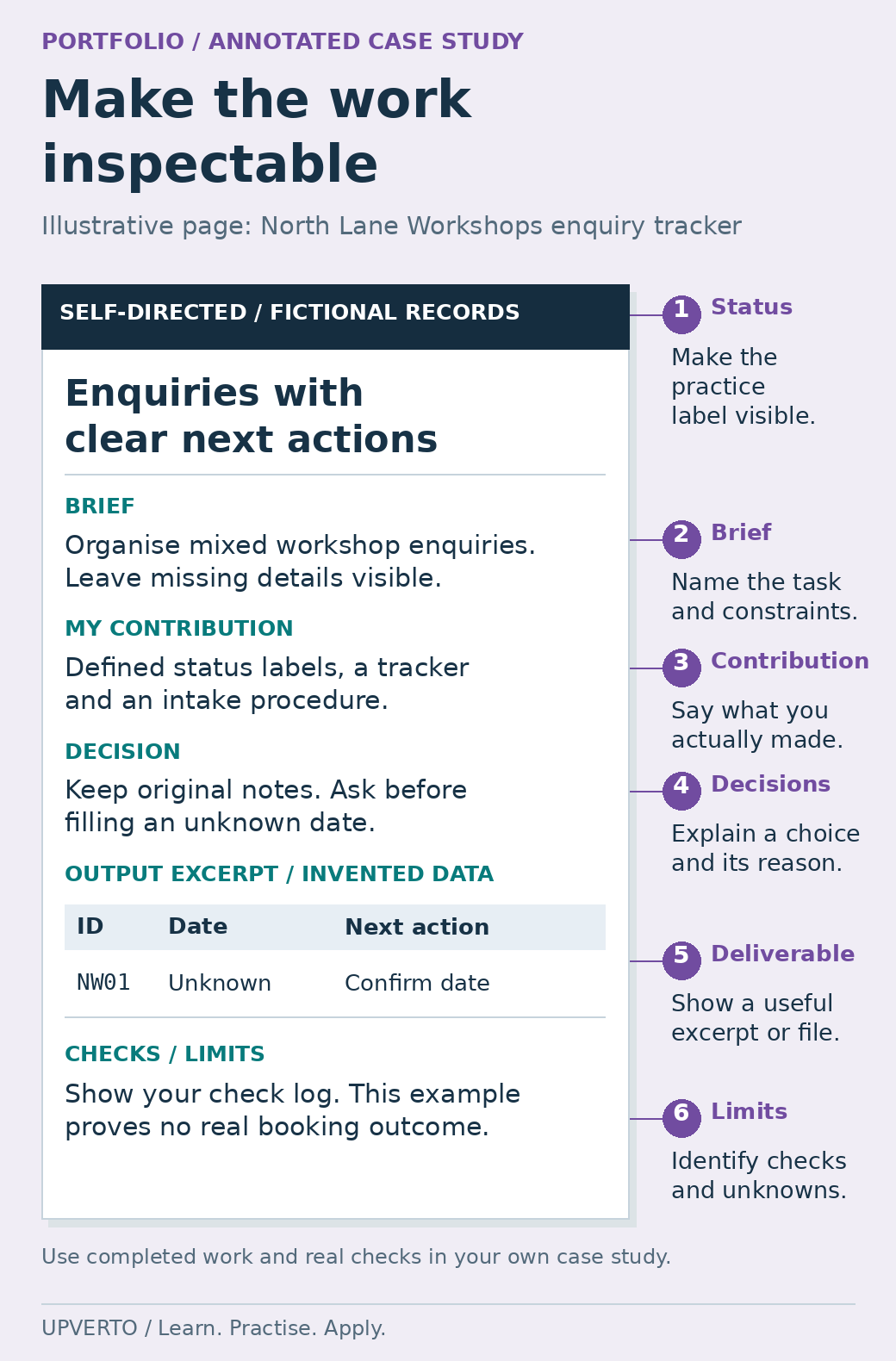
Read the text version: Annotate a case study a reader can inspect
The annotated page is an illustrative case study for North Lane Workshops, a fictional training business. The example record NW01 has an unknown date and the next action “Confirm date”; the date is not guessed.
- Status: self-directed practice using fictional records.
- Brief: organise workshop enquiries while keeping missing details visible.
- Contribution: explain the tracker, status labels and intake procedure you actually created.
- Decisions: show why original notes are preserved and why an unknown date is referred for clarification.
- Deliverable: provide a useful excerpt or accessible file.
- Checks and limits: provide your actual check log and identify what was not tested or measured.
This drawing is an example of presentation, not a fabricated software screen or proof that a real client project was completed. Do the work before making its claims.
Practical summary
- Brief: the problem and constraints you worked with.
- Decisions: what you chose and why.
- Output: the deliverable a reader can inspect.
- Checks: what you tested and what remains unverified.
- Contribution: which parts are your work and which came from others.
Choose an honest way to create samples
| Sample type | How it works | What to disclose |
|---|---|---|
| Fictional project | Create an invented business or scenario and solve a written brief. | State that it is a self-directed concept project and that its business details are fictional. |
| Personal project | Solve a real problem for yourself, such as organising a personal reading log. | Describe the actual context and remove private information before sharing. |
| Course or guided project | Complete an exercise, then add a clearly identified independent extension. | Credit the exercise or source and explain your own contribution. |
| Permission-based volunteer work | Agree on a limited piece of work for an organisation. | Obtain permission to use the work and describe the unpaid relationship accurately. |
Volunteer work is one option, not a requirement. Keep its scope, deadlines, data access, and permission to show the result clear. Do not perform unsolicited changes on another organisation’s website or systems simply to create a sample.
If you create an unsolicited redesign of an existing brand, avoid implying that the brand commissioned or approved it. A fictional brief often makes ownership and endorsement easier to explain, though the assets you use still need appropriate rights.
Build a small set of relevant projects
Choose each project for a reason. One might demonstrate the core task, another a meaningful variation, and another the handling of a constraint. Three is a possible starting structure, not a minimum required by employers, marketplaces, or search engines.
For video editing, a variation might change the audience or delivery format. For virtual assistance, it might introduce incomplete information that must be flagged. For a website, it might require a clear mobile navigation path and a tested handover.
Avoid adding several nearly identical samples just to increase the count. Use the project-selection worksheet to connect each sample to a buyer problem and the evidence it will provide.
Explain each project as a short case study
A case study gives context to the work. Use plain language and let the reader inspect the most relevant evidence.
| Section | What to include |
|---|---|
| Project and status | A descriptive title and an honest label: concept, personal, guided, volunteer, or commissioned. |
| Brief | The audience, problem, supplied information, constraints, and requested output. |
| My contribution | The parts you completed, collaborators, reused assets, and material tool assistance. |
| Key decisions | Two or three choices that changed how the work served the brief. |
| Deliverable | Relevant screenshots, files, excerpts, or a working demonstration. |
| Checks and limitations | What you verified, how you verified it, and what you did not measure. |
| What I would improve | A specific next improvement rather than a vague claim of perfection. |
Keep outcomes precise. “The exported file contains the required text and opens correctly” is a check you can perform. “The design increased sales” needs actual evidence from a real context. A fictional project cannot establish a real commercial result.
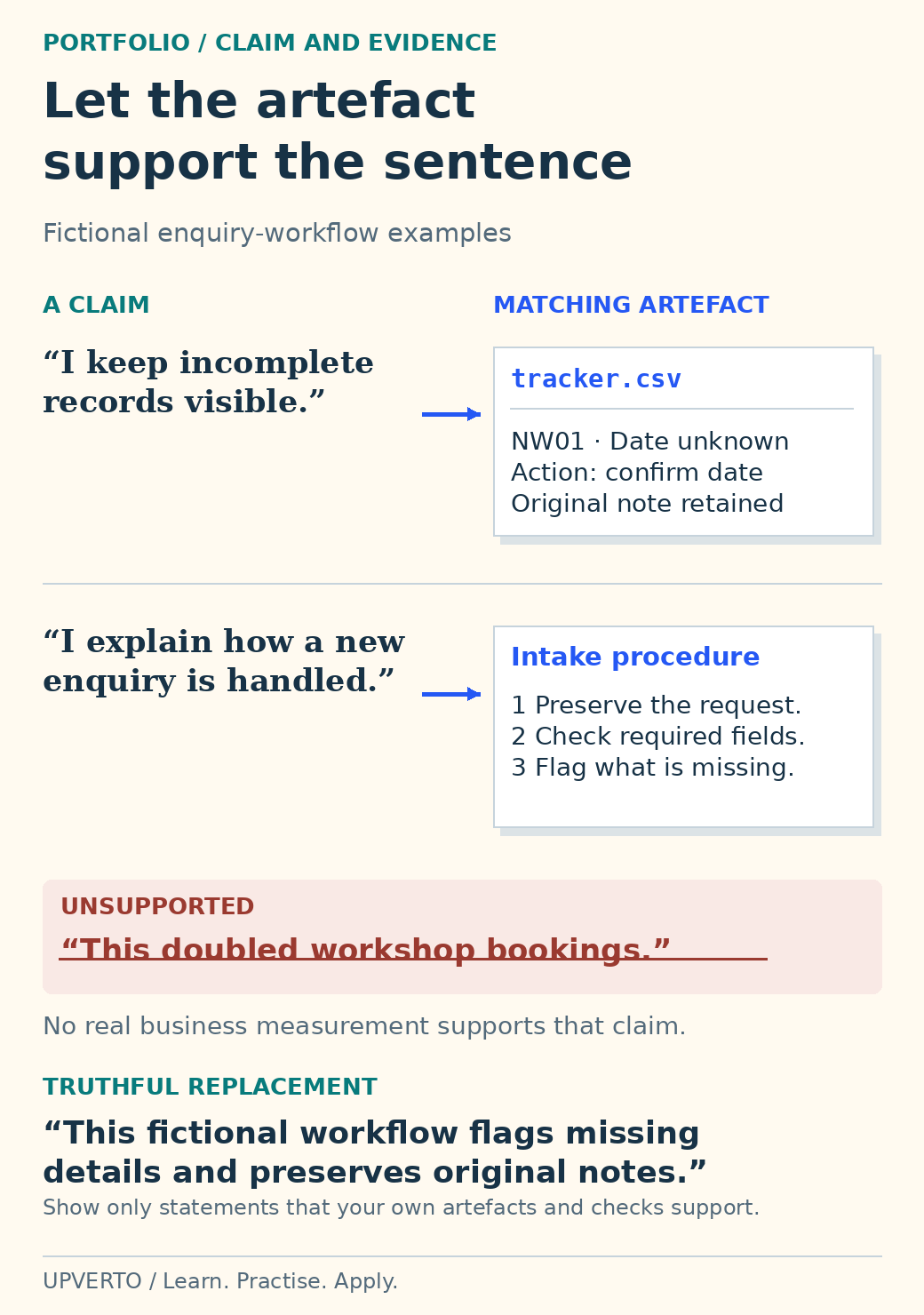
Read the text version: Connect portfolio claims to evidence
These are fictional examples of claim-to-evidence matching.
- Claim: “I keep incomplete records visible.” Matching artefact: a tracker excerpt showing NW01 with an unknown date, a confirm-date next action and its original note.
- Claim: “I explain how a new enquiry is handled.” Matching artefact: an intake procedure that preserves the request, checks required fields and flags missing information.
Unsupported claim: “This doubled workshop bookings.” No real business measurement supports that statement. A truthful replacement is: “This fictional workflow flags missing details and preserves original notes.”
For your own portfolio, inspect the actual files and report only checks you performed. The illustrative snippets here are not evidence of a real client engagement.
Worked example: a fictional operations project
Project: Organising enquiries for North Lane Workshops, a fictional training business. Status: self-directed practice using invented records.
Brief: Turn a mixed set of workshop enquiries into a tidy tracking sheet. Each record needs a request date, workshop, contact status, next action, and owner. Missing details must remain visible rather than being guessed.
Decisions: Use a short set of status labels, keep original notes in a separate field, and flag records that need clarification. Create a one-page procedure explaining how a new enquiry is added and reviewed.
Evidence to produce: the fictional input, completed sheet, procedure, and a check log showing how duplicates and incomplete entries were handled. Limit: this demonstrates an administrative workflow; it does not prove experience with a real client’s systems or sensitive customer information.
This is an example of how to frame a project. The completed sheet and results belong in your portfolio only after you have actually created and checked them.
Choose a presentation format you can maintain
A simple website, a PDF, or a suitable platform profile can all hold useful evidence. Choose a format that lets the intended reader understand the work and access the relevant files without unnecessary friction.
A website can support a working demonstration. A PDF can provide a focused selection for a particular conversation. A marketplace profile may have its own format and content rules, which should be checked in the platform’s current official guidance.
Use descriptive project titles and readable text. Where an image conveys information, explain that information in the surrounding text and provide an appropriate text alternative. The W3C images tutorial explains how alternatives depend on an image’s purpose.
Check rights, permissions, and confidential information
Before sharing, examine every screenshot, filename, visible account detail, and sample record. Use fictional data for practice. For real work, obtain the relevant permission and remove information the client has not agreed to disclose.
Record where images, fonts, templates, code, and media came from and what reuse is permitted. Do not assume an asset is reusable because it was downloadable or appeared in a search result. Keep required attribution and explain substantial third-party contributions.
Testimonials must come from the person whose words they represent. A sample review written for a fictional business should never look like a real client endorsement.
Review the portfolio as a prospective client
- Can a reader identify the service or task you are demonstrating?
- Is the project’s real status clear?
- Can they see your contribution and inspect a useful part of the output?
- Do the links and files open in the intended viewing conditions?
- Are the text and images readable on a smaller screen?
- Are claims limited to what the evidence establishes?
- Is there a clear way to discuss a suitable project with you?
If a sample exposes a gap in your ability, improve the work before adding stronger marketing language. The readiness rubric helps distinguish attractive presentation from the ability to deliver.
Frequently asked questions
Do I need a personal website before finding clients?
Not necessarily. Use a format that suits the channel and allows a relevant buyer to inspect your evidence. A simple, accessible presentation can be useful while a larger website is still being developed.
Can I include a tutorial project?
Yes, when you clearly credit the source and explain what you followed and what you contributed. Add an independent variation if you want the project to demonstrate more than the ability to follow instructions.
How many projects should I put in my first portfolio?
Choose a small set that supports the work you want to offer. Each project should show a distinct relevant ability and include enough context to assess your contribution. Improve incomplete or repetitive examples before adding more. The count matters less than the relevance and quality of the evidence.
How should I label a fictional portfolio project?
State that it is a practice project, concept or fictional brief near the project description. Explain the imagined audience, the constraints and the work you completed. Avoid wording, logos or testimonials that imply the business hired you or approved the result.
What can I say about results when I have no client metrics?
Report what you can actually demonstrate: completed deliverables, checks performed, changes made and lessons learned. Explain why you made important decisions. Do not invent revenue, traffic or conversion improvements. A clear account of the work is stronger evidence than an unsupported performance claim.
How do I turn a portfolio project into a service offer?
Identify the buyer problem and deliverables demonstrated by the project. Define a matching service with clear scope, required inputs and review conditions, then link to the relevant case study. Make sure the offer stays within the abilities and workflow that the evidence supports.
Build one case study you can stand behind
Choose a project that matches your intended work, complete it, and write the case study with honest limitations. Then connect it to a clearly defined service and prepare for relevant client conversations.