To practise independently, give yourself a task whose answer is not already on the next screen. Keep the task small, change one meaningful constraint and attempt a solution before consulting the exact tutorial step.
Independent practice still includes documentation, feedback and help. The aim is to understand what to do and why, including how to recognise a wrong result. The guide to how to learn a digital skill provides the wider learning process; this guide gives you concrete ways to move from a demonstration to your own decisions.

In this guide
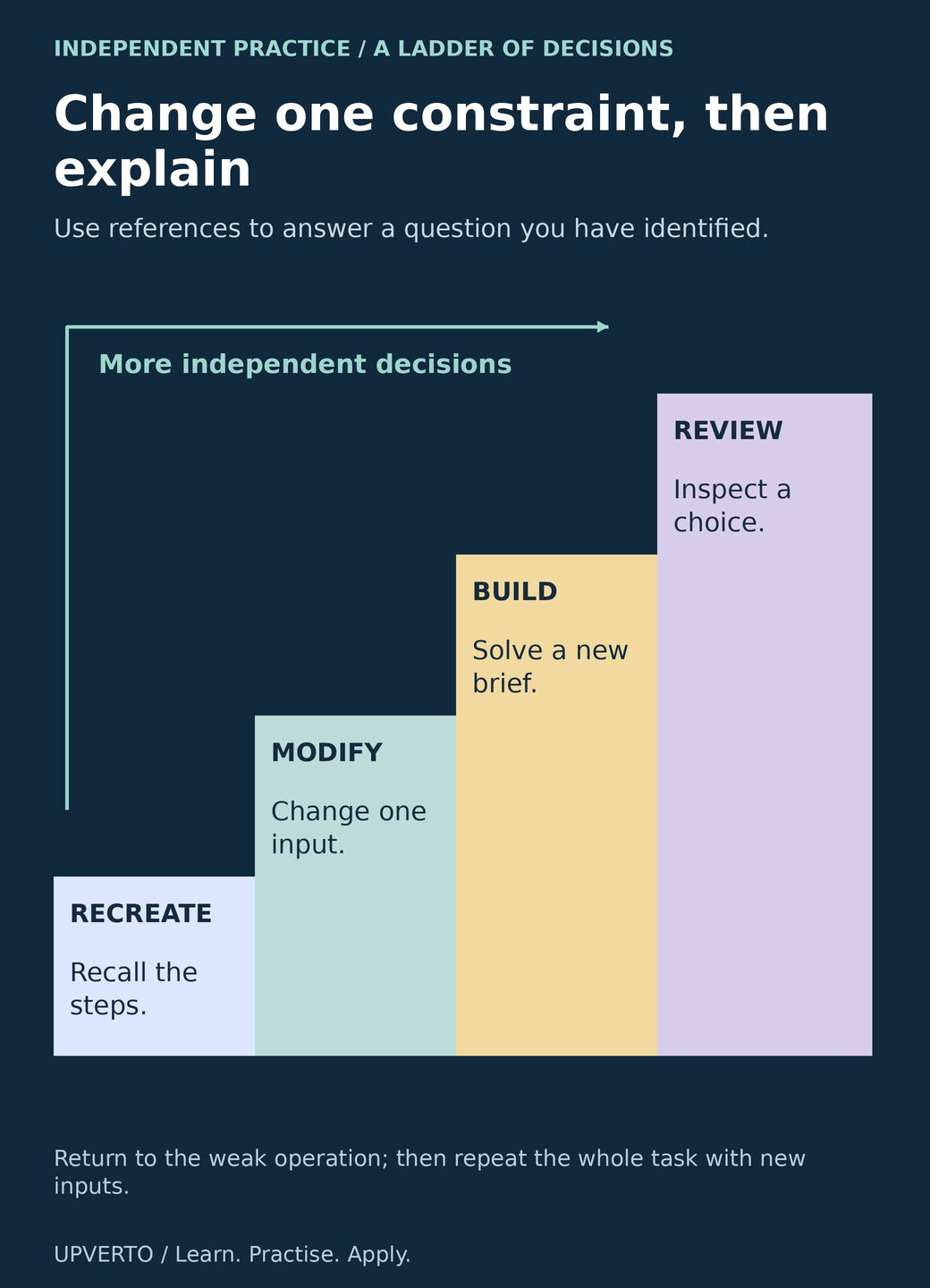
Read the text version: Climb from reconstruction to review
The practice ladder has four levels of independence: reconstruct a small known task by recalling its steps; modify one meaningful input or constraint; build a new brief using the core skill; review an actual choice and its result. Use references to answer identified questions. Return to a weak operation, practise it and then repeat the whole task with different inputs. The steps are not a fixed timetable and do not represent hours or a guarantee of paid readiness.
Identify what the tutorial is doing for you
A lesson often chooses the brief, supplies clean files, selects the tool, decides the order and explains the error before you encounter it. Completing those steps can build useful familiarity. It does not show which of those decisions you can make when the inputs change.
After a guided exercise, close the video and write the task in your own words. List the required output, the main operations and the checks you would use. Mark the parts you cannot yet explain. Those gaps are more useful than a vague feeling that you need to watch everything again.
There is research behind taking recall seriously. Karpicke and Roediger’s vocabulary-learning experiment found a delayed-recall benefit from repeated retrieval. It studied memory under particular conditions, not every creative or technical workflow. The ladder below is an original practice design: attempt, inspect, seek targeted help and try again with a changed task.
Use the modify-build-review ladder
- Reconstruct: recreate a small known task without following each instruction. Use your notes after the attempt to identify missing steps.
- Modify: change one requirement that affects decisions, such as a longer headline, a missing value or a smaller screen.
- Build: solve a new brief with the same core skill and different inputs. Write acceptance checks before you begin.
- Review: compare the output with the brief, explain a choice and record a specific weakness.
- Repeat selectively: practise the weak operation in a second small task, then return to the whole workflow.
These are levels of independence, not a fixed timetable. You may return to a demonstration when the tool itself is unfamiliar. Do so with a question: “How do I preserve heading structure in the export?” A targeted question helps you reconnect the reference to the work.
Do not introduce every possible complication at once. If you change the software, audience, format and source quality together, it becomes difficult to identify what caused the problem. Change enough to require judgement while retaining a clear way to check the answer.
Choose a meaningful change for your kind of work
| Family | Guided task | Independent change | Check |
|---|---|---|---|
| Creative | Lay out a short event announcement. | Use a much longer venue name and adapt a second format. | All details remain accurate and readable; the layout is deliberately adapted. |
| Technical | Build a simple page with a heading and link. | Add a second section and make the page usable with a keyboard. | Headings describe the structure; focus and links work. |
| Operations | Sort a clean list of fictional registrations. | Add a duplicate, a blank required field and inconsistent date text. | Exceptions are identified and recorded without inventing missing information. |
The changed constraint must relate to the skill. Recolouring a finished graphic may practise a control, but it does not necessarily test hierarchy. Copying a different code snippet may change the output without improving debugging. Ask which decision the new condition forces you to make.
For a web exercise, W3C’s page-structure tutorial gives a primary reference for semantic organisation. Use such references to define the check. A visually large line of text is not evidence that it is marked up as the correct heading.
Worked example: the longer venue name
Fictional brief: Cedar Reading Hour needs an announcement with the event name, Saturday 11:00, a location and [email protected]. The tutorial used “Cedar Room.” Your new approved location is “Cedar Community Learning and Reading Room.” Produce one square graphic and one portrait information sheet. These are practice formats, not platform specifications.
The first independent attempt squeezes the new location into a small single line. The problem is observable: the location becomes much harder to read than the date. Instead of copying the original layout literally, allow the venue to wrap onto two lines, align it with the date and move the booking instruction into a clear separate group.
The second format requires another decision. A portrait sheet has different space, so use the event name at the top and place the date and venue together beneath it. Do not simply crop the square output. Open both exports and compare the approved wording character by character.
The revision record can say: “I allowed the venue to wrap and adjusted the information group to preserve readable type. I checked the actual exported files.” It cannot say that the change increased attendance or bookings, because no such outcome was measured.
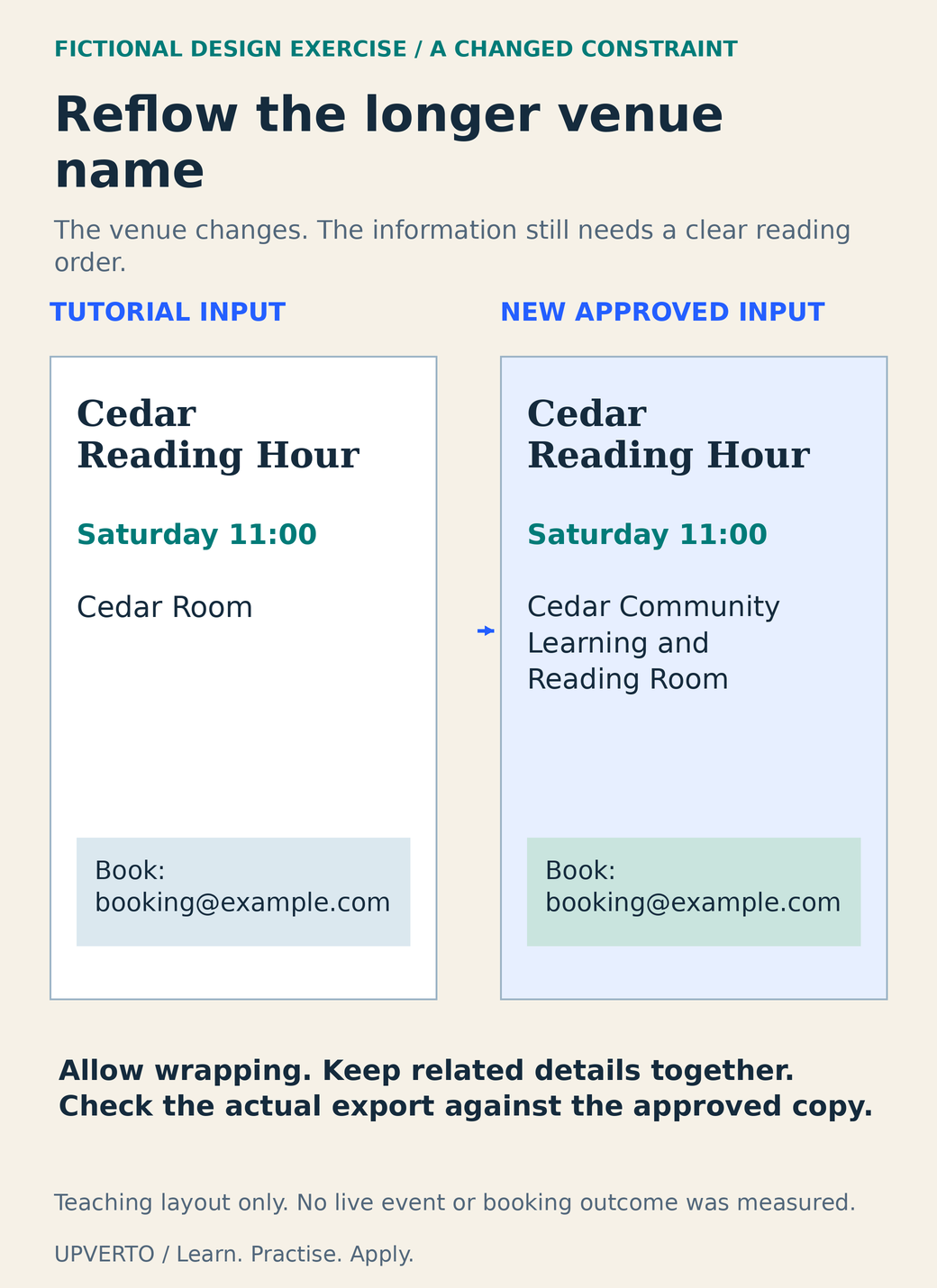
Read the text version: Adapt a layout to a longer approved input
Both teaching announcements are for Cedar Reading Hour on Saturday at 11:00, with [email protected] as the fictional booking address. The tutorial input uses Cedar Room. The changed brief uses Cedar Community Learning and Reading Room, which is wrapped across readable lines. The date and venue remain grouped, and the booking instruction retains a clear separate position. Allow the layout to change when approved input changes, then inspect the actual export against the brief. No live event, attendance or booking result was measured.
Keep an attempt log that helps the next attempt
| Field | Example or instruction |
|---|---|
| New constraint | Venue name is longer; two formats are required. |
| Independent attempt | Describe what you tried before finding a reference. |
| Observed problem | Location text became too small in the square export. |
| Targeted help | Record the reference or feedback that answered the specific question. |
| Revision and check | Wrap the venue; reopen both exports and compare the copy. |
| Next task | Try a different long information group without the tutorial. |
Keep the first attempt as well as the revision. A reviewer can then inspect the change instead of relying on your description. Ask a concrete question such as “Where did you look for the location?” or “Which input caused the formula to fail?” Avoid asking only whether the work looks professional.
Once an exercise fits a service you want to offer, use choose portfolio projects for freelance services to decide whether it belongs in a portfolio. Label tutorial-derived work accurately and explain your contribution. Before accepting a client task, use the ready for paid client work checklist; a successful practice variation is useful evidence, but delivery also requires estimation, communication and handover.
Frequently asked questions
Should I stop using tutorials completely?
No. Use them to learn unfamiliar operations and answer specific questions. Then attempt a task without following every step. Alternating guided help with independent work shows which parts you understand and which still depend on the demonstration.
Is looking up documentation cheating?
Documentation is part of professional work. The useful distinction is whether you understand the requirement, choose the relevant reference and check the result. Copying an answer you cannot explain leaves an unresolved gap even if the output appears to work.
What should I change first in a practice project?
Change one condition that affects the skill you are learning. Try a longer text block for layout, an unexpected input for a formula or a second screen size for a webpage. Keep a clear acceptance check so you can identify the effect of the change.
How do I practise debugging when I am a beginner?
Use a small harmless example and record expected versus actual behaviour. Change one likely cause, test again and keep the result. Ask for help with that evidence. Avoid random changes to a large project or practising on a live system you cannot safely restore.
Can tutorial projects go in my portfolio?
They can be learning evidence if the source and your contribution are clearly labelled and permissions allow it. A stronger service sample usually adds an independent brief, meaningful decisions and checks. Do not present copied assets or guided decisions as entirely your own.
How do I know the exercise is finished?
Compare the output with the checks you wrote before starting, reopen the final files and explain one decision and one limitation. If a check fails, record it and revise. Finishing the tutorial video is not the same as meeting the new brief.
Sources and review notes
Primary sources checked on 27 October 2026 (UTC). Check the current provider pages before relying on a changing feature, policy or price. Worked examples and worksheets are original teaching material; fictional examples are not evidence of client results.