AI is useful for learning when it helps you ask a better question and inspect an answer you can verify. It becomes less useful when a polished response replaces your own explanation, test or decision.
Choose a small task, make an attempt and ask for help with the part you can identify. Keep confidential information out of practice prompts. This guide fits inside how to learn a digital skill and includes a complete calculation exercise you can check without trusting any model’s confidence.

In this guide
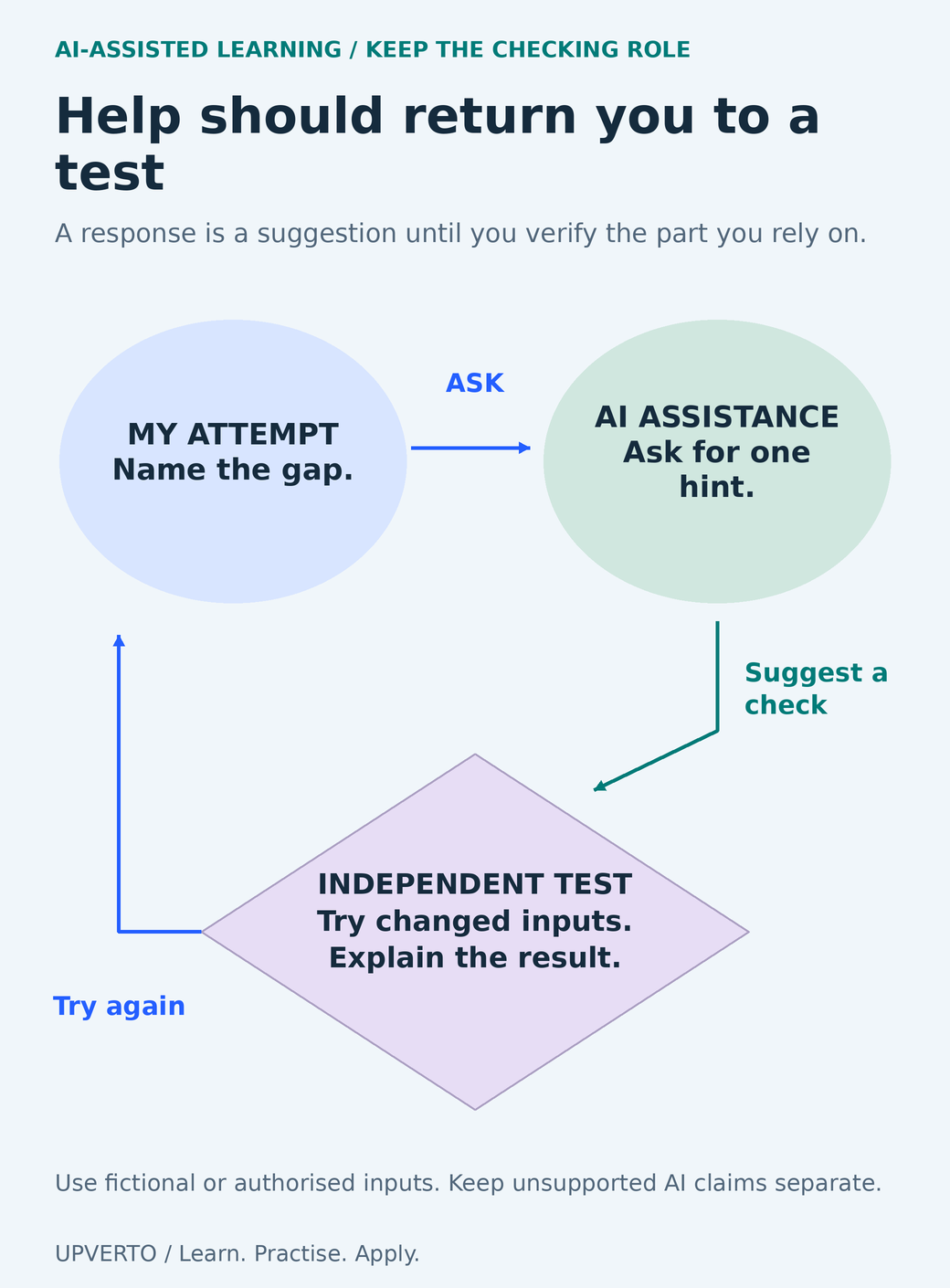
Read the text version: Use AI assistance inside an inspectable learning loop
Start with your own attempt and name the gap. Ask AI for a bounded hint or suggested check. Independently test the part you rely on using changed inputs, and explain the result in your own words. Return to another attempt when the test reveals a gap. A model response is a suggestion until verified. Use fictional or authorised material and keep unsupported claims separate from checked notes. This process diagram does not report a tested model result.
Give AI a bounded role in the exercise
Different requests create different learning conditions. “Do the project” can hide every decision. “Ask me to explain why this formula should work” leaves the reasoning with you. “Suggest three edge cases” can help you design a test, provided you check whether those cases matter to the actual task.
| Role | Useful request | Your responsibility |
|---|---|---|
| Explainer | Explain this operation using my harmless example. | Restate it and try a changed input. |
| Questioner | Ask one question that checks my understanding. | Answer before requesting the explanation. |
| Critic | Compare my draft with these acceptance checks. | Verify each criticism against the actual work. |
| Test assistant | Suggest inputs that might expose an error. | Run the tests and inspect expected versus actual results. |
An AI response may invent a feature, misread an input or provide a plausible citation that does not support its claim. Ask for sources when needed, open the actual primary source and check the specific passage. A citation’s presence is not verification.
Decide what you can share before writing the prompt
Use invented data or material you are authorised to process. Remove names, account details, secrets and unnecessary context. Replacing a name alone may not anonymise a distinctive project or a small dataset. When the learning task can use fictional data, there is little reason to upload a real client’s records.
Provider settings matter. The Gemini Apps Privacy Hub, checked on 27 October 2026, describes human review of some data and warns against entering confidential information. Its controls and account arrangements can differ. Read the policy for the actual product and account you use; do not assume that a work account, temporary session or disabled history grants permission to share someone else’s material.
The exercise below is tool-independent and requires no paid generation. It is a prompt and a verification method, not a report that a particular model produced the illustrated error. The incorrect answer is deliberately constructed to make the checking task inspectable.
Worked exercise: inspect a plausible but wrong total
Fictional input: a practice order has three rows. Quantity and unit price are separate fields; every amount is an invented USD value for arithmetic, not a price recommendation.
| Item | Quantity | Unit price | Correct line total |
|---|---|---|---|
| Notebook | 2 | $18 | 2 × 18 = $36 |
| Pencil pack | 3 | $4 | 3 × 4 = $12 |
| Folder set | 1 | $12 | 1 × 12 = $12 |
The correct order total is 36 + 12 + 12 = $60. A deliberately wrong shortcut adds the quantities, adds the unit prices and multiplies the two totals: (2 + 3 + 1) × (18 + 4 + 12) = 6 × 34 = $204. It combines each quantity with prices from unrelated rows.
Before asking AI, calculate the three line totals yourself. Then use this prompt: “I am learning to calculate a total from quantity and unit price. Use this fictional table. Ask me to explain why multiplying the sum of quantities by the sum of prices is wrong. Give one hint first. After my answer, show a row-by-row check and suggest a new input that would expose the same mistake.”
A correct explanation should preserve the row relationship. The operation is the sum of each row’s quantity multiplied by that row’s unit price. If you use a spreadsheet, check its current function syntax and your actual cell ranges; a formula that references the wrong rows can still return a plausible number.
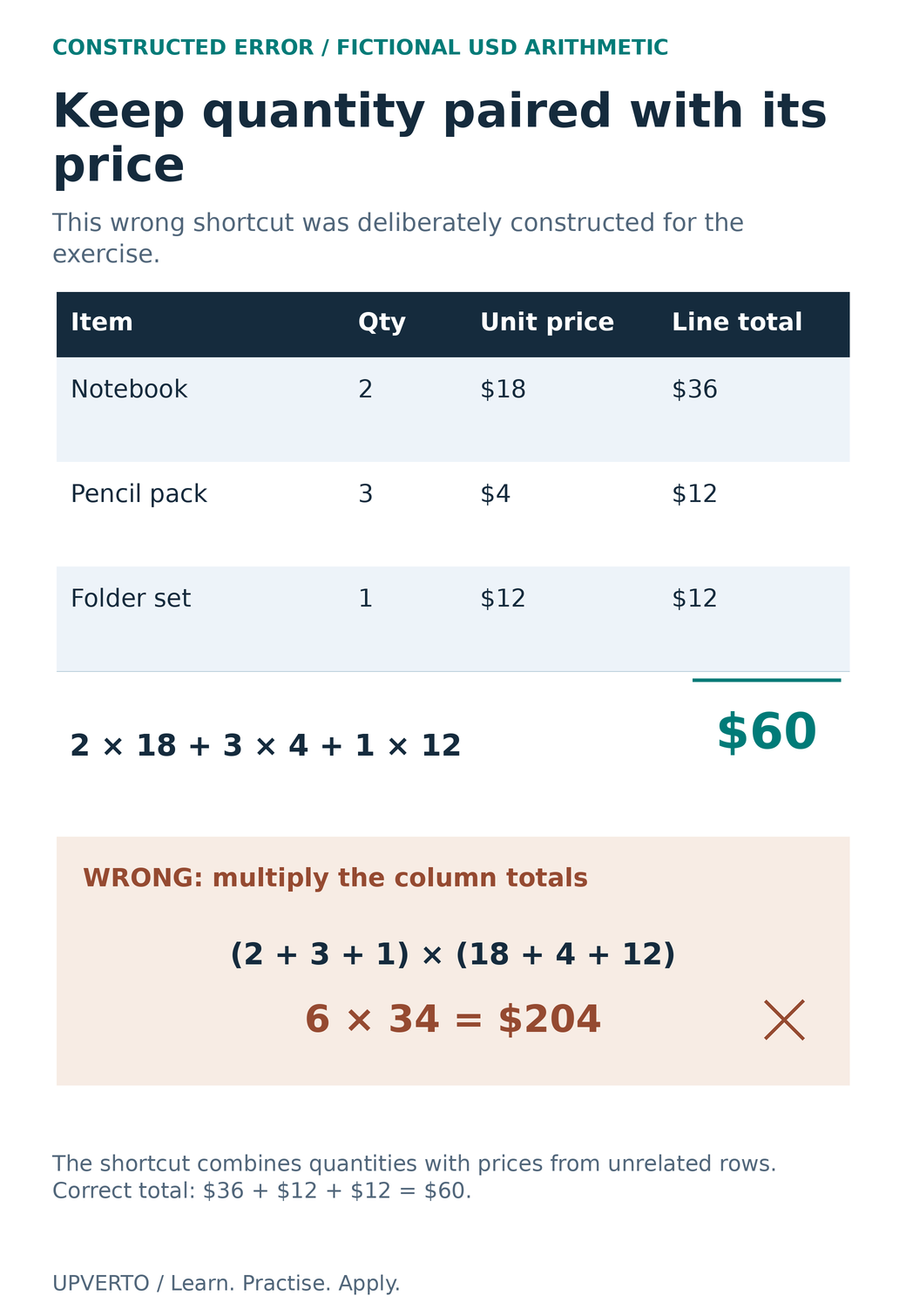
Read the text version: Inspect the row relationship behind a calculation
The fictional USD table contains 2 notebooks at 18 each, 3 pencil packs at 4 each and 1 folder set at 12. Correct line totals are 36, 12 and 12, giving 60. The correct operation is 2 x 18 + 3 x 4 + 1 x 12. The deliberately wrong shortcut multiplies total quantity 6 by the sum of unit prices 34, giving 204. It combines quantities with prices from unrelated rows. This is a constructed verification exercise, not an observed output attributed to any model and not a price or earnings recommendation.
Test the idea with changed inputs
Try a zero quantity for one item. Its line total should become zero while the other lines remain unchanged. Try one item with quantity one: its line total should equal its unit price. Try two identical rows: the combined total should double that row’s amount. These checks test the relationship, not only the original answer.
Then explain the method without reading the AI response. If you can only reproduce the wording, rebuild the table with different values. Use practise skills beyond tutorials to choose a variation that makes you decide rather than copy.
The same pattern applies outside arithmetic. For code, run a harmless example and inspect errors. For a design critique, compare the feedback with the audience and brief. For a claimed software feature, verify the current documentation and test the relevant operation. A generated judgement cannot replace the observable result.
Keep a prompt-and-verification log
| Field | What to record |
|---|---|
| Learning objective | The operation or decision you want to understand |
| My attempt | Your answer and the point of uncertainty |
| Safe input | Fictional data or permission to use the supplied material |
| AI assistance | The prompt, useful suggestion and unsupported claim |
| Independent evidence | Calculation, actual file, test or primary documentation |
| Changed-input result | What happened when a meaningful constraint changed |
| Remaining gap | What you still cannot explain or perform |
Keep the model’s output separate from your verified notes. You can mark a suggestion “not checked” rather than accidentally promoting it into an instruction. If a response is wrong, preserve the counterexample and explain the failure; do not ask repeatedly until a confident answer feels reassuring.
Before using AI-assisted work in a client task, check the agreement, data permissions and any required disclosure. Your responsibility for the delivered output remains. Use the ready for paid client work checklist to review whether you can independently check, explain and support the work you propose to deliver.
Frequently asked questions
Should I ask AI for the answer before attempting the task?
Try a bounded attempt first when possible, then ask about the specific uncertainty. If you need an introduction, ask for a small explanation and immediately apply it to a changed example. The aim is to expose your understanding rather than hide it behind a finished response.
Is the $204 mistake a real model result?
No. It is a deliberately constructed wrong answer used to teach verification. The input and arithmetic are fully visible, so you can inspect why it fails. The guide does not claim a particular model made this error or attach a fabricated success rate to a tool.
Can I upload a client spreadsheet if I remove names?
Not automatically. Other fields may identify people or reveal confidential business information. Check permission and the actual provider policy, and minimise the data. For learning, replace the material with an invented table that tests the same operation.
What if AI cites an official page?
Open the page independently and confirm that it supports the specific statement, version and context. Links can be wrong or insufficient. For an operation you will rely on, test the relevant behaviour as well as reading the documentation.
How do I use AI for design feedback?
Supply a harmless brief and clear criteria such as hierarchy, wording and required formats. Treat each comment as a suggestion to inspect. Check the actual exported design and, where useful, ask a person to perform the intended reading task. Do not turn an AI preference into a measured audience outcome.
Can AI-assisted practice become portfolio work?
Yes, if the work, tool use, permissions and your contribution are represented honestly. Keep evidence of what you checked and changed. Do not imply that you independently created or verified parts you cannot explain, and follow any applicable client or platform disclosure requirements.
Sources and review notes
Primary sources checked on 27 October 2026 (UTC). Check the current provider pages before relying on a changing feature, policy or price. Worked examples and worksheets are original teaching material; fictional examples are not evidence of client results.