A useful freelance proposal helps a client decide whether you understand the task and can deliver the required work. It should connect their problem to your approach, evidence and boundaries. A long biography or a generic promise of quality makes that decision harder if it does not explain the actual project.

In this guide
The guide to how to find freelance clients covers the wider search for opportunities. This article focuses on the proposal itself. The example is fictional, has not been sent to anyone and does not represent a winning application or a real client result.
Read the brief for the decision the client needs to make
Extract the problem, deliverables, inputs, constraints and open questions. Identify what is explicitly stated and what you are assuming. If the brief says that visitors cannot find current workshop dates, do not immediately propose a complete website rebuild. First understand the information path and the owner’s desired scope.
Look for the evidence the client requests: a relevant sample, a technical explanation, availability or a particular qualification. Check eligibility and platform rules before investing in a detailed response. If the work is outside your competence, narrow the proposed role or decline rather than exaggerating experience.
Use create freelance service packages to clarify your own deliverable. A proposal is easier to write when you already know what inputs you need, what you will hand over and what is excluded. You can then adapt the service to the brief instead of inventing a new offer in every opening paragraph.
Organise the proposal around six useful parts
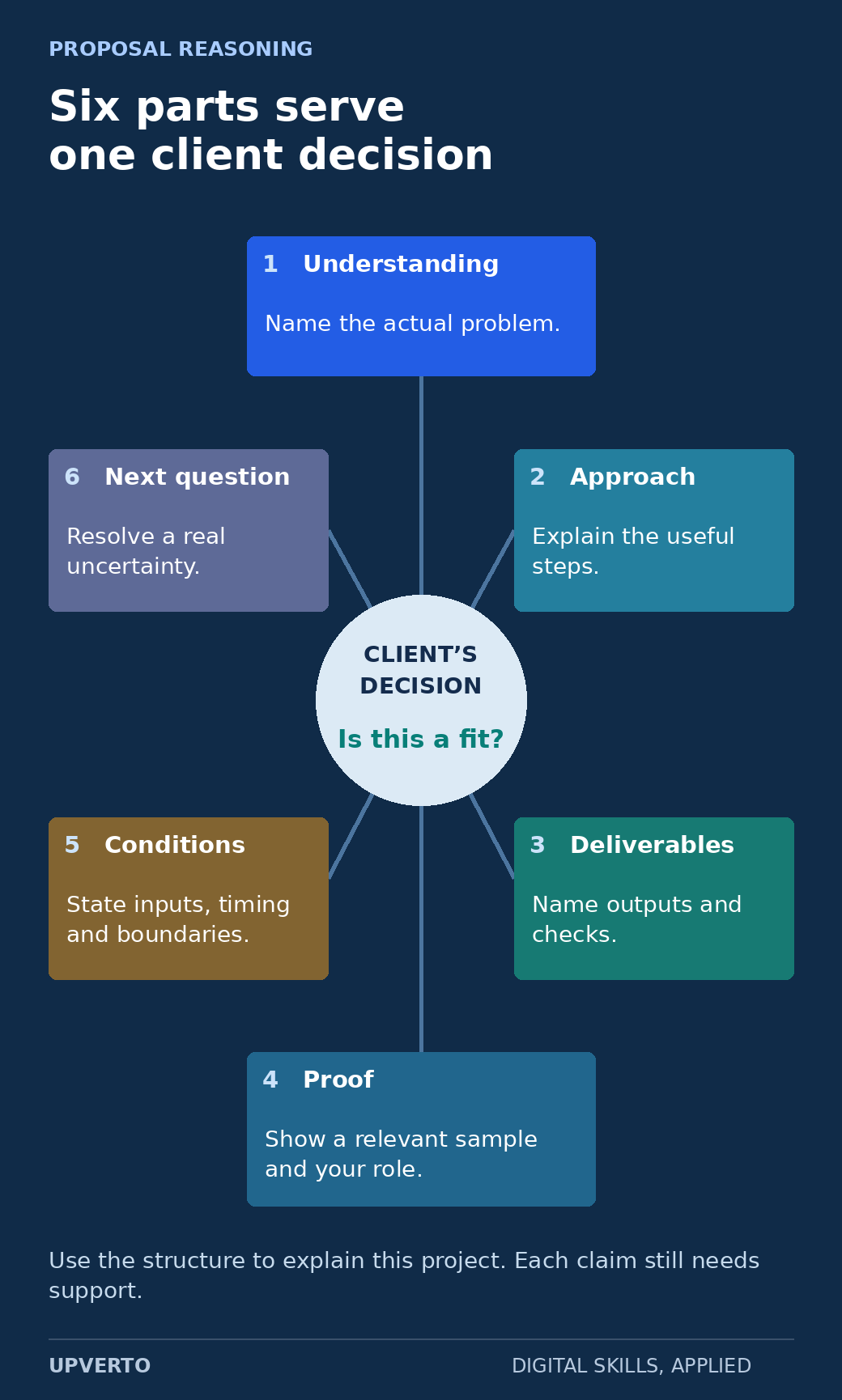
Read the text version: Organise a proposal around the client decision
- Understanding: name the actual problem.
- Approach: explain the useful steps.
- Deliverables: name outputs and checks.
- Proof: show a relevant sample and your role.
- Conditions: state inputs, timing and boundaries.
- Next question: resolve a real uncertainty.
Each part helps the client assess fit; claims still require support and the channel may impose its own submission requirements.
Begin with your understanding of the problem. Describe a short approach that addresses it. Name the deliverables and checks. Attach or link relevant evidence with your role clearly stated. Explain the timeline assumptions and boundaries. End with a question or next step that resolves a real uncertainty.
GOV.UK’s guidance on clear acceptance criteria offers a useful principle: describe completion in language the involved people can understand. In a proposal, “three reviewed event pages with current details and checked links” is easier to assess than “a premium digital experience.”
Keep platform submission mechanics separate from the proposal’s reasoning. For example, Upwork’s current proposal help describes its own fields and process. Follow the current requirements of the channel you are using, including attachment and communication rules. This guide does not assume that every platform has the same form.
Worked example: a fictional page-update proposal
The invented client brief asks for three workshop information pages updated from approved copy and images. The owner wants consistent dates, clear request instructions and a readable mobile layout. There is an existing website, but access and the final asset set have not yet been confirmed. No booking-system changes are requested.
Your brief describes three workshop pages whose dates and request instructions need to be consistent and easy to find. I propose updating those pages from your approved copy and images, then checking their links and layout on the agreed screen sizes.
I would first confirm the page list and access, prepare the updates in a draft or staging environment, and send one consolidated review set. The handover would include the three approved pages and a short record of the checks and remaining questions.
My attached sample is a fictional information-page project. I created its layout and check log; it demonstrates this task, not a live client outcome.
The proposed schedule is four working days after access and final inputs are ready, subject to confirmation. One consolidated revision round is included. Copywriting, new forms and booking-system changes would need separate agreement.
Who will approve the content, and are the three page URLs and final assets ready to share through the agreed channel?
This example deliberately uses conditional timing. It does not promise to finish four days after an unknown start or assume that missing assets will appear. A real proposal also needs the appropriate price or terms where requested, but those should follow an actual scope estimate rather than a copied number.
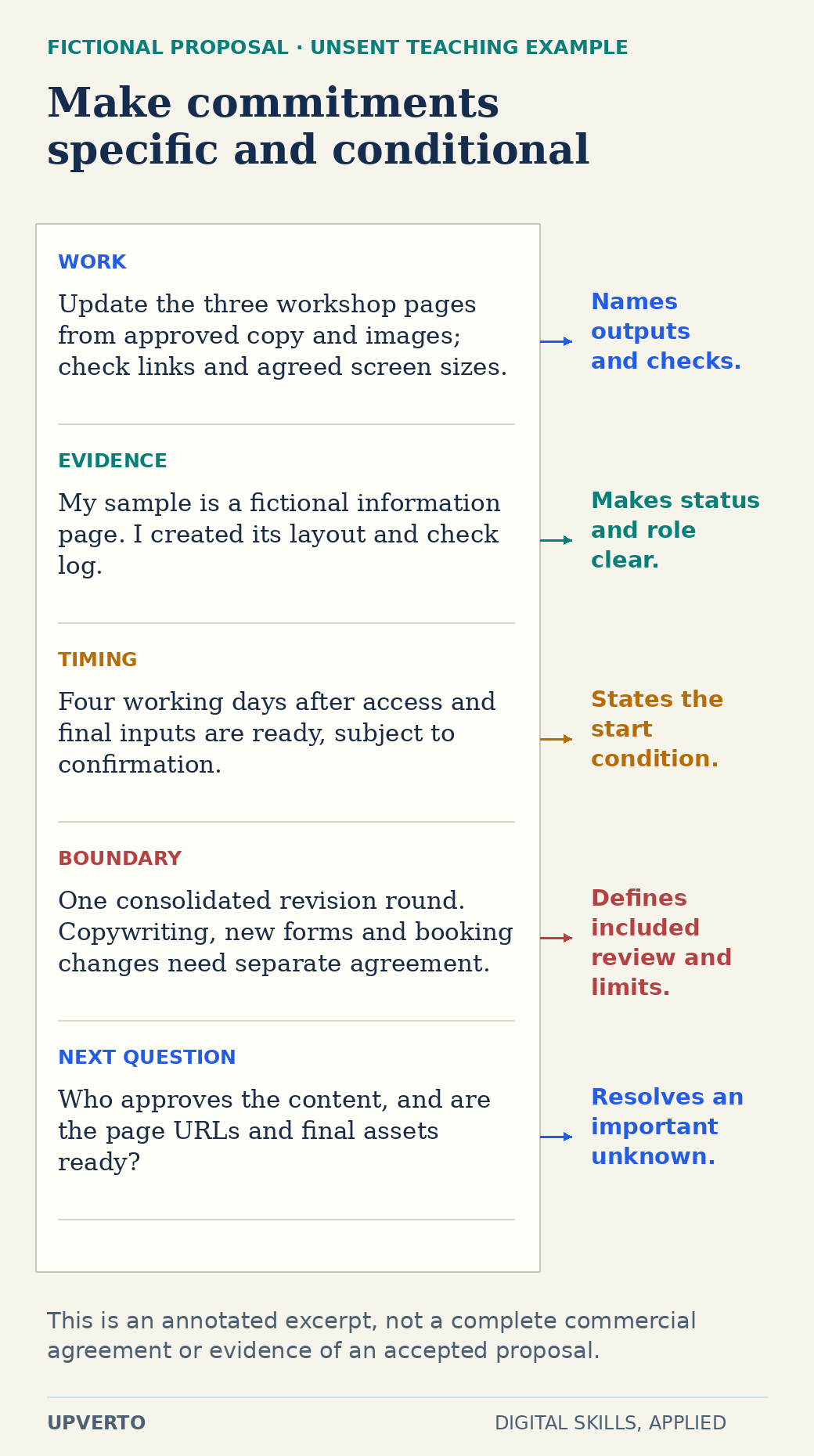
Read the text version: Inspect a fictional proposal’s commitments
- Work
- Update three workshop pages from approved copy and images, then check links and agreed screen sizes.
- Evidence
- Identify the information-page sample as fictional and state responsibility for the layout and check log.
- Timing
- Propose four working days after access and final inputs are ready, subject to confirmation.
- Boundary
- Include one consolidated revision round; copywriting, new forms and booking changes need separate agreement.
- Next question
- Ask who approves the content and whether page URLs and final assets are ready.
This is an unsent teaching excerpt, not an accepted proposal or a complete commercial agreement.
Use evidence that matches the claim
Choose one or two relevant samples and explain the connection in a sentence. A page-update sample with a check log is more relevant to this brief than a large unrelated collection. If the project was collaborative, identify what you did. If it was fictional, say so before the reader has to infer it.
Do not claim client experience you do not have or invent an improvement percentage. You can demonstrate a method and a finished practice output honestly. Use tailor portfolio to client niche to select the evidence most relevant to the buyer’s task.
Explain limitations that affect the decision. A static mockup can show layout reasoning but cannot prove that a real form submits correctly. A screenshot can show appearance but cannot prove a link works. Attach evidence that supports the specific capability you are offering.
Ask questions that change the work
A useful question resolves scope, access, authority or timing. “Who approves the final content?” affects review. “Are the supplied images cleared for use?” affects asset readiness. “Does the request button lead to an existing process?” affects implementation. These questions show attention to the task without pretending to have audited a system you have not seen.
Avoid sending a long discovery questionnaire when one uncertainty determines whether the project is suitable. Start with the few questions needed to take the next step. Save deeper investigation for an agreed discussion or paid discovery stage when appropriate.
The guide to freelance discovery call questions develops that conversation. A proposal does not need to solve every unknown before the client responds, but it should identify assumptions that materially affect your commitment.
Use the proposal self-review checklist
| Check | Question to answer before sending |
|---|---|
| Understanding | Have I described the actual problem without adding an unsupported diagnosis? |
| Approach | Does each proposed step help produce the requested deliverable? |
| Evidence | Can the sample support the claim, and is my role clear? |
| Scope | Are inputs, outputs, checks and revisions understandable? |
| Timing | Have I stated dependencies and realistic availability? |
| Next step | Does the final question resolve a useful uncertainty? |
Read the proposal from the client’s perspective. Remove sentences that could be sent unchanged to any project and add detail only when it helps the decision. Check names, links, files, stated availability and any platform-specific requirements. Do not include confidential material as proof of competence.
Keep the proposal connected to the agreed work
If the client replies with changed requirements, update the scope and assumptions before treating the proposal as settled. Preserve the agreed version. A conversation can clarify the work, but scattered messages can also create contradictory expectations if nobody records the final decision.
After an unsuccessful proposal, review whether the opportunity fit, whether the evidence was relevant and whether the response answered the brief. A rejection does not prove that the whole skill is unsuitable. Avoid inventing reasons when the client gives no feedback; record what is known and improve the parts you can inspect.
Frequently asked questions
How long should a freelance proposal be?
Use enough space to explain understanding, approach, deliverables, evidence, assumptions and the next step. Follow the channel’s requirements. Length should follow the complexity of the decision, not a universal word count.
Can I use a proposal template?
Use a structure or checklist, then write the substance for the actual brief. Remove generic claims and verify every detail. A template should help you remember important questions, not conceal that you have not understood the task.
What should I say when I have no client experience?
Describe the relevant practice project honestly, identify your role and show the output and checks. Do not invent a client or commercial result. Offer only the responsibility your evidence can support.
Should I provide a complete solution before being hired?
Explain enough of your approach for the client to assess fit, but distinguish a proposal from a full discovery or implementation deliverable. Clarify unknowns and any paid investigation needed before making detailed commitments.
How do I state a deadline when inputs are missing?
State the dependency and a proposed duration after the required inputs and access are ready. Confirm availability before agreement. Avoid presenting a conditional estimate as an unconditional delivery promise.
What if the client asks for extra work after the proposal?
Clarify whether it changes the agreed deliverables, effort or timeline. Update the scope and terms through the appropriate process before doing the additional work. Keep a clear record of the version both sides accepted.