Tailoring a portfolio means selecting and explaining relevant evidence for a particular buyer. It does not require a new website for every industry, and it does not justify rewriting a concept project as if it were commissioned by that industry.
Start with the work you actually have. The guide to build freelance portfolio without clients explains how to create honest samples. Here, the task is to connect those samples to a prospective client’s needs while keeping the limits visible.

In this guide
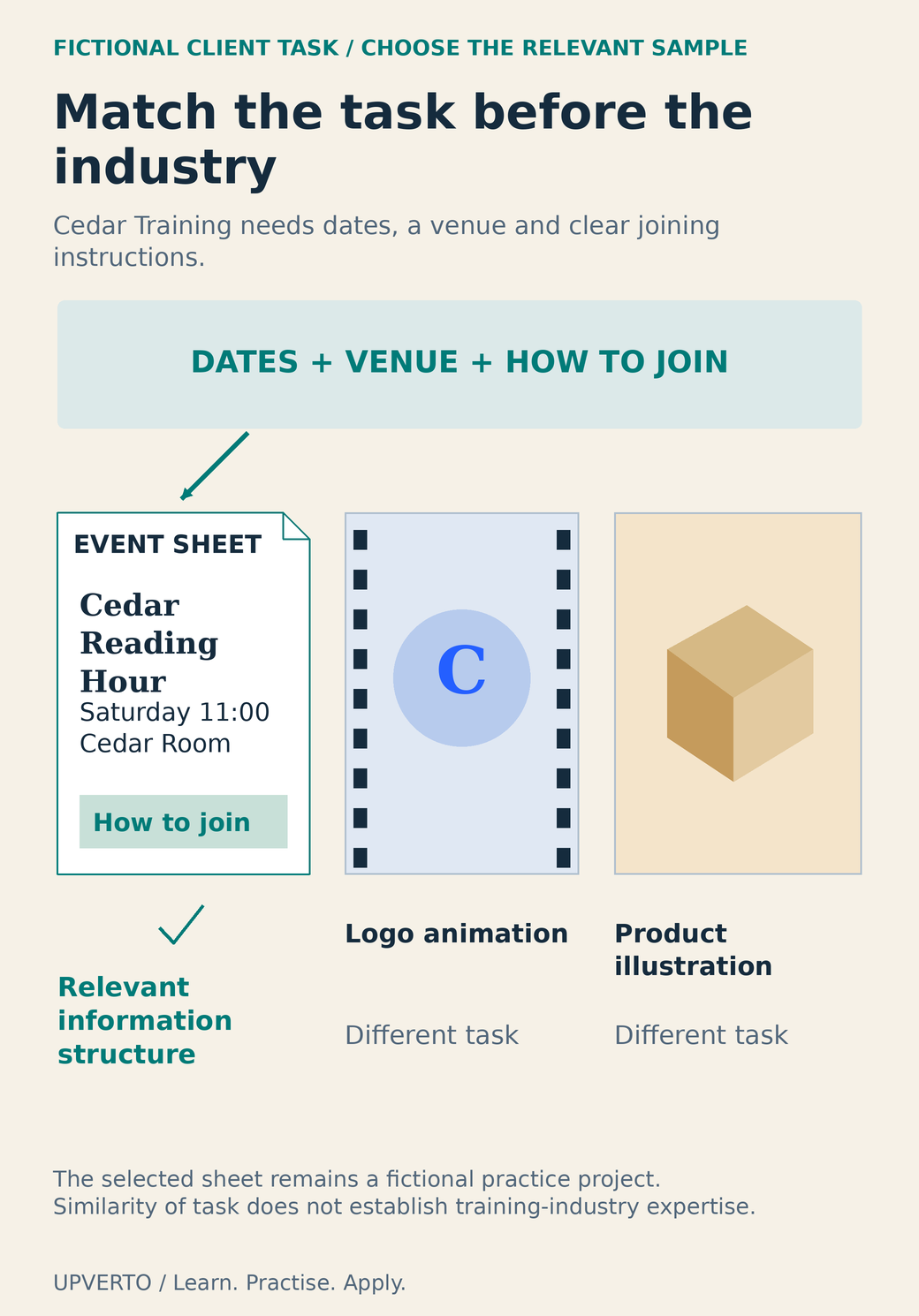
Read the text version: Select the sample that matches the information task
The fictional Cedar Training request concerns arranging dates, a venue and joining instructions. A Cedar Reading Hour event-information sheet demonstrates related grouping and hierarchy decisions. A logo animation and a product illustration demonstrate different tasks, so they are not the strongest evidence for this particular request. The selected event sheet must retain its fictional practice label. Selecting related work does not establish industry knowledge, specialist approval or a business result.
Translate the industry label into a task
“Education client” is a broad category. The request might be a captioned training video, a printable parent information sheet, an enrolment form or a monthly reporting process. Each requires different evidence. Identify the audience, input, output, constraints and checks before choosing samples.
Use public information and the client’s stated brief. Do not pretend to know private priorities or diagnose a business from a logo and a website. If something is uncertain, make it a question. “Will the information sheet be printed or read mainly on phones?” is more useful than claiming that every organisation in the sector needs the same design.
The guide to choose freelance client niche covers the broader focus decision. Portfolio tailoring is the narrower activity of selecting evidence for a specific conversation. It should not turn into a claim that you have expertise in every industry you approach.
Match evidence at three levels
| Level | What matches | What to explain |
|---|---|---|
| Same task and context | A permitted project with comparable audience and constraints | Your role and any differences in the new brief |
| Same task, different context | A similar output for another audience or a fictional brief | The transferable decisions and the context still to learn |
| Adjacent capability | A sample showing part of the required workflow | What it demonstrates and what it does not establish |
A sample with matching colours but an unrelated task may be less useful than a plain sample showing accurate information hierarchy or checked captions. Select for the decision the client must make: can you perform the defined work and understand its constraints?
Specialist contexts can add responsibilities. A health, legal or financial organisation may need expert review, controlled wording or particular privacy arrangements. A visually similar concept does not qualify you to write regulated advice or handle sensitive data. State which work you perform and who supplies or approves specialist content.
Write a short relevance note beside the sample
Use three sentences: what the sample is, which part relates to the prospective task and what remains different. Keep its original project label. This is clearer than changing the fictional client’s name to match the prospect’s sector.
For example: “This is a fictional community information-sheet project. It shows how I grouped dates, locations and an action instruction across a screen version and a printable PDF. Your organisation’s approved terminology, audience needs and production specifications would need to be confirmed in a separate brief.”
Use clear headings and descriptive links so the reader can reach the relevant work. W3C’s writing guidance supports meaningful structure and link text. The editorial decision to select a particular sample is your own reasoning, and it should be justified by the task rather than presented as a research-backed guarantee of conversion.
Worked example: choosing evidence for a training organisation
Fictional prospect: Cedar Training needs a short participant information sheet from approved copy. The requirements mention session dates, venue, accessibility contact and joining instructions. The learner has three samples: a fictional reading-event sheet, an abstract logo animation and a practice product illustration.
The reading-event sheet is the closest match because it handles a similar information task. The logo animation may demonstrate motion skills, but it does not show that a reader can find a date or joining instruction. The product illustration is also less direct evidence for this particular request.
The learner selects the event sheet, adds a readable extract showing the information grouping and explains the export checks. The note states that it is a concept project for a different audience. The learner asks the prospect who approves the accessibility contact wording and which final formats are needed.
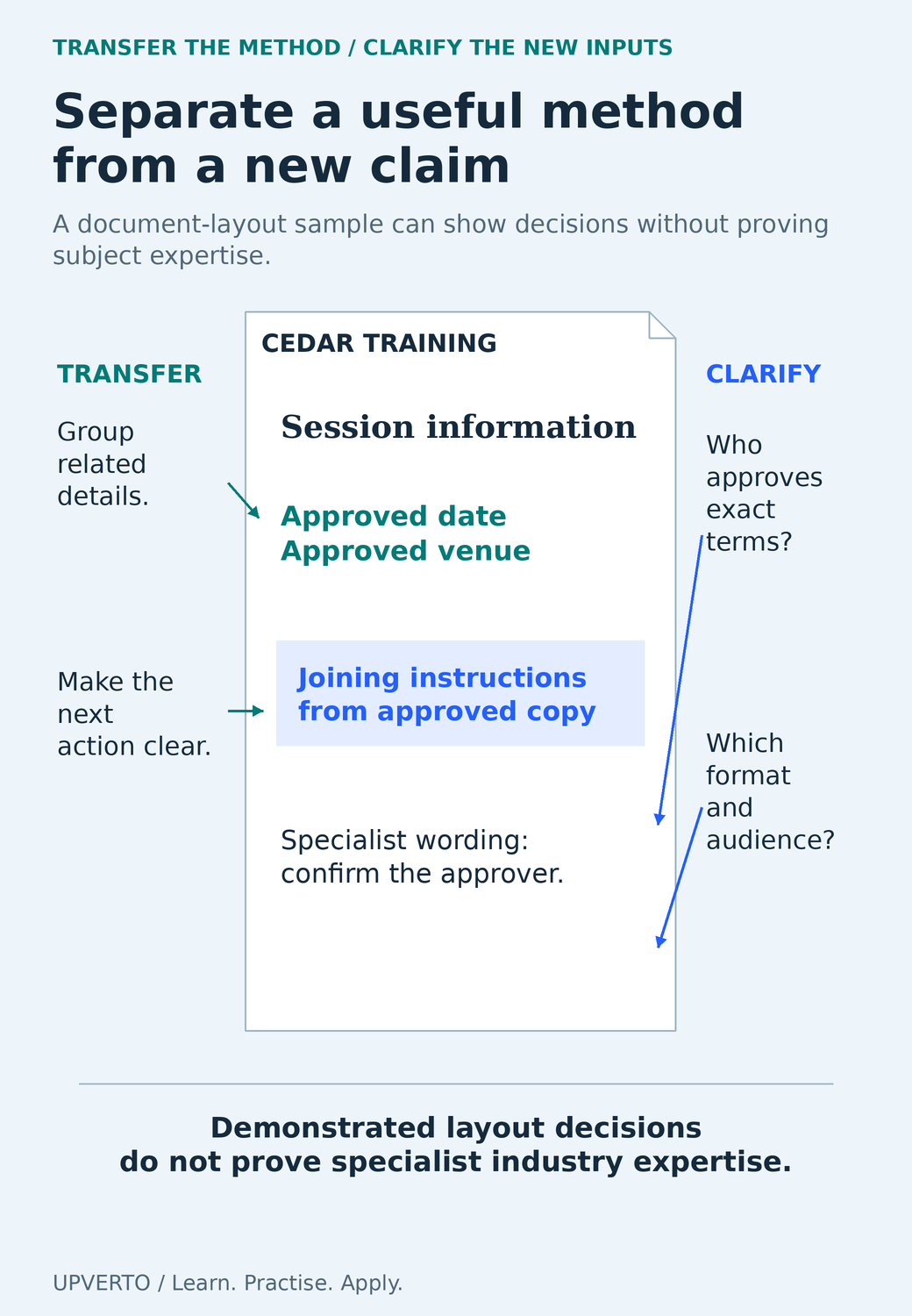
Read the text version: Distinguish transferable layout decisions from client-specific knowledge
| Transferable evidence | New input to clarify |
|---|---|
| Grouping related date and venue details | Exact approved wording and the person who approves it |
| Making the joining instruction easy to find | The intended audience and required output format |
The Cedar Training sheet is a fictional teaching schematic. A previous document sample can demonstrate layout decisions. It does not establish expertise in training content, regulation or specialist terminology. Preserve the original project label and state where subject-matter approval belongs.
No new client history is invented. The learner does not claim experience in training compliance or promise that the design will improve attendance. The tailored presentation simply makes the relevant existing evidence easier to inspect.
Use the portfolio-selection worksheet
| Field | Entry |
|---|---|
| Prospective task | Named output, audience and current source of the requirement |
| Important constraints | Format, approved terminology, access, privacy and review |
| Candidate sample | Actual project title and honest project type |
| Evidence of relevance | Specific decision, output or check the reader can inspect |
| Difference or gap | Context, input or responsibility the sample does not cover |
| Permission | Whether this exact material may be shown to this recipient |
| Next question | One uncertainty that affects fit or scope |
Keep the master case study accurate, then tailor the selection and introductory note. This avoids maintaining multiple contradictory versions of your experience. If an industry-specific concept would teach a useful new constraint, create it as a new fictional brief and label it accordingly. Do not add a sector name only to target a keyword.
For a fuller explanation of the work, use write a portfolio case study. When a prospect has a real brief, use write freelance proposal to connect the evidence with a defined approach, assumptions and next step. A tailored portfolio supports that discussion; it does not replace discovery or an agreement.
Frequently asked questions
Can I approach an industry without a project from that industry?
You can show a relevant task sample and explain the transferable capability, while stating the context you have not worked in. Ask about specialist requirements. Do not present a concept or adjacent task as proof of industry experience you do not have.
Should I make a separate portfolio site for every niche?
Usually a clear master portfolio with selected case studies and a relevant introductory note is easier to maintain. Separate sites create update and consistency work. Use them only when there is a concrete audience or access reason, not simply to repeat industry keywords.
What if the closest sample is fictional?
Keep the fictional label visible and explain the task it demonstrates. The reader can still inspect hierarchy, formatting, code or delivery checks. Do not rename the fictional organisation to resemble the prospect or imply that the sample had a real client outcome.
Should I hide the parts of a project that are unrelated?
Select a useful excerpt while preserving enough context to avoid misleading the reader. Explain your role and provide access to further relevant detail when appropriate. Do not crop out a concept label, collaborator credit or limitation that changes the meaning of the sample.
How do I handle a regulated or specialist industry?
Separate your production capability from subject-matter responsibility. Confirm who supplies and approves specialist wording and what data you may handle. Seek qualified support or decline parts outside your competence; a similar-looking sample is not evidence of regulatory expertise.
How many samples should I send to a prospect?
Send the smallest useful selection that addresses the task and the recipient’s requested format. Explain why each item matters. A long unrelated gallery can make the client do the matching work you should have done before sending it.
Sources and review notes
Primary sources checked on 27 October 2026 (UTC). Check the current provider pages before relying on a changing feature, policy or price. Worked examples and worksheets are original teaching material; fictional examples are not evidence of client results.