Part of How to Make Money Online with Digital Skills: A Beginner’s Roadmap.
Turn a digital skill into a freelance service by connecting something you can do reliably to a specific buyer’s problem and a clear deliverable. Then define the inputs, limits, review process, and checks that make the work understandable to both sides.

In this guide
A skill describes your capability. A service describes the work a client can hire you to complete. Learning to use a design application is a capability. Preparing an agreed set of event graphics from supplied text is one possible service.
Connect the skill, problem, and deliverable
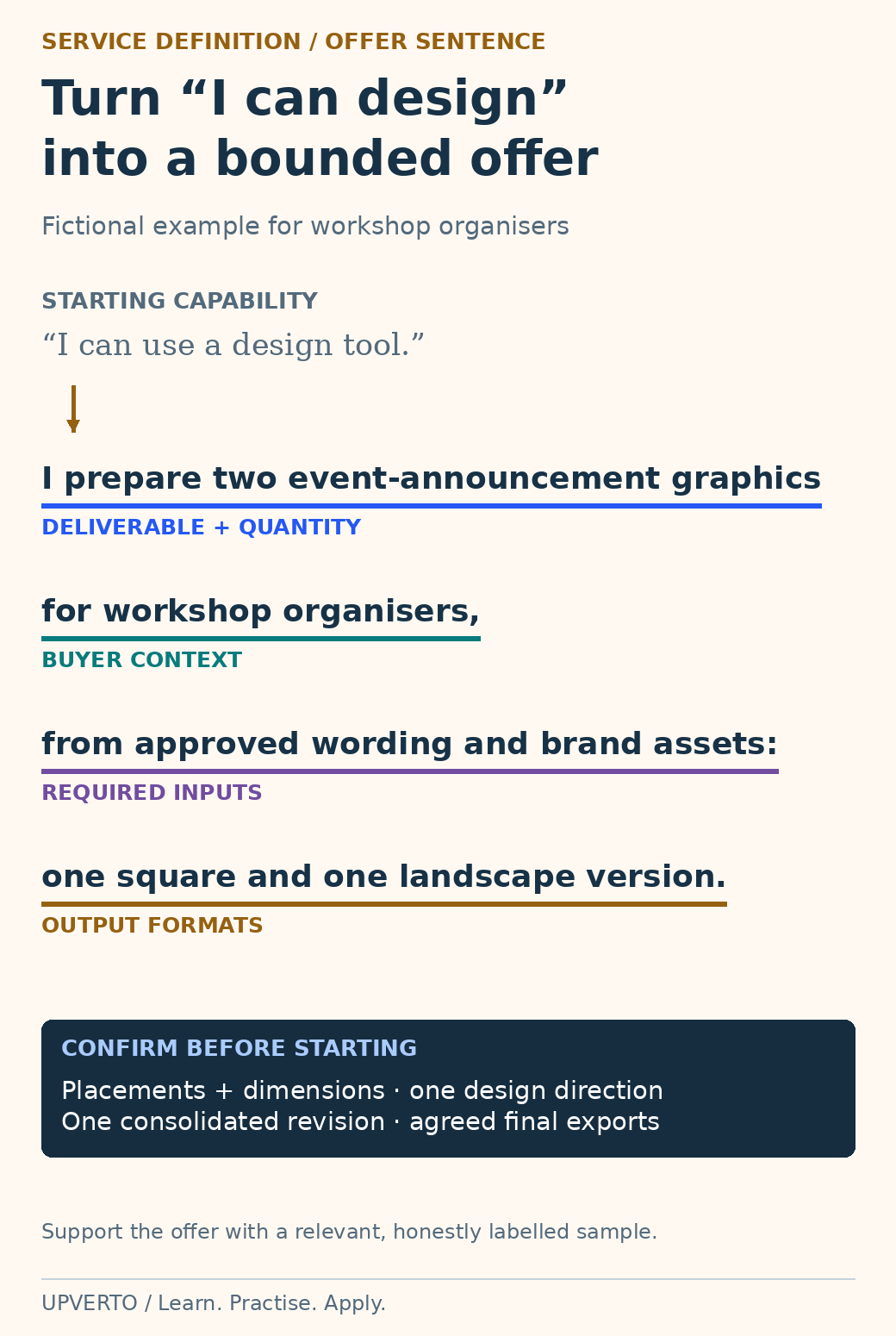
Read the text version: Construct an offer from concrete parts
A broad capability such as “I can use a design tool” does not yet specify a client service.
I prepare two event-announcement graphics for workshop organisers, from approved wording and brand assets: one square and one landscape version.
- Deliverable and quantity: two event-announcement graphics.
- Buyer context: workshop organisers.
- Required inputs: approved wording and permitted brand assets.
- Output formats: one square and one landscape version.
In this fictional example, placements and dimensions are agreed before starting. The offer includes one design direction, one consolidated revision round and the agreed final exports. A relevant honestly labelled sample should support the provider’s ability to deliver the task. No commercial result is promised.
Practical summary
- Skill: what you can perform and check.
- Buyer: who has a relevant task to complete.
- Problem: what currently needs attention.
- Deliverable: the work you will provide.
- Conditions: the inputs and boundaries that make delivery possible.
For example, a small training provider may have recorded a useful explanation but need it edited into a concise video. The service can specify the edit, captions, export format, and review process. It should not promise that the video will produce a certain number of sales or views.
Start from your demonstrated ability. The readiness checklist helps you identify the scope you can support. If you are still deciding what to learn, use the skill-selection guide before building an offer around a tool you have barely used.
Examples across different skills
| Skill | A possible defined service | Important boundary |
|---|---|---|
| Graphic design | Prepare a specified set of event graphics from approved copy and assets. | Brand strategy, copywriting, and extra formats need explicit agreement. |
| Video editing | Edit supplied footage into an agreed video with checked captions. | Filming, advanced restoration, or new animation may be separate work. |
| WordPress | Update an agreed group of information pages and test the affected navigation. | Live-system access, backups, forms, and functionality must be understood. |
| Virtual assistance | Organise a defined set of records and document a repeatable intake procedure. | Confidentiality, permissions, and decisions that require approval must be clear. |
| SEO | Review an agreed set of pages and provide prioritised recommendations with evidence. | An audit is different from implementation, and neither guarantees rankings. |
These are illustrative offers, not an instruction to sell them before practising. Each one needs a suitable brief and evidence. The relevant roadmaps explain the learning: design, editing, WordPress, virtual assistance, and SEO.
Choose a buyer context you can understand
You do not need to declare a permanent niche immediately. Choose a context that makes your offer concrete enough to test. “Small workshop organisers who already have event details and need clear graphics” is easier to investigate than “anyone who needs design.”
Look at actual requests, existing workflows, and conversations you are authorised to have. Record what you observed and what remains an assumption. A business with an unattractive website does not automatically want to buy a replacement; it may have different priorities or constraints.
Ask how the task is handled now, what causes difficulty, who approves it, and what a useful completed result would look like. This helps you refine the service without inventing a need.
Define an output you can control
Separate the client’s business goal from your deliverable. A client may want more enquiries. Your agreed work may be a clearer service page, a tested contact route, and a documented handover. You can verify those outputs; you cannot automatically claim responsibility for every factor affecting enquiries.
Define quantities, formats, source-material limits, and review points where they matter. “A short video” leaves major questions unanswered. “One edited video from the agreed source material, in one specified format, with one consolidated review round” is more useful, provided the details are completed before work begins.
Use the service-package guide for the full specification. It includes inputs, exclusions, revisions, and acceptance checks.
Attach evidence that matches the offer
Choose a sample showing a similar task and similar constraints. Explain its status and your contribution. A concept project can demonstrate your decisions without pretending to be a paid client result.
If your current portfolio does not support the service, build a relevant practice project first. Then present it using the portfolio guide. This can also reveal hidden steps that should be included in the offer, such as file preparation or client review.
Estimate the work before choosing a price
Break the work into understanding the brief, preparing inputs, production, quality checks, communication, revisions, and handover. Use your practice record to estimate the effort. Include the costs that actually apply to the project and distinguish recurring business costs from one-off purchases.
A fixed price requires sufficiently clear scope. An hourly arrangement still requires clear tasks, reporting, and limits. An ongoing arrangement needs a defined capacity or set of outputs. The choice should fit the work and the agreement.
This guide does not prescribe a market rate. Check current channel fees, applicable taxes, payment arrangements, and contractual requirements for your situation before quoting. If you need jurisdiction-specific legal or tax advice, use an appropriately qualified source.
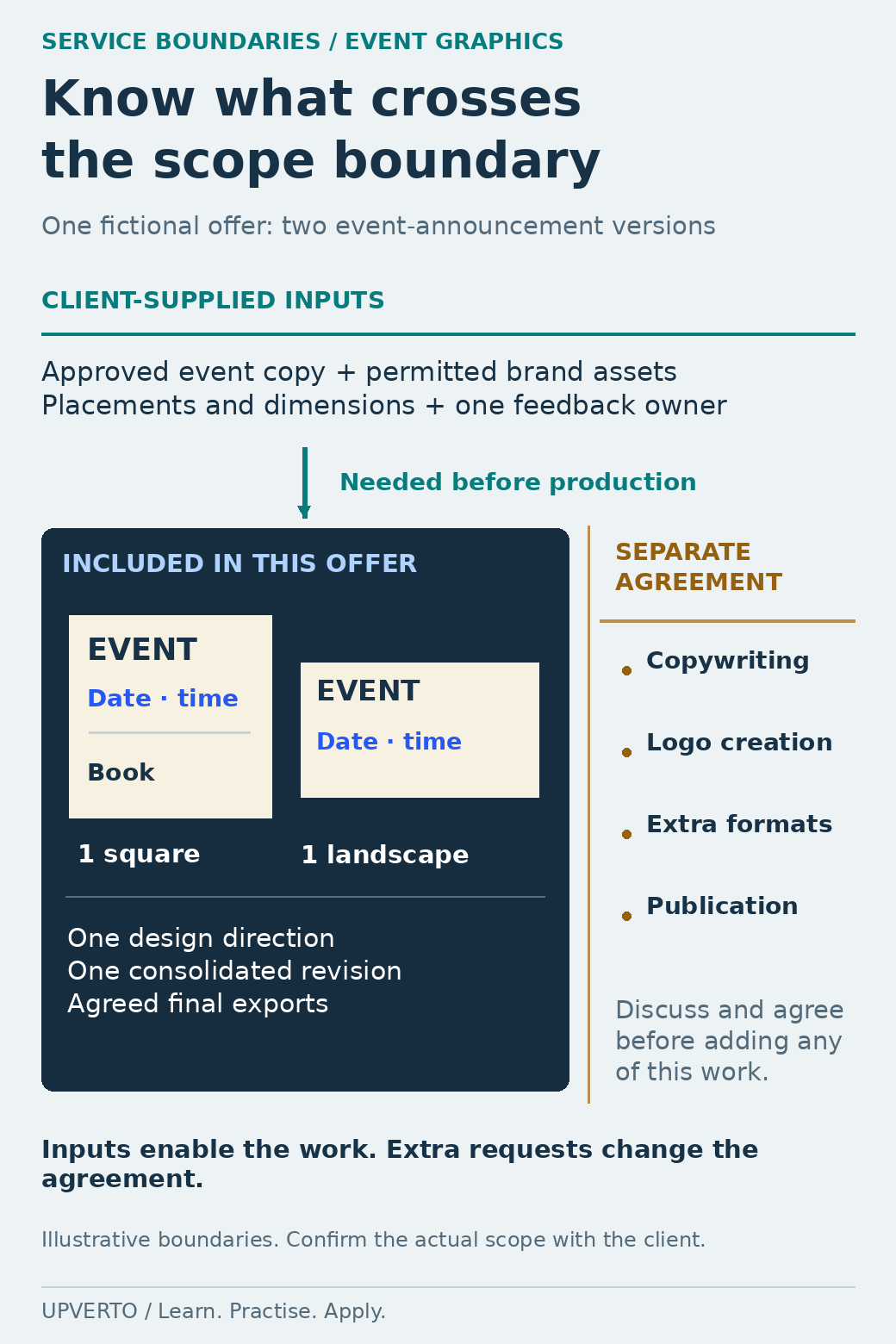
Read the text version: Map included work, client inputs and extra scope
This map uses the article’s fictional event-graphics offer.
- Client-supplied or approved inputs
- Final event wording, permitted brand assets and images, confirmed placements and dimensions, and one person responsible for feedback.
- Included work
- Two announcement versions: one square and one landscape. One design direction, one consolidated revision round and the agreed final exports are included in the example.
- Separate agreement
- Copywriting, logo creation, extra formats and publication are outside the example’s scope unless separately discussed and agreed.
The input arrow means those materials and decisions enable production. The marked boundary separates the defined deliverables from additional responsibility. Confirm the actual scope, permissions and review terms with the client rather than treating this example as a universal package.
Write a one-page service definition
| Field | Your answer |
|---|---|
| Buyer and task | I help [buyer] complete [specific task]. |
| Reason it matters | The task addresses [observed problem or clearly labelled assumption]. |
| Deliverable | The client receives [named outputs and formats]. |
| Inputs | The client supplies or approves [materials, access, and decisions]. |
| Limits | The service includes [scope] and excludes [separate work]. |
| Process | Brief → production → agreed review → checks → handover. |
| Evidence | Link to a relevant sample and explain its status. |
| Estimate | Record effort, costs, assumptions, and uncertainties before quoting. |
| Next conversation | Ask a question that establishes whether the actual request fits. |
Worked example: an event-graphics service
Fictional offer: “I prepare two event-announcement graphics from your approved wording and brand assets: one square version and one landscape version. We confirm the placements and dimensions before work begins. The package includes one design direction, one consolidated revision round, and the agreed final exports.”
The provider then lists what is needed: final event details, logo files with permission to use them, approved images, and one person responsible for feedback. Copywriting, logo creation, additional versions, and publication are separate unless agreed.
A relevant concept sample demonstrates hierarchy, readability, and adaptation between formats. The provider’s estimate includes time to check the event details, prepare both versions, review feedback, and inspect exports. No invented revenue result is needed to explain the service.
Test whether people understand the offer
Show the definition to someone who can reasonably assess the problem. Ask what they think they would receive, what they would need to supply, and what remains unclear. Their response can expose ambiguity before you make a promise.
When discussing a real opportunity, use the client’s actual requirements to refine the scope. Avoid giving away a full unpaid production project as a test. A short, relevant sample or a properly agreed small engagement can provide evidence without leaving the terms uncertain.
Frequently asked questions
Should I offer everything I am learning?
Offer work supported by your evidence and delivery process. You can list broader learning interests elsewhere, but a client-facing service should make clear what you can currently complete.
Do I need three package tiers?
No. Begin with a clear service. Add options when they reflect real differences in scope, complexity, or support. Extra tiers do not fix an unclear underlying offer.
What is the difference between a skill and a service?
A skill describes what you can do. A service explains how you will apply that ability to a particular need, with defined deliverables and conditions. For example, editing ability becomes a clearer offer when it specifies the source material, finished video and review process.
How narrow should my first service be?
Make it specific enough that a suitable client can understand the output and you can estimate and check the work. Include the important boundaries. You can expand later when your evidence and delivery process support additional responsibilities.
Can I offer a service based on practice projects?
Practice work can demonstrate relevant ability when its status is clear. Explain what the sample proves and assess whether you can repeat the complete workflow under the proposed conditions. Do not imply paid-client experience or accept responsibilities that the sample does not support.
How can I test whether my offer is clear?
Ask someone to explain back who the service is for, what they would receive and what they would need to provide. Note the questions they cannot answer. Improve the wording and scope before adding packages, promotions or stronger promises.
Make the offer ready for a useful conversation
Complete your one-page definition and the package worksheet, then choose one relevant sample. Use the client-finding guide to identify suitable opportunities and the delivery guide to prepare for the work that follows.