Checking demand means investigating who needs a piece of work, what they expect and which conditions you would need to meet. A list of popular skills cannot answer all three questions. Use a repeatable sample of actual buyer or employer needs, record how you found it and keep the limits of the evidence visible.

In this guide
The guide to make money online with digital skills gives the broader route from learning to useful work. This article focuses on the research decision before a large commitment. It contains a small, dated example from real public listings, followed by a worksheet you can use for your own skill and market.
Define the demand question narrowly
“Is web development in demand?” combines many different tasks, buyers and experience levels. A more useful starting question is: “What work do organisations ask a WordPress developer to do, and which requirements would matter to a beginner in my location?” That question can guide a search and reveal gaps without pretending to predict your income.
Specify the skill, deliverable, buyer type, geography, work route and observation date. Decide whether you are examining employment, project work or product purchases. Keep those categories distinct because the responsibilities and evidence differ. The SBA’s market-research guidance supports investigating customers and alternatives rather than relying on assumptions.
Choose a sample you can explain
Use a defined source and method. For example, inspect relevant current listings on one specialist job board, then compare with another source or direct buyer research. Record the search phrase, filters, pages reviewed and exclusions. Do not select only the posts that confirm your preferred conclusion.
A convenience sample is useful for learning the language of the work, but it is not a market census. A board may overrepresent particular platforms, locations, employers or seniority levels. Counts can change, listings can expire, and repeated advertisements may describe the same need. Preserve a dated note and recheck before making a consequential decision.
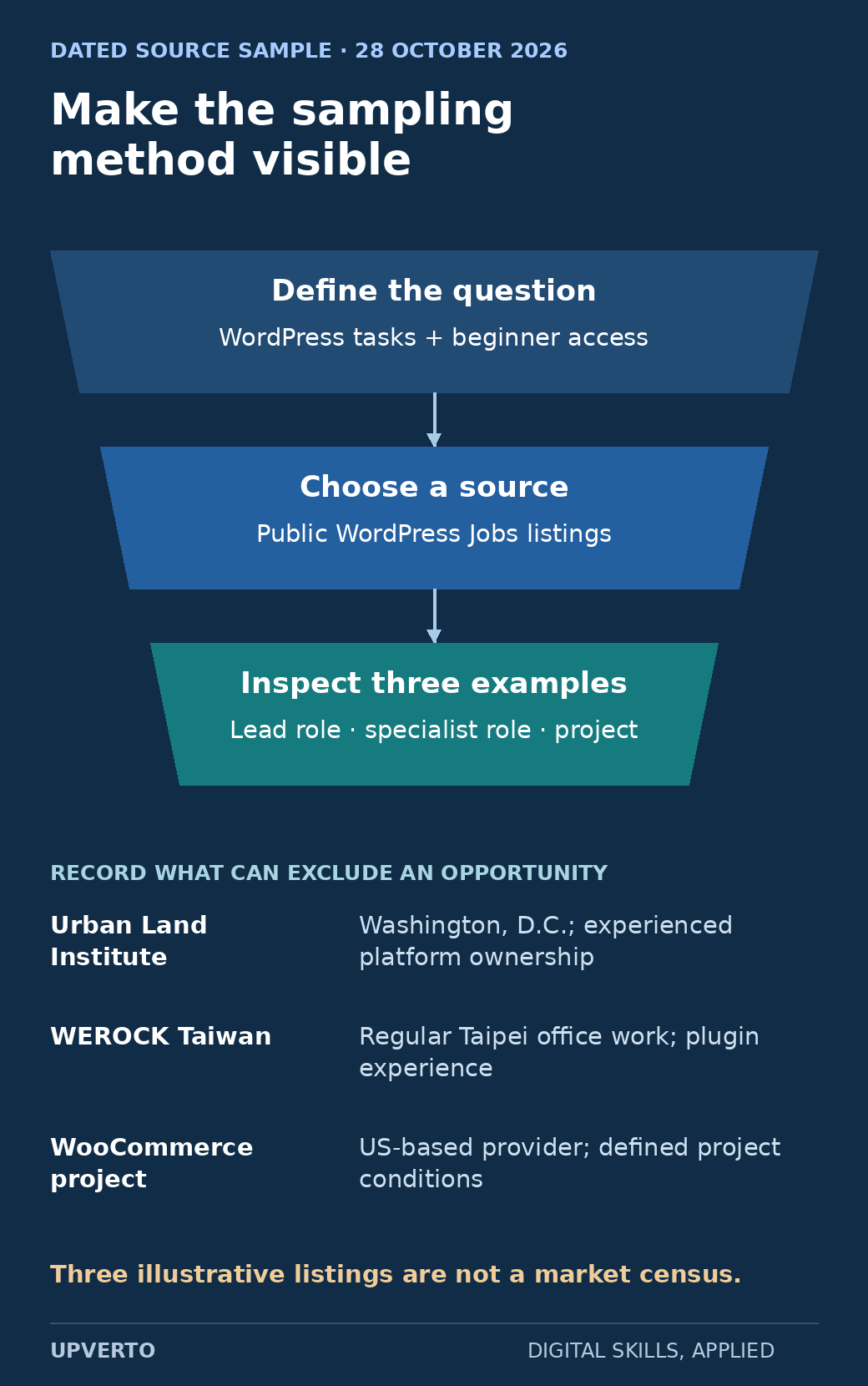
Read the text version: Record a transparent demand sample
Observed 28 October 2026: define a question about WordPress tasks and beginner access; use public WordPress Jobs listings; inspect three illustrative examples. Urban Land Institute: Washington, D.C. and experienced platform ownership. WEROCK Taiwan: regular Taipei office work and plugin experience. WooCommerce project: US-based provider and defined project conditions. This is not a random sample or market census. Source links and posting dates are in the article.
Worked example: three public WordPress listings
This teaching sample uses three listings reviewed on 28 October 2026, linked from WordPress Jobs. They were chosen to illustrate different responsibility and eligibility boundaries: a leadership role, a specialist employment role and a project. This is a deliberately small teaching sample, not a random sample or a count of all available work.
| Listing and posted date | Observed need | Constraint to record | What it does not prove |
|---|---|---|---|
| Urban Land Institute: Lead Web Developer — 19 October 2026 | Consolidating web properties, integrations, accessibility and ongoing platform responsibility | Washington, D.C.; substantial production and ownership expectations | That a beginner can qualify after a short course |
| WEROCK Technologies Taiwan: WordPress Developer — 11 October 2026 | Custom plugins, business integrations and maintainable website operations | Experience required; regular Taipei office work, with limited home-working by agreement | That every WordPress role is fully remote or globally accessible |
| US WooCommerce developer: new store project — 11 October 2026 | A digital-download store with security, interface and handover requirements | US-based provider requested; client prioritises work within an agreed allowance | That the advertised project was awarded, paid or profitable |
The useful observation is that these listings request specific responsibilities beyond installing a website theme. They mention integration, operations, security, accessibility or ongoing maintenance. That suggests topics to investigate and practise for those kinds of work. It does not establish how common each requirement is across the wider market.
The examples also show why geography and experience belong in the research log. A relevant technical task may still be inaccessible because of location, work authorisation, schedule or required evidence. Record that limitation rather than counting every matching keyword as a realistic opportunity.
Separate three kinds of evidence
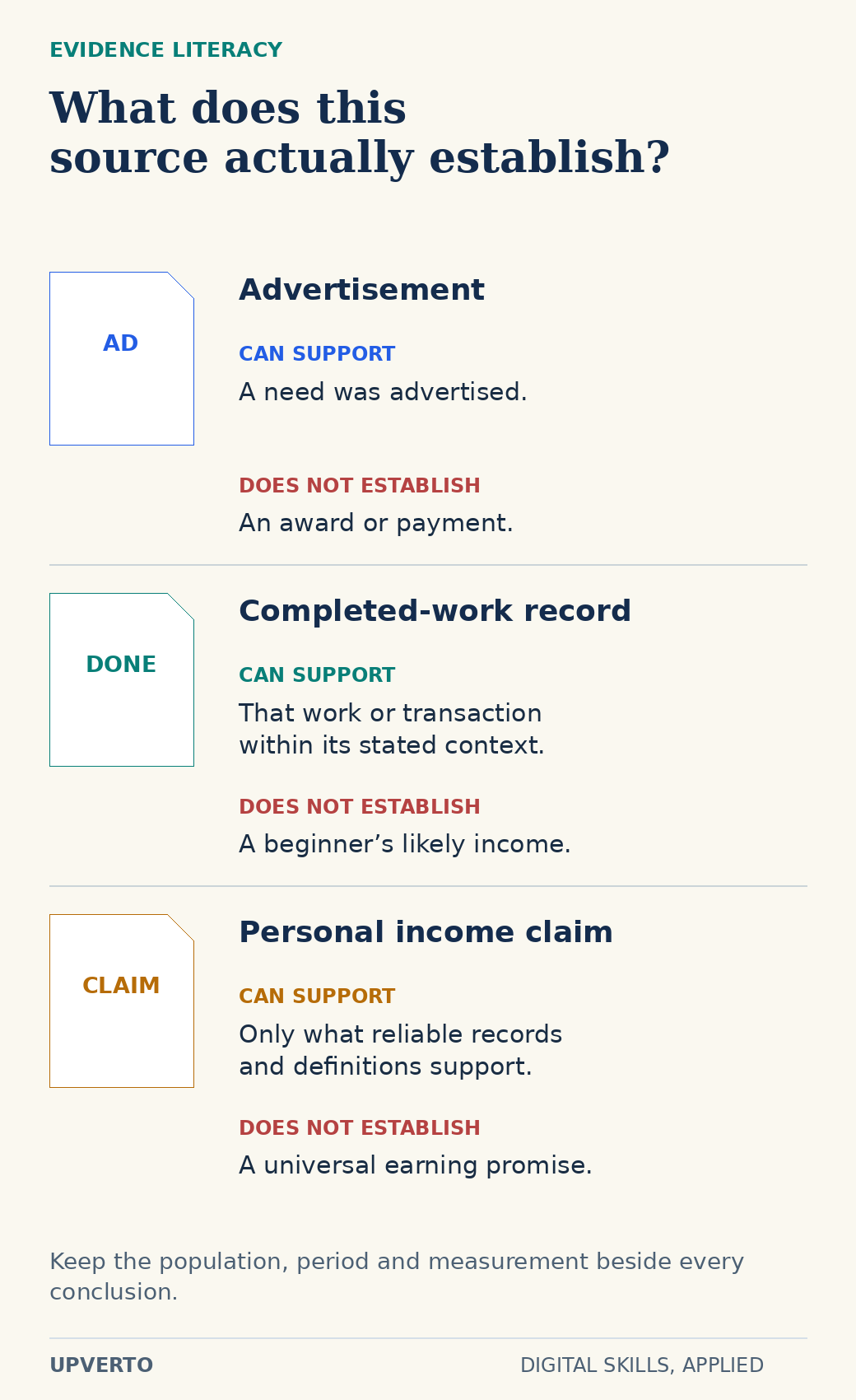
Read the text version: Separate advertised needs from completed work and income claims
- Advertisement
- Shows a need was advertised; does not establish an award or payment.
- Completed-work record
- May support a specific completed task or transaction in its stated context; does not establish a beginner’s likely income.
- Personal income claim
- Requires reliable records and definitions; does not establish a universal earning promise.
Record population, period and measurement with each conclusion.
A job advertisement is evidence of an advertised need at a particular time. It may include a budget or salary range, but that is not proof of a completed engagement or someone’s take-home income. A completed marketplace contract or verified transaction can support a different claim, though its context still matters. A personal earnings claim requires its own reliable evidence and cannot be generalised to beginners.
Upwork’s 2026 skills report release describes a methodology based on completed jobs and freelancer earnings during 2025, with demand originating in the United States. That source can inform a question about activity within its defined platform sample. It cannot by itself describe all countries, every work route or a new learner’s likelihood of earning.
Keep the source’s population, period and measurement beside any conclusion. If you cannot explain what a number counts, do not use it to rank a skill. Avoid turning a report headline into a universal claim that one direction is “best.”
Use this demand-research log
Create one row per distinct opportunity or evidence item. Include: source URL; observation date; posting date; query and filters; buyer or employer; task; deliverable; tools; experience; location; schedule; stated budget if relevant; evidence type; access constraint; and unanswered questions.
Add two interpretation fields. First, “What can I reasonably infer?” For the WEROCK example, one inference is that this employer values plugin and integration competence. Second, “What cannot I infer?” You cannot infer that every employer wants the same stack or that the advertised role is available to someone outside its stated conditions.
- Deduplicate repeated postings before counting a pattern.
- Distinguish required qualifications from optional preferences.
- Record the actual work verbs: migrate, reconcile, edit, test, maintain or explain.
- Mark advertised budgets separately from completed payment evidence.
- Include listings that reveal a mismatch with your current ability or constraints.
- Keep missing information as unknown and identify a lawful, appropriate way to investigate it.
Turn the research into a learning decision
Look for recurring tasks within the sample, then ask what a small practice project could demonstrate. If several relevant briefs ask for clear handover documentation, include that in your next sample. If the work requires specialised permissions or high-risk operations, recognise the additional learning and supervision needed.
Use which digital skill should I learn to compare the work itself with your interests and resources. Demand evidence is one input alongside your ability to learn, access to the market and willingness to do the task. A highly visible skill can still be the wrong immediate choice for your situation.
Your next step is to validate a freelance service idea through a more focused buyer-and-problem test. Research can narrow uncertainty, but it does not guarantee a client. Keep your conclusion modest: “This sample gives me a reason to investigate this task further,” followed by the specific next evidence you need.
Frequently asked questions
How many listings do I need to inspect?
Use enough to see whether your observations repeat across relevant sources, and record the method. There is no universal number that makes a convenience sample representative. The three listings here teach the process and are deliberately insufficient for a market-wide conclusion.
Does an advertised budget show what freelancers earn?
No. It describes a stated allowance or offer, not a completed payment, final scope, costs or take-home income. Keep advertised budgets in a separate field and do not convert them into an earnings promise.
Can I use a platform report to choose a skill?
Yes, as one source if you understand its population, period and method. Combine it with actual task requirements and your constraints. A platform-specific report does not automatically describe global demand or beginner access.
Why include geography when the work is online?
Online work can still have location, legal eligibility, time-zone or language conditions. The real sample includes regular office attendance and a US-based-provider requirement. Those conditions affect whether an opportunity is relevant to you.
What if all the listings I find require experience?
Record that result honestly. Investigate smaller responsibilities, adjacent roles or supervised opportunities, and build practice evidence for the relevant tasks. Do not reinterpret senior requirements as proof that a short course guarantees entry.
When should I repeat the research?
Recheck before committing substantial time or money, changing your service or applying to a particular opportunity. Keep dated notes so you can distinguish a changed market observation from your earlier assumptions.