A client niche is a group of buyers whose situation and needs you can understand well enough to serve. It is not simply an industry label attached to a skill. “Websites for businesses” says little about the work. “Updating workshop information pages for small training providers” identifies a buyer, recurring information and a possible bounded task.

In this guide
The guide to turn digital skill into freelance service explains the wider move from capability to an offer. This page helps you choose which buyers to investigate. The shortlist is a research decision, not a claim that a particular group will hire you.
Separate buyer choice from skill choice
A skill describes work you can do: editing video, cleaning data or building a page. A buyer group describes who might need that work and under which conditions. The same skill can serve different groups with different inputs, vocabulary, approval processes and risks.
If the skill itself is still unclear, use which digital skill should I learn. Once you have a small capability to demonstrate, ask who has a task it could support. Avoid choosing a niche solely because someone claims it pays well. You need accessible evidence of the problem and a realistic way to understand the buyer.
For a first shortlist, specify the organisation type, responsible person, task and relevant constraint. “Community workshop coordinator who needs accurate session pages before each new schedule” is more useful than “education.” It also suggests questions about who supplies dates, approves changes and maintains the page.
Gather evidence before creating a persona
The SBA’s market-research guidance encourages investigating customers, demand and alternatives. Begin with public information you can inspect, actual briefs and appropriate direct research. Record the source and date. A fictional persona is a design aid, not evidence that real buyers think or behave as described.
Use check demand for digital skills to build a dated research log. Distinguish an observed issue from your interpretation. A page with an old date is observable; the claim that the owner urgently wants to pay someone to fix it requires further evidence. The organisation may have a different priority, an existing provider or a reason for the current page.
When speaking with potential buyers through an appropriate, authorised channel, ask about their process and recent examples. Avoid presenting your preferred solution as a fact about their needs. Ask who handles the task now, what makes it difficult and what would make a change worthwhile.
Build a small buyer-and-problem shortlist
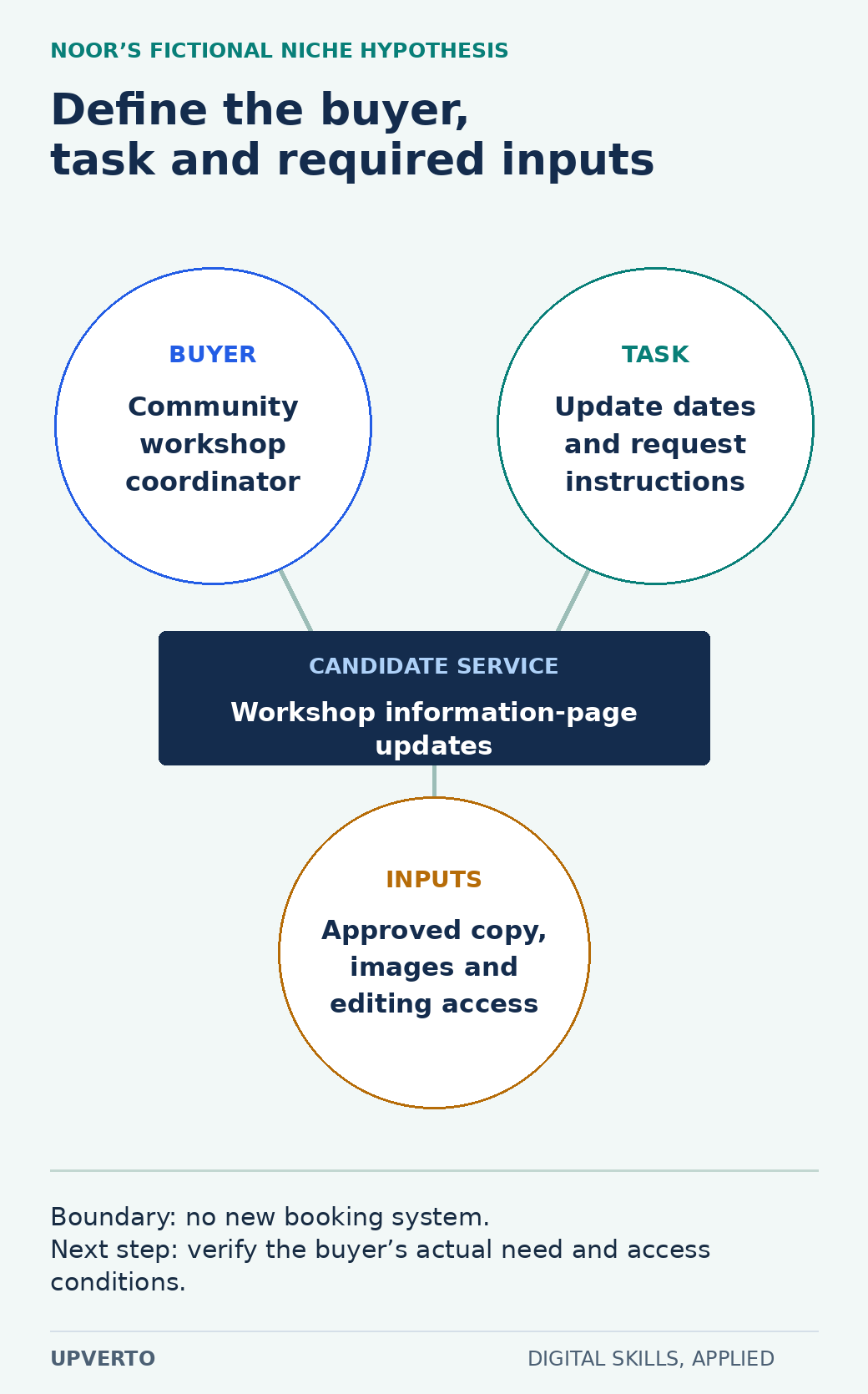
Read the text version: Define a client niche as a buyer, task and input relationship
Noor’s candidate niche combines a buyer, a task and feasible inputs: a community workshop coordinator; current dates and request instructions; approved copy, images and authorised access. The proposed service updates information pages and excludes a new booking system. The next research step is to verify the real need, owner and access conditions.
The fictional freelancer Noor can update informational web pages from approved copy and check links and narrow-screen layout. She is considering three invented buyer groups. The entries below are assumptions supplied for a learning exercise, not findings from real interviews.
| Candidate buyer | Possible task | Access or evidence to investigate | Boundary |
|---|---|---|---|
| Community workshop providers | Update session details and request instructions | Who owns the schedule and approves page changes? | No booking-system development in the initial offer |
| Independent retailers | Update opening hours and service information | Who supplies current details and controls the website? | No checkout, inventory or payment changes |
| Member associations | Prepare public event pages from an approved brief | How many people review content, and what is the cycle? | No private member data or account access work |
Each group could be worth investigating, but the worksheet does not prove demand. Noor chooses workshop providers for her next research round because the task closely matches her sample and the required information is relatively easy to define. She still needs to verify the buyer’s actual problem and access conditions.
Compare fit without inventing a precision score
Use four questions: can I understand the task, can I demonstrate the deliverable, can I reach appropriate evidence or people, and can I handle the responsibility? Mark each answer as supported, uncertain or outside current ability. Explain the reason in a sentence.
A group with a clear task but inaccessible decision makers may require more research. A group with accessible contacts but sensitive systems may be unsuitable for your current offer. A group with frequent visible updates may already have an effective internal process. Avoid assuming that apparent activity automatically creates outsourced demand.
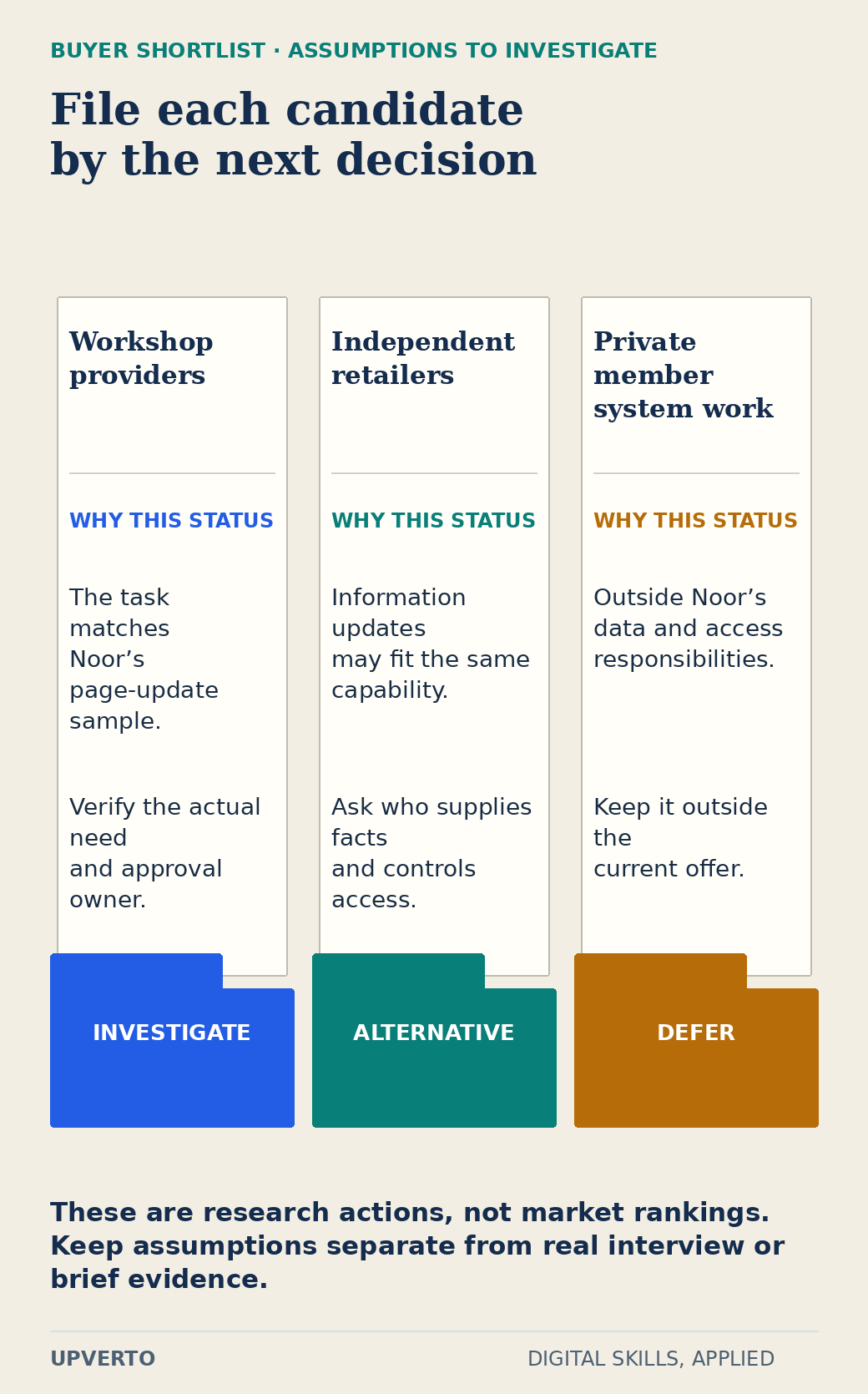
Read the text version: Turn a niche shortlist into three conditional next actions
| Candidate or work type | Decision | Reason and next step |
|---|---|---|
| Workshop providers | Investigate first | The task matches Noor’s sample. Verify actual need and the approval owner. |
| Retail information updates | Keep as an alternative | May fit the same capability. Ask who supplies facts and controls access. |
| Private member-system work | Defer | Outside demonstrated data and access responsibilities. Keep it outside the current offer. |
These are research actions based on fictional assumptions, not demand findings or market rankings.
Noor’s fictional decision is conditional: “Investigate workshop page updates first. Keep retail information updates as an alternative. Defer member-system work because it falls outside my demonstrated access and data responsibilities.” This is a practical next step, not a permanent identity or a market ranking.
Ask questions that reveal the real work
Prepare a short research guide. Ask the buyer to describe the last time the information changed, where the input came from, who approved it and what happened when something was wrong. Ask which parts are routine and which require judgment. These questions are more useful than asking whether they “would like a better website.”
Investigate the existing alternative. The buyer may do the task personally, use a staff member, retain an agency or leave the information unchanged. Your offer would need to fit that situation. Do not assume the only competitor is another freelancer with the same title.
Keep notes factual and proportionate. If a person describes one difficult update, do not report that all organisations in the group share the same problem. Seek patterns across relevant evidence and record contradictory observations. A good niche decision can be to stop investigating a group whose needs do not fit.
Use the buyer-and-problem worksheet
For each candidate, record: buyer group; responsible role; recurring task; trigger; required inputs; finished output; current alternative; evidence source and date; access constraints; responsibility limits; missing information; and next research action.
- Write the task in a way the buyer would recognise.
- Attach an actual source or mark the entry as an assumption.
- Connect the task to a sample you can show.
- Identify who can approve the work and provide access.
- Separate routine updates from systems or specialist advice you cannot support.
- State what evidence would make you continue or reject the candidate.
Keep the shortlist small enough to investigate. Three well-defined candidates can be more useful than a spreadsheet of fifty industries with unsupported income estimates. The worksheet should reduce uncertainty about the work, not create an impressive-looking list.
Test the service idea before committing to the label
Use the guide to validate a freelance service idea for the next step: a bounded test of the buyer problem and proposed deliverable. You may discover that the group needs a different task, that approval is more complex than expected or that your current sample is not relevant enough.
Adjust the offer or choose another candidate based on that evidence. You do not need to change your entire skill direction because one group is unsuitable. Buyer choice is a focused hypothesis you can revise as you understand the work more accurately.
Frequently asked questions
Do I need to choose one niche before learning a skill?
No. A small skill trial can come first. Once you can demonstrate a useful task, investigate buyer groups that might need it. Avoid building an elaborate niche identity without understanding the work you would deliver.
Is an industry name enough to define a niche?
Usually it needs more detail. Add the responsible buyer, the task, the trigger and relevant constraints. Two organisations in the same industry can have very different needs and approval processes.
Can a visible website problem prove that someone will pay?
No. It shows an observable condition, not the owner’s priority, budget or willingness to outsource. Use it as a question for research and keep your interpretation separate from the evidence.
Should I choose the niche with the highest advertised budgets?
Budget claims alone do not show fit, access, scope, costs or completed payment. Compare the actual task and responsibility with your ability, then investigate the buyer’s situation. Do not treat a large advertised amount as guaranteed profit.
What if I know people in a different industry from my portfolio sample?
Access can help you learn, but check whether your sample demonstrates the relevant task. You may adapt a clearly fictional project to that context while preserving honest claims about your experience.
When should I stop researching a candidate group?
Stop or defer it when evidence shows that the task is outside your ability, access is impractical, the need is not present or the responsibility is unsuitable. Record the reason and move to the next focused hypothesis.