Keep three questions separate: what amount has been billed, what payment has actually arrived, and what records or obligations apply to your situation. An invoice, a payment confirmation and a bank receipt describe related events but are not interchangeable. A simple operational record helps you spot a mismatch before it becomes a larger problem. This is part of manage freelance projects.
Start with the agreed billing arrangement
Confirm the customer or entity to bill, the work reference, the agreed amount and currency, the billing trigger, payment route and due-date arrangement. Use hourly vs fixed price vs retainer for the payment-model decision. Do not invent a deposit requirement, late fee or withholding rule after the engagement has begun.
The operational record should match the brief prepared through write project brief acceptance criteria. A purchase order, approved milestone or other required reference may determine how the client processes an invoice. The UK Small Business Commissioner’s guidance highlights the importance of confirming the actual invoice recipient and relevant references. These practical questions are useful without assuming that its legal context applies everywhere.
Ask whether the project contact and accounts-payable contact are different. Confirm the submission method and what acknowledgement means. A message saying an invoice was received is not proof that the invoice was approved, scheduled or paid. Record the actual state and the next appropriate action.
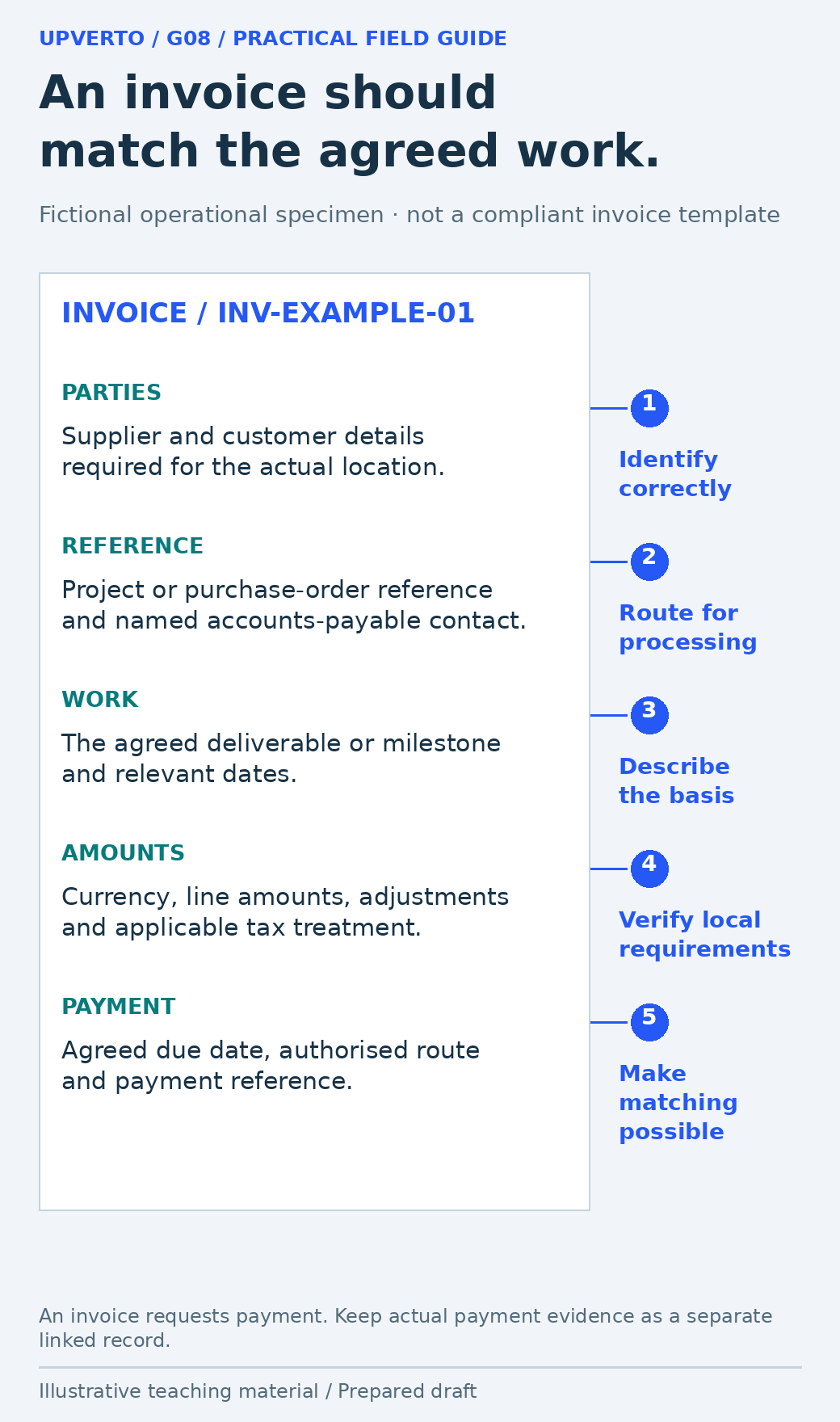
Read the text version: Check the information behind an invoice
The fictional invoice checklist asks for the correct parties, project/purchase-order reference, agreed work and dates, currency and amounts with applicable local tax treatment, and the agreed due date and payment route. It is not a universally compliant invoice template. An invoice requests payment; actual payment evidence is a separate linked record.
Prepare an invoice that can be matched to the work
| Field group | Operational question |
|---|---|
| Identity | Who is billing whom, using the details required in the applicable location? |
| Reference | What unique invoice number, project reference or purchase order identifies it? |
| Work and dates | What agreed work or milestone does it cover, and when was it supplied or invoiced? |
| Amounts | What currency, line amounts, applicable adjustments and total are being requested? |
| Tax information | Which local registration, tax, exemption or other requirements actually apply? |
| Payment | What agreed due date, route and reference should the client use? |
Check local official requirements rather than treating this table as a universal compliant invoice. For example, GOV.UK’s invoicing guidance describes UK rules and distinguishes an invoice from a receipt. Whether a particular registration number, tax amount or additional field is required depends on the relevant rules and your circumstances. Obtain suitable accounting or legal help for those determinations.
Use consistent identifiers so a payment can be matched without guessing. If an invoice needs correction, preserve an audit trail and follow the applicable correction process. Do not silently overwrite a previously issued amount and leave the client with two conflicting versions.
Compare payment routes by eligibility and total operation
A provider being well known does not establish that you can use its business services. Stripe’s availability page and Wise’s business eligibility guidance are examples of primary sources to check for current country, entity and activity support. They are not recommendations for a particular reader, and this guide does not assume account approval or international eligibility.
| Comparison field | Evidence to record for each candidate |
|---|---|
| Eligibility | Your actual location, entity type, business activity and supported account/service |
| Payment and withdrawal | Can the client pay and can you receive or withdraw through the required route? |
| Currency | Invoice, charge, settlement and withdrawal currencies; conversion method |
| Fees | Published current fee components and a dated quote for your specific transaction |
| Timing and restrictions | Availability of funds, limits, possible holds and required verification |
| Records and support | Exportable transaction references, statements and a support route |
| Agreement fit | Whether platform or client terms restrict how payment must occur |
Compare the whole route rather than one advertised fee. A payment may involve processing, conversion or withdrawal costs, and the party responsible for them should be clear. Do not use someone else’s account or misstate your location to bypass an eligibility restriction. Recheck changing provider details before relying on them.
Worked example: a payment is not the net bank deposit
Fictional arithmetic example: An already agreed invoice total is 1,000 monetary units. This illustration makes no tax assumption and uses no real provider rate. The client pays 400 units against it. Under the example’s agreed arrangement, the freelancer bears a 12-unit processing fee, so the bank receives 388 units.
| Record | Amount | Meaning |
|---|---|---|
| Invoice total | 1,000 | The amount billed in this sample |
| Client payment applied | 400 | Payment allocated to this invoice |
| Unpaid invoice balance | 600 | 1,000 minus 400 |
| Processing fee | 12 | A separate cost borne by the freelancer in this scenario |
| Net bank receipt | 388 | 400 minus 12 |
The remaining invoice balance is 600, not 612. The 12-unit cost explains the difference between the client’s payment and the net deposit; it is not automatically a new debt owed by the client. A different agreement or fee structure needs its own treatment. Record the transaction reference, allocation and fee separately so the reconciliation is visible.
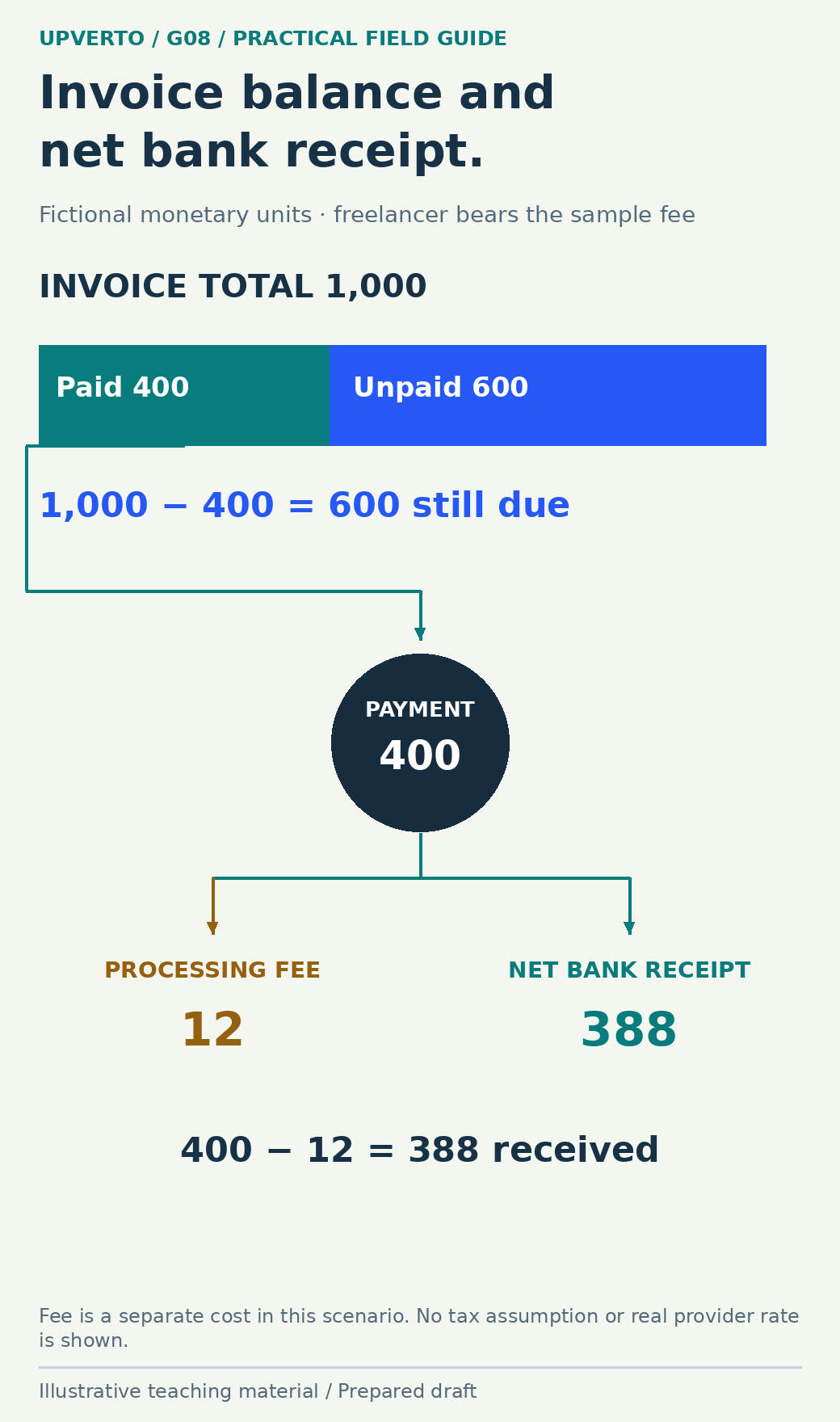
Read the text version: Reconcile an invoice payment, fee and net deposit
Fictional example: invoice 1,000 minus client payment 400 leaves 600 unpaid. The top bar is proportional to these amounts. Separately, the 400 payment minus a 12 processing fee leaves a 388 net bank receipt. The freelancer bears the fee under this scenario’s arrangement, so the invoice balance is not 612. No actual provider rate or tax treatment is assumed.
Keep a small reconciliation trail
Connect the agreed work, invoice, payment reference, fee record and bank receipt. Record dates and currencies accurately. If one payment covers several invoices, show the allocation. If a payment is partial, keep the balance visible rather than marking the whole invoice paid. If money is refunded or disputed, record that event separately.
| Record field | Example or instruction |
|---|---|
| Invoice ID and total | INV-EXAMPLE-01; 1,000 units |
| Status | Issued, acknowledged, part paid, paid, disputed or corrected as appropriate |
| Payment allocation | 400 units applied to INV-EXAMPLE-01 |
| Fee and settlement | 12 fee; 388 net deposit; actual transaction references in your own record |
| Outstanding amount | 600 units, subject to any later agreed adjustment |
| Next action | Follow up through the agreed process at the appropriate point |
Store records with access appropriate to their sensitivity and retain them according to the requirements that apply to you. This guide does not prescribe a universal retention period. If payment details change, verify the instruction through an established authorised route rather than treating an unexpected message as sufficient evidence.
Use the records to make the next decision
When payment is late or the records disagree, first check the invoice recipient, due-date arrangement, references, payment allocation and any documented issue. A calm, specific enquiry is more useful than assuming bad intent. Legal remedies, interest and collection steps depend on the applicable agreement and jurisdiction; check official guidance or obtain qualified advice before asserting them.
Use track freelance income costs capacity to connect the records with costs and available time. Billed amounts are not automatically cash in the bank, and cash received is not automatically profit or spendable personal income. Good operational records make those questions easier to discuss with the appropriate adviser.
Frequently asked questions
Is an invoice the same as a receipt?
No. An invoice requests payment for identified work or goods, while a receipt acknowledges payment. Keep the invoice and actual payment evidence connected, and follow the rules that apply to your location.
Which payment provider should I use?
Compare current eligibility, supported services, currencies, full costs, withdrawal options, records and agreement restrictions for your situation. This guide does not recommend a universal provider or assume that a business account will be approved.
Should a processing fee increase the client’s unpaid balance?
Not automatically. It depends on the agreed arrangement and applicable requirements. In the worked example, the freelancer bears the fee, so a 400-unit payment reduces a 1,000-unit invoice balance to 600 even though the bank receives 388.
What tax should I put on the invoice?
That depends on your location, registrations, customer and transaction. Consult current local official guidance or a qualified adviser. Do not copy a tax percentage from a generic online template.
How should I record a partial payment?
Record the amount, date, currency and transaction reference, allocate it to the invoice, and retain the remaining balance. Keep fees, refunds and later adjustments distinct so the record can be reconciled.
How long should I keep payment records?
Check the applicable tax, accounting, contractual and privacy requirements for your situation. There is no universal period in this guide. Keep records securely and avoid retaining unrelated personal information without a reason.
Sources and scope
The worked examples, worksheets and diagrams are original fictional teaching materials. They are not reports of client results. Primary references were checked during preparation; verify current rules and account-specific features before acting.