A pricing model defines what the client is paying for: recorded effort, a specified output or an agreed recurring commitment. The model should fit the work and its uncertainty. It does not determine a fair price by itself.
Begin with a service you can deliver, as explained in turn digital skill into freelance service. This guide compares arrangements. Use how to price freelance work for the separate task of estimating effort, costs and an actual quote.

In this guide
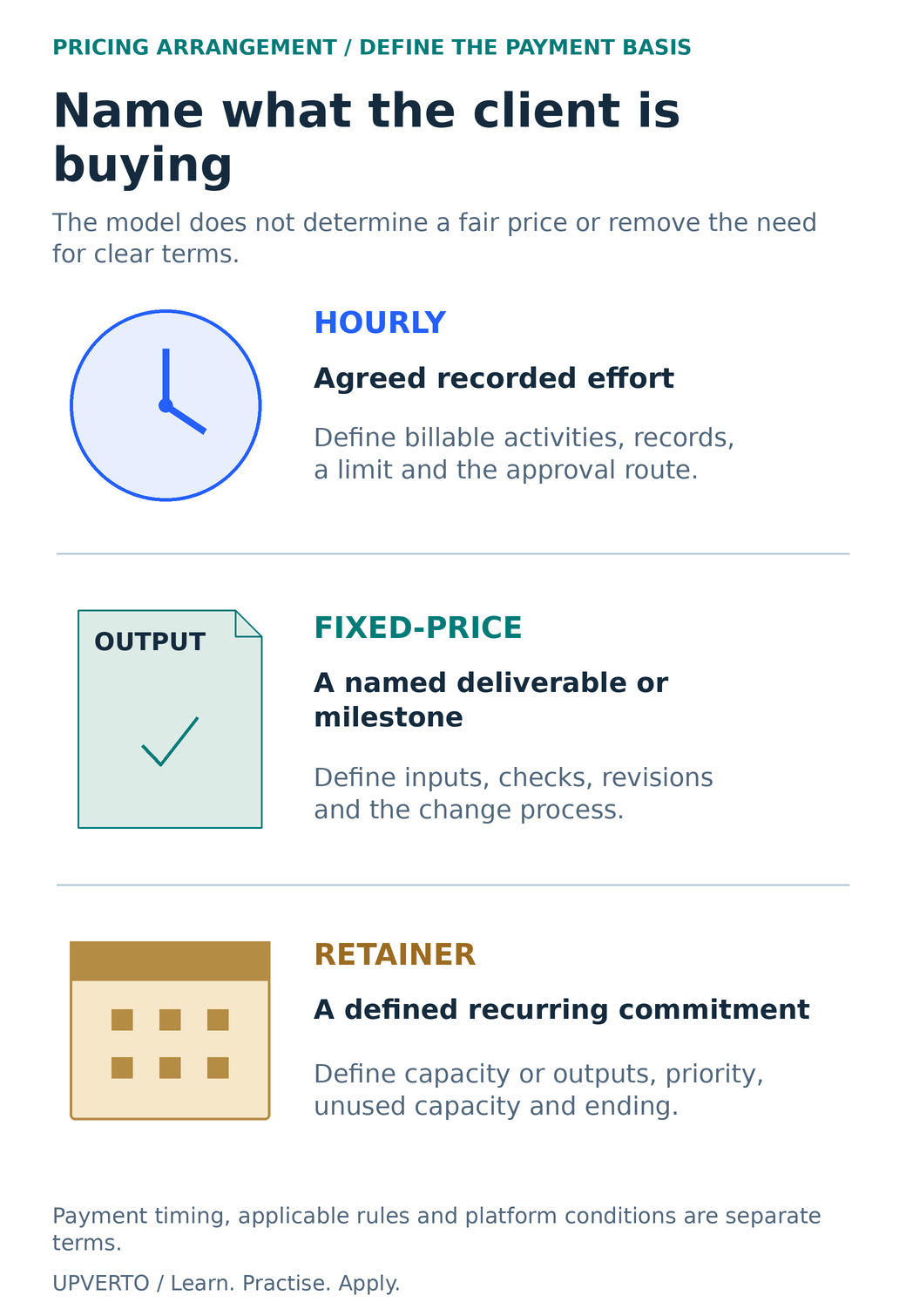
Read the text version: Distinguish three payment bases
| Arrangement | Payment basis | Terms to define |
|---|---|---|
| Hourly | Agreed recorded effort | Billable activities, records, limit and approval route |
| Fixed-price | A named deliverable or milestone | Inputs, acceptance checks, revisions and changes |
| Retainer | Defined recurring capacity, access or outputs | Period, priorities, unused capacity and ending |
The model does not set a fair price. Payment timing, applicable law and any platform conditions need separate consideration. A recurring fee does not automatically mean unlimited work.
Understand what each arrangement controls
| Model | Payment basis | What must be clear | Common ambiguity |
|---|---|---|---|
| Hourly | Agreed recorded time | Rate, billable activities, records, limit and approval process | Assuming every hour is automatically authorised |
| Fixed-price | Named deliverable or milestone | Inputs, output, checks, revisions and change process | Assuming an output price includes every related request |
| Retainer | Defined recurring access, capacity or outputs | Period, included work, availability, unused capacity and ending | Assuming a recurring fee means unlimited work |
Terms vary across agreements and platforms. “Retainer” can describe different arrangements, so explain the actual promise rather than relying on the label. Payment timing, deposits, invoices and legal treatment need to be specified separately for the engagement.
A hybrid can be appropriate when the phases differ. A bounded discovery task may clarify an uncertain problem before a fixed production scope. Do not use a hybrid to obscure the total commitment or charge twice for the same work.
Choose around what can be known before starting
Fixed-price work is easier to discuss when the output and acceptance checks can be described. For example, two layouts from approved copy with named formats and one consolidated review can have a clear boundary. If the client cannot yet say what the source material contains, the uncertainty needs investigation before a reliable commitment.
Hourly work can accommodate uncertain effort, but it still needs control. Agree on what counts as work, how time is recorded, when the client receives an update and what happens near a limit. A cap should trigger a conversation before it is exceeded; it should not be a surprise on an invoice.
Recurring work needs evidence of a recurring need. A retainer may reserve a defined amount of capacity or deliver a specified set of outputs during each period. Decide how requests are prioritised, what response commitment exists and what happens to unused capacity. Never imply that payment guarantees constant availability unless that is explicitly defined and sustainable.
Check the contract rules of the channel you use
Platforms implement arrangements through their own systems. Upwork’s hourly and fixed-price guidance distinguishes time records and weekly limits from fixed milestones. These mechanics are examples of a provider’s current workflow, not universal rules for direct-client agreements.
Read protection conditions separately. Upwork’s payment-protection guidance states that hourly protection has eligibility criteria and does not cover manual time or bonuses. Do not describe any arrangement as guaranteed payment simply because the platform offers a protection programme. Fixed-price work has its own requirements.
For direct work, record the agreement and use appropriate payment and administrative processes. Local tax, employment-status, contract and consumer rules may affect the arrangement. A label such as contractor or retainer does not settle those questions across jurisdictions.
Worked example: three different tasks, three possible arrangements
Fictional task one: create a square announcement and printable information sheet from approved copy and permitted assets. The outputs, review round and checks are known. A fixed project or two defined milestones may fit, subject to the actual estimate and agreement.
Fictional task two: investigate why an existing document workflow produces inconsistent exports. The cause and repair effort are unknown. A bounded hourly investigation with a stop-and-report limit may fit. The output of that phase is a diagnosis and options, not an unlimited promise to repair every issue.
Fictional task three: a client has a genuine continuing need for small approved content updates. An illustrative monthly arrangement reserves up to twelve hours for a named set of update tasks. It specifies a request queue, response windows and what happens when capacity is used. Twelve hours is an invented example boundary, not a recommended retainer size.
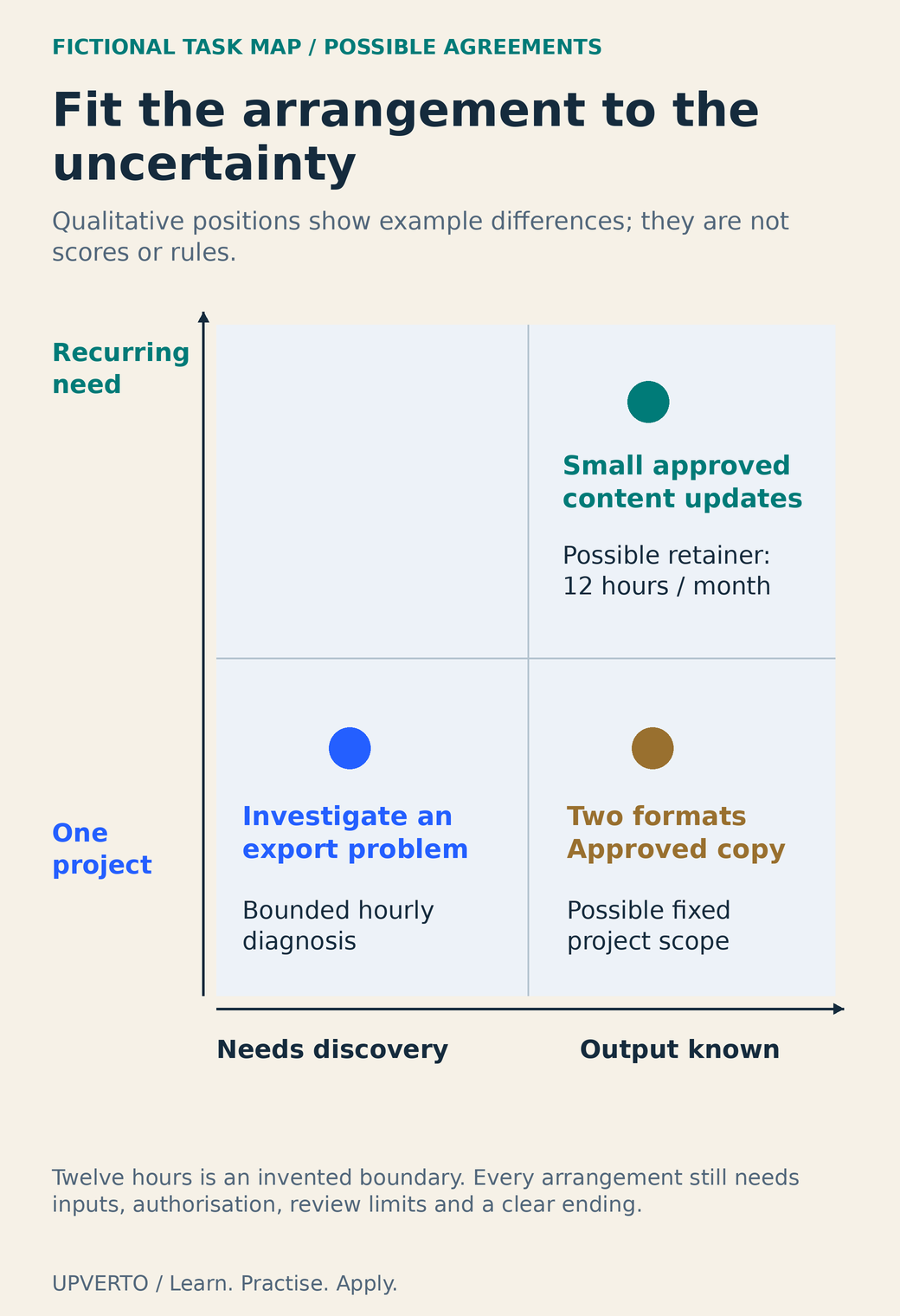
Read the text version: Match three example tasks to possible arrangements
This fictional, non-numeric map uses two questions: does the work recur, and is the output already known? An investigation into inconsistent exports has an unknown cause and may fit a bounded hourly diagnosis. A square announcement and printable sheet from approved copy may fit a fixed scope. Genuine recurring small approved updates may fit an illustrative retainer with up to 12 hours per month. The positions are not measured scores, and these choices are not universal rules. Twelve hours is an invented teaching boundary. Each arrangement needs explicit inputs, authorisation, review limits and ending conditions.
The third arrangement still needs decisions about unused hours, holidays, urgent requests, access, ending and out-of-scope work. If those decisions remain unwritten, the word retainer hides the uncertainty rather than resolving it.
Use the pricing-model decision worksheet
| Question | Implication to discuss |
|---|---|
| Can the output and acceptance checks be defined? | If yes, consider a fixed scope; if not, clarify or separate discovery. |
| Can effort be recorded and authorised? | If yes, hourly work may fit the uncertainty with clear limits. |
| Is the need genuinely recurring? | If yes, consider a bounded recurring arrangement; do not assume unlimited work. |
| Who supplies inputs and decisions? | Record dependencies before promising timing. |
| What changes the commitment? | Define review limits, extra work and the approval route. |
| How does the arrangement end? | Specify handover, notice or completion conditions as appropriate. |
Use estimate freelance project scope to make the underlying work concrete. Then explain the model in the proposal using ordinary words: what is included, what is measured and when another decision is needed.
Before the client agrees, ask them to restate what they believe they are buying. If they describe unlimited support while you mean a bounded monthly allocation, correct the wording. The guide to write freelance proposal helps connect the chosen arrangement to the actual need, assumptions and next step.
Frequently asked questions
Is fixed-price always better for beginners?
No. It can fit a well-defined output you can estimate, but unclear inputs or unfamiliar work can make the commitment difficult to sustain. Clarify the task or define a bounded discovery phase. Choose the arrangement from the work rather than a rule about experience level.
Does hourly pricing mean the client has no budget control?
It should not. Agree on billable activities, records, update points and a limit or approval threshold. Explain what happens before the limit is reached. The arrangement needs both transparent effort records and a clear route for decisions.
Is a retainer the same as unlimited revisions?
No. A retainer describes a recurring arrangement whose actual promise must be defined. It may cover specified outputs, capacity or availability. Revision limits, priorities, unused capacity and additional work still need explicit agreement.
Can I combine hourly discovery with fixed production?
Yes, if the phases and payment basis are clear and appropriate for the engagement. Explain what discovery delivers and how the production quote will be decided afterwards. Do not present the initial phase as the full project price.
Should unused retainer hours roll over?
That is a commercial term to agree, not an automatic rule. Consider how rollover affects future capacity and the client’s expectations. State the period, any limits and what happens at the end of the arrangement in clear language.
Does a platform payment-protection programme cover everything?
No. Read the current criteria for the exact contract type and workflow. Some time, transactions or circumstances may be excluded. Keep the records and submission steps the provider requires, and avoid promising a guarantee the terms do not provide.
Sources and review notes
Primary sources checked on 27 October 2026 (UTC). Check the current provider pages before relying on a changing feature, policy or price. Worked examples and worksheets are original teaching material; fictional examples are not evidence of client results.