A freelance price should be connected to the work, your costs and the uncertainty you are accepting. Copying another person’s rate does not reveal whether their scope, expenses or capacity resemble yours. Build an estimate you can explain, then decide whether a particular quote makes sense for the buyer and your business.

In this guide
The guide to turn digital skill into freelance service covers the broader service decision. Before pricing, use create freelance service packages to define the inputs, deliverables and review boundary. An unclear package produces an unclear estimate, even when the arithmetic is correct.
Describe the work before attaching a number
List the deliverables, required client inputs, acceptance checks and included revisions. Identify what is outside scope. A page update using approved copy is different from researching, writing, designing and building the page. A “small change” can contain several different responsibilities.
Break the work into preparation, production, checking, communication, revisions and handover. Include the time needed to make the result usable by the client. If access, data quality or requirements are uncertain, investigate first or make the assumption explicit. Do not disguise an unknown as a precise hour estimate.
The SBA’s cost-planning guidance distinguishes one-time and recurring expenses. Use that distinction to identify relevant software, equipment, connectivity and other operating costs. Check current amounts for your actual situation. Taxes, local obligations and business accounting need appropriate treatment; the example below does not calculate them for you.
Estimate a planning floor using realistic capacity
The fictional freelancer Amir works in USD for this exercise. He sets a monthly personal-compensation planning target of USD 600 and allocates USD 120 of business overhead. He estimates 40 billable hours for the month after allowing time for learning, administration and finding work.
The planning amount is (600 + 120) ÷ 40 = USD 18 per billable hour. This is an internal planning assumption, not a market rate, wage recommendation or guarantee that forty hours will be sold. If only thirty hours are realistically billable, the same monthly amount would require USD 24 per hour before project-specific costs.
Do not divide by every hour you are awake or available. Some working time will not be billable, and some capacity may remain unused. Review your assumption against actual records over time. The guide to track freelance income costs capacity addresses that wider record-keeping task.
Worked example: estimate one bounded project
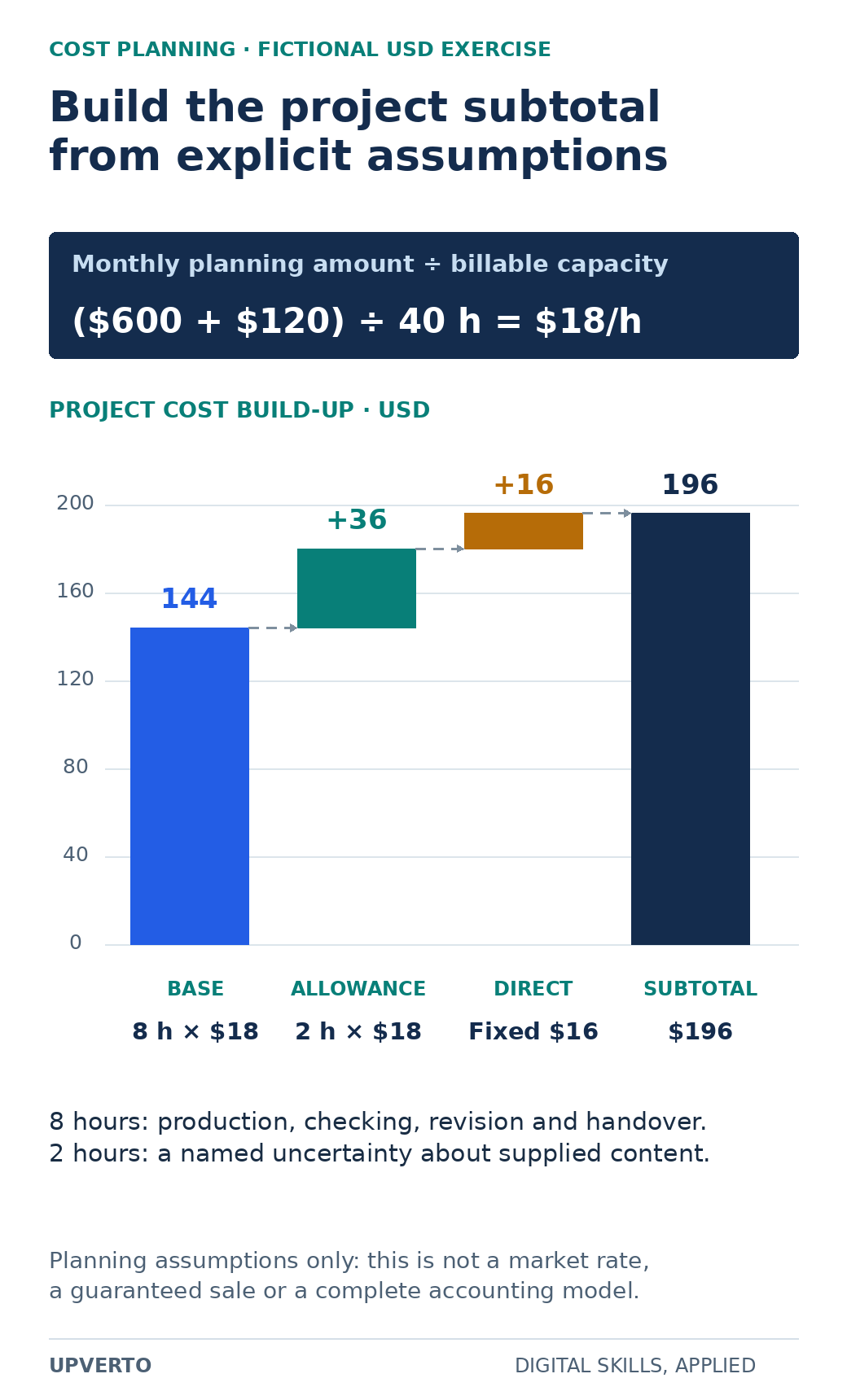
Read the text version: Reconcile a fictional project cost subtotal
Fictional monthly assumptions: USD 600 personal-compensation planning target plus USD 120 overhead, divided by 40 billable hours, equals USD 18 per billable hour.
| Project component | Calculation | USD |
|---|---|---|
| Base effort | 8 hours ×18 | 144 |
| Named uncertainty allowance | 2 hours ×18 | 36 |
| Project-specific direct cost | Fixed invented amount | 16 |
| Planning subtotal | 144+36+16 | 196 |
This is neither a market rate nor a complete accounting model; no sale or earnings are promised.
Amir’s fictional project is a small information-page update from approved copy and assets. The estimate is five hours of production, one hour of checking, one hour for the included revision round and one hour of preparation and handover. That is eight hours. A further two hours are reserved for identified uncertainty about the supplied content.
| Planning component | Calculation | USD |
|---|---|---|
| Base effort | 8 hours × 18 | 144 |
| Uncertainty allowance | 2 hours × 18 | 36 |
| Project-specific cost | Invented fixed cost | 16 |
| Cost-planning subtotal | 144 + 36 + 16 | 196 |
The two-hour allowance is tied to a named uncertainty. It is not permission to accept unlimited changes. If the client adds new pages or asks for writing work, revisit scope. If the unknown could be much larger, a separate discovery task may be more appropriate than an arbitrary percentage.
Account for a fee on the quoted amount correctly
Suppose, purely for arithmetic practice, a collection fee is 5% of the gross quoted amount. This is an invented assumption, not a current fee for any platform. To retain USD 196 after that fee, divide by 0.95: 196 ÷ 0.95 ≈ USD 206.32, rounded to cents.
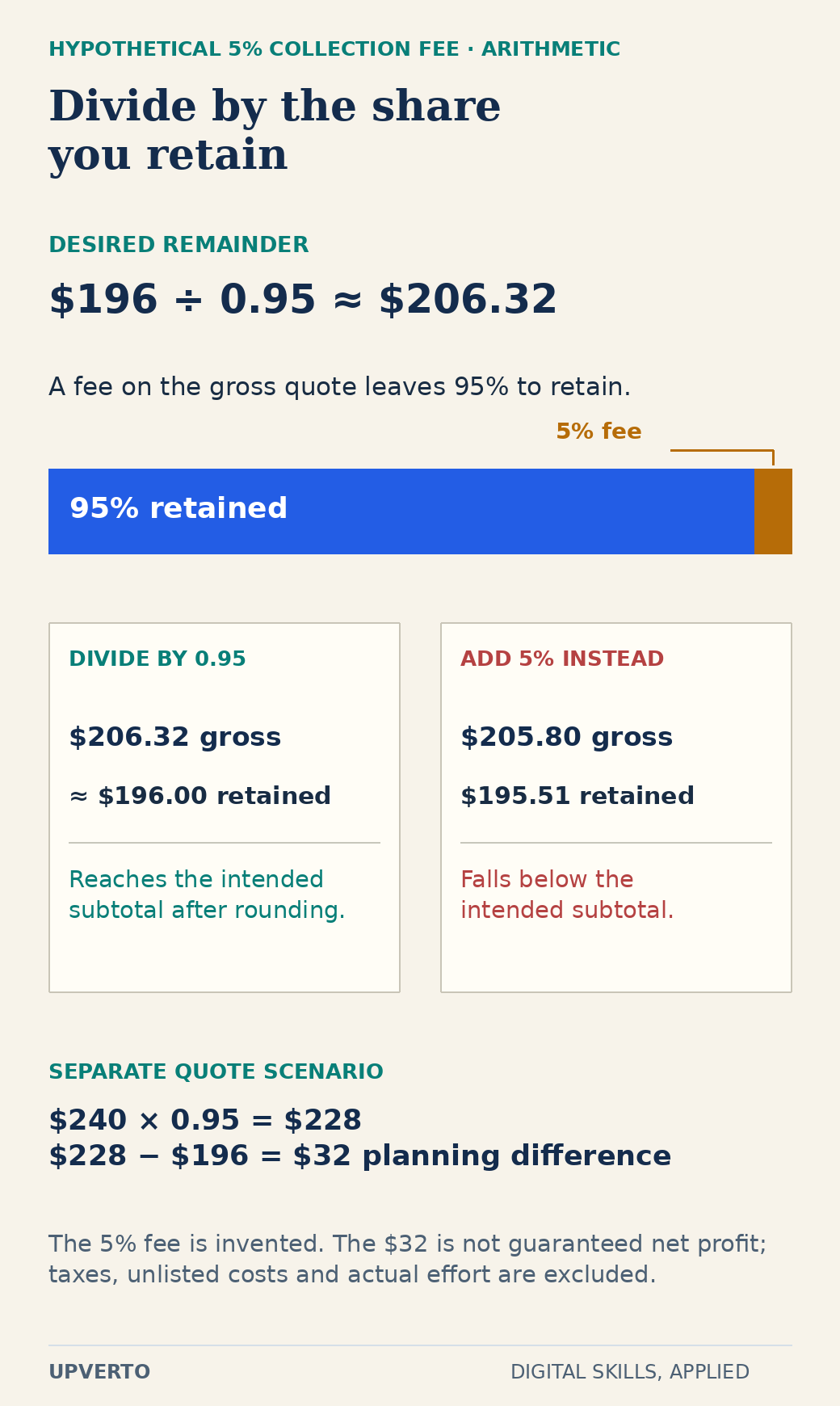
Read the text version: Check the denominator for a fee on the gross quote
If a hypothetical fee is 5% of the gross quote,95% remains. To retain USD 196, calculate 196/0.95≈USD 206.32. Adding 5% instead gives USD 205.80; after the hypothetical fee it leaves USD 195.51, below the target.
Separate scenario: USD 240×0.95=USD 228. Subtracting the USD 196 planning subtotal leaves USD 32. This planning difference excludes taxes, unlisted costs and variation in actual effort; it is not guaranteed net profit.
Adding 5% to the subtotal would give USD 205.80. After a 5% fee on that amount, the remainder is USD 195.51, which is below the intended subtotal. The denominator matters because the fee is charged on the final amount. Real fees may have fixed components, tiers, currency conversion or tax treatment; use the actual current rules.
For a separate quote scenario, Amir considers USD 240. Under the same hypothetical 5% fee, the remainder is USD 228. Subtracting the USD 196 cost-planning subtotal leaves USD 32. Call this a planning difference, not a guaranteed net profit: the model excludes taxes and any unlisted costs, and actual effort may differ.
The SBA’s break-even calculator illustrates how fixed costs and contribution relate in a business model. The project worksheet is a simpler, explicit planning exercise. Its purpose is to expose assumptions, not to replace accounting or establish what a buyer will pay.
Review the quote as a decision
A cost floor is not automatically the correct quote. Consider the buyer’s problem, the value and suitability of the deliverable, your alternatives, the market evidence available and the responsibility you would accept. If the buyer’s budget cannot support the agreed work, reduce scope, change the delivery approach or decline rather than quietly relying on unpaid effort.
Explain the proposed deliverables and assumptions in the quote. Name the currency, payment arrangement, revision boundary and conditions that require a change. Do not expose unnecessary personal financial detail; the client needs to understand what they receive and the commercial terms, not every internal calculation.
Separate the pricing method from the billing arrangement. Hourly work, fixed-price projects and retainers allocate uncertainty differently. Use hourly vs fixed price vs retainer to compare those arrangements after you understand the task and estimate.
Use the price-estimation worksheet
Record: currency; monthly planning needs; allocated overhead; realistic billable capacity; project tasks and hours; direct costs; named uncertainties; fee assumptions and date checked; exclusions; proposed quote; and review date. Keep the calculation separate from the final quote document.
- Check that every task in the scope appears in the estimate.
- Include checking, communication, revisions and handover where required.
- Distinguish one-time project costs from overhead already allocated.
- Avoid counting the same cost twice.
- Recalculate any percentage fee on the amount it actually applies to.
- Test a longer-effort scenario and decide whether the risk is acceptable.
- After delivery, compare actual time and costs with the estimate.
If the project takes twelve hours instead of the planned ten including the allowance, the model changes. Record why: a poor estimate, missing input, a defect you needed to correct or added scope. Those causes suggest different improvements. Increasing every future quote without understanding the reason may not solve the underlying problem.
Improve the estimate with actual evidence
Keep a small record of estimates and actual delivery. Over time, it can reveal which tasks you routinely undercount and which assumptions need clarification. Do not use another freelancer’s success story as a substitute for your own capacity and cost evidence.
The immediate next step is to complete the worksheet for one clearly defined sample service. Label every invented amount and unresolved condition. You can then review a concrete estimate rather than choosing a price because it sounds professional.
Frequently asked questions
Is USD 18 per hour a recommended freelance rate?
No. It is the result of fictional monthly planning assumptions in this exercise. Your costs, capacity, location, responsibilities and market conditions may differ. The method helps expose assumptions; it does not set a universal rate.
Should I charge only for production time?
Include the work required to deliver the agreed result, such as preparation, checking, communication, included revisions and handover. Otherwise the estimate may omit substantial effort even when the visible production task is small.
Why divide by 0.95 for a 5% fee?
In the example, you retain 95% of the gross quote. Dividing the desired remainder by 0.95 finds the gross amount needed. Adding 5% to the remainder applies the percentage to a different base.
Is the USD 32 difference guaranteed profit?
No. It is a planning difference under explicit fictional assumptions. Actual time, unlisted costs, taxes and other conditions can change the result. Do not describe the simplified worksheet as a complete accounting calculation.
What if the client cannot afford the estimate?
Discuss a smaller deliverable, different priorities or a different arrangement if suitable. Keep the scope honest. Do not accept the same responsibility while assuming that unlimited unpaid work will make the numbers fit.
How should I handle uncertain requirements?
Clarify them before quoting where possible. Use a defined allowance only for a bounded uncertainty, or propose a separate discovery stage. State which changes require a revised scope and price.