A quiet period can make every small decision feel urgent. Before changing your offer, buying more tools or sending a large batch of messages, review what has actually changed. Separate the state of your current commitments, cash, pipeline and service fit.
The aim is a useful next action, not a promised turnaround date. A slower month may have several causes, and a small set of enquiries cannot prove which one dominates. A calm review is part of learning to grow a sustainable freelance business.
Take a dated snapshot of the situation
Start with accepted work and obligations. Which deliverables still need attention? Which payments are due under existing agreements? Which costs are already committed? Use records that track freelance income costs capacity so available cash and available time are not inferred from how busy your inbox feels.
Then define the period you are reviewing. A count of conversations this week cannot be compared directly with proposals sent over the last six months. Record the date and keep earlier snapshots if you want to understand change. Mark incomplete data instead of filling gaps from memory.
The SBA finance guidance is a useful general starting point for keeping money records distinct. This guide does not prescribe spending, borrowing or financial products. If you have an immediate cash problem, identify the actual obligations and appropriate help for your situation before treating new marketing as the only response.
Separate pipeline stages by observable evidence
A researched organisation is not automatically a prospect, a conversation is not a proposal, and a proposal is not accepted work. Give each stage an entry condition. That makes your review more informative than a single large “leads” count.
| Stage | Evidence needed | Common confusion |
|---|---|---|
| Researched | A dated note about a relevant organisation or need | Assuming public contact details permit promotion |
| Suitable to approach | A credible fit and an appropriate permitted route | Counting everyone in a directory |
| Conversation | An actual exchange about a potential need | Counting a sent message as a reply |
| Defined proposal | A specific scope and decision process | Treating a vague estimate as agreed work |
| Accepted work | The required agreement and start conditions | Assuming silence means acceptance |
If those foundations are missing, revisit how to find freelance clients. Keep the contact approach relevant and respectful. For example, the UK ICO’s B2B marketing guidance distinguishes recipient types and the treatment of personal data; that is UK-specific guidance, not a worldwide permission to contact anyone with a business address.
Worked example: inspect a small fictional pipeline
This fictional cohort contains 18 organisations researched during a defined review period. Six met the freelancer’s fit and contact-route criteria. Three became actual conversations, two reached defined proposals and none had been accepted by the snapshot date. The counts are nested historical stages for this example, not five independent piles to add together.
Those numbers do not establish a conversion benchmark or forecast. The two proposals need individual inspection. One is waiting for the client’s approved input; the other includes a requirement outside the freelancer’s demonstrated ability. Sending more messages would not resolve either issue by itself.
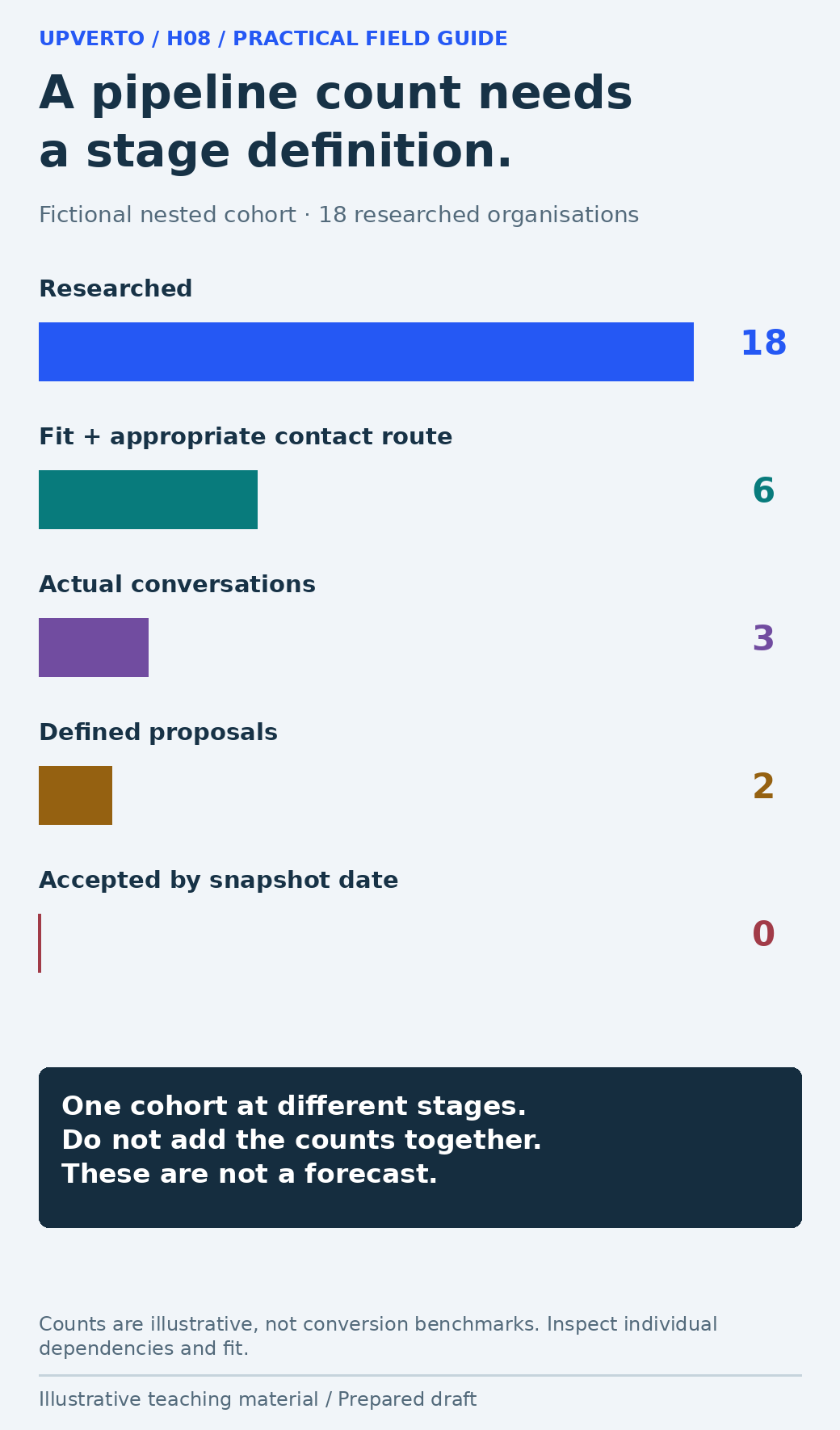
Read the text version: Define the stages in a small freelance pipeline
Fictional historical stages within one cohort: 18 organisations researched; 6 met fit and appropriate contact-route criteria; 3 became actual conversations; 2 reached defined proposals; 0 were accepted by the snapshot date. Bars are proportional to counts. These are nested stages, not separate groups to add. The counts are neither a conversion benchmark nor a forecast; inspect the individual records.
| Fictional record | Current evidence | Useful next action |
|---|---|---|
| North Lane / proposal | Named decision owner; approved copy still missing | Ask whether the input and decision date are still realistic |
| Harbour Group / proposal | Request includes an unsupported specialist integration | Clarify the limit; narrow, refer or close the unsuitable scope |
| Cedar Lane / conversation | No current reply and no agreed project | Review whether a relevant follow-up is appropriate, otherwise close the active item |
The next action is specific to the evidence. None of these records is labelled “almost won.” No business outcome is claimed, and no outreach has been sent. A closed or unsuitable item can improve the accuracy of the pipeline even though it reduces the apparent total.
Review the offer and existing relationships
Ask whether your current examples show the kind of work a suitable buyer needs. A portfolio can be polished yet unclear about the deliverable, audience or limits. Read recent questions and objections for precise information: “We need editable files” is more actionable than “clients do not value design.”
The SBA market-research guidance suggests examining demand and alternatives. Applied here, compare the problem you offer to solve with what people actually described. Do not infer demand from your enthusiasm for a tool or from another freelancer’s public success story.
Existing relationships deserve the same care. Review unfinished follow-through, agreed review points and real recurring needs. Do not invent a reason for contact or imply that a past client owes you new work. If there is a relevant question, ask it concisely through an appropriate route and respect an answer or a request to stop.
Copy the pipeline and next-action review sheet
Create one row per real opportunity or relationship. Keep personal information limited to what is necessary for the review and follow the relevant rules and platform terms.
| Field | What to write |
|---|---|
| Snapshot date and period | The point in time and cohort you are reviewing |
| Stage and entry evidence | The actual exchange, scope or agreement supporting the stage |
| Fit | Need, relevant capability and known exclusions |
| Decision owner | Who can decide the next step, if known |
| Open dependency | Missing input, permission, timing or unresolved scope |
| Next appropriate action | A specific action, including pause or close |
| Owner and review date | Who does it and when the record should be checked |
| Result | What actually happened; leave blank until observed |
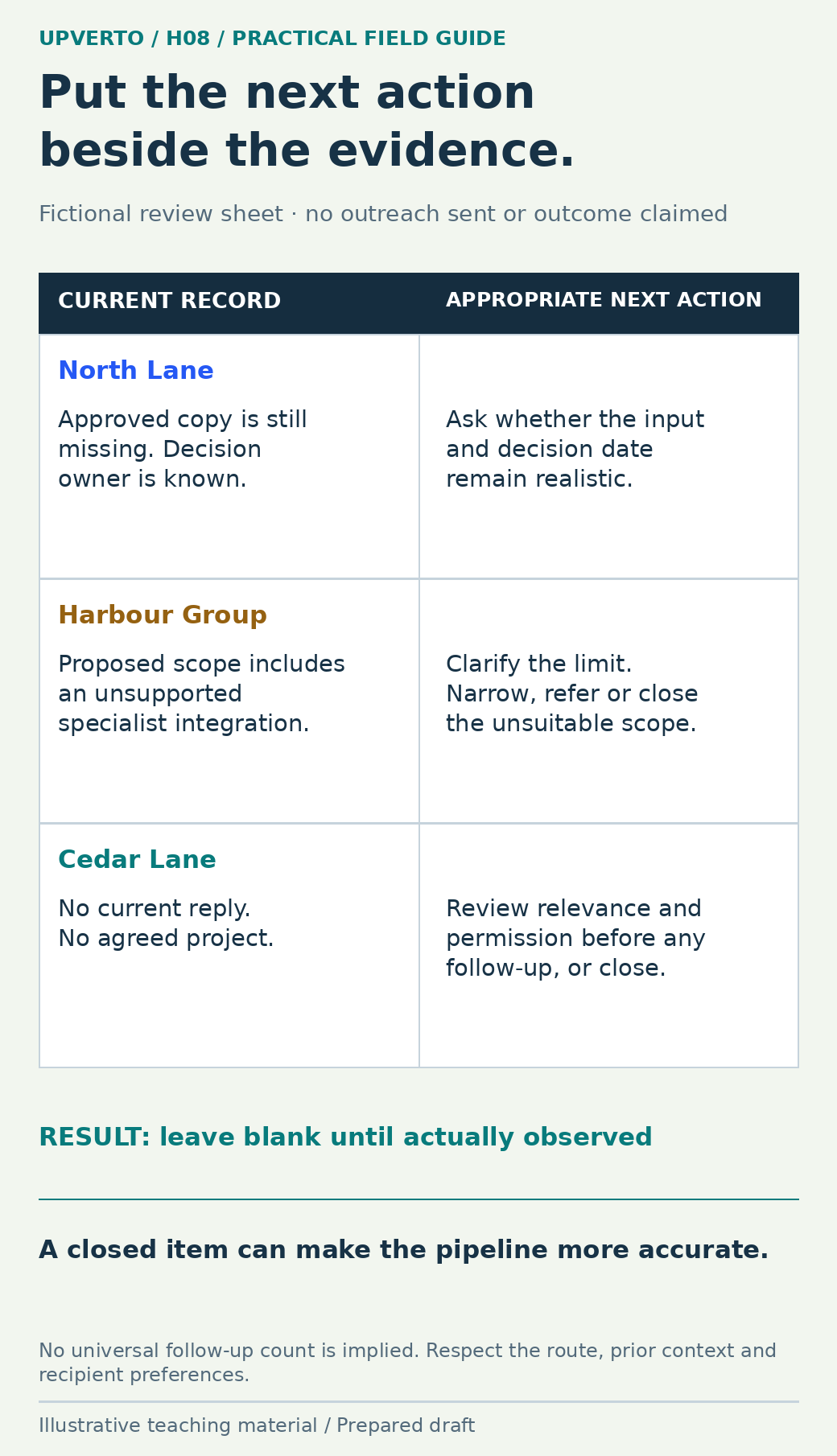
Read the text version: Translate pipeline evidence into specific next actions
Fictional review: North Lane has a known decision owner but missing approved copy, so ask whether the input and decision date remain realistic. Harbour Group requests an unsupported specialist integration, so clarify the limit and narrow, refer or close unsuitable scope. Cedar Lane has no current reply or agreed project, so review relevance and permission before any follow-up or close the item. The result field remains blank until observed. No outreach is sent and no outcome is claimed.
Do not automatically recycle every “no reply” into another message. Consider relevance, past contact, the permitted route and any objection. There is no universal follow-up count or interval that makes a message welcome. Record a reason to close an item so it does not reappear merely because the list was sorted differently.
Give your own development work a limit too. One missing portfolio example may be worth preparing; rebuilding an entire website can become a way to avoid a small, useful conversation. Choose work that answers an identified uncertainty.
Choose a small reviewable experiment
If the records suggest an offer-fit problem, use them to validate a freelance service idea. A bounded experiment might clarify one service description, build one relevant sample or ask a few suitable people about a specific workflow. Define what you want to learn and what evidence would change your next decision.
If the problem is delayed inputs, resolve that dependency. If the offer repeatedly attracts work beyond your ability, narrow it or develop the required skill before promising delivery. If time is available, use part of it for a concrete improvement while preserving existing commitments and a realistic routine.
Set a review date and compare the evidence, not your hope for the experiment. Record unchanged demand honestly. This process can improve decisions without guaranteeing new work, a particular income or a quick recovery.
Frequently asked questions
How long should it take to recover from a slow month?
There is no reliable universal timetable. Demand, timing, fit, relationships and capacity differ. Use a dated review and small actions whose results you can observe. Avoid a plan that depends on new work arriving by a promised date when no agreement supports that assumption.
Should I lower my prices immediately?
First inspect why suitable work is not progressing. A missing decision owner, unclear scope or unsupported requirement may have little to do with price. Review costs and the offer before changing future terms. A lower price does not guarantee demand and may leave the delivery problem unresolved.
Should I message every past client?
Contact should have a relevant purpose, an appropriate route and respect for the recipient’s preferences and applicable rules. Review each relationship rather than treating a past transaction as permission for unlimited promotion. A genuine service review or useful question is different from an invented urgency claim.
What does a zero in the accepted-work column mean?
It means no items in that defined cohort had reached the stated acceptance condition by the snapshot date. It does not prove permanent failure or forecast future results. Inspect the individual records and the period. Keep proposals, pending decisions and accepted work distinct.
Is a bigger lead list the best next step?
Only if insufficient relevant opportunities is the evidenced constraint. A larger list will not fix unsuitable scope, missing proof, unclear decisions or late inputs. Define the stage where progress is actually blocked and choose an action that addresses it. Keep contact routes and recipient preferences in view.
What should I do with available time?
Protect current obligations, then select a bounded improvement tied to an identified gap: a better sample, a clearer service description, an overdue record update or targeted skill practice. Set a review point. Avoid assuming that every free hour must be filled with new software, paid promotion or repetitive outreach.
Sources and scope
The worked examples, worksheets and diagrams are original fictional teaching materials. They are not reports of client results. Primary references were checked during preparation; verify current rules and account-specific features before acting.