Part of How to Make Money Online with Digital Skills: A Beginner’s Roadmap.
A sustainable freelance business depends on useful work, reliable delivery, suitable clients, and enough time and income to support the way you operate. Growth can mean better projects, clearer scope, more repeat work, or a manageable schedule. It does not have to mean taking every available assignment.

In this guide
This guide is for people who have begun delivering work and want to improve the business around it. If you are still preparing your first offer, start with defining a service and finding suitable clients.
Review what your completed projects actually show
For each project, record the agreed scope, estimated and actual effort, direct costs, payment status, revisions, and issues. Keep client feedback alongside those records, with permission and appropriate privacy controls.
Look for patterns. You may discover that a particular deliverable takes longer than expected, that missing inputs repeatedly delay work, or that a clear onboarding checklist prevents confusion. These observations give you concrete improvements to make.
Separate money invoiced from money received, and revenue from costs. A busy month does not automatically mean a financially healthy month. Use accounting and tax guidance appropriate to your jurisdiction for formal records and obligations.
Read the text version: Turn a business review into one improvement
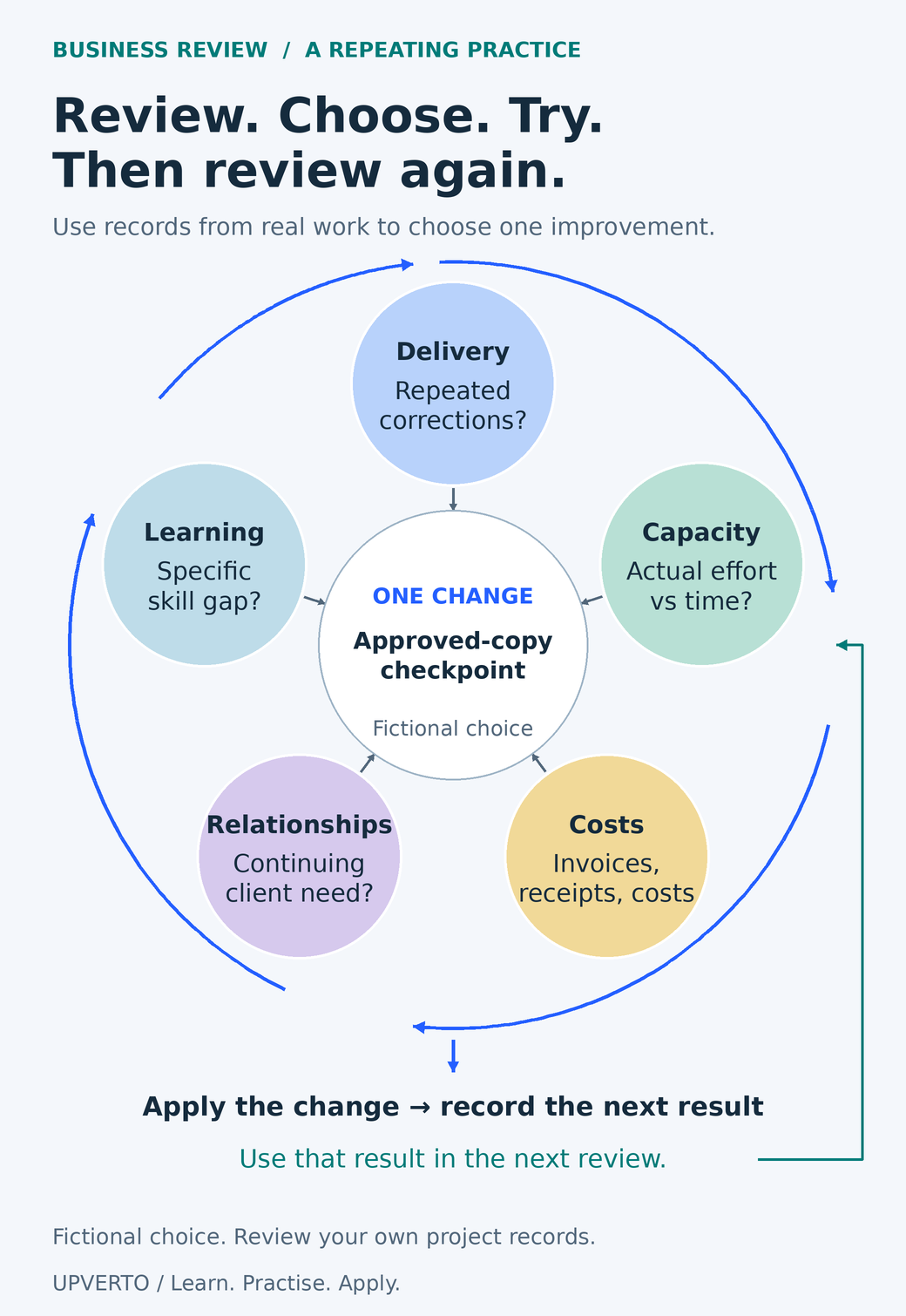
Use records from your own work to review five connected areas: delivery (which corrections or problems repeat), capacity (actual effort compared with available time), costs (invoices, money received and costs), relationships (a genuine continuing need), and learning (a specific skill gap).
The centre contains a fictional choice: add an approved-copy checkpoint before production. It is an example of an improvement to test, not a reported business result. Apply the chosen change, record what happens in the next relevant project, and use that observation in the next review. The return arrow makes the review a cycle. The coloured review areas are not scores or quantitative proportions.
Practical summary
- Quality: does the work meet the agreed requirements?
- Relationships: are expectations and communication clear?
- Capacity: can you deliver within the time available?
- Economics: do the actual costs and payment arrangements support the work?
Develop repeat work from a continuing need
After a successful handover, ask whether there is another relevant task or an ongoing need you can support. Connect the discussion to actual work: a recurring content schedule, a maintenance responsibility, a reporting cycle, or another defined output.
An ongoing arrangement should specify capacity or deliverables, response expectations, review points, exclusions, and how additional work is handled. Avoid promising unlimited access or support without understanding what it could require.
Use the package worksheet to make the arrangement clear. Continue to assess whether the work fits your ability and the client’s needs rather than assuming the first successful task covers every future request.
Plan capacity beyond production time
Your available time includes more than making the deliverable. Allow for enquiries, planning, communication, checking, revisions, administration, learning, and recovery from unexpected problems.
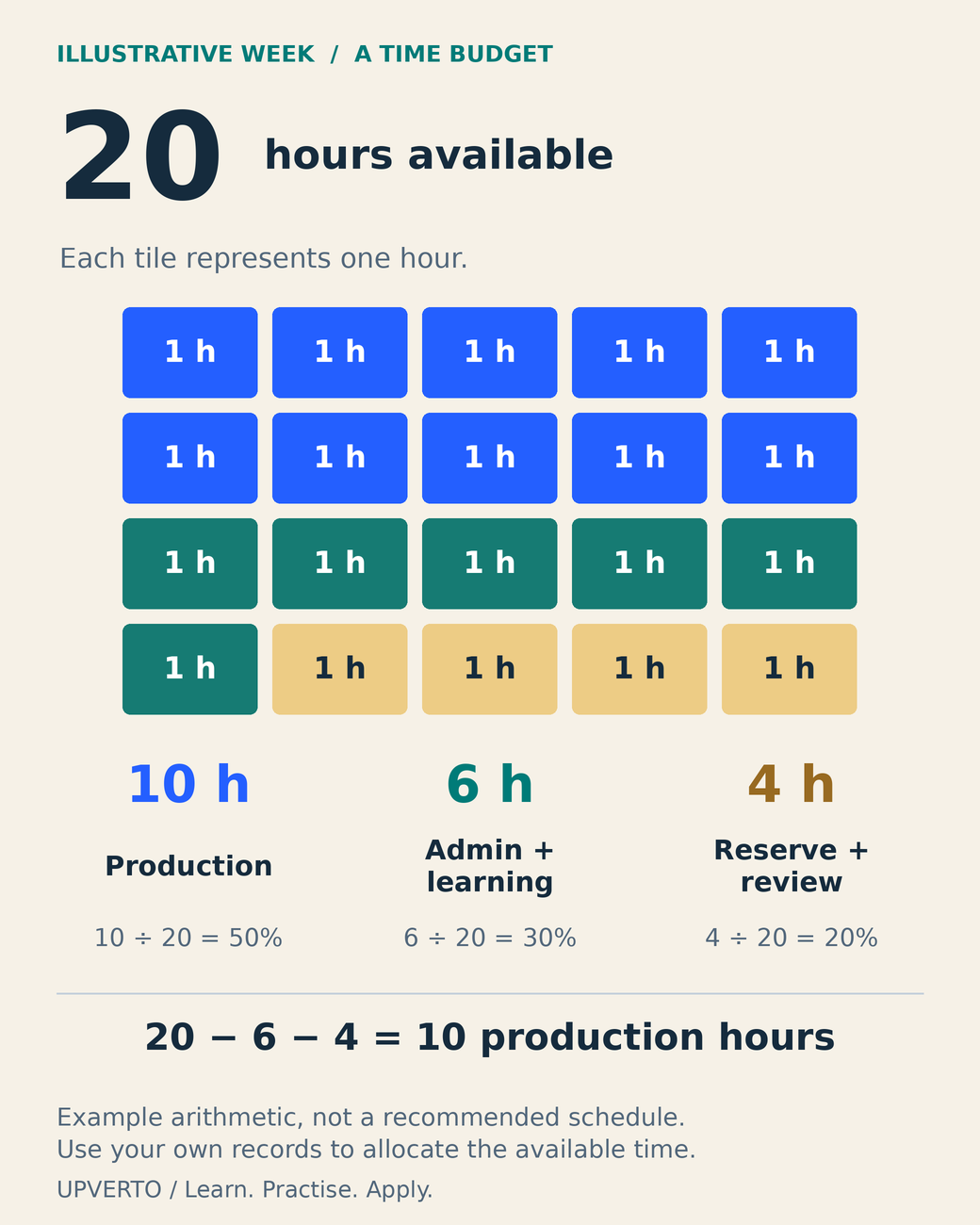
Illustrative planning example: If you have 20 hours available in a week and reserve six for administration and learning plus four for uncertainty and review, ten hours remain for planned production. Those numbers are an example of arithmetic, not a recommended schedule. Your own records should determine the allocation.
Before accepting new work, look at the whole delivery calendar and its dependencies. If two projects both need final review on the same day, moving a production task may not resolve the bottleneck.
Read the text version: Allocate the whole 20-hour budget
The fictional weekly budget contains 20 hours in total. Each of the 20 tiles represents one hour; the grid is a unit budget, not a day-by-day timetable.
- Production: 10 hours. 10 ÷ 20 = 0.50, or 50%.
- Administration and learning: 6 hours. 6 ÷ 20 = 0.30, or 30%.
- Reserve, review and unexpected problems: 4 hours. 4 ÷ 20 = 0.20, or 20%.
The allocation totals 10 + 6 + 4 = 20 hours and 50% + 30% + 20% = 100%. Reserving six hours for administration and learning and four for uncertainty leaves 20 − 6 − 4 = 10 hours for planned production. These values illustrate the arithmetic; choose your own allocation from actual records and commitments.
Review prices and scope using evidence
When the work consistently takes more effort than estimated, investigate why. The brief may be too broad, the inputs may be poor, the process may need improvement, or the price may not reflect the actual service.
Clarify scope before treating a price increase as the answer to every problem. For future engagements, explain changes in the offer and quote clearly. For existing agreements, follow the agreed terms and discuss proposed changes before applying them.
Do not compare your price with an isolated online claim as if the services are identical. Compare the deliverables, responsibility, experience, support, channel costs, and client context. This guide provides a review process, not a universal rate recommendation.
Make repeated work easier to perform consistently
Create reusable structures for tasks you have actually repeated: an intake form, a brief, a file-naming convention, a check list, a delivery note, or an estimate worksheet. Review the structure after real use and remove steps that do not help.
Keep templates free of previous clients’ confidential information. Reusing your process is different from reusing client-owned materials or disclosing another client’s work. Check ownership and permissions before carrying assets into a new engagement.
If you automate a repeated step, test normal inputs, missing inputs, and a likely failure. Keep a way to notice the failure and recover. Automation can change the work you perform; it does not remove responsibility for the result.
Build a reputation with accurate evidence
When asking for a testimonial, invite the client to describe their actual experience in their own words. Obtain permission for the wording and where it will appear. Do not write a fictional quote and present it as their endorsement.
For a case study, confirm what you may disclose and which outcomes were actually measured. Update your portfolio with useful evidence while preserving the distinction between your contribution and factors outside your control.
A referral request should be specific and respectful: explain the kind of work you are seeking and let the client decide whether they know someone suitable. A positive relationship is not permission to contact their customers or reuse their private contact lists.
Use a simple quarterly improvement plan
| Area | Review question | One action to choose |
|---|---|---|
| Service fit | Which tasks matched my ability and the client’s needs? | Clarify or narrow one offer. |
| Delivery | Which problem repeated across projects? | Improve one step in the workflow. |
| Capacity | Where did actual effort exceed available time? | Adjust limits, scheduling, or estimates. |
| Financial records | Are invoiced amounts, receipts, costs, and obligations recorded accurately? | Resolve a record gap with suitable accounting guidance. |
| Relationships | Which clients have a genuine continuing need? | Discuss one relevant next project or arrangement. |
| Learning | Which skill would remove a recurring limitation? | Complete a focused learning project. |
| Resilience | What would happen if a major project stopped? | Review dependence, commitments, and the acquisition process. |
Quarterly is a suggested review rhythm. Choose a frequency that suits your volume of work and decisions. The useful part is turning records into a manageable improvement, rather than creating a report you never use.
Decide whether help or a team would improve delivery
Before hiring or subcontracting, identify the actual bottleneck. More people do not automatically fix unclear scope, weak demand, or inconsistent quality checks.
If collaboration is appropriate, define responsibilities, review, communication, permissions, and payment arrangements. Confirm whether client agreements allow the proposed involvement and what information may be shared. Keep the client’s understanding of who performs the work accurate.
Frequently asked questions
Should I stop learning once I have clients?
Use real delivery gaps to guide continued learning. Choose a specific improvement, practise it safely, and assess it before adding a stronger promise to your service.
What should I do when work slows down?
Review current commitments, records, previous enquiries, client needs, and the clarity of your offer. Identify whether the issue is demand, reach, fit, evidence, or conversion before making a major change. Avoid treating a short quiet period as proof that you need to buy a new set of tools.
Does growing a freelance business always mean taking more projects?
Growth can also mean clearer scope, stronger work, better-fit clients, more reliable repeat engagements or a manageable schedule. Review your actual capacity and project records before increasing volume. More assignments can create problems if the delivery process cannot support them.
How can I turn a completed project into repeat work?
After a useful handover, discuss a genuine continuing need that matches your ability. Define the next deliverables, response expectations and review points clearly. Do not assume that a successful first task gives you permission to access more information or expand the service automatically.
When should I review my prices?
Review them when your records show a change in effort, costs, responsibility or the service itself. Check whether unclear scope or an inefficient process is causing the problem. Explain future quotes clearly and follow the agreed terms when discussing changes to an existing engagement.
When does subcontracting make sense?
Identify the actual bottleneck and whether qualified help would improve delivery. Clarify responsibilities, review, permissions and payment arrangements, and confirm that the proposed involvement is consistent with the client agreement. Adding people will not by itself fix an unclear offer or weak quality checks.
Improve one part of the business
Review one completed project and choose one concrete change. It might be a clearer package, a stronger delivery checklist, a more relevant client-acquisition process, or a focused learning plan. Build growth from evidence about the work you actually do.