You can improve a freelance business without building a team. A solo practice may fit the kind of work, client relationships and life you want. A small agency may make sense when there is a repeatable delivery need and you want to take responsibility for coordinating other people’s work.
The decision starts with the work you need to deliver, the limits you face and the responsibility you are prepared to keep. More people can increase production capacity, but they also create briefing, review, communication and payment obligations. Compare the whole arrangement before promising a larger service.
Name the constraint before choosing a structure
Begin with records that track freelance income costs capacity. Is the constraint too much suitable production work, unreliable inputs, underpriced scope, a skill gap or inconsistent demand? Hiring does not resolve all of these. An unclear brief can become a confusing brief shared with more people.
Separate a temporary peak from a repeated need. If one unusual project exceeds your capacity, a narrower scope, later schedule or clearly agreed specialist collaboration may be more proportionate than changing the whole business. If demand is uncertain, do not treat every enquiry as committed work.
Write the constraint as an observable statement: “Three accepted projects need export preparation in the same week” is more useful than “I need to scale.” Then list possible responses, including declining work, improving the process or staying solo with a more focused offer.
Compare the responsibilities you would actually hold
The GOV.UK service-delivery governance guidance emphasises decisions and responsibility at the appropriate level. Applied to a small freelance project, that means naming who can decide the scope, who performs the work and who checks the final delivery. The worksheet below is an original adaptation, not an agency operating standard.
| Question | Solo practice | Small team arrangement |
|---|---|---|
| Production | You make the agreed outputs | Named people make defined outputs |
| Quality | You check your own delivery against requirements | You need a review and correction route across contributors |
| Client communication | Usually fewer handovers | Agree who communicates and who can commit to changes |
| Capacity | Bounded by your time and skills | Bounded by production, coordination, review and availability |
| Cost | Your tools, operations and delivery costs | Add collaborator payments and coordination overhead |
| Continuity | Plan for your absence | Plan for dependencies and absent contributors |
Do not assume that delegating a task transfers your promise to the client. Clarify the actual arrangement and who remains accountable for delivery. Legal structure, employment status, insurance and contractual duties depend on the location and facts; this article does not prescribe a classification or hiring process.
Worked example: six delegated hours free four lead hours
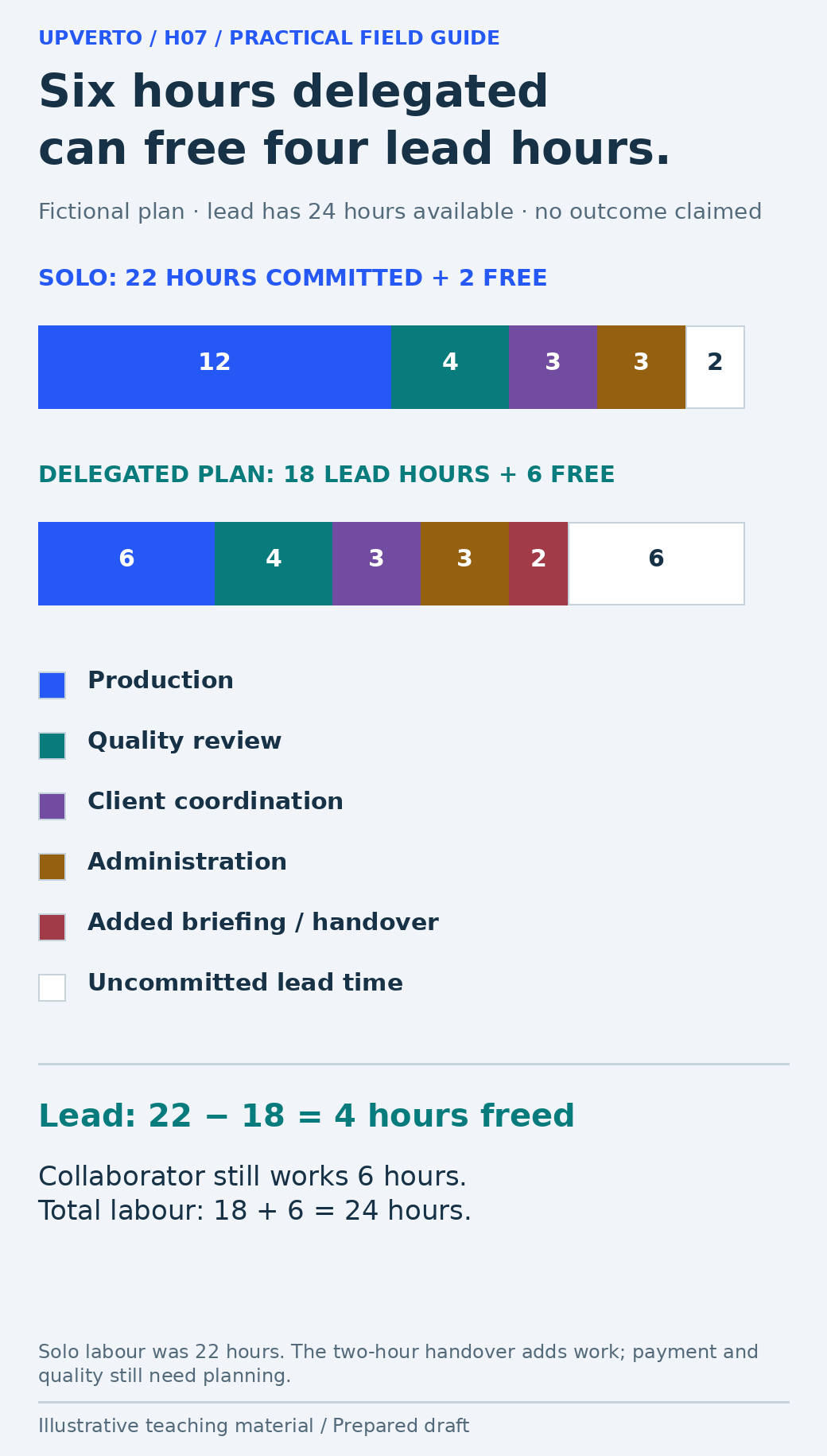
The following is a fictional planning scenario, not a tested staffing result. A freelancer has 24 available hours in a week. The solo plan uses 12 for production, four for quality review, three for client coordination and three for administration. That is 22 hours, leaving two uncommitted.
Suppose an authorised collaborator takes six hours of the production work. The lead now has six production hours, the same four quality hours, three coordination hours and three administration hours. Briefing and receiving the collaborator’s work adds two hours. The lead’s total becomes 18 hours, leaving six uncommitted.
The lead gains four hours of capacity, not six: 22 − 18 = 4. The collaborator still works six hours and must be paid under the agreed arrangement. Total planned labour rises from 22 to 24 hours because the handover adds work. No revenue increase, quality improvement or profit is assumed.
Read the text version: Count coordination overhead when evaluating delegation
Fictional solo plan: 12 production + 4 quality review + 3 client coordination + 3 administration = 22 lead hours, with 2 of 24 uncommitted. Delegated plan: 6 production + 4 quality + 3 coordination + 3 administration + 2 added briefing/handover = 18 lead hours, with 6 uncommitted. The lead frees 4 hours. The collaborator works 6 hours, so total labour is 24 rather than 22. Payment, quality and actual coordination effort still need planning; no gain or result is guaranteed.
This example is useful because it exposes what must be estimated. The two coordination hours could be wrong. A new collaborator may need more explanation, or a well-defined task may need less. Replace each assumption with evidence from a bounded trial before relying on it for larger commitments.
Define one task that can be reviewed
A delegation brief should identify the approved input, exact output, constraints, due point and acceptance check. “Help with design” leaves too much open. “Prepare the two specified export sizes from the approved source file, retain the date and venue, and return files for my review” is inspectable.
Agree access and client permission before sharing material. The least-privilege principle in the OWASP source means access should fit the task; it does not establish that the client has authorised another person to receive information. Resolve both questions. Avoid using a shared administrator account simply because it is convenient.
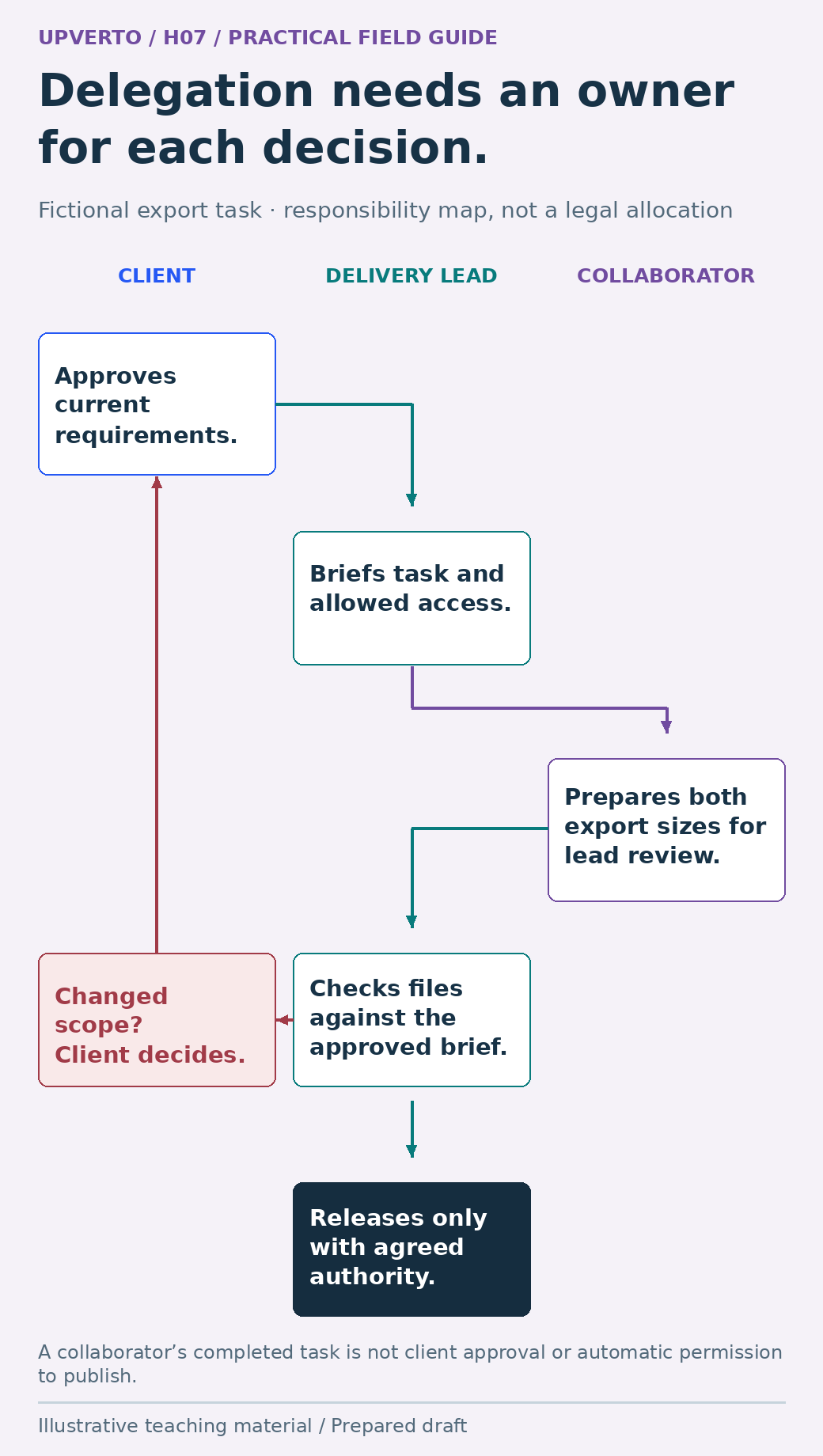
Define what the collaborator may decide and what must come back to you. A request for a new format, a changed deadline or permission to publish should not slip through as an informal production choice. The client decision owner and the delivery lead have different roles.
Read the text version: Assign the decisions around a delegated export task
Fictional responsibility map: the client approves requirements. The delivery lead briefs the task and allowed access. The collaborator prepares two export sizes for lead review. The lead checks actual files against the approved brief. A scope change returns to the client decision owner. Release happens only with the agreed authority. This is an operational example, not a legal allocation of duties.
Use a digital project quality checklist for the returned work. Check the actual output against the current approved requirements, record defects and allow time for correction. A reliable collaborator still needs a clear review standard; “looks fine” does not explain what was inspected.
Complete the solo-versus-team worksheet
Fill this in before changing the offer or promising team capacity. Use “unknown” where the evidence is missing.
| Decision field | Write a concrete answer |
|---|---|
| Repeated demand | Which accepted or evidenced work would continue, and over what period? |
| Constraint | Which task exceeds your capability or realistic capacity? |
| Alternative | Could scope, schedule, process or a more focused offer solve it? |
| Delegated output | What exactly would another person return for review? |
| Retained responsibility | Who approves, checks, communicates and resolves errors? |
| Permission and access | What agreement and task-specific access are needed? |
| Full cost | Payment, briefing, review, tools and potential rework |
| Continuity | What happens if you or the collaborator is unavailable? |
| Review point | What evidence would support continuing, changing or stopping? |
Compare the proposed arrangement with staying solo, not with an imaginary version where delegation has no overhead. Include whether you want to manage people. A preference for concentrated craft work is a legitimate business-design input; it is not a readiness score to overcome.
Make a reversible next decision
If the constraint and task are clear, consider a bounded collaboration with permissions, terms and review responsibilities settled first. Keep the test small enough to understand. Evaluate the actual output and coordination effort before offering wider capacity. Do not present a first experiment as an established agency capability.
If the worksheet exposes uncertain demand or an unclear offer, work on those questions before adding a team. If staying solo supports your desired quality and workload, that is a complete option. The broader guide to grow a sustainable freelance business can help you connect the structure to a sustainable direction.
Choose the next action in plain language: narrow one service, improve one handover, investigate one specialist relationship or preserve the current solo model. A business label is less useful than a clear delivery responsibility.
Frequently asked questions
Do I need an agency to earn more or progress?
No particular structure guarantees earnings or progress. A solo practice can change its offer, client mix, scope or process without hiring. A team is a different set of responsibilities and costs, not an automatic next level. Choose it because a clear delivery need and your preferred role support it.
How much time does delegation save?
Estimate the production time removed and subtract the briefing, review, coordination and correction time added. The fictional example removes six production hours but adds two lead hours, freeing four. Actual results depend on the task, inputs, skill and working relationship; the example is not a benchmark.
Can I share a client account with a collaborator?
First establish permission and the appropriate access route. Use a named, task-specific account where supported and appropriate, and record when access should end. Possessing credentials does not settle authority to share information or delegate work. Resolve the agreement and access questions before the task begins.
Who should check a collaborator’s work?
Name a competent reviewer and an acceptance check in advance. In many lead-freelancer arrangements, the lead retains the client-facing delivery responsibility, but the actual terms matter. Inspect the returned output, allow correction time and record who can approve release rather than assuming that production completion is approval.
Should I hire an employee or use a contractor?
That requires a location-specific assessment of the actual relationship and obligations. Labels alone do not decide status. This guide compares operational responsibilities and does not recommend a legal classification. Consult current local official guidance and appropriate professional advice before setting up the arrangement.
What if I only need help for one large project?
Consider the project’s actual constraint and a bounded, properly agreed collaboration, narrower scope or revised schedule. One unusual workload does not establish recurring demand for a permanent team. Check permissions, costs, responsibilities and continuity for the chosen response, and avoid promising capacity you have not secured.
Sources and scope
The worked examples, worksheets and diagrams are original fictional teaching materials. They are not reports of client results. Primary references were checked during preparation; verify current rules and account-specific features before acting.