A weekly learning plan should tell you what to make, when you will work and how you will recognise progress. A timetable filled only with videos does not show whether you can use the skill. Start with the time you actually have and one small output you can check at the end of the week.

In this guide
The guide to how to learn a digital skill explains the wider learning process. This page turns that process into a practical week. The schedule is a fictional example, not a promise of mastery or a required pace.
Begin with a realistic time budget
Look at your existing commitments before adding study blocks. Identify sessions you can usually protect and a small reserve for interruptions. A plan that assumes every evening is free may fail for reasons unrelated to motivation. If your availability changes, use the guide to learn digital skills part time to think through a part-time routine.
Distinguish available time from concentrated working time. Opening files, resolving a setup issue and reviewing notes all take time. Include them in the plan rather than treating them as a personal failure. If a task repeatedly takes longer than expected, use that observation to improve the next estimate.
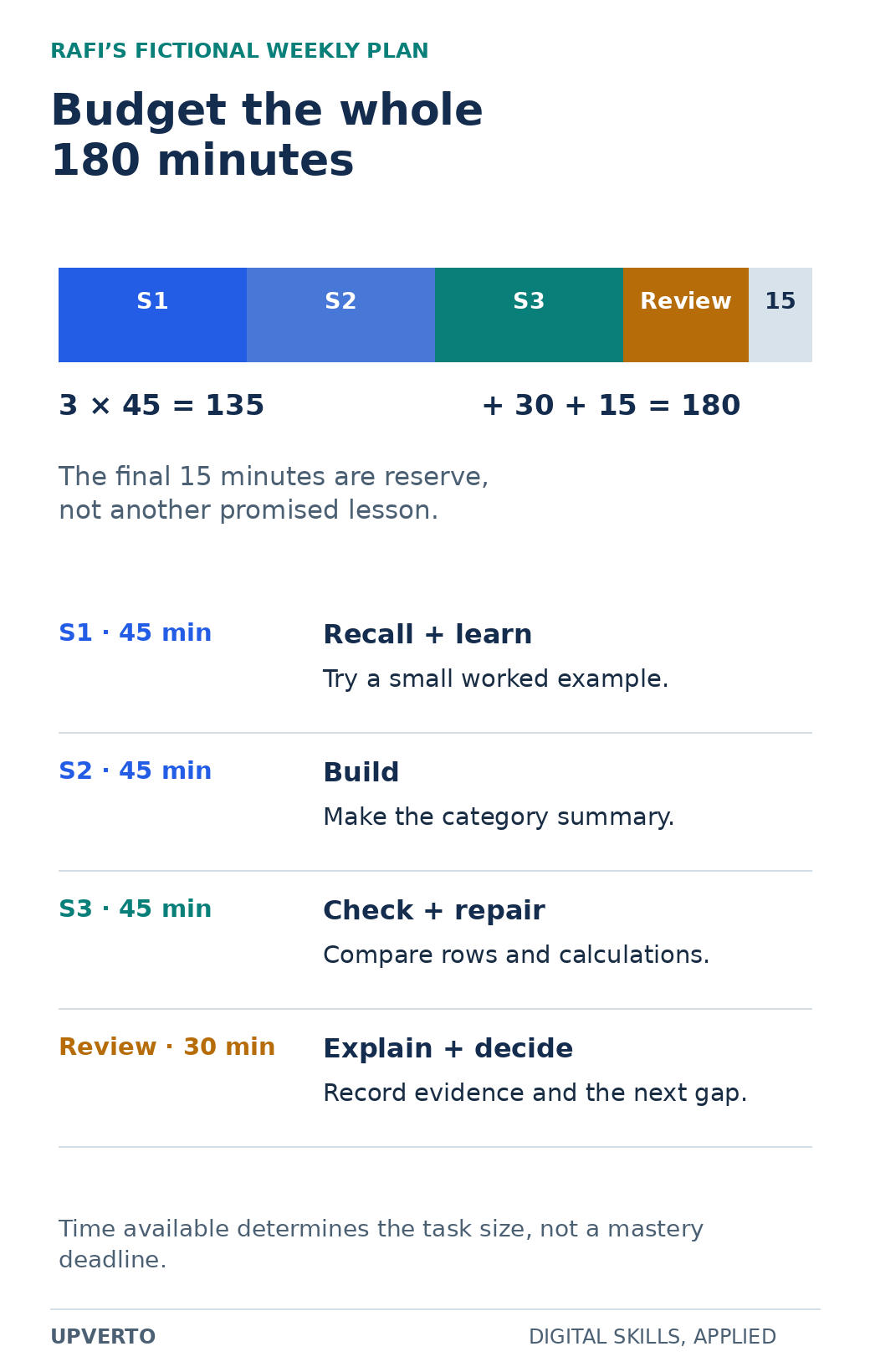
For the fictional learner Rafi, the weekly budget is 180 minutes. He plans three 45-minute sessions, a 30-minute review and a 15-minute reserve. That is 135 + 30 + 15 = 180 minutes. The reserve is not secretly assigned to another lesson.
Read the text version: Account for all minutes in a weekly learning plan
Three 45-minute sessions total 135 minutes. Add 30 minutes for review and 15 minutes reserve: 180 minutes. Session 1 recalls and learns through a worked example. Session 2 builds the category summary. Session 3 checks and repairs it. Review explains the method and selects the next gap. Reserve is not preassigned to another lesson.
Choose an output that fits the budget
Rafi is practising a spreadsheet summary. His objective is: “From a five-row fictional input, create a checked category total and explain one data-quality issue.” This is narrower than “learn Excel” and more observable than “understand formulas.” He will keep the input, workbook and a short review note.
Choose the smallest useful variation that stretches your present ability. If you have never opened a spreadsheet, file handling and a simple formula may be the right objective. If you can already repeat a tutorial, use a different input and explain your decision without the tutorial open.
Write the completion check at the same time as the objective. Rafi will compare the total with a manual calculation, identify the included rows and describe what happens to a missing value. The check prevents a visually finished workbook from being mistaken for a correct one.
Give each session a different job
| Block | Minutes | Task | Saved output |
|---|---|---|---|
| Session 1 | 45 | Recall the previous method, read the needed reference and try a small example | Worked example and one question |
| Session 2 | 45 | Build the category summary from new fictional input | First complete workbook |
| Session 3 | 45 | Check calculations, investigate one error and repair it | Revised workbook and check log |
| Review | 30 | Explain the method without the lesson and choose the next variation | Review note and next objective |
| Reserve | 15 | Handle an interruption or setup problem if needed | No extra task promised in advance |
The blocks do not need to occur on consecutive days. Separating practice can create opportunities to recall what you learned rather than merely repeat what is still on screen. The Institute of Education Sciences practice guide discusses spacing and retrieval in an educational context. Applying those principles here is a learning-plan choice, not evidence that this exact schedule guarantees adult professional outcomes.
Begin the next session by trying a small part from memory, then consult the reference to correct it. The purpose is to reveal what you can retrieve and where help is needed. Do not spend the whole session struggling with an unknown concept; use feedback and documentation after a fair attempt.
Review evidence instead of counting attendance alone
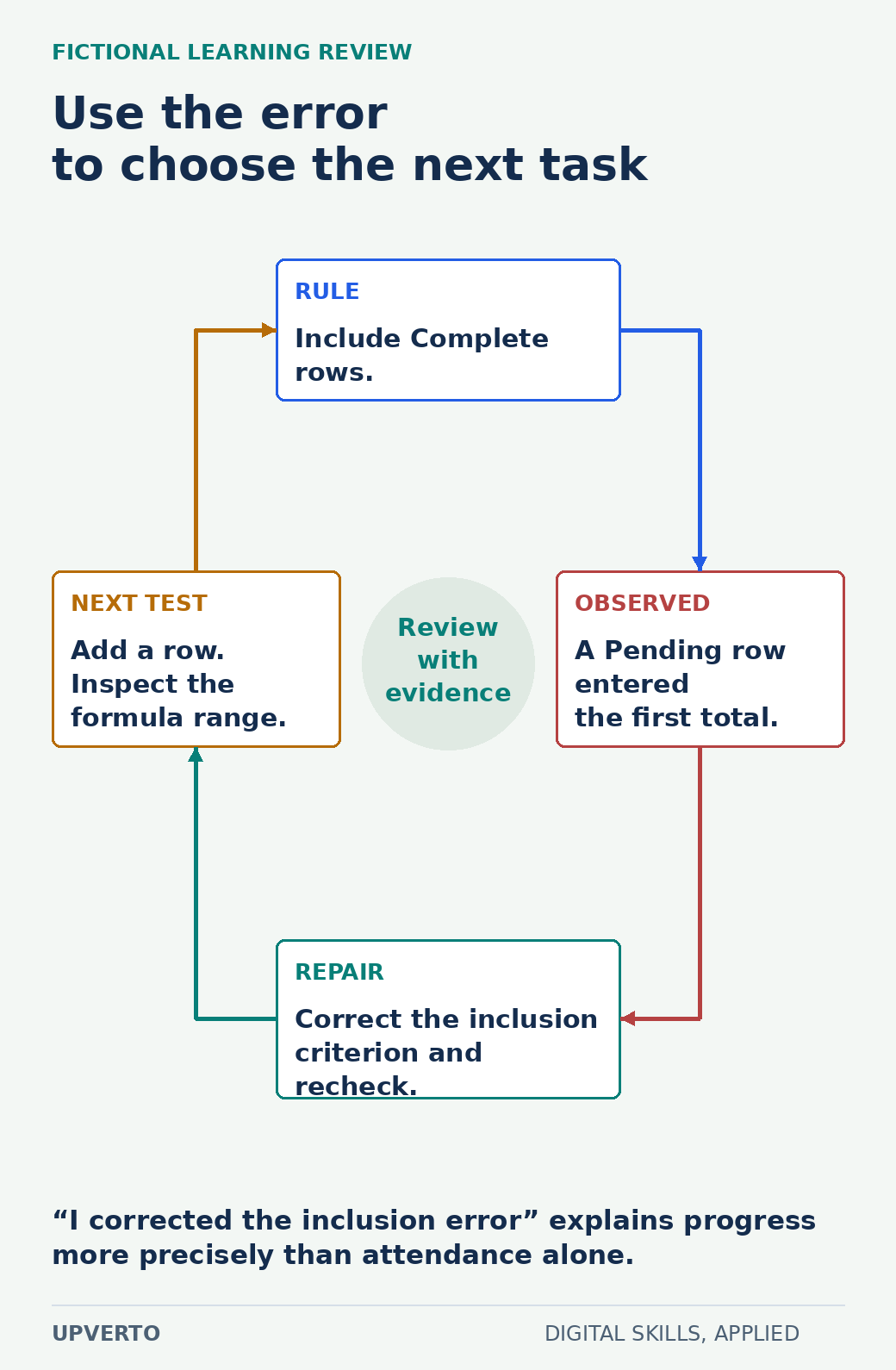
Rafi’s fictional review records that his first total included a pending row. He compared the selected rows with the written rule, corrected the formula and saved the before-and-after values. He can now explain the inclusion rule, but he still needs practice with ranges that expand when new data is added.
Read the text version: Turn a learning error into the next practice task
- Rule: include Complete rows.
- Observed in the fictional review: a Pending row entered the first total.
- Repair: correct the inclusion criterion and recheck.
- Next task: add a row and inspect the formula range.
Keep the evidence behind the review rather than reporting study time alone.
That review gives him a specific next objective. “I studied for three hours” describes effort; “I corrected an inclusion error and can explain why” describes a learning observation. Keep both if useful, but do not confuse them.
Use three questions: What can I now do without copying? What evidence supports that? Which remaining gap matters most for the next task? If the output is incomplete, identify the blocker. It might be an unrealistic scope, a missing prerequisite, unclear instructions or an interrupted week.
Adjust the plan without turning it into a backlog trap
If one session is missed, decide what still fits. Do not automatically double the next session or carry every unfinished task forward. Preserve the core output and reduce optional work. If the prerequisite is missing, replace the planned project with a smaller exercise that addresses it.
If the week feels too easy, add one meaningful variation rather than several unrelated tools. For example, use a new category or a deliberate blank value in the spreadsheet. The variation should test the same underlying method. Use practise skills beyond tutorials to move beyond reproducing a tutorial.
If the task repeatedly overwhelms the available time, split it at an observable boundary. “Import the data and record its issues” can be a complete weekly output before “build the report.” Avoid dividing only by lesson number when the lessons do not map to a useful action.
Copy the weekly learning planner
Fill these fields at the start of the week: available minutes; protected sessions; reserve; one output; required inputs; reference; prerequisite; completion check; likely interruption; and review date. At the end, add actual time, evidence saved, error found, feedback received and next decision.
- Continue: the task fits, and a new variation will test understanding.
- Reduce: the output was too large for the available time.
- Repair: one prerequisite blocked the main task.
- Seek feedback: the result is complete but you cannot judge an important aspect.
- Change direction: a fair trial reveals a mismatch with the work or your constraints.
Keep the planner short enough to update. A complicated tracking system can consume the time intended for practice. One page with links to the actual work is sufficient for many beginner projects.
Use the plan to build evidence over time
Several finished weeks can produce a useful record of increasing independence, but the count alone does not establish client readiness. Compare your actual work with the proposed responsibility. The ready for paid client work checklist helps you inspect repeatability, quality checks, communication and handover when you reach that decision.
For now, choose the next output and reserve its first session. A useful plan survives ordinary interruptions because its priority is clear: complete a small task, check it and use the evidence to decide what to practise next.
Frequently asked questions
How many hours should I study each week?
Use the hours you can sustain while meeting existing responsibilities. There is no universal weekly number that guarantees competence. Define a smaller output when time is limited and review what you actually completed.
Should I schedule a different skill every day?
For a beginner project, a focused sequence often makes it easier to finish and check an output. Related concepts can be combined when the task needs them, but switching among unrelated tools can make progress difficult to assess.
What should I do if I miss a session?
Reassess the remaining time and preserve the most useful part of the objective. Reduce optional work or move the review point deliberately. Do not automatically create an unrealistic catch-up plan.
Does watching a lesson count as practice?
It can support learning, but the plan should also include doing the task and checking the result. Keep a concrete output so you can distinguish exposure to a concept from the ability to use it.
How can I review when I have no teacher?
Compare the work with a written requirement, use a manual or independent check where possible, and explain the method without copying. Seek appropriate feedback for aspects you cannot judge reliably, rather than inventing a pass.
When should I increase the difficulty?
Increase it when you can repeat and explain the current task with the agreed checks. Add one relevant variation so you can identify what changed. A larger project is useful only if its new responsibility is clear.