A free resource can be exactly what you need, and a paid course can still leave your main difficulty unresolved. Start by naming the learning gap. Then inspect whether a resource provides the explanation, practice, feedback or structure needed to close it. Price is one condition in that decision, not a measure of learning quality by itself.

In this guide
The broader guide on how to learn a digital skill explains how to combine learning with practice. This page helps you choose the materials for that process without assuming that every reader should buy a course.
Name the problem before comparing products
“I need to learn web design” is too broad to evaluate a resource. A more useful statement is: “I can copy a page layout, but I do not understand how to check the keyboard path and form labels.” That identifies a subject and a practical task. It may call for official documentation and an exercise rather than a complete beginner course.
Other gaps need different support. If you do not know the learning sequence, a structured curriculum may help. If your work is complete but you cannot judge it, feedback may matter more than another explanation. If you repeatedly stop because of setup problems, check prerequisites and environment instructions before adding advanced content.
Write one test task that would show progress. For the web example, the learner should identify the controls, connect labels properly, follow the page with a keyboard and record remaining issues. The resource can then be judged by whether it helps with that task.
Compare the learning design, not the sales page
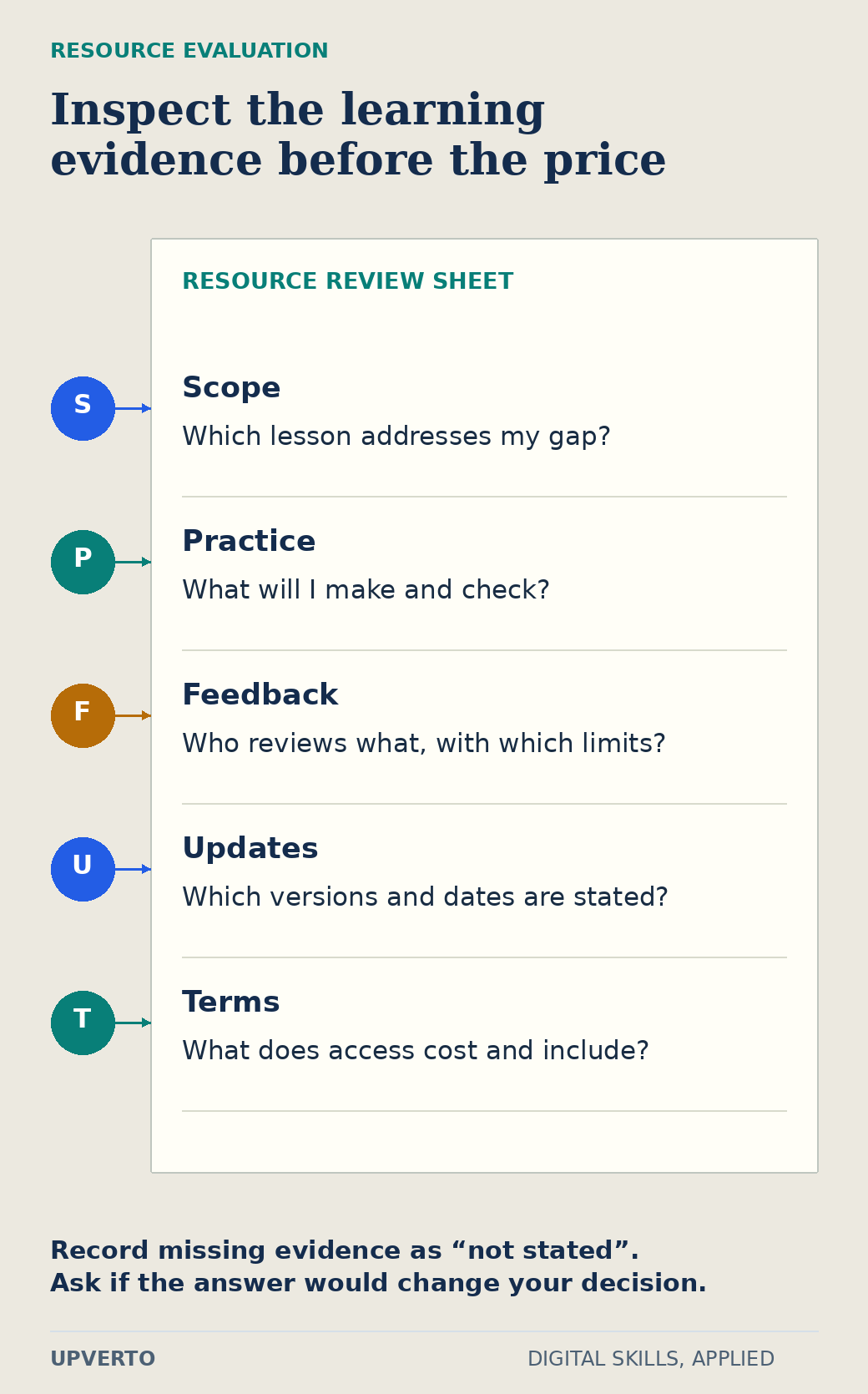
Read the text version: Inspect five types of learning-resource evidence
- Scope: which lesson addresses the gap?
- Practice: what will the learner make and check?
- Feedback: who reviews what, and with which limits?
- Updates: which versions and dates are stated?
- Terms: what does access cost and include?
Record missing evidence as not stated. Ask a specific question if its answer would change the decision.
| Question | Evidence to inspect | Warning sign |
|---|---|---|
| Does the scope match my gap? | Actual syllabus, lesson sample and stated outcomes | Broad promises with no inspectable content |
| Can I start with my current skills? | Prerequisite list and setup requirements | Hidden tools or assumed knowledge |
| Will I make something? | Exercises, projects and completion checks | Only passive viewing presented as competence |
| How is work reviewed? | Feedback method, reviewer and limits | “Support included” without a clear meaning |
| Is the material current enough? | Update dates, version notes and recent samples | Unexplained mismatch with the tools used |
| Can I sustain the commitment? | Total cost, access period and realistic study time | Urgency that discourages reading the terms |
Use a sample lesson if available. Check whether the explanation makes sense to you and whether you can apply a small part. A polished trailer may show production quality without revealing teaching quality. A long curriculum can still omit the exact feedback you need.
Use free material where it does the job
Official documentation can be a strong source for how a tool or platform currently behaves. For example, MDN’s accessibility learning module provides public material on web-interface foundations and identifies prerequisite knowledge. It can support a targeted study task without requiring you to assume that a separate paid course is necessary.
Free material may be fragmented or assume that you know what to study next. You can address that by making a short sequence around one project and keeping a question list. Do not judge a reference manual as though it promises individual tutoring; understand the format it actually provides.
Feedback can come from a teacher, a suitable peer, a community with clear rules or an experienced reviewer. Check the quality and relevance of the response. A comment that something “looks good” may be encouraging, but it does not replace a specific check against the project’s requirements.
Identify what a paid option would add
A paid resource may offer organised progression, assessed projects, individual feedback, scheduled sessions or support. Verify which of these are actually included. Ask how many submissions are reviewed, who reviews them, how long access lasts and which tools require separate payment. Read the current purchase and refund terms before deciding.
Distinguish course access from professional readiness. A certificate may document completion under the provider’s rules, but a client or employer can still require evidence of the actual work. Avoid courses whose main proposition depends on guaranteed earnings or a fixed promise of mastery.
The SBA’s cost-planning guidance separates one-time and recurring costs. Apply that simple distinction to your learning budget: course fee, software subscription, equipment access and time. The guide on the cost to start digital services can help you identify the wider commitment. Do not spend a whole budget on access if the required tools remain unaffordable.
Worked example: a choice based on the missing support
Leena is fictional. She has built a sample page but needs to understand labels, keyboard interaction and error messages. She has four short study sessions available and a learning budget she does not want to spend without a clear reason.
Option A is a free official module with examples and exercises but no individual review. Option B is a fictional paid course with a broad design curriculum and a discussion forum, but its description does not promise review of her project. Option C is a fictional paid feedback session with a named scope: review one page against agreed interface checks.
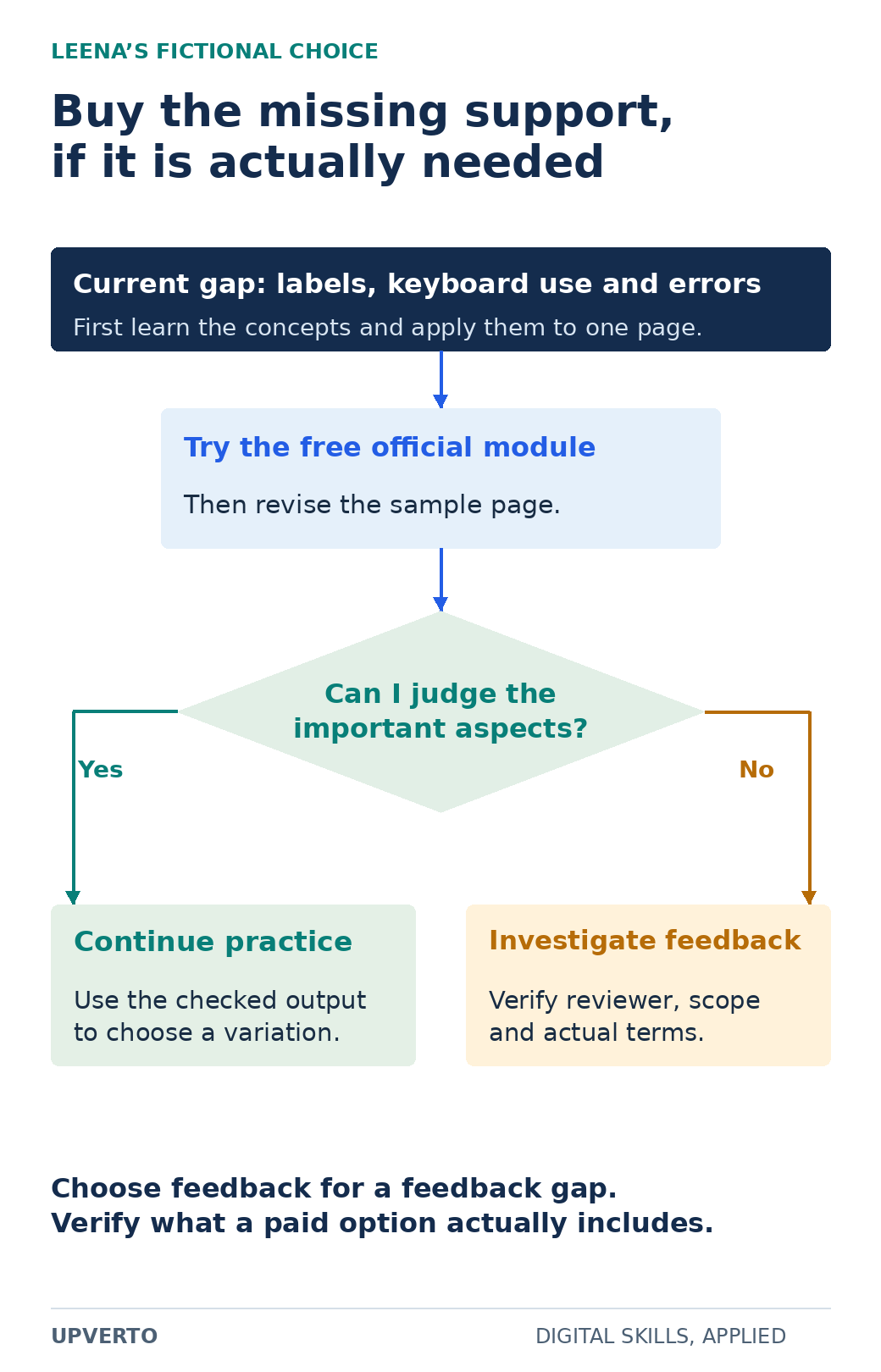
Read the text version: Choose a resource by the unresolved learning gap
Leena first needs to understand labels, keyboard use and errors. She starts with a free official module and revises one page. If she can judge the relevant aspects, she continues with a variation. If she cannot, she investigates suitable feedback and verifies the reviewer, scope and terms. A broader paid course is not automatically the solution to a specific feedback gap.
Leena begins with Option A because her immediate gap is understanding the concepts. She schedules a small page revision and a self-check. If she later cannot judge an important aspect, she will investigate suitable feedback, including the actual terms of Option C. She does not buy Option B merely because it has more lessons.
This is a decision exercise, not a review of real products. The lesson is to connect the purchase to a defined gap. A different learner who needs a structured sequence from the beginning could reasonably make a different choice after inspecting the evidence.
Use the resource-evaluation checklist
Record the resource title, provider, URL, date checked, target skill, prerequisites and test task. Then write the evidence for scope, practice, feedback, currency, support, cost and access. Use “not stated” when a claim cannot be verified. Send a specific question to the provider if that answer would change your decision.
- Which lesson or exercise addresses my current gap?
- What will I produce, and how will I check it?
- What support is included, and what is excluded?
- Which tools, subscriptions or prior skills are required?
- What happens when access ends or the software changes?
- Can I try a representative sample before committing?
- What evidence will make me continue, supplement or stop?
Do not turn the checklist into a false-precision score. Missing feedback may be decisive for one learner and irrelevant for another. Write the reason for your decision in a sentence so you can review it later.
Make the chosen resource part of a practice plan
Use weekly digital skill learning plan to reserve time for reading, application and review. The IES learning practice guide discusses spacing and retrieval in educational settings; here, those ideas inform a practical choice to revisit and use the material rather than only watch it once. They do not guarantee a particular professional outcome.
After the first defined task, inspect the output. Did the resource help? Was the real blocker different from what you expected? Continue when the evidence supports it, supplement a specific gap when necessary and stop accumulating material that you are not using. The useful outcome is an improved capability you can demonstrate.
Frequently asked questions
Are paid courses usually better than free resources?
Price alone cannot establish that. Compare the actual scope, practice, feedback, prerequisites and support with your learning gap. A free reference can be ideal for one task while a structured or reviewed course may help with another.
What does “support included” need to mean?
Find out who responds, which questions or projects are covered, the response process and any limits. A discussion forum, technical help desk and individual project critique are different kinds of support.
Should I buy a course because it provides a certificate?
Consider what the certificate represents and whether the role or client you want values it. Completion evidence can be useful, but it does not replace the ability to perform and check the relevant work.
How can I judge whether material is current?
Inspect update dates, version notes and a representative lesson against the current official documentation. Some foundational concepts remain useful longer than interface instructions. Identify the parts where a mismatch would block your task.
What if I already own several unfinished courses?
Choose one current task and inspect which resource best supports it. Finish a small output before buying another broad course. If the blocker is feedback or a prerequisite, address that specific gap.
When is paying for feedback a reasonable choice?
When you have work to review, a clear question and a suitable reviewer whose scope and terms you understand. Feedback is more useful when it points to observable issues and next actions, rather than offering only general encouragement.