A useful service page helps a prospective client decide whether your offer fits their task. It explains what you produce, what the client supplies, how review works and what to do next. It does not need inflated expertise claims or a promise of business results.
Define the offer first with turn digital skill into freelance service. Then write the page around the client’s decision, using the package details you can actually support.

In this guide
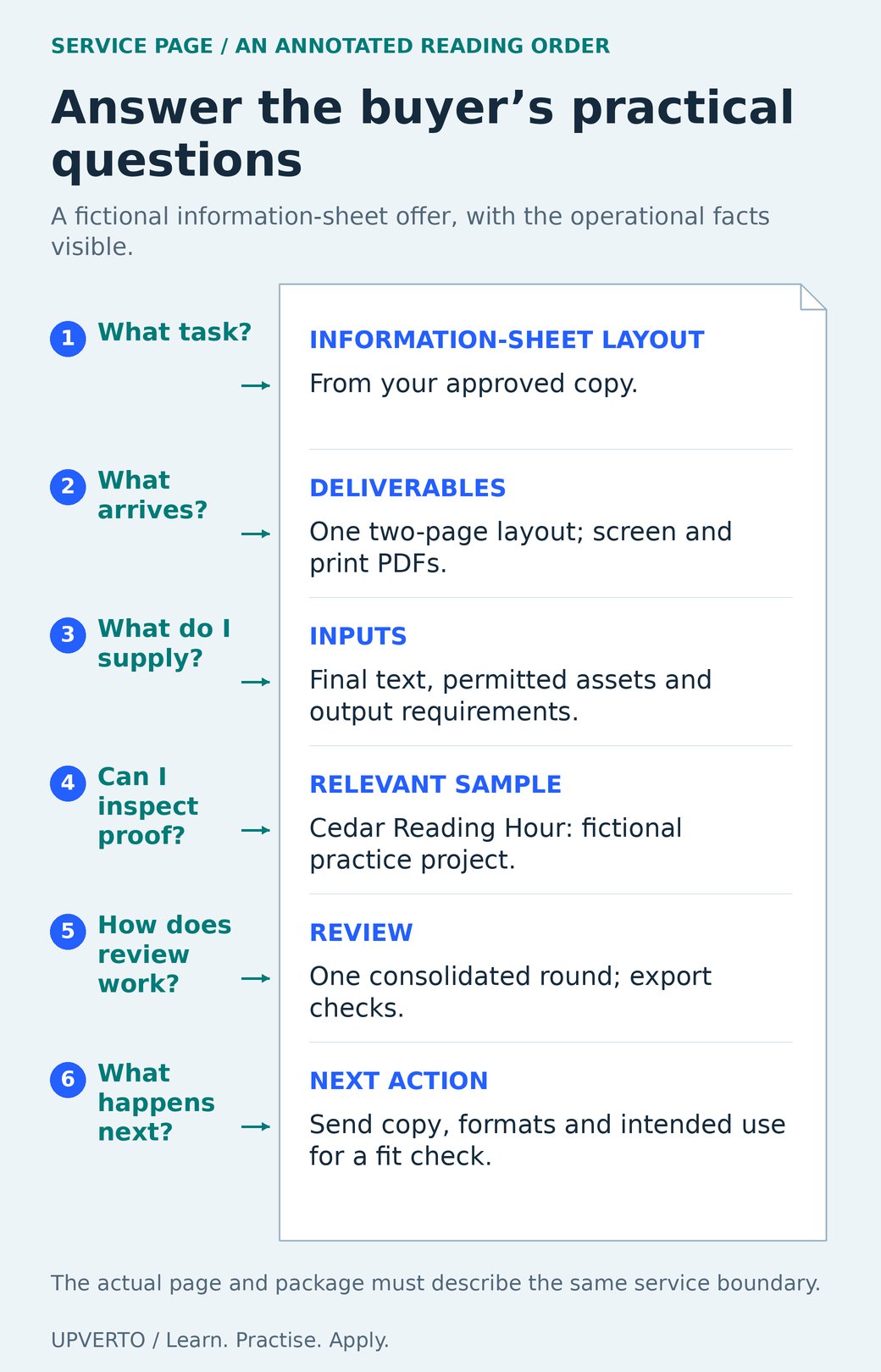
Read the text version: Organise a service page around six buyer questions
- What task? Information-sheet layout from approved copy.
- What arrives? One two-page layout, a screen PDF and a print PDF with specifications agreed before production.
- What do I supply? Final text, permitted assets and output requirements.
- Can I inspect proof? A relevant Cedar Reading Hour sample labelled as a fictional practice project.
- How does review work? One consolidated review round and export checks.
- What happens next? Send the copy, required formats and intended use for a fit check.
The example teaches structure. Real quantities and limits must match the provider’s actual package and capability.
Answer the buyer’s questions in a useful order
Lead with the task and the relevant audience. “Information-sheet layout from approved copy” gives a reader more to assess than “Creative solutions that transform your brand.” Follow with the outputs and a clear example of when the service fits.
Next explain the required inputs, included work and boundaries. A client should not have to start a conversation merely to discover that you do not write the copy or that editable source files are separate. The page can remain concise while making these decisions visible.
Then show relevant proof, describe the process and offer a proportionate next action. The reader may need to send a brief for a fit check rather than buy immediately. Match the action to the amount of uncertainty in the work.
Use an annotated service-page outline
| Section | Reader question | Content to provide |
|---|---|---|
| Offer heading | What task do you help with? | Specific output and relevant context |
| Deliverables | What will I receive? | Quantity, format and agreed handover |
| Inputs and scope | What do I supply, and what is included? | Approved copy, assets, access and exclusions |
| Proof | Can I inspect related work? | Honest sample with contribution and project label |
| Process and review | How will the work proceed? | Start conditions, feedback and acceptance checks |
| Next action | How do we establish fit? | Clear enquiry route and the information needed |
Use create freelance service packages to fill in the operational details. The page is the buyer-facing explanation of the offer; it should not quietly promise a broader service than the package you intend to deliver.
Price presentation depends on how well the scope can be standardised. If you show a starting price, make the associated scope and assumptions understandable. If you require a quote, explain the information needed to prepare it. Do not invent urgency or hide necessary charges merely to obtain an enquiry.
Use proof that supports the exact offer
Choose a sample that resembles the task, not simply your most decorative piece. Explain your role, the supplied inputs and the checks performed. A concept sample should remain clearly labelled as a concept. A testimonial should be authentic, permitted and presented in its proper context.
For a fuller explanation, use write a portfolio case study. The service page can show a concise extract and a descriptive link to the evidence. Avoid a claim such as “results-driven design” if the only available evidence is a fictional layout exercise.
Clear structure also matters for access. W3C’s writing guidance recommends meaningful headings, descriptive links and clear instructions. Apply those principles to the page: a heading should describe the offer, and a link should tell the reader what they will open. These practices help the reader navigate; they do not guarantee rankings or enquiries.
Worked example: a bounded information-sheet service
Fictional service-page copy: the following example demonstrates structure. Its quantities and limits are teaching assumptions, not a standard market package.
Information-sheet layout from your approved copy
I format a short information sheet for organisations that already have approved wording and need a clear screen and print version.
You receive: one two-page layout, one screen PDF and one print PDF prepared to specifications agreed before production. Editable source delivery is discussed separately.
You supply: final text, approved names and contact details, permitted images or logos, and the intended print or screen requirements.
Included: hierarchy, spacing, image placement, one consolidated review round and checks of the exported files. Copywriting, new illustration and additional pages need a separate agreement.
See the approach: the Cedar Reading Hour sample is a fictional practice project showing information grouping and export checks. It does not represent a client commission or measured booking result.
Next step: send the draft copy, required formats and intended use through the enquiry form. I will confirm whether the task fits and what information is still needed before quoting or agreeing a start date.
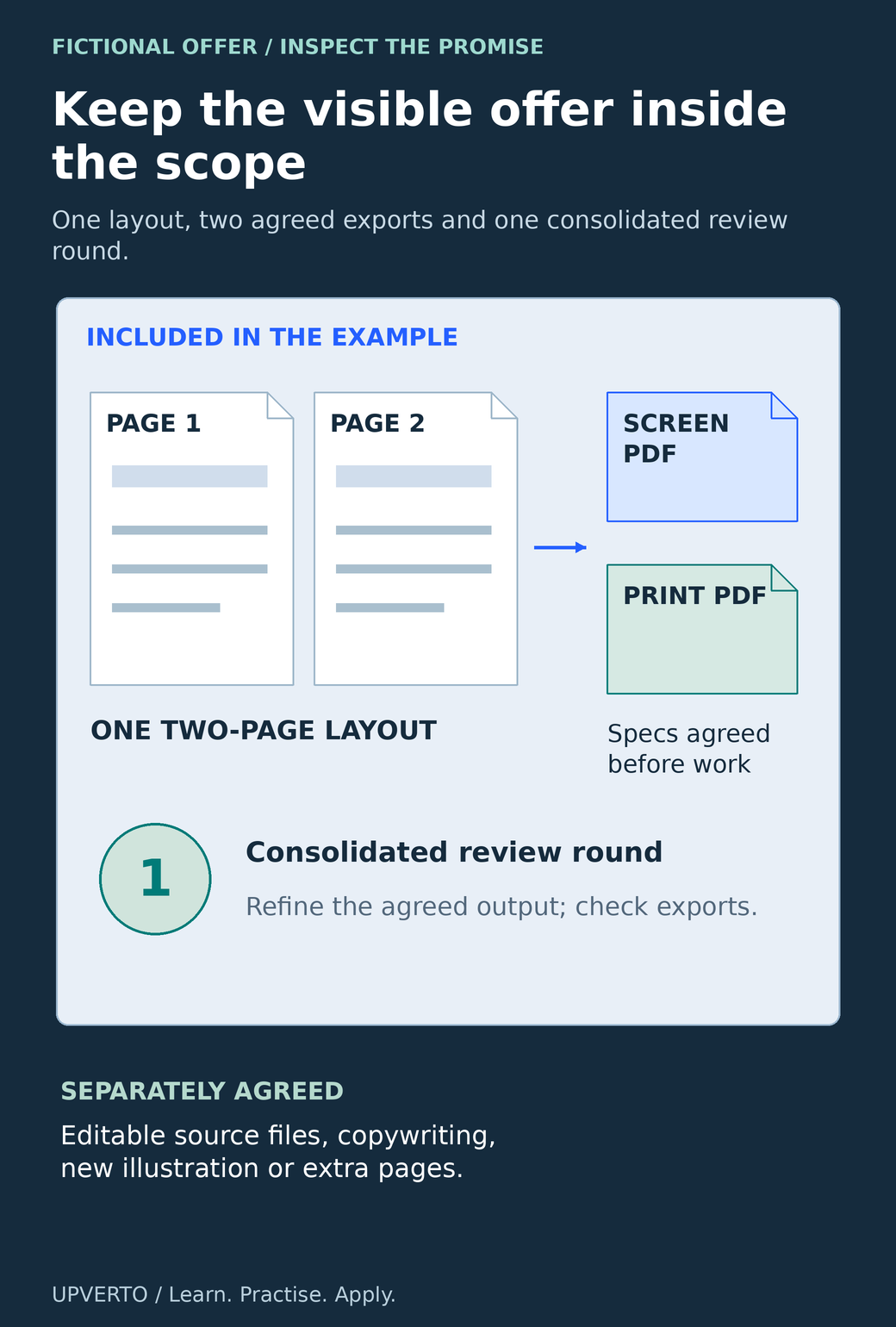
Read the text version: Check that a service-page promise fits its package
The fictional service-page package includes one two-page layout, one screen PDF and one print PDF prepared to specifications agreed before production. One consolidated review round and export checks are included. Editable source delivery is discussed separately. Copywriting, new illustration and extra pages need a separate agreement. Check that the visible page copy describes these same boundaries. A labelled concept sample demonstrates layout decisions; it does not supply a testimonial or prove a business outcome.
The copy answers practical questions without claiming that layout alone will increase sales. A real page should replace the teaching assumptions with a service the provider can reliably perform, including the actual review and handover arrangements.
Review the page as an offer, not an article
Ask someone to list what they believe is included, what they must supply and what happens after they enquire. If they expect copywriting or unlimited revisions, revise the wording. If they cannot find the sample or the next action, repair that path before adding more explanatory text.
| Check | Evidence |
|---|---|
| Offer matches the actual capability | A defined task and a checked relevant sample |
| Scope is understandable | Outputs, inputs, exclusions and revision boundary |
| Claims are supported | Honest labels, permitted proof and no invented outcomes |
| Next action works | Correct form, link or permitted platform route |
| Page is usable | Readable layout, meaningful headings and accessible instructions |
Test the actual contact route with harmless data where authorised, including confirmation and error messages. Do not collect information you do not need for a fit check. A brief may be enough initially; passwords, financial details and private source files should not be requested through an unsuitable public form.
Once the page is clear, use find freelance prospects and write outreach to approach appropriate opportunities. Keep the offer aligned with the work you are ready to deliver, and update the page when your scope, process or evidence changes.
Frequently asked questions
Should a service page teach the whole skill?
No. Its main job is to explain the offer and help a buyer assess fit. Link to useful educational material where relevant, but keep deliverables, inputs, proof and the next action easy to find. Long background explanations can obscure the practical agreement.
Do I need three packages?
Only if three meaningful scopes help the buyer choose and you can deliver each one. A single well-defined offer can be clearer. Do not create artificial tiers that differ only in vague labels or hide essential work in an unexpected upgrade.
Can I use a concept project as proof?
Yes, if it is labelled clearly and demonstrates the relevant task. Explain your role and checks. Do not present it as a commissioned project, testimonial or measured business result, and keep the label visible in the service-page extract.
Should I publish a price or ask people to enquire?
Choose according to how clearly the scope can be standardised. A displayed price needs an understandable included scope and assumptions. A quote-based offer should explain what information is needed. Neither approach justifies hiding necessary charges or promising an unverified timeline.
What should the enquiry form ask first?
Ask for the task, intended use, required outputs, available source material and a suitable contact route. Keep the request proportionate. Do not ask for account passwords or sensitive client records merely to decide whether the project fits.
How can I tell whether the page is clear?
Give a reader a concrete task: explain the deliverable, identify what they must supply and find the next step. Compare their interpretation with your actual package. Record and fix misunderstandings, rather than relying only on compliments about the design.
Sources and review notes
Primary sources checked on 27 October 2026 (UTC). Check the current provider pages before relying on a changing feature, policy or price. Worked examples and worksheets are original teaching material; fictional examples are not evidence of client results.