A useful project estimate includes the work needed to understand, produce, review, check and hand over the deliverable. It also states the assumptions that make the estimate possible. A production-only guess can miss the tasks that determine whether delivery is reliable.
Start with a defined service using turn digital skill into freelance service. Then turn the client’s request into observable outputs, required inputs and a review process before committing to time or price.

In this guide
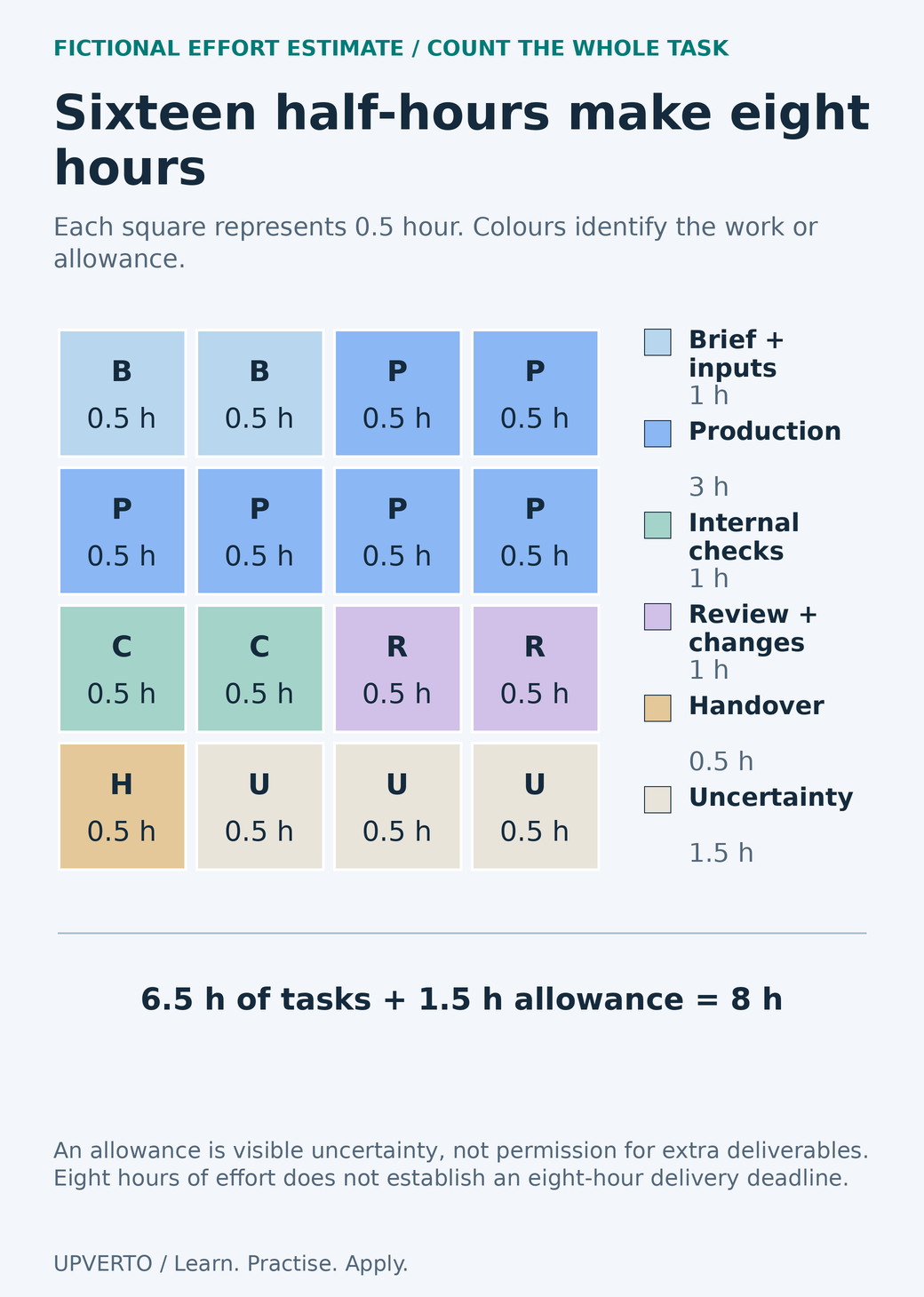
Read the text version: Inspect every half-hour in a fictional project estimate
| Work or allowance | Hours | Half-hour squares |
|---|---|---|
| Brief and inputs | 1 | 2 |
| Production | 3 | 6 |
| Internal checks | 1 | 2 |
| Review and agreed changes | 1 | 2 |
| Handover | 0.5 | 1 |
| Explicit uncertainty allowance | 1.5 | 3 |
The task estimate is 6.5 hours; adding 1.5 hours gives 8 planned hours, represented by 16 equal half-hour squares. These are invented teaching inputs. The allowance does not authorise extra outputs. Effort and elapsed delivery time are different because inputs and feedback can create dependencies.
Translate the request into deliverables and checks
“Make a professional brochure” leaves several decisions unresolved: page count, audience, supplied copy, images, print requirements, editable files and approval. Write the output in units the client can understand, and ask what conditions will show that it meets the brief.
The GOV.UK user-story guidance describes acceptance criteria as outcomes used to check whether a need has been met. For a small service, the same practical idea can become plain-language checks: approved text is present, specified formats open correctly and the agreed contact details match the source. You do not need to import an entire project-management system to write a clear check.
Use create freelance service packages for the broader agreement structure and write project brief acceptance criteria for the detailed brief. The estimate should refer to the same outputs, so the package, quote and checks do not describe different projects.
Break down effort and identify dependencies
| Work area | Questions before estimating |
|---|---|
| Brief and inputs | Is the copy approved? Are files usable? Who supplies missing material? |
| Production | Which operations, formats and quantities are required? |
| Internal checks | What must you inspect before the client sees a draft? |
| Client review | Who consolidates feedback, and how many rounds are included? |
| Revisions | What changes fit the agreed output, and what would create new work? |
| Handover | Which exports, source files, dependencies and instructions are included? |
| Uncertainty | Which assumptions could fail, and how will you respond? |
Use your own comparable records when available. If you have never completed the task, run a small practice or define a separate investigation instead of presenting a precise-looking guess as experience. A range can communicate uncertainty better than an unsupported exact number, but it still needs assumptions.
Distinguish effort from elapsed time. Six hours of work may require several days because approved copy, access or feedback is only available at particular times. State when production begins and how delayed inputs affect the schedule.
Worked example: two versions of an event sheet
Fictional estimate: a learner is planning one two-page information layout, a screen PDF and a print PDF. Approved copy and permitted assets are supplied. The print specifications are confirmed in advance. The following hours are invented teaching inputs, not market benchmarks or a promise about your work.
| Task | Hours |
|---|---|
| Confirm brief and inspect inputs | 1 |
| Build layout and adapt the outputs | 3 |
| Internal copy and export checks | 1 |
| One consolidated review and agreed revisions | 1 |
| Handover and dependency notes | 0.5 |
| Explicit uncertainty allowance | 1.5 |
The task estimate is 1 + 3 + 1 + 1 + 0.5 = 6.5 hours. With the stated allowance, planned capacity is 6.5 + 1.5 = 8 hours. The allowance is visible; it does not authorise extra deliverables or disguise work you already know is missing.
The schedule also depends on a client review window. If the client asks for a third format or replaces the approved copy, the learner reassesses the scope before promising that the original estimate still applies. If the source files reveal an unanticipated problem, the learner explains the observation and options.
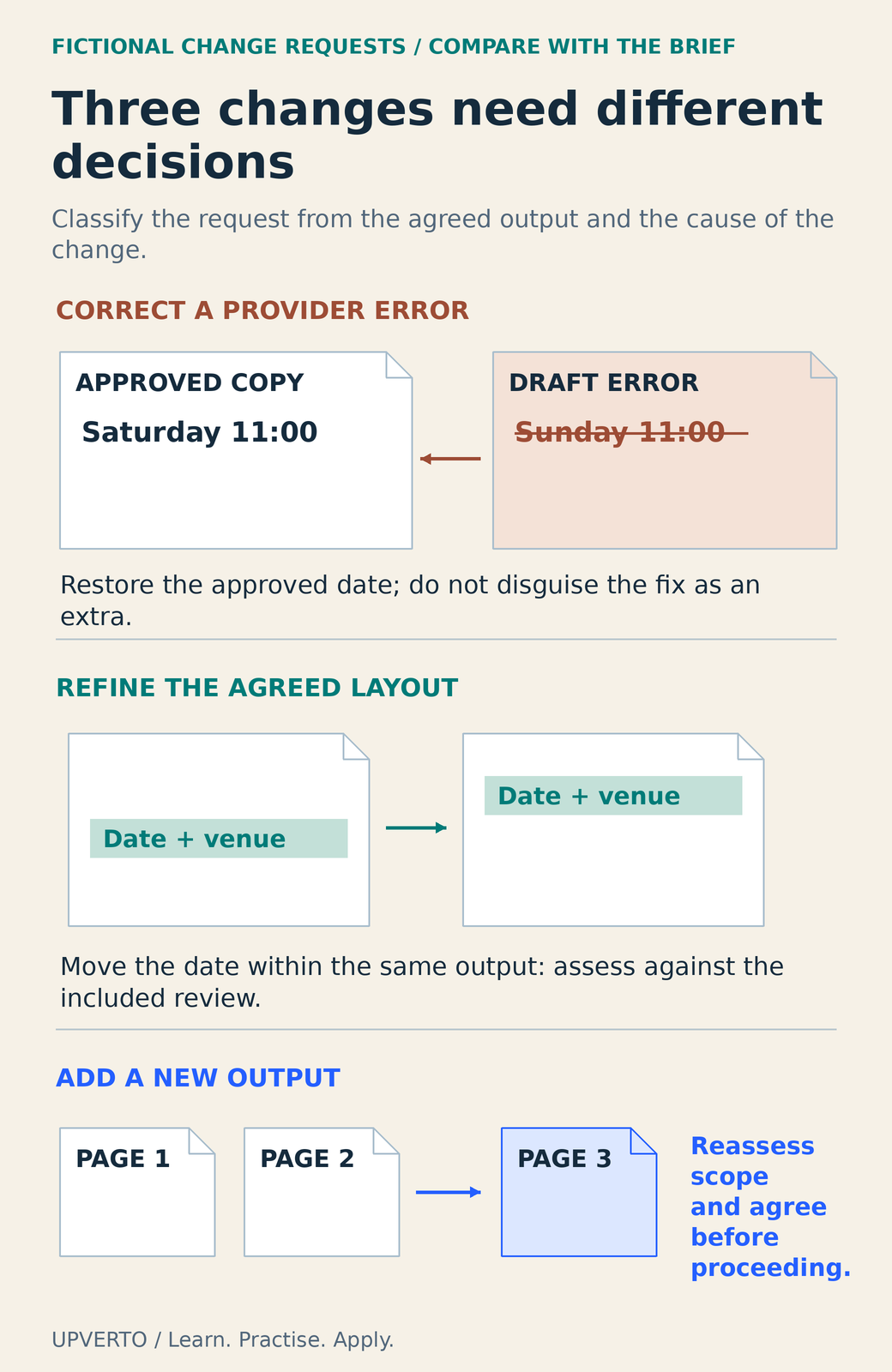
Read the text version: Distinguish correction, refinement and additional scope
- Correction: the approved copy says Saturday at 11:00, but the draft says Sunday. Restore the approved wording. A provider error should not be disguised as a paid optional revision.
- Refinement: move the existing date and venue higher within the same agreed layout. Assess whether this fits the defined review round.
- Additional scope: add a third page to an agreed two-page output. Reassess the work and obtain agreement before proceeding.
These are fictional examples. The actual brief, cause of the change and agreed review boundaries determine the next conversation.
Define a review round with examples
A round should have a clear trigger and collection method: the client receives a named draft, one decision-maker gathers approved comments and the provider applies changes within the agreed deliverable. State how the client should distinguish corrections, preferences and new requests.
For the event sheet, moving the date within the agreed layout may fit the included review. Adding a new page or an extra language version changes the output. Correcting your own error against the approved text is a correction you should make; it should not be disguised as a paid optional extra.
Do not rely on a bare phrase such as “two revisions” without explaining what it covers. Two tiny spelling changes and two completely new concepts are different work. If the client needs flexible ongoing iteration, choose an arrangement that records and approves that effort rather than making an unlimited promise inside a fixed scope.
Discuss these boundaries before work begins. When a change arrives during delivery, record what changed and confirm any effect on the estimate before proceeding.
Complete the scope and revision worksheet
| Field | Entry to agree |
|---|---|
| Outputs and acceptance | Quantity, format, purpose and observable checks |
| Client inputs | Approved source material, access, rights and decision-maker |
| Task estimate | Production, checking, review and handover effort |
| Assumptions and uncertainty | What is known, what is unverified and how it affects the estimate |
| Review definition | Named draft, consolidated comments and included changes |
| Exclusions | Concrete extra outputs or responsibilities requiring another agreement |
| Schedule dependencies | Start conditions, feedback windows and decision points |
Before sending the estimate, read the brief as if you were the client. Could someone reasonably expect work you have excluded? Are source files mentioned in one place and missing in another? Correct the wording while the project is still easy to adjust.
If important questions remain, use freelance discovery call questions to resolve the uncertainty. A useful estimate is not the most confident-looking number; it is the clearest account of the work, assumptions and next decision.
Frequently asked questions
Should I estimate only the time spent making the output?
No. Include brief clarification, input inspection, checks, agreed review, revisions and handover. These tasks are part of delivery. Keep uncertainty visible rather than assuming that every non-production activity will fit into unplanned spare time.
Is an eight-hour estimate the same as next-day delivery?
No. Effort and elapsed time are different. The schedule may depend on approved inputs, access and client feedback. State the start conditions and review windows so the promised timing reflects the actual dependencies.
How many revisions should I include?
Choose a boundary that fits the task and the arrangement, then explain what a round means. There is no universal number. Use concrete examples of included refinements and additional scope, and identify the person who consolidates approved feedback.
Should fixing my own mistake count as an extra revision?
An error against the approved brief should be corrected. Do not use a revision limit to disguise that correction as an optional extra. Distinguish it from a client changing an approved requirement or requesting another deliverable.
What if the client cannot provide complete inputs?
Identify the missing material and its effect before promising production. You may define a separate discovery or preparation task, reduce the scope or wait for approval. Do not silently assume that writing copy, sourcing assets or repairing files is included.
How can I estimate a task I have never completed?
Run a small representative practice or a bounded investigation and record the effort and problems. Be explicit about uncertainty. Avoid presenting a precise quote as a demonstrated estimate when it depends on learning an unfamiliar technique during the client project.
Sources and review notes
Primary sources checked on 27 October 2026 (UTC). Check the current provider pages before relying on a changing feature, policy or price. Worked examples and worksheets are original teaching material; fictional examples are not evidence of client results.