Freelancing, remote jobs and digital products organise work differently. The better starting route depends on the work you can demonstrate, the responsibilities you want to carry and the opportunities you can realistically access. Choosing a route does not remove the need to learn a useful skill or create evidence of your ability.

In this guide
The broader guide to make money online with digital skills connects learning, practice and paid work. Here, compare the three routes as operating choices. There is no ranking of guaranteed income, and you can change direction as your experience and circumstances change.
Compare what each route asks you to own
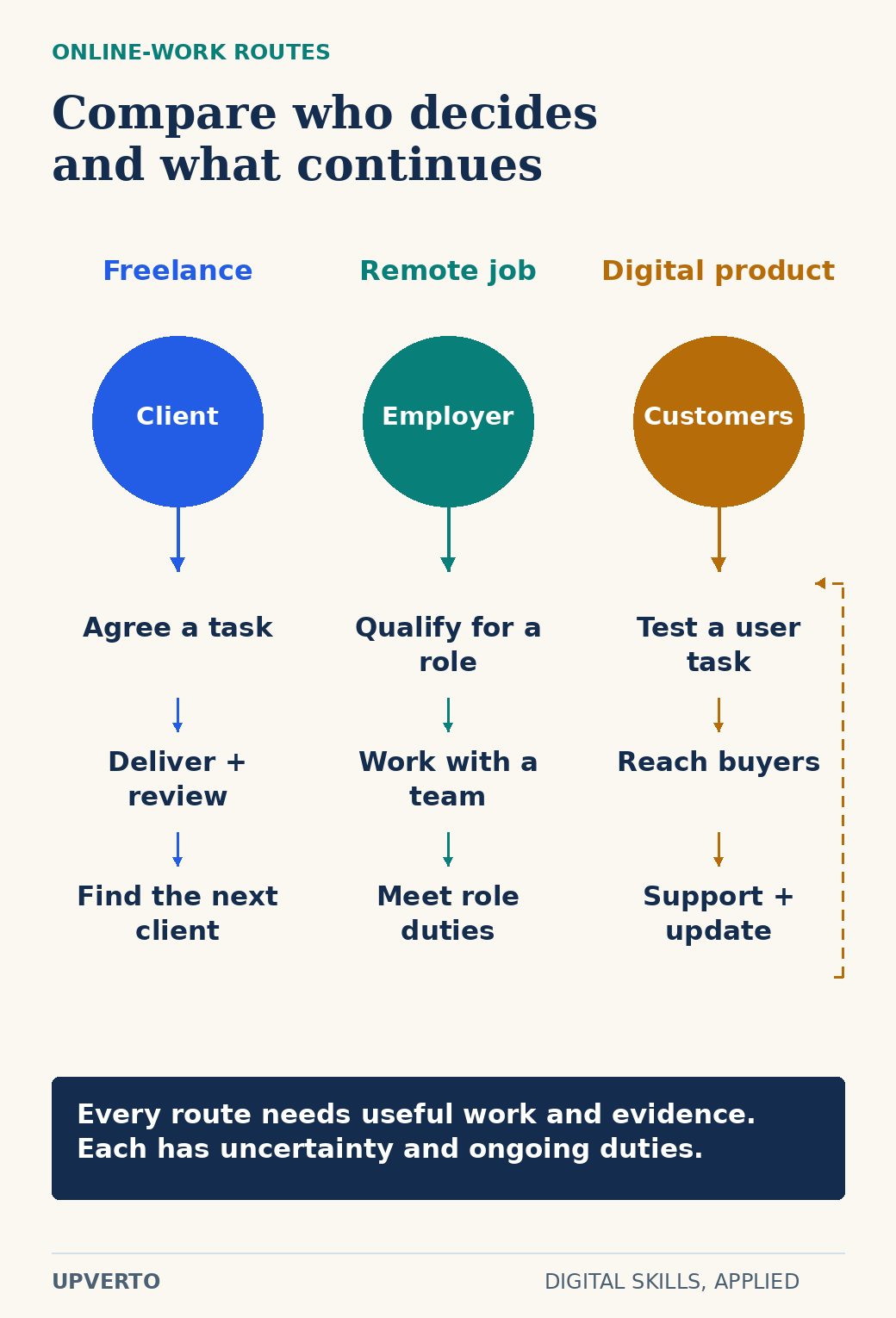
In freelance services, you offer a defined piece of work to a client. You usually need to clarify the problem, agree scope, deliver, handle revisions and manage the business side of the engagement. A platform may help with some administration, but it does not make the client’s expectations or your costs disappear.
In remote employment, you apply for a role in an organisation. The work may be performed away from its office, but the job can still have location, time-zone, work-authorisation, availability and experience requirements. Review the actual posting and employment terms rather than assuming “remote” means open to anyone anywhere.
With a digital product, you create something multiple customers may use, such as a template or educational resource. You also need a way to reach appropriate buyers, explain the product, deliver access, answer questions and maintain it. Reusable does not mean effortless or permanently current.
Read the text version: Compare the operating responsibilities of three routes
Freelance services: a client evaluates the specific task; agree, deliver, review and find further clients. Remote employment: qualify for a role, coordinate with a team and meet its duties. Digital products: test a user task, reach buyers, support users and update the product. Each route requires useful work and evidence and involves uncertainty.
| Decision | Freelance service | Remote job | Digital product |
|---|---|---|---|
| What someone evaluates | Your fit for a specific client problem | Your fit for a role and team | Whether the product solves their task |
| Useful preparation | A bounded offer and relevant sample | Role-aligned evidence and application | A tested sample and clear instructions |
| Ongoing work | Finding clients, delivery and administration | Role duties, coordination and development | Distribution, support and updates |
| Questions to resolve | Scope, access, payment and revisions | Eligibility, expectations and working arrangements | Audience, rights, delivery and maintenance |
Start with your constraints rather than a slogan
List the time you can reliably offer, equipment you can use, work you can already demonstrate and responsibilities you can take on. Distinguish a preference from a constraint. “I would like flexible hours” is a preference; “I can only be available after a fixed shift” may exclude particular roles or client schedules.
Write down your financial boundary before buying tools or training. The SBA’s startup-cost guidance distinguishes one-time and recurring expenses; the distinction is useful even for a small experiment. For your own plan, include required software, connectivity, equipment access and any delivery costs, then verify current prices. The guide on the cost to start digital services can help you make that budget explicit.
Do not assume a product route avoids customer contact. Support questions and updates may arrive after the sale. Do not assume freelancing means complete schedule control; client availability and deadlines still matter. Do not assume employment removes uncertainty; you still need to qualify for an actual role and understand its terms.
Worked example: one skill, three possible routes
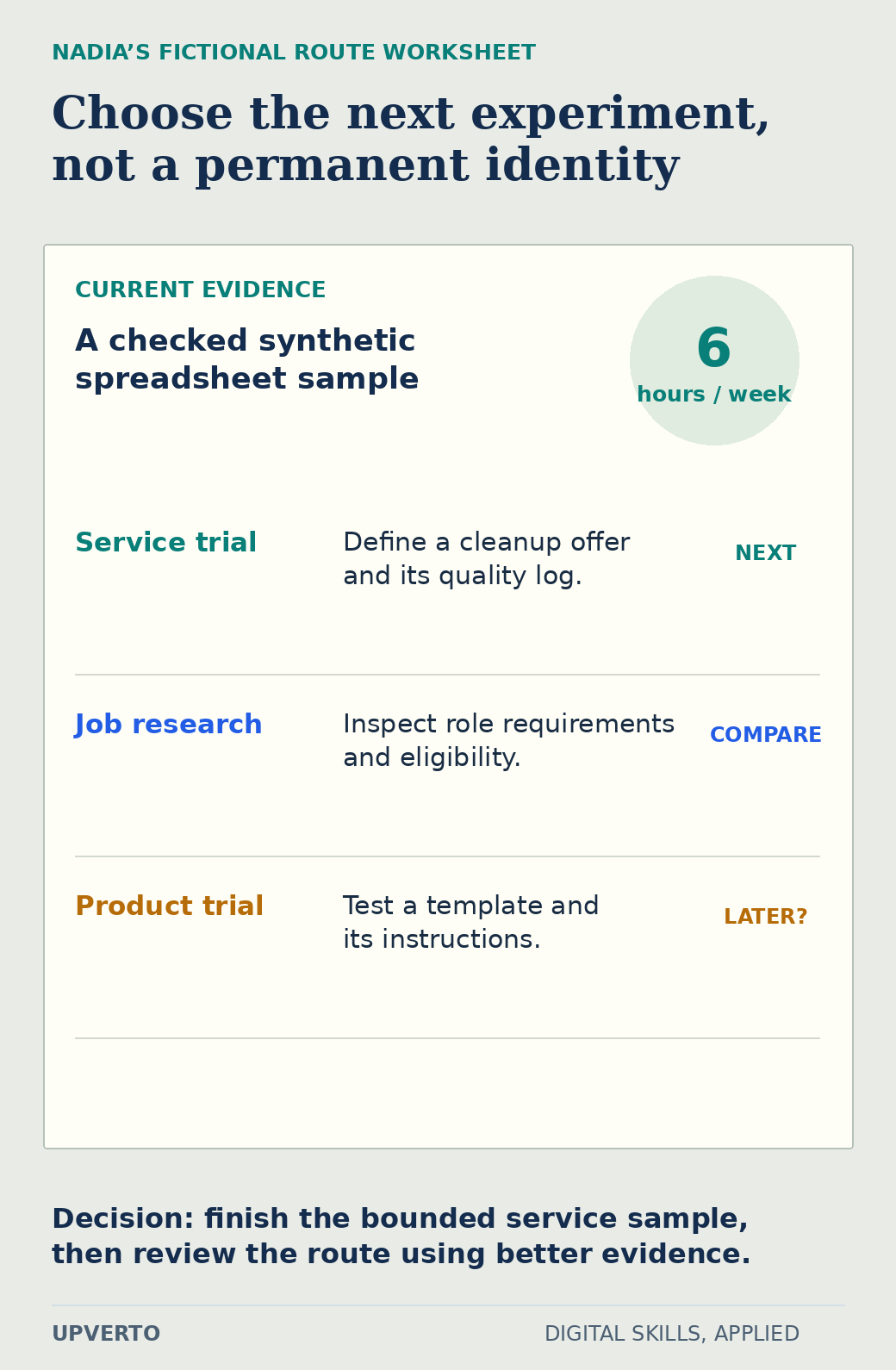
Nadia is fictional. She can prepare a clear spreadsheet from a small synthetic dataset and has a documented sample. She has six predictable hours a week for further practice. She is comparing three experiments, not deciding how much she will earn.
Her freelance experiment is to write a narrow offer for cleaning an agreed spreadsheet and delivering a quality log. Before approaching anyone, she needs to define the data limits and show a repeatable check. Her employment experiment is to examine relevant junior operations postings and record their actual responsibilities, eligibility and evidence requirements.
Her product experiment is to build a simple inventory template with fictional data and ask an appropriate reviewer to follow its instructions. She needs to discover whether the template supports a real task and what maintenance or support it creates. Producing a file is only the first part of that experiment.
Read the text version: Use a route worksheet to select one experiment
Nadia has a checked synthetic spreadsheet sample and six hours a week for further practice. Her service experiment is to define a cleanup offer and quality log. Her employment experiment is to inspect relevant role requirements and eligibility. Her product experiment is to test a template and instructions. She chooses the bounded service sample next, then reviews the route. This is a fictional learning decision, not proof of demand.
Nadia chooses the spreadsheet-service sample as her next learning exercise because it is small enough to finish and inspect with her present resources. That choice does not prove there is a buyer or rule out employment later. She sets a review point after completing the sample and collecting more evidence about the routes she can access.
Gather different evidence for different questions
For freelancing, look for specific buyer problems and the inputs and outputs involved. For employment, read actual role requirements and distinguish essential criteria from preferences. For a product, investigate the user’s task, competing alternatives, distribution and support needs. The SBA’s market-research guidance provides a useful starting point for researching customers and alternatives.
A public job advertisement shows that an organisation advertised a need; it does not show that you can obtain that role. A product listing shows an offer; it does not reveal its profit. A freelancer profile shows how someone presents services; it does not prove that every beginner can reproduce their results. Keep the evidence type beside your notes.
Be alert to offers requiring payment to obtain a supposed job or to release wages. The FTC’s job-scam guidance explains common warning signs, including fake-check arrangements. Verify an opportunity independently before sharing sensitive information or moving money. Learning costs and an employer demanding a payment are different situations.
Use the route-comparison worksheet
Make one row per route and answer the following questions in plain language. Use “unknown” when evidence is missing rather than assigning an optimistic score.
- What exact work or product would I offer, apply for or test?
- Who evaluates it, and how would I reach that person or audience?
- What sample, qualification or experience is actually required?
- Which responsibilities remain after the initial delivery or application?
- What time, equipment, costs or eligibility constraints apply?
- What can I test this week without committing money I cannot afford?
- What result would make me continue, adjust or pause this route?
Compare the answers, not an invented numerical ranking. A route with attractive potential can still be unsuitable if a required condition is unavailable. A modest experiment can be useful if it gives you reliable information about the work you enjoy and the skill gap you need to close.
Choose a reversible next step
Write a one-sentence decision: “For the next practice period, I will test this route by producing this output, using these resources, then review these questions.” Keep the time boundary realistic and the output inspectable. Avoid switching routes every time you see a new success story.
If you cannot yet name the work, use which digital skill should I learn to choose a small skill trial. A route becomes meaningful when connected to a task you can learn and check. You do not need to commit permanently; you need enough focused practice and honest evidence to make the next decision better informed.
Frequently asked questions
Which route is best for a complete beginner?
There is no universal answer. Start with a useful task and compare your available time, equipment, eligibility and willingness to handle each route’s responsibilities. A small practice experiment can reveal more than an abstract ranking.
Does remote employment mean I can work from any country?
Not necessarily. A posting can restrict location, hours, work authorisation or other conditions. Read the actual requirements and clarify uncertainties before investing heavily in an application.
Are digital products passive income?
They can be reused, but creating, reaching buyers, supporting users and updating the product still require work. Do not assume that uploading a file creates demand or that a product will remain accurate indefinitely.
Can I combine freelancing with a job?
Possibly, depending on time, the employment terms, conflicts of interest and applicable rules. Check those conditions and your capacity. Avoid accepting work that you cannot deliver reliably alongside existing responsibilities.
How can I compare routes without estimating earnings?
Compare the work, responsibilities, required evidence, access to buyers or employers, costs and constraints. Choose a reversible test. You can improve the decision without inventing an income projection.
When should I change my initial route choice?
Review it after completing a defined experiment or discovering a material constraint. Use the completed work and evidence to explain the change. A difficult first session alone may indicate a learning gap rather than the wrong route.