Managing paid advertising means taking responsibility for money, claims and measurement as well as creative work. A beginner can study those responsibilities and prepare a useful campaign plan without launching ads. Use a no-spend simulation until you can explain the objective, the intended audience, the landing page, the measurement and the conditions that require review.

In this guide
This route sits within which digital skill should I learn. It is different from simply writing social posts or pressing a campaign launch button. The fictional example below contains no live account, real tracking, purchased traffic or performance result.
Start with the business action and its limits
An advertising objective should connect to a real action the organisation can handle. For a fictional training workshop, the action might be a qualified request for a place. A click is an earlier interaction; a page view is another. If you optimise and report the wrong event, a busy dashboard may not answer the client’s question.
Google Ads’ conversion-measurement guidance describes tracking selected actions after ad interactions. The useful first task is to define the action and what it represents. Does “request received” mean a complete, valid request, or merely that someone opened a form? Does a duplicate count twice? Who verifies whether the request fits?
Write the definition before choosing settings. Use clear names such as “valid workshop request” and identify the system that records it. Define the normal path, an invalid entry and a duplicate. A beginner practice project can document expected behaviour without installing tags or collecting personal data.
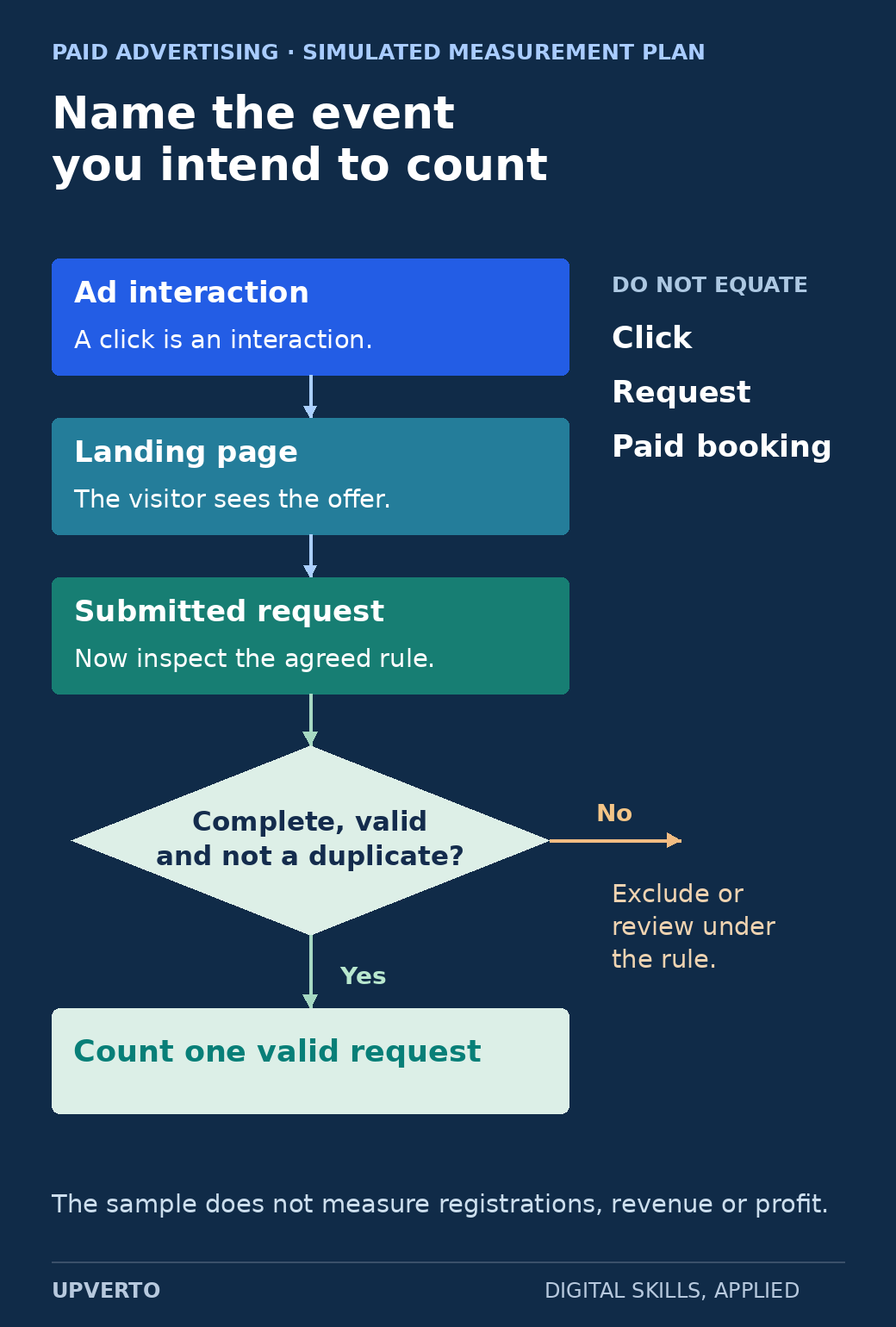
Read the text version: Define a valid-request measurement event
- An ad click is an interaction.
- The landing page presents the offer.
- A submission is inspected against the agreed rule.
- Only a complete, valid, non-duplicate request enters the sample count; other cases are excluded or reviewed.
A click, valid request and paid booking are distinct. This simulation measures no registrations, revenue or profit.
Build the learning sequence around responsibilities
Learn audience and intent first: who has the problem, in what situation, and what information they need before acting. Then learn the campaign structure for one platform, the relationship between targeting and creative, and the page that fulfils the ad’s promise. A misleading or incomplete destination cannot be repaired by a clever headline.
Study measurement configuration and verification separately from reporting. Google’s current website-conversion setup documentation is a primary reference for that platform. Settings change, so check the actual documentation and account context before applying instructions. Installing a tag does not demonstrate that the intended event is recorded correctly.
Learn the applicable platform policies, including claims, restricted subjects and destination requirements. Google Ads’ misrepresentation policy addresses misleading offers and business information. Review both the creative and the page together. A compliant headline cannot make an unavailable offer or unsupported guarantee acceptable.
Finally learn budget authority, monitoring and change control. Agree who can authorise spending, which changes you may make, when results are reviewed and what conditions require pausing or escalation. Do not use a client’s money as an unapproved training exercise.
Worked example: a no-spend campaign plan
Willow Workshop is fictional. The sample plan promotes one beginner session to an audience defined only for the exercise. The offer is a request process, not an instantly confirmed seat. We will prepare two honest message variants: one explaining the beginner level and one explaining the practical activity. Both point to the same complete information page.
The simulated total media allowance is USD 200. Planning allocates USD 120 to an initial review window and leaves USD 80 unallocated until that review. These are invented amounts to practise control; they are not a recommended budget or actual platform spend. Platform delivery and billing rules can differ from a simple daily planning division.
| Planning item | Fictional entry | Check before a real launch |
|---|---|---|
| Purpose | Receive valid requests from suitable beginners | Owner can review and answer requests |
| Creative | Two message variants using confirmed session details | Claims and assets approved; no invented urgency |
| Destination | Session detail page and request form | Mobile path, errors, confirmation and availability checked |
| Measurement | Record the agreed valid-request event | Test event meaning and duplicates; review privacy requirements |
| Authority | USD 200 total planning ceiling; owner review before further allocation | Written authority and current account spending controls confirmed |
A real plan also needs the geography, schedule, exclusions, account ownership, data access and applicable consent or privacy requirements. Those depend on the organisation and jurisdiction. The sample deliberately does not pretend that one configuration is suitable everywhere.
Separate arithmetic from a forecast
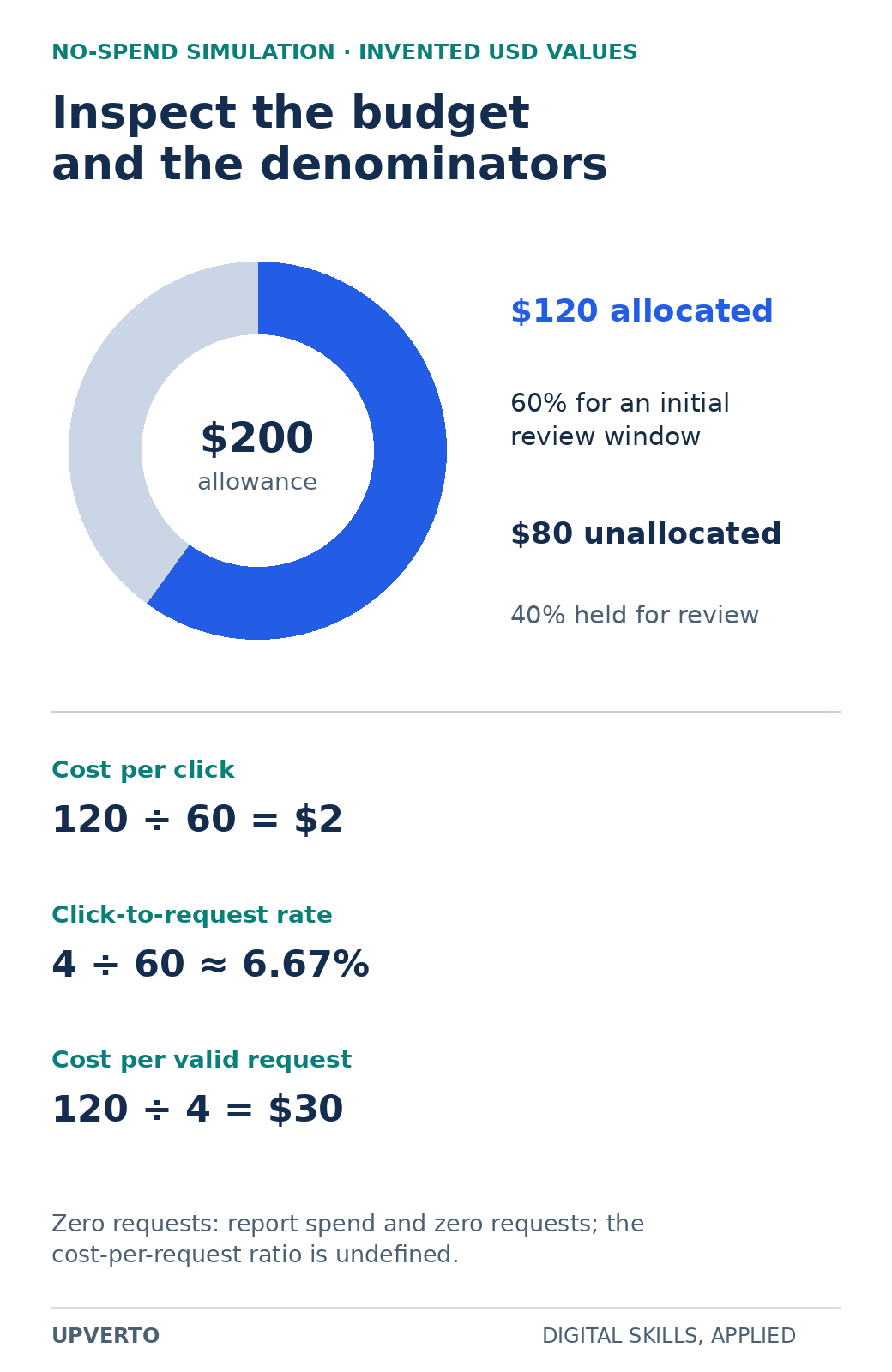
Read the text version: Check simulated advertising arithmetic
Fictional allowance: USD 200. Allocate USD 120 (60%) to an initial review window and retain USD 80 (40%) unallocated. With simulated spend of USD 120, 60 clicks and four valid requests: cost per click is USD 2; click-to-request rate is about 6.67%; cost per valid request is USD 30. If requests are zero, the ratio is undefined. No campaign was run.
For arithmetic practice only, suppose the simulation records USD 120 in spend, 60 clicks and 4 valid requests. Cost per click is 120 ÷ 60 = USD 2. Click-to-request rate is 4 ÷ 60 ≈ 6.67%. Cost per valid request is 120 ÷ 4 = USD 30. The unused portion of the planning allowance is USD 80.
These invented figures do not predict what an account will produce. They also do not show paid registrations, revenue or profit. If valid requests were zero, cost per valid request would be undefined, not zero; report the spend and zero requests explicitly. If a tracking error inflated requests, the computed figure would be arithmetically correct but operationally misleading.
Do not infer a winning message from a tiny sample with uncontrolled differences. Decide in advance what you are comparing and keep a record of changes, dates and possible confounding factors. A useful beginner report can identify what remains uncertain and what needs inspection; it need not manufacture a confident optimisation recommendation.
Use the measurement and authority checklist
- Write the primary action and distinguish it from page views, clicks and final business outcomes.
- Document which system creates the event and how invalid or duplicate actions are treated.
- Test the landing-page task using sample data in a permitted environment.
- Review the creative, destination, claims and current platform policies together.
- Record the total authorised allowance, who approves it and the limits of your access.
- Specify the monitoring owner, review timing, escalation conditions and change log.
- Label simulated metrics and keep real account exports separate from illustrative arithmetic.
Save the fictional brief, ad-copy drafts, destination sketch, event definition and calculation sheet as a portfolio pack. Explain that no campaign ran. A client can inspect your reasoning without being misled into believing you have a performance record.
Choose an appropriate first responsibility
A limited preparation service might organise supplied campaign assets or produce a draft measurement specification for an experienced practitioner to review. Running campaigns adds responsibility for settings, spending and ongoing decisions. Offering strategy, tracking implementation and account management together requires broader evidence than completing one course exercise.
Use how to learn a digital skill to structure study and practice. Apply the ready for paid client work checklist to the particular responsibility you intend to accept, and use the guide to estimate freelance project scope before estimating a real assignment. If tracking, policy or budget control is unresolved, keep the work in planning or seek experienced supervision.
Frequently asked questions
Must I spend money to create a first advertising portfolio sample?
No. A clearly labelled simulated plan can show the brief, creative, landing-page reasoning, event definitions and arithmetic. It cannot claim real campaign performance, but it can demonstrate useful preparation without risking a client’s budget.
Is a form submission always a conversion worth optimising for?
Only if it matches the agreed action and is recorded appropriately. A blank, duplicate or unsuitable request may not represent the business outcome. Define the event and its limitations before treating its count as success.
Why is cost per request undefined when requests are zero?
The formula divides spend by the number of requests. Division by zero does not produce a meaningful cost per request. State the actual spend and zero recorded valid requests, then investigate measurement and delivery without substituting zero cost.
Can a beginner guarantee leads or sales?
No responsible service should promise an outcome it cannot control. Advertising depends on the offer, audience, landing page, measurement, competition and other conditions. Define the work and decision process you will deliver instead.
Does a daily planning budget guarantee an exact daily charge?
No. A planning allocation is different from a platform’s current delivery and billing rules. Review those rules and the actual account controls before authorising spend. The sample USD figures are arithmetic assumptions, not platform instructions.
What should happen if the landing page or tracking is broken?
Follow the agreed pause and escalation procedure, document what you observed and inform the authorised owner. Do not continue spending while making unsupported assumptions about missing or incorrect measurement.