Review prices when the service, costs, effort or responsibility has changed enough to deserve a new decision. Use your project records to understand the cause before proposing a change. A higher price cannot by itself repair an unclear brief, repeated rework or an unrealistic schedule. This review belongs within grow a sustainable freelance business.
Identify what has actually changed
The initial estimation method is covered in how to price freelance work. A later review asks whether its assumptions still match the work. Compare the planned outputs, inputs, review effort, direct costs and responsibility with recent completed projects. Use comparable work rather than a single unusual job.
Australian Government pricing guidance recommends considering costs and reviewing prices when conditions change. This guide adapts that general business principle into a project worksheet. It does not provide a market rate, a universal percentage increase or a promised income level.
Useful triggers include a consistently wider deliverable set, higher necessary costs, more coordination, additional checking or changed support responsibilities. Better evidence and a clearer service may also affect the offer you can make. Distinguish those reasons from an isolated social-media claim that someone else charges more.
Read the text version: Compare estimated and recorded project effort
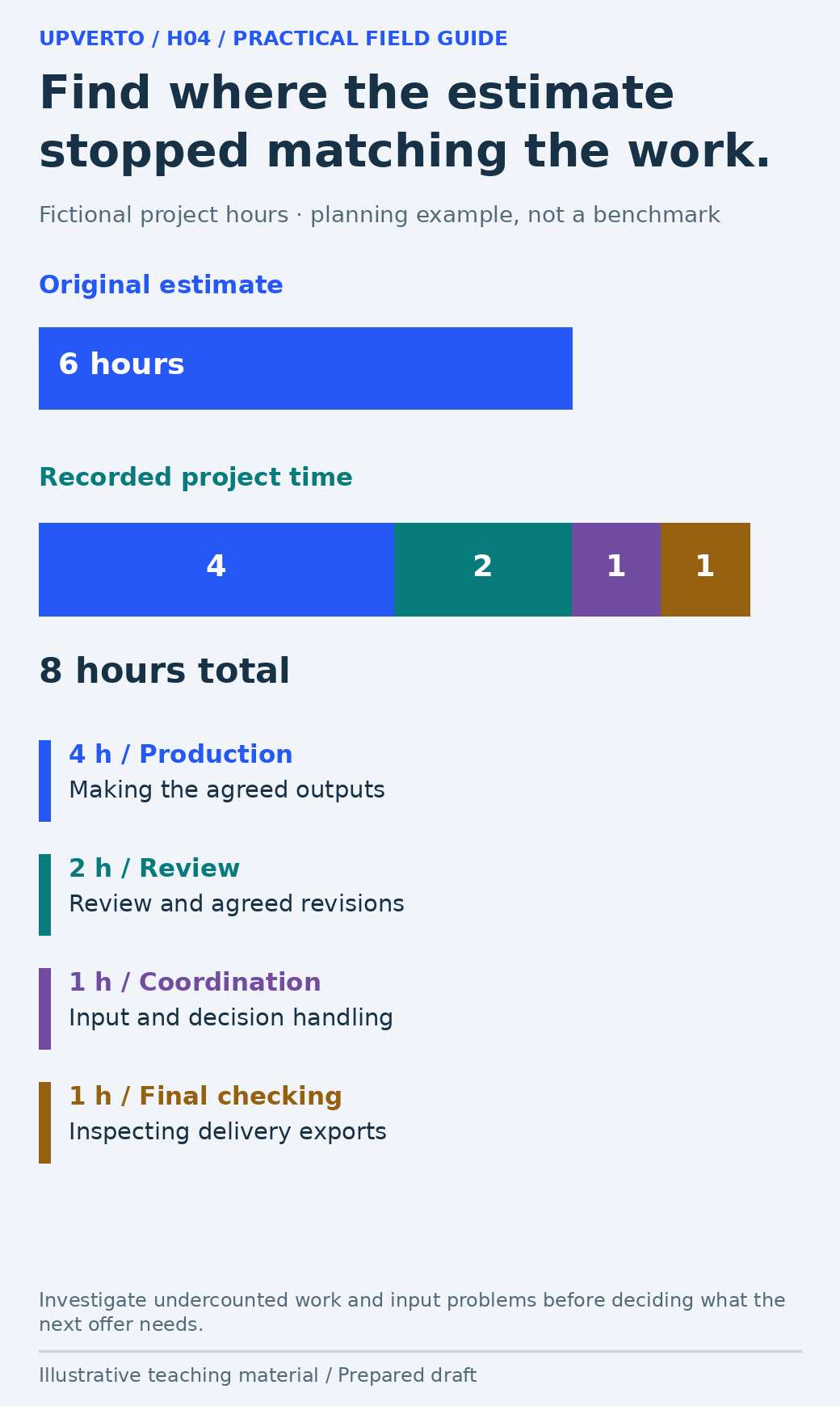
Fictional example: the original estimate is 6 hours. Recorded time totals 8 hours: production 4, review 2, coordination 1 and checking 1. Bar lengths use the same scale. Investigate the estimate and input/process conditions before deciding on a future scope or price. These figures are not a benchmark or forecast.
Separate price pressure from scope or process problems
| Observed pattern | Question before changing the price |
|---|---|
| Actual effort exceeds the estimate | Was the original estimate wrong, or did the work expand? |
| Many review cycles | Were the acceptance conditions and final approver clear? |
| Repeated missing inputs | Would a better intake process reduce avoidable waiting and rework? |
| Higher direct costs | Are they necessary for this service and recorded accurately? |
| Calendar overload | Is the problem capacity, scheduling or the service promise? |
| Client needs have changed | Should the offer be narrowed, redesigned or separately scoped? |
A price review can produce several legitimate outcomes: a different scope, clearer input conditions, a new delivery process, a revised quote for future work or a decision to stop offering the service. Do not assume that every difficulty requires the client to pay more for the same unresolved process.
Use track freelance income costs capacity to obtain the records behind the discussion. Include non-production time that belongs to the project, such as coordination and checking. Avoid comparing a fee only with time spent making the visible output while ignoring the work needed to deliver it responsibly.
Worked example: the six-hour estimate becomes eight
Fictional arithmetic example: A defined design job was estimated at six hours and agreed at 300 monetary units. The recorded project time is eight hours: four production, two review, one coordination and one final checking. Direct external costs are 20 units. These are invented planning values, not market prices or expected earnings.
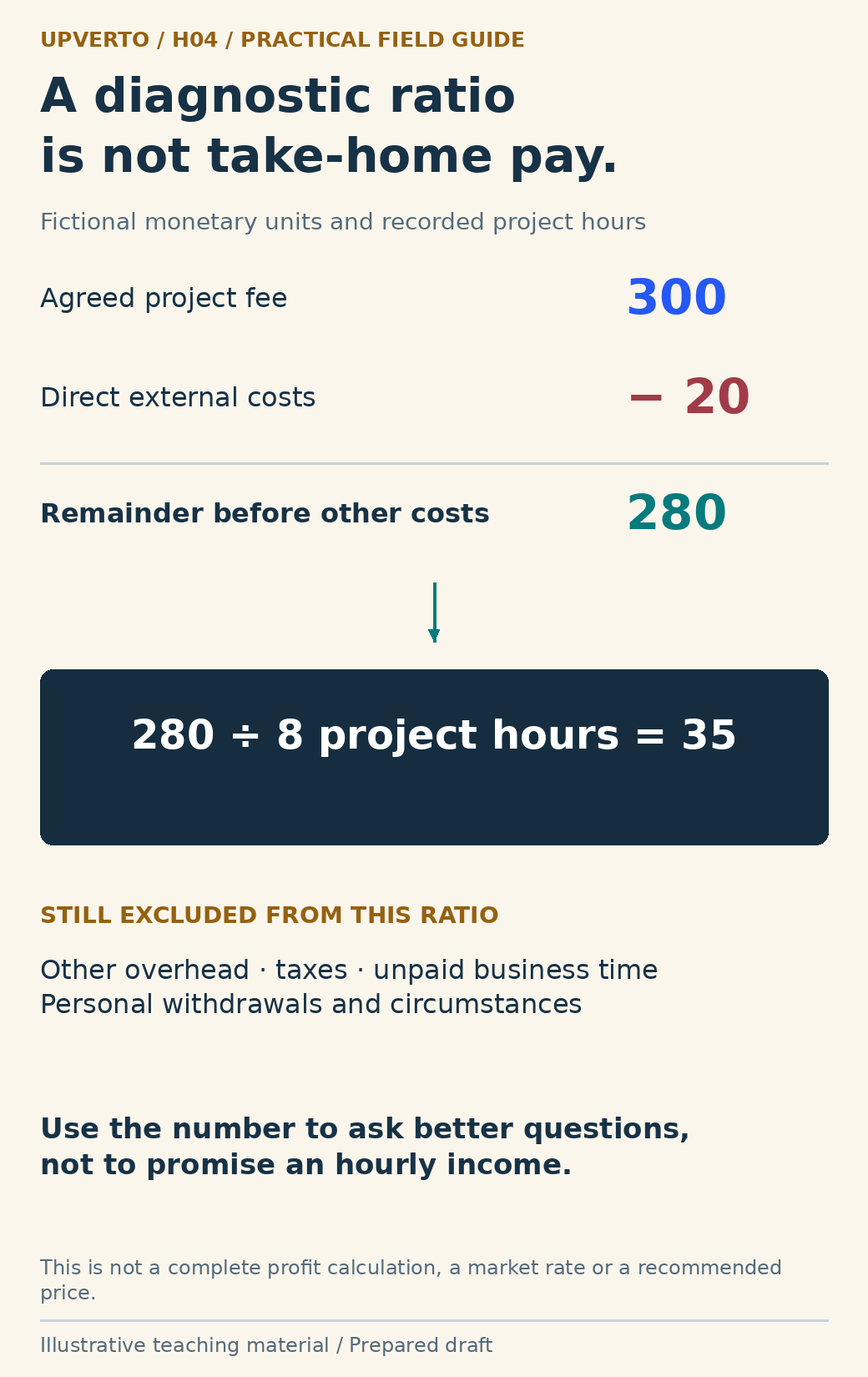
The 300-unit fee minus 20 units of direct costs leaves 280 units before other overhead, taxes, unpaid business time and personal withdrawals. Dividing 280 by eight project hours gives 35 units per recorded project hour. That diagnostic ratio is not take-home hourly pay and is not a complete profit calculation.
| Question | Fictional finding | Possible response |
|---|---|---|
| Did the output expand? | No additional format was added | Do not label all extra time new scope |
| Where was time underestimated? | Review and checking were undercounted | Improve the estimate for comparable future work |
| Were inputs unclear? | Two unapproved copy changes caused avoidable review | Confirm copy approval before layout |
| What should change next? | Future scope and estimate need revision | Prepare a clear new proposal; do not alter an existing fee silently |
Read the text version: Interpret a price-review ratio with its limits
Fictional arithmetic: 300 monetary units fee minus 20 direct external costs equals 280 before other costs. Dividing 280 by 8 recorded project hours equals 35 per recorded hour. Other overhead, taxes, unpaid business time and personal circumstances are excluded. This is not complete profit, take-home pay, a market rate or a recommended price.
Copy a price-review worksheet
| Field | What to record |
|---|---|
| Comparable service | Deliverables, audience, input conditions and responsibility |
| Previous assumptions | Estimated effort, costs, review and support |
| Observed records | Actual time categories, costs and scope changes |
| Cause | Estimate gap, process problem, changed requirement or genuine cost change |
| Proposed offer | What stays, changes or is excluded |
| Planning calculation | Your own assumptions and costs, clearly distinguished from a market claim |
| Capacity and fit | Whether you can deliver the revised promise |
| Communication | Which future quote or renewal is affected and what needs agreement |
If you use an internal time allowance to inform a future price, label it as your planning assumption. Include the costs and business responsibilities you actually need to cover. A spreadsheet result is not evidence that a buyer values the offer at that amount. Consider the task, alternatives and the client’s context without claiming certainty about demand.
Review outliers separately. A one-off corrupted file or unusual emergency may not represent normal work. Conversely, a problem that repeats across several comparable projects deserves attention. Keep enough context to explain why the new assumption is more credible than the old one.
Explain a proposed change before it applies
For a new enquiry, quote the current defined service clearly. For an existing engagement or renewal, follow the actual agreement and discuss the proposed change before applying it. Legal requirements and contract terms vary; this guide does not prescribe a universal notice period or right to change an existing price.
Fictional communication outline: “For the next project, I propose a package that includes the two named formats, one consolidated review stage and final export checks. My recent records show that those checks and coordination need more time than the old estimate allowed. The attached proposal states the revised fee and input conditions. Please review it before we schedule the next project; the current agreed project remains governed by its existing terms.”
Explain the changed offer and decision without apologising for a legitimate review or inventing a scarcity claim. Give the client a clear way to accept, ask questions or decline. If you offer a smaller option, make its reduced scope explicit rather than quietly delivering less under the old description.
Check whether the revised offer works in practice
After using the revised scope, compare the assumptions with actual work again. Did copy approval reduce avoidable revisions? Did you allow enough checking time? Did the agreed capacity remain manageable? These observations can improve the next estimate without turning every project into a price experiment.
For continuing work, use retain freelance clients ongoing services to discuss usefulness and boundaries at the review point. A responsible price conversation connects the fee to a clear, deliverable service. It does not guarantee acceptance, profitability or a particular level of income.
Frequently asked questions
How often should I raise my prices?
There is no universal schedule or required increase. Review relevant costs, effort, responsibility and service changes at a sensible interval or when evidence changes. A review may lead to clearer scope or process improvements instead of a higher fee.
Can I increase the price halfway through a project?
Do not change an existing agreement unilaterally. Follow its terms and the applicable requirements. If genuinely new work is requested, explain and agree its impact through the change process before starting it.
Does earning 35 units per project hour mean I take home 35?
No. In the example, the ratio subtracts only direct external costs and uses recorded project hours. Other overhead, taxes, unpaid business work and personal circumstances are not included.
What if competitors advertise much lower prices?
Compare the actual outputs, inputs, responsibility, support and evidence rather than the number alone. You may need a different scope or customer fit. This guide does not claim that matching or exceeding another price produces work.
Should I give every existing client a discount?
That is a business decision within your agreement and circumstances, not a rule. Assess the defined service and costs, explain any option clearly and avoid a concession that creates an unsustainable promise.
What if a client declines the revised offer?
Respect the decision and discuss a genuinely smaller scope only if it would still be useful and deliverable. Do not hide exclusions or promise the full service at a price your records show you cannot responsibly support.
Sources and scope
The worked examples, worksheets and diagrams are original fictional teaching materials. They are not reports of client results. Primary references were checked during preparation; verify current rules and account-specific features before acting.