Repeat work starts with a continuing need that you can serve reliably. After a useful handover, identify what will change, who owns it and what support would help. An ongoing relationship should remain understandable to both sides: defined outputs, workable communication and a clear review point. This is one part of grow a sustainable freelance business.
Look for a recurring job, not a reason to keep billing
Begin after the freelance project handover, when the recipient can use the completed work and any remaining issues are clear. Ask what will need attention next. The answer might be a changing workshop schedule, a repeated reporting task or a content calendar. It might also be “nothing for now,” which is a valid conclusion.
A recurring need has a recognisable trigger and a useful outcome. “Update the approved event details when the programme changes” is easier to define than “keep improving everything.” Identify who supplies information, how often it genuinely changes and what happens if nobody acts. Do not promise monitoring, urgent response or new specialist capability simply because you delivered the original project.
Distinguish prevention, maintenance and new production. Checking whether an agreed link still works is different from writing a new landing page. Updating supplied text is different from deciding the organisation’s legal wording. Naming the task prevents a friendly relationship from becoming an undefined support obligation.
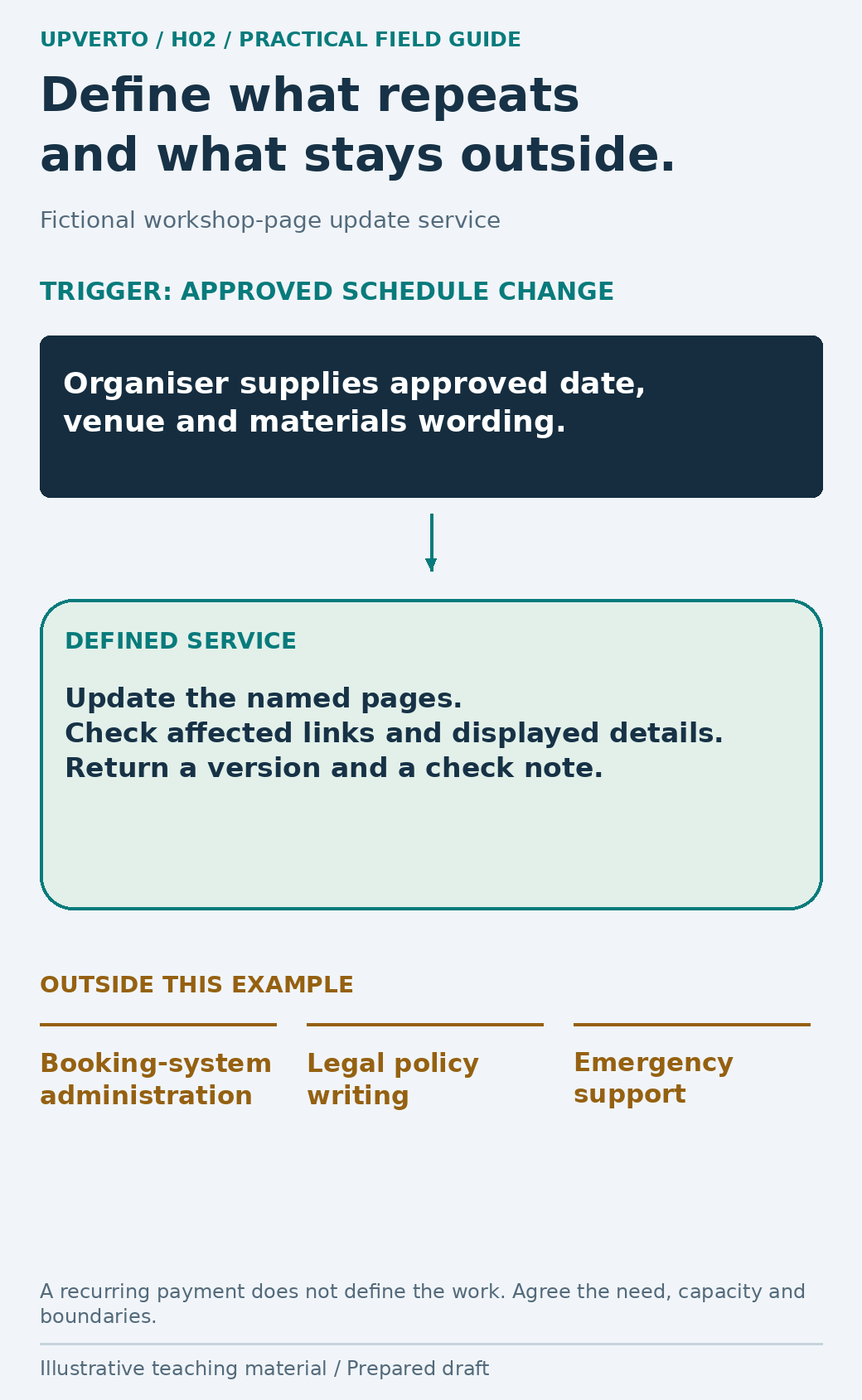
Read the text version: Define a recurring service from its actual trigger
In this fictional ongoing service, an organiser supplies approved date, venue and materials wording. The freelancer updates named pages, checks affected links and details, and returns a version and check note. The example excludes booking-system administration, legal policy writing and emergency support. Capacity, communication and payment arrangements require their own agreement.
Make the ongoing service concrete
| Boundary | Question to settle |
|---|---|
| Trigger | What event starts the work: a scheduled review or a specific approved request? |
| Outputs | What will be supplied, in what form, and what is excluded? |
| Inputs | Who provides approved content or data and by when? |
| Capacity | How much work can be handled and how is excess demand discussed? |
| Communication | Which channel, response expectation and decision owner apply? |
| Review and exit | When will usefulness be reviewed, and what happens when the need changes? |
The guide to hourly vs fixed price vs retainer owns the payment-model discussion. Relationship strategy comes first here: understand the need and the work before selecting a charging arrangement. A recurring payment model does not make an unclear service useful, and an informal relationship does not remove the need to agree boundaries.
Be precise about response and resolution. Acknowledging a request within an agreed period does not guarantee that every issue will be fixed in that time. State dependencies and exceptions in language the client can understand. If you cannot support urgent incidents, do not imply an emergency service.
Review usefulness with evidence appropriate to the task
The GOV.UK guidance on service metrics begins with the purpose of the service and gives measurements context. A small ongoing freelance arrangement can use the same principle without adopting a large dashboard. Select evidence that shows whether the agreed work is being performed and whether it remains useful.
For a schedule-update service, a useful record might identify approved changes received, the versions updated, checks completed and unresolved questions. That record does not prove increased attendance or revenue. For a recurring report, the important evidence may be whether the figures reconcile and the intended reader can use the report, not how many pages you produced.
Ask the client what is helping, what creates friction and what should stop. Record specific answers rather than turning every positive comment into a testimonial. Where an outcome has not been measured or has multiple causes, describe your contribution and the observed result accurately.
Worked example: reviewing a workshop update service
Fictional scenario: Cedar Lane has changing workshop details. A proposed service updates supplied approved text on named pages and provides a check note. It excludes booking-system administration, legal policy writing and emergency support. The following review records are invented to demonstrate decisions; they are not evidence of a real service.
| Review period | Fictional need | Useful decision |
|---|---|---|
| Cycle 1 | Four approved workshop changes supplied | Update the named pages and record checks |
| Cycle 2 | One cancellation; wording not yet approved | Ask the owner for approved wording before changing the page |
| Cycle 3 | No schedule changes | Review whether the arrangement should continue unchanged, narrow or pause |
The third cycle is not automatically a failure, nor a reason to invent work. The parties might still need a defined scheduled check, or the update service might no longer be useful. The right decision depends on the agreed responsibilities and actual need. A good relationship permits that discussion without pressure.
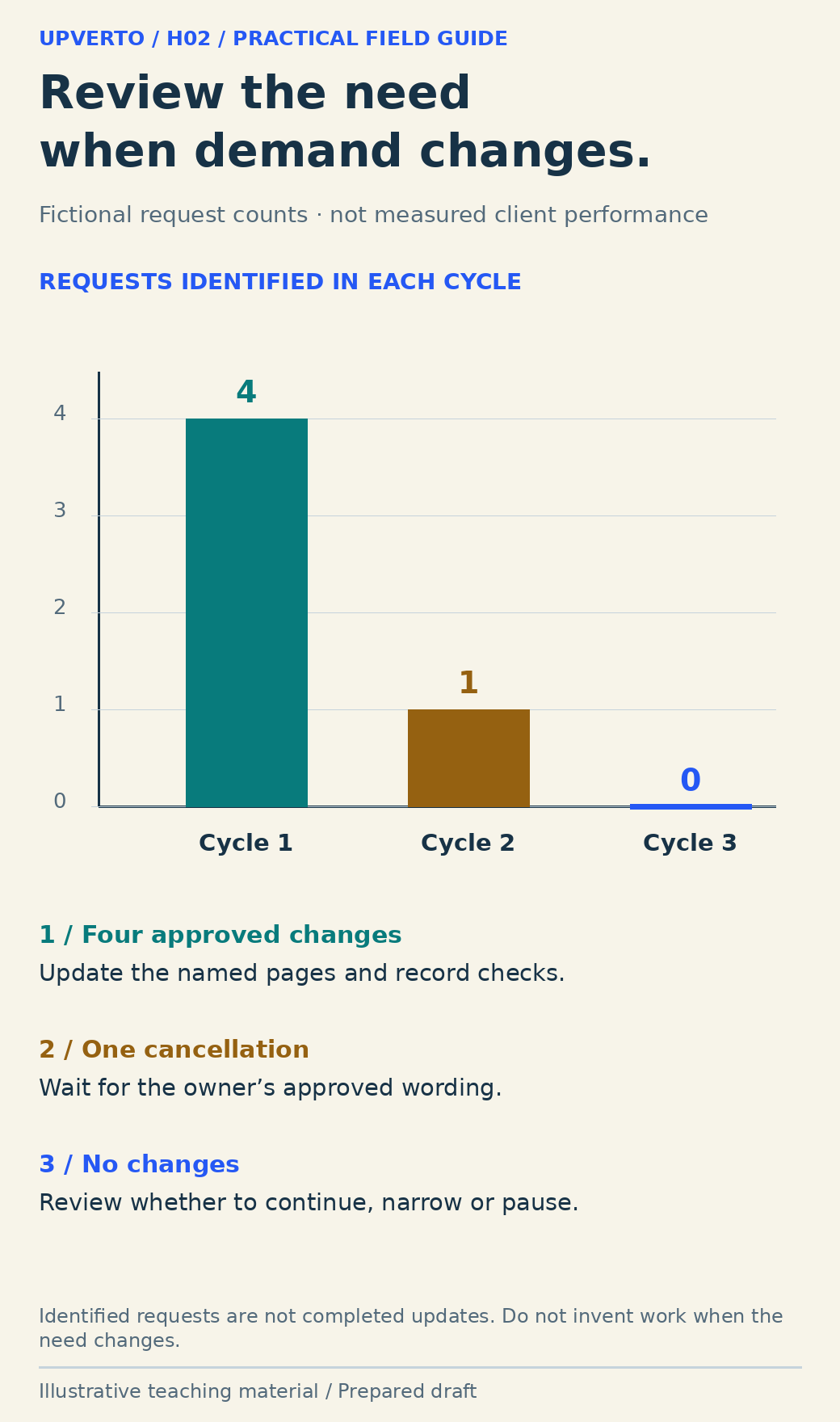
Read the text version: Use changing request volume to review an ongoing service
Fictional identified request counts are 4, 1 and 0 across three review cycles. Cycle 1 has four approved changes to update and check. Cycle 2 has a cancellation whose wording needs owner approval. Cycle 3 has no changes and prompts a discussion about continuing, narrowing or pausing. Identified requests are not the same as completed work, and no performance outcome is claimed.
Copy an ongoing-service review note
| Field | What to record |
|---|---|
| Continuing need | The recurring task and its trigger |
| Work completed | Actual outputs and relevant versions |
| Evidence | Checks, client observations and unresolved limitations |
| Demand versus capacity | Requests received, work deferred and why |
| Inputs and decisions | What repeatedly arrives late or remains unclear |
| Boundary changes | New work requested and whether it needs a separate agreement |
| Next period | Continue, narrow, change, pause or end, with an owner and date |
Use the review to improve the arrangement, not merely justify its continuation. If the client repeatedly asks for work outside the service, investigate whether the offer is wrong or the boundary is unclear. If input quality causes repeated delays, consider a better intake process. If demand is lower than expected, discuss a proportionate alternative.
Keep the client’s account and data access aligned with the continuing task. A past project does not authorise new access or reuse of confidential information. If the service pauses or ends, follow the agreed handover, access and record process so there is no unclear owner for a live responsibility.
Invite the next conversation without pressure
A useful invitation is specific: “The next workshop schedule changes monthly. Would it help to agree a small update process for the named pages, with approved copy supplied by the organiser?” It connects the offer to a known workflow and leaves room for the client to decline or choose another approach.
Avoid implying that the original delivery will become unusable unless the client buys more work. Explain real dependencies honestly, including what the client can manage themselves. A relationship can remain valuable after a project ends, and a successful handover should not be weakened to create dependence.
If the completed work supports it, ask freelance clients testimonials referrals explains how to request accurate feedback or an introduction with permission. Repeat work and referrals both depend on real experience; neither should be presented as a guaranteed result of a particular message.
Frequently asked questions
When should I discuss ongoing work?
After the current delivery and remaining responsibilities are clear, or earlier when a known recurring need affects the original scope. Connect the conversation to a concrete task and avoid using unfinished work as pressure to buy more.
Does every client need a monthly arrangement?
No. Some needs are occasional, one-off or already covered internally. Choose an arrangement that reflects actual work and review it when demand changes. Do not invent recurring tasks solely to justify billing.
How can I avoid promising unlimited support?
Name the outputs, capacity, channel, response expectations and exclusions. Explain how additional work or urgent issues are handled. A friendly relationship benefits from boundaries that both sides can understand.
What should I measure?
Use evidence related to the service’s purpose, such as approved changes processed and checks completed. Distinguish those records from unmeasured sales or attendance outcomes. Ask the client whether the work remains useful.
What if the client needs less work than expected?
Review the actual need and agreement. A narrower, paused or different arrangement may be appropriate. Discuss the options clearly rather than generating unnecessary activity to preserve the original volume.
Can I use the client’s account for a new service?
Only with appropriate authority for the new task. Existing access does not automatically authorise expanded work or data use. Agree responsibilities, access and boundaries before proceeding.
Sources and scope
The worked examples, worksheets and diagrams are original fictional teaching materials. They are not reports of client results. Primary references were checked during preparation; verify current rules and account-specific features before acting.