A useful complementary skill solves a specific problem in work you can already do. It might help you inspect an export, understand a client’s input or handle a repeated dependency. It does not need to be the next popular tool.
Start with evidence from your primary skill. If you cannot yet complete its basic task, another roadmap may hide the gap instead of resolving it. The broader guide to how to learn a digital skill explains the learning cycle. Here, the decision is narrower: which additional capability is worth learning next, and how will you tell?

In this guide
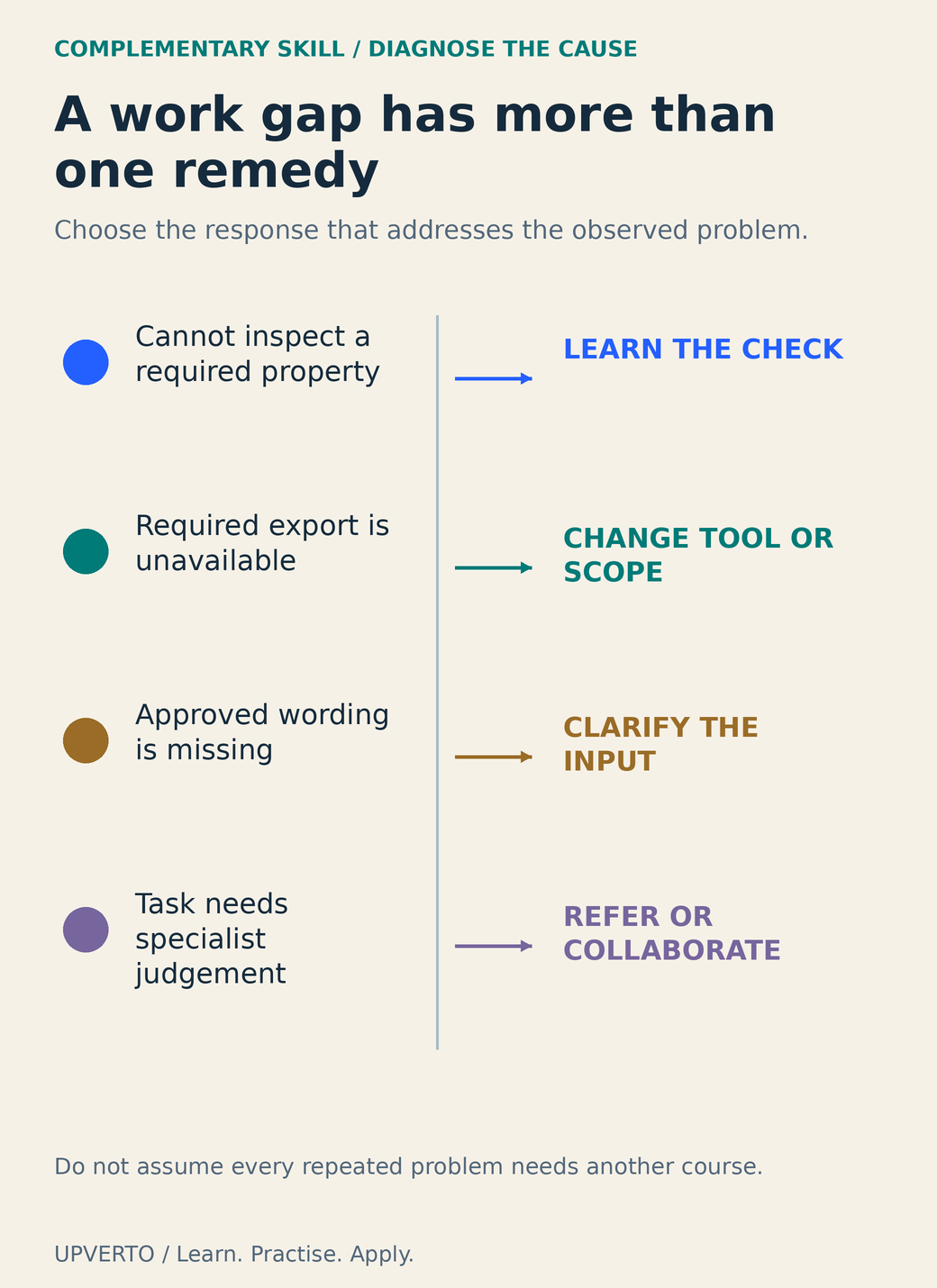
Read the text version: Match an observed gap to a suitable response
Choose a response from the observed cause. If you cannot inspect a required output property, learn the checking method. If the necessary export is unavailable, investigate another tool or revise the scope. If approved wording is missing, clarify the input and approval responsibility. If the work requires specialist judgement beyond your competence, refer or collaborate. These are illustrative mappings to investigate, not automatic rules. Another course is not the solution to every repeated problem.
Establish a reliable primary task first
Name an output you can produce, check and explain. “I can format a short information document from approved copy and inspect the exported PDF” is a useful starting point. “I know design, marketing and AI” does not reveal which work is reliable enough to extend.
Review the ready for paid client work checklist for the primary task. A complementary skill is not a substitute for communication, estimation or recovery. If the main task repeatedly fails because files are disorganised, a new animation course may not be the relevant next step.
Collect observations from practice or permitted real work. Record the point where you stopped, the help you needed and the consequence for the output. Keep facts separate from interpretations. “I could not confirm the PDF reading order” identifies an observed gap; “clients want me to become an accessibility expert” would require additional evidence.
Distinguish a learning gap from other problems
| Observed problem | Possible response | What to check first |
|---|---|---|
| Repeatedly cannot inspect an important output property | Learn the relevant checking method. | Is the check within the service you want to offer? |
| Client supplies ambiguous copy | Improve briefing and approval questions. | Is copywriting actually included or simply missing? |
| Tool cannot export the required format | Change tool or delivery agreement. | Is the limit technical, contractual or just unfamiliar? |
| Specialist work is occasional and high consequence | Refer or collaborate with a qualified specialist. | Can a short course genuinely support the responsibility? |
| Too many unrelated tasks compete for time | Narrow the service or prioritise work. | Would another skill increase the overload? |
Learning is one possible intervention. A checklist, clearer input requirement, different tool or professional referral may solve the problem more directly. Choose the response that fits the actual cause.
Compare candidates by the task they unlock
For each candidate, write the precise improvement it could enable. A video editor might learn basic audio inspection to identify an unusable recording before promising a clean edit. A document designer might learn accessible heading and reading-order checks. A website builder might learn version control to keep changes inspectable. These are examples of adjacent capabilities, not claims about market demand.
Primary curricula can help you define the content of a gap. MDN’s accessibility curriculum treats accessible styling, interaction and assistive technology as connected capabilities in web work. It is a scope reference, not proof that completing one module qualifies someone to certify every website.
Compare the learning effort, tool access, risk and frequency of use. Avoid a numerical score that looks scientific without a basis. A short written decision is often clearer: “Learn basic heading structure now because it affects every information page I build; defer advanced animation because the current service does not use it.” If you are still choosing your first field, return to which digital skill should I learn instead.
Worked example: document layout plus reading-order checks
Fictional learner: Leila can create a two-page information sheet. In a practice review, the document looks orderly, but she cannot explain how its headings and content will be read by assistive technology. She considers learning logo animation, advanced illustration or document structure and reading-order checks.
Her current output is a document. The third option addresses the observed problem directly. She defines a small trial: create a document with proper heading styles, export it, inspect the structure using appropriate available tools and record any limitation she cannot resolve. Adobe’s PDF accessibility guidance provides a reference for tags and verification; it does not make visual inspection alone sufficient.
The trial result is not a promised accessibility certification. It is a concrete set of files and notes showing what she could check. If the tool cannot expose the required structure, she identifies that limitation and seeks suitable help rather than claiming compliance from appearance.
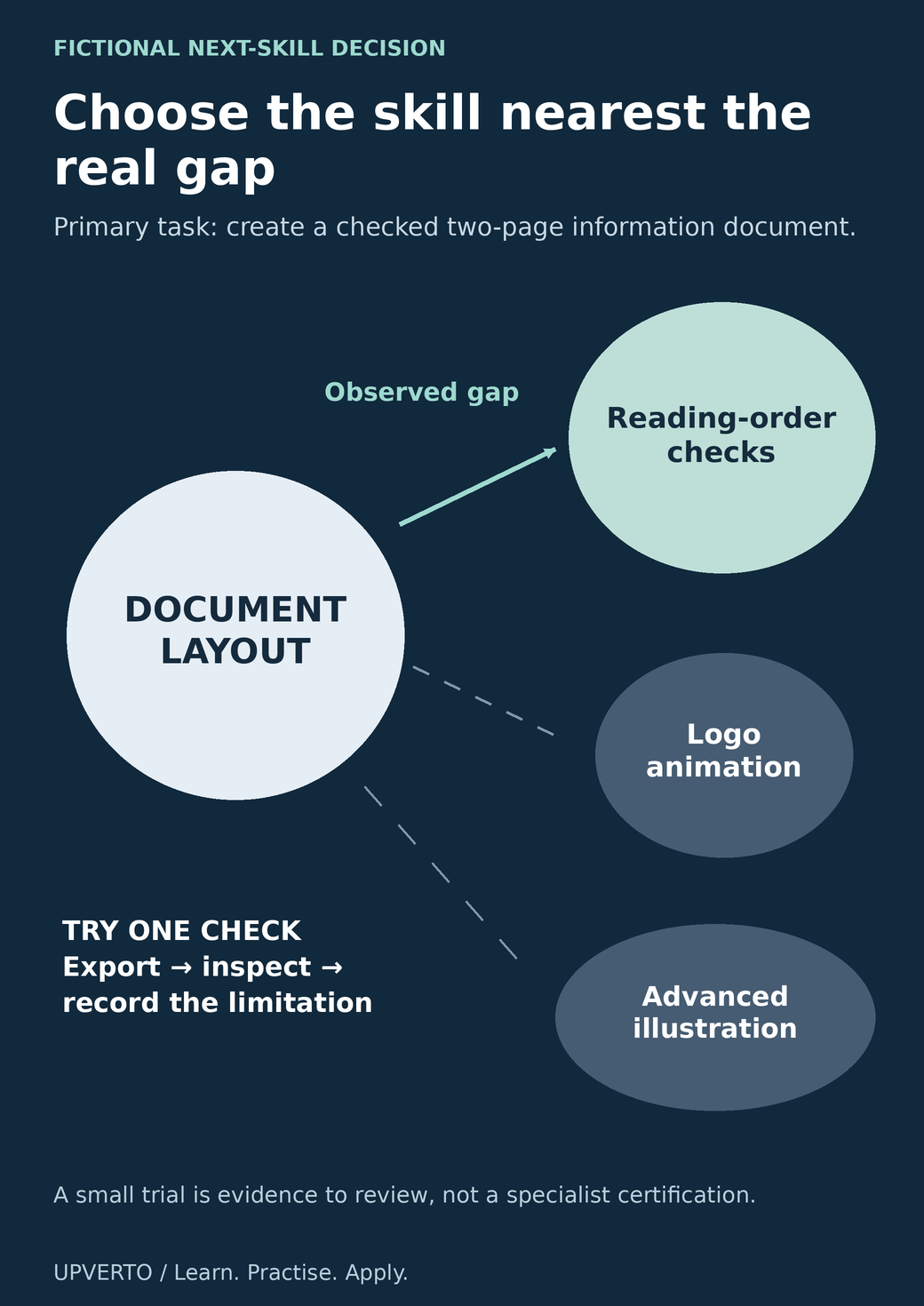
Read the text version: Select a complementary capability from the observed gap
In the fictional example, the reliable primary task is two-page document layout. The observed gap is an inability to inspect reading order. Learning that check is connected directly to the task. Logo animation and advanced illustration may be future interests, but they do not address the current gap and are shown as deferred options. Run a small trial: export the document, inspect its structure and record unresolved limitations. The trial is evidence for the next learning decision, not a specialist certification.
After the trial, she can decide whether to continue learning, change the format or collaborate with a specialist. Logo animation remains a possible future interest, but it is not the response to the current document gap.
Use the gap-to-next-step worksheet
| Field | Your entry |
|---|---|
| Reliable primary output | Name the task and the evidence that it works. |
| Observed gap | Describe a specific failure, dependency or unanswered question. |
| Frequency and consequence | Record when it occurred and what it affected; do not invent a percentage. |
| Alternatives | Learning, process change, different tool, narrower scope or referral |
| Candidate capability | State the operation or judgement you want to add. |
| Trial output | Choose one file, check or demonstration you can inspect. |
| Decision after trial | Continue, defer, change approach or seek specialist support |
Set a review point for the trial. You need not commit to a full course catalogue before discovering whether the capability fits. Keep the original and revised work so the comparison shows the actual difference. Explain what remains outside your competence.
When adding a capability changes the service, revise the package, proof and estimate accordingly. Do not quietly bundle extra responsibilities into an unchanged promise. The guide to grow a sustainable freelance business connects learning decisions to capacity, delivery and business review. A useful next skill should make that system clearer, not simply make the list of tools longer.
Frequently asked questions
How is a complementary skill different from choosing a new career?
It supports a defined task you already perform or intend to perform reliably. A new career direction can be valid, but it may require a separate foundation and evidence. Name the work gap first so you know which decision you are making.
Should I learn marketing after every creative skill?
Only if a specific marketing task belongs in your intended work and you can define its responsibility. A designer does not automatically need to own campaign strategy, advertising or analytics. Client communication and clear service explanation may be the more immediate gap.
What if the gap appears only once?
Investigate its consequence and likely recurrence before investing heavily. A rare specialist task may be better referred or excluded. One occurrence can still justify learning when it exposes a fundamental check you need, but record the reason rather than assuming frequency.
Can a short course qualify me to offer a specialist audit?
Course completion alone does not establish that you can assess every relevant condition or support the conclusions. Use practice, appropriate references and review to understand your limits. Narrow the offer or collaborate when the work exceeds your demonstrated competence.
How should I compare two possible next skills?
Write the task each would improve, the observed evidence for that need, the learning and tool requirements and the consequences of getting it wrong. Choose a small trial for the stronger candidate. Avoid treating an invented weighted score as objective evidence.
When should I update my portfolio after learning the new skill?
When you have a checked example that demonstrates the new capability and can explain its limits. Show the specific improvement and your contribution. Do not add a broad expert label simply because you completed an introductory module.
Sources and review notes
Primary sources checked on 27 October 2026 (UTC). Check the current provider pages before relying on a changing feature, policy or price. Worked examples and worksheets are original teaching material; fictional examples are not evidence of client results.