Useful outreach begins with a defensible reason to contact one particular business. Identify a relevant problem, separate what you observed from what you guessed, and offer a manageable next step through an appropriate channel. Personalisation is the substance of that connection, not inserting a name into a mass message. The broader guide to how to find freelance clients explains where outreach fits among other ways of finding work.
Find a reason that survives inspection
Start with a service you can explain and deliver. “I help anyone with anything online” gives you no basis for selecting a prospect. A more workable offer names an output, an audience and a boundary: updating supplied workshop details on an existing website, with a review copy for approval before any live change.
If that description is still unclear, first write a freelance service page. You can also use the guide to choose freelance client niche to narrow the kind of business whose workflow you understand. A niche is a working choice to investigate, not permission to assume that every business in it has the same problem.
Look at information the organisation intentionally makes public for the relevant purpose: its service description, a public request for suppliers, its stated application process or an event page. Record the exact page and date. Read enough surrounding material to avoid treating an archived event, an intentional design choice or an already answered question as a defect.
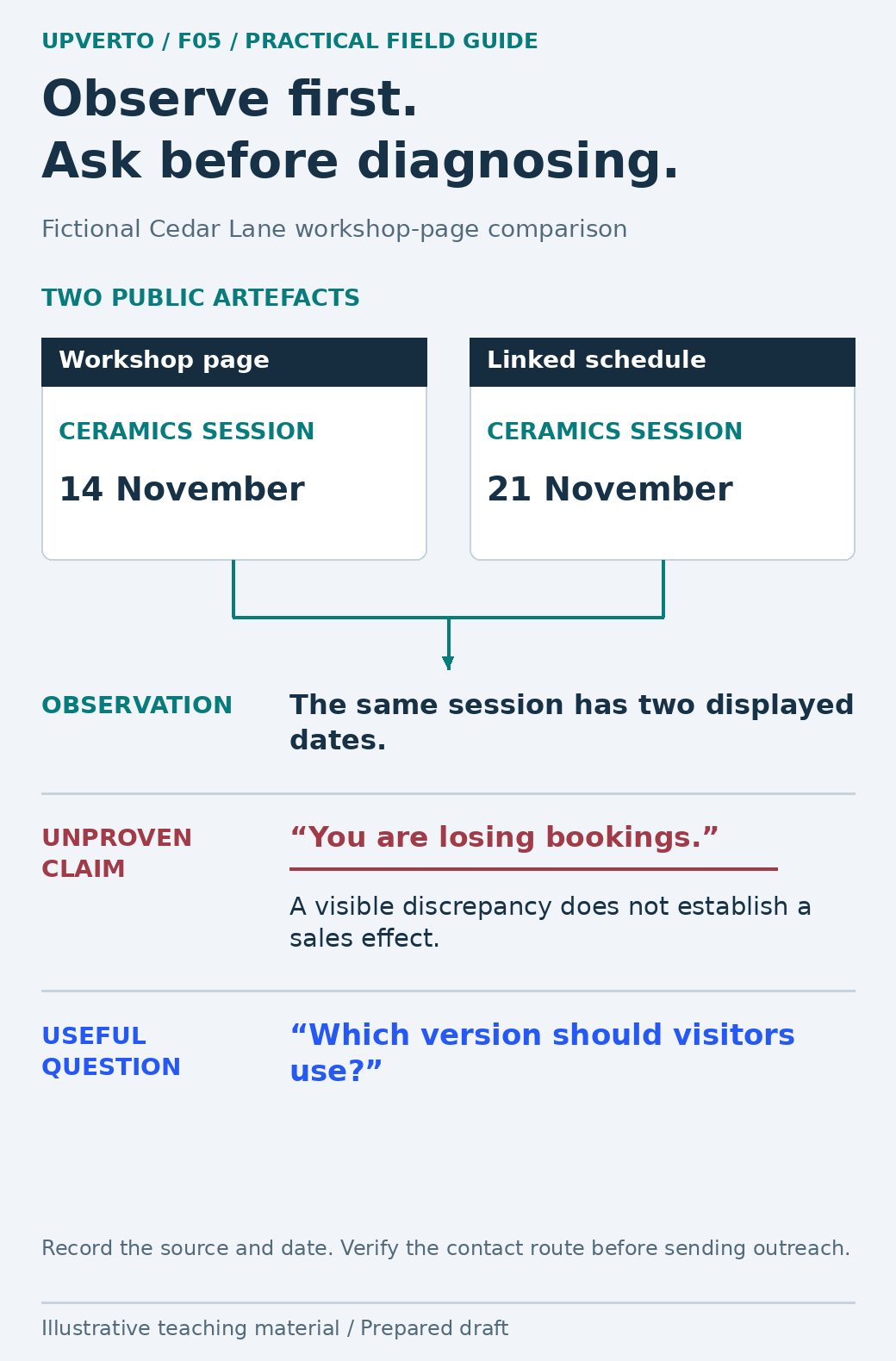
Read the text version: Separate observable evidence from a prospecting claim
Fictional example: a Cedar Lane workshop page says 14 November and the linked schedule says 21 November. The observable fact is a disagreement between dates. A claim that this is losing bookings is not established. Ask which version visitors should use, and check the appropriate contact route before sending anything.
Separate observation, hypothesis and question
An observation describes something another person could inspect. “The workshop page lists 14 November and the downloadable schedule lists 21 November” is an observation in our fictional example. “You are losing customers” is an unsupported outcome claim. “Which date should visitors use?” is a useful question that the business can answer.
The distinction changes your behaviour. If you cannot verify the cause or effect, do not present a diagnosis as established fact. Offer to check a small, relevant issue rather than declaring the whole business broken. Do not run intrusive scans, submit fake enquiries, access private accounts or modify files to manufacture evidence for a pitch.
Reject weak prospects before drafting a message. A visible issue may already have an internal owner, be outside your ability or have no meaningful connection to your service. A record marked “not suitable” is useful because it prevents repeated irrelevant contact. You do not need to collect employees’ private details to make that decision.
Check whether and how contact is appropriate
Channel permission and business relevance are separate questions. A publicly visible address does not settle the rules for using it. The UK ICO’s business-to-business marketing guidance distinguishes recipient types and explains that personal-data rules may apply in a business context. That is a UK example, not a worldwide permission rule. Check the applicable location, recipient category and channel requirements before sending commercial messages.
Follow the receiving organisation’s published process. A supplier application form is different from an emergency support address or a private employee account. On LinkedIn, the Professional Community Policies prohibit spam and using invitations for promotional messages to people you do not know. Its User Agreement also restricts scraping and unauthorised automation. Do not use a tool to turn a small relevance exercise into a scraped contact list.
Keep only the information needed to explain the fit, record the appropriate contact route and avoid recontacting someone who declined. Limit access to your log and review whether old records are still needed. If you cannot establish an appropriate route, use another acquisition method or wait for a public request; an unresolved permission question is a reason to pause that message.
Worked example: a workshop-page discrepancy
Fictional scenario: Cedar Lane Workshops publishes two different dates for the same session. A designer has an honestly labelled practice example showing how event details can be grouped and checked. No real organisation was inspected, and the following message was not sent. Assume the recipient has invited relevant supplier enquiries through its stated channel.
Subject: Which date should the ceramics workshop page use?
Hello Cedar Lane team, your workshop page lists 14 November, while the linked schedule lists 21 November. I may be looking at an older schedule. Is there a preferred version?
I prepare small website-content updates from approved copy, including a review draft and a check of the affected links. My linked example is a self-directed practice project, not client work. If updating this page is on your list, would a short discussion of the required changes be useful?
If this is not relevant, I will leave it there. Thank you, Amira.
The opening identifies the exact discrepancy without claiming lost sales. The uncertainty is visible. The offer matches the observed task, the evidence is labelled, and the question can be answered without committing to a project. The message does not invent familiarity, praise the business generically or imply that a free audit has uncovered hidden problems.
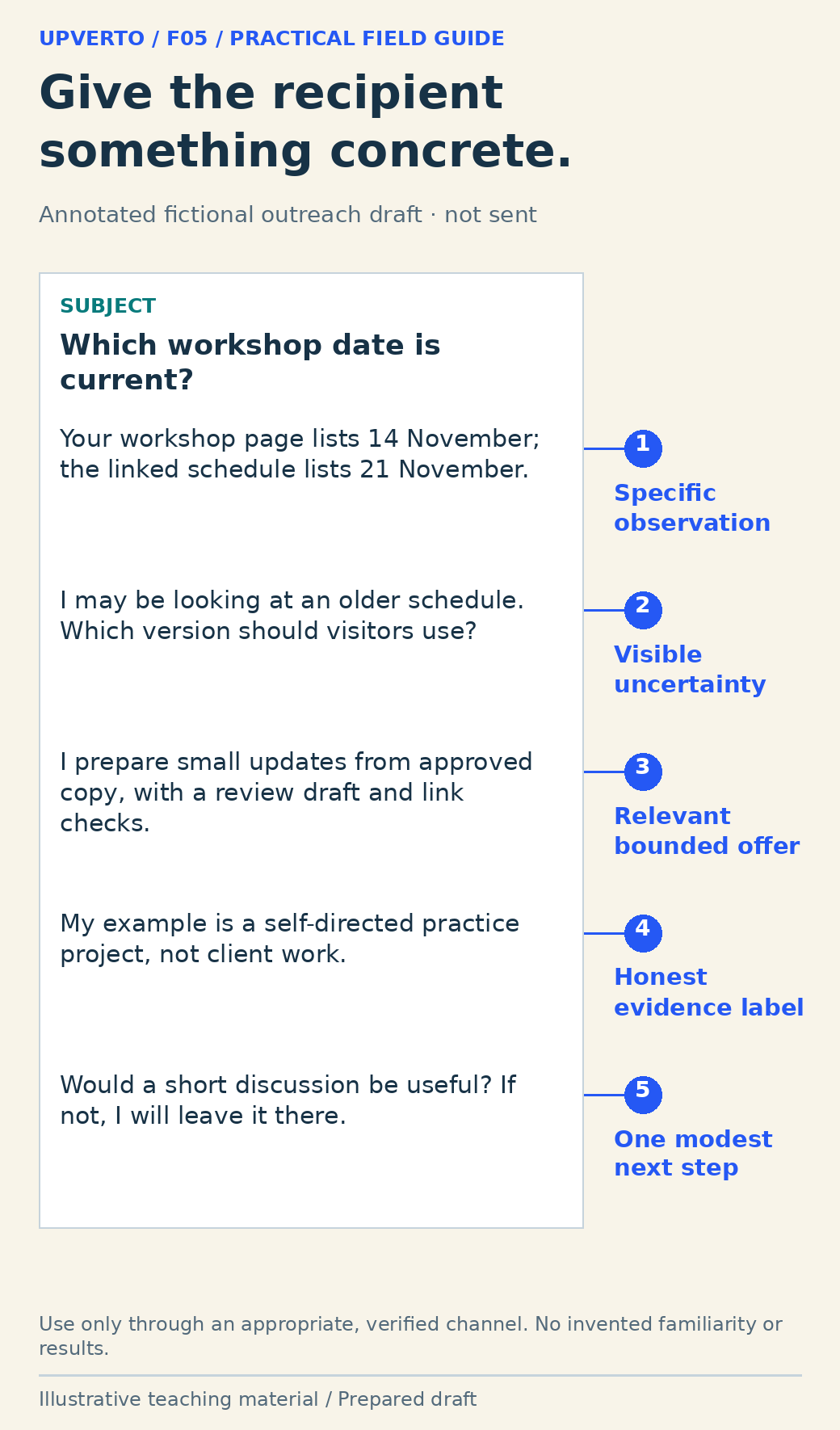
Read the text version: Annotate a relevant outreach message
This fictional draft has five parts: a specific difference between displayed dates; an acknowledgement that one schedule may be old; a small service based on approved copy; an honest self-directed-practice label; and a request for a short discussion without pressure. The message is not sent, and appropriateness of contact must be checked separately.
Copy this prospect log and message check
| Field | Fictional filled example |
|---|---|
| Organisation and public source | Cedar Lane Workshops; workshop page and linked schedule; inspected date recorded in your own log |
| Observation | The same session has two displayed dates |
| Unknown | Which schedule is current; whether an update is wanted |
| Service fit | A small approved-copy update; no booking-system rebuild |
| Evidence | Clearly labelled practice page and checking note |
| Contact basis and route | Record the actual invitation or other verified appropriate basis before sending |
| Status and next action | Prepared only; verify dates and contact route |
| Do-not-contact note | Record a decline or request to stop; do not override it |
Before sending, remove any claim you cannot substantiate. Check the recipient, reference link, spelling, offer boundaries and contact requirements. Read the message as the recipient: can they see why it concerns their work, what evidence you have and what decision you are requesting? A technically personalised message can still be irrelevant.
Use the log to organise decisions, not to assign invented lead scores. Keep “researched,” “appropriate to contact,” “sent,” “replied” and “closed” distinct. A prepared draft is not a sent message; a reply is not a qualified project. These differences matter when you later review whether the offer or channel needs to change.
Handle replies and silence proportionately
A useful reply may correct your observation, decline the offer or identify a different owner. Thank the person and update the record. When someone asks you to stop, stop. Do not shift to another channel to evade that choice. Silence does not establish interest, consent or a commitment to read further messages.
There is no universal follow-up count that makes contact appropriate. Consider the channel rules, the original invitation and whether you have a legitimate new reason to write. If a follow-up is appropriate, keep it brief and make the connection to the earlier message clear. Do not add urgency you cannot justify or send an automated sequence indefinitely.
When there is genuine interest, move to freelance discovery call questions to clarify the task before quoting. The goal of the first message is an informed conversation about a plausible need. It does not guarantee a response, a contract or any income.
Frequently asked questions
How many prospects should I contact each day?
Use the number you can research and handle responsibly, within the relevant channel rules. A daily target that encourages weak relevance or ignored objections is counterproductive. Record why each prospect fits before counting them as appropriate to contact.
Can I say a website problem is costing the business money?
Only if you have adequate evidence for that particular claim. A visible inconsistency does not establish lost revenue. Describe the observable issue and ask about its importance instead of inventing a business impact.
Is a public business email address permission to send a pitch?
Not by itself. Recipient type, location, applicable marketing rules and the stated purpose of the address matter. Check current official requirements and the organisation’s contact instructions before sending.
Can AI personalise my outreach?
It can help edit your own verified notes, but you remain responsible for relevance, accuracy and the channel rules. Do not upload confidential data, invent shared history or allow a tool to scrape contacts and send messages automatically.
What should I do after a polite rejection?
Record the answer and close the opportunity unless the person explicitly invites a future conversation. Do not treat a rejection as an objection you must overcome or continue through a different account.
Can a practice project support an outreach message?
Yes, if it demonstrates the relevant task and is clearly labelled as practice. Explain your actual contribution and checks. Do not imply a client commissioned it or attach invented results to it.
Sources and scope
The worked examples, worksheets and diagrams are original fictional teaching materials. They are not reports of client results. Primary references were checked during preparation; verify current rules and account-specific features before acting.