Social media management combines planning, coordination, publishing and review. The useful output is not simply a stream of posts. It is relevant content that the organisation can approve, maintain and explain, with a record of what was published and what the available evidence says. Start by learning that operating routine on a small fictional project.

In this guide
This is one route within which digital skill should I learn. It covers organic social content and related coordination. Managing paid campaigns involves separate budget, measurement and policy responsibilities; do not quietly add them to a basic posting service.
Understand the responsibilities before choosing tools
Begin with the audience’s task. A local workshop’s visitors may need to understand the session level, check the date and know what equipment to bring. Those needs give you more useful content ideas than an arbitrary instruction to publish daily. Ask the owner which information is confirmed, which questions recur and which action a visitor can actually take.
Learn to turn those inputs into a brief, prepare copy, coordinate images, check permissions and accessibility, and route the draft for approval. Publishing requires the correct account role and an agreed schedule. Community work requires response boundaries: which questions you can answer, what must go to the owner and how sensitive messages are handled.
LinkedIn’s Page publishing documentation is an example of why platform instructions and permissions need to be checked in their current form. An account credential is not a substitute for an authorised role. Practise with drafts or a permitted test account; you do not need to publish an invented business to demonstrate the planning work.
Build a calendar from an actual information need
Willow Workshop is fictional. Its practice brief is to prepare three posts about a beginner repair session. The date, capacity and booking route are invented for this exercise. No post is scheduled or published, and no real audience response is claimed.
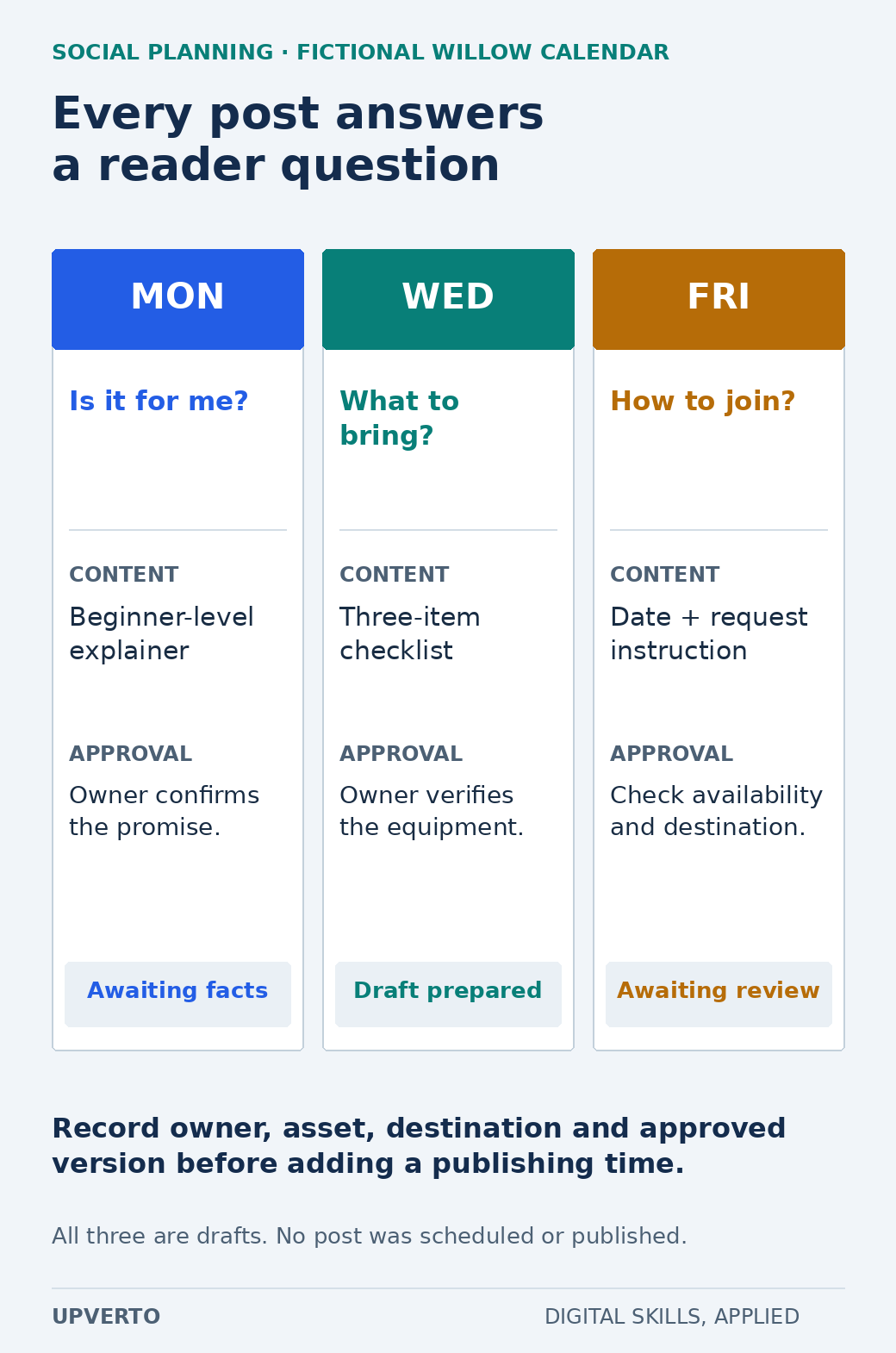
Read the text version: Plan three posts through questions and approvals
| Draft | Question | Content | Review |
|---|---|---|---|
| Monday | Is it for me? | Beginner-level explainer | Owner confirms the promise; awaiting facts |
| Wednesday | What should I bring? | Three-item checklist | Owner verifies equipment; draft prepared |
| Friday | How do I join? | Date and request instruction | Check availability and destination; awaiting review |
Record owner, asset, destination and approved version before scheduling. Nothing was published.
| Draft | Reader question | Content and input | Approval and status |
|---|---|---|---|
| Monday explainer | Is this suitable for a beginner? | Short explanation of the level; owner confirms the task taught | Owner checks the promise; awaiting confirmation |
| Wednesday preparation | What should I bring? | Three-item checklist with an original labelled illustration | Owner verifies equipment; draft prepared |
| Friday reminder | How do I request a place? | Date, location and the agreed request link | Check availability and destination before approval |
The calendar is a coordination document. Add an owner, due date, asset location, destination URL and last-approved version to each row. A scheduled time belongs after approval, not in place of it. If the date changes, the same record helps you find affected posts and update the source information.
Choose a realistic cadence for the information and production capacity available. Three well-prepared draft posts are enough for this exercise; they are not a universal recommendation for a business. Repeating an unsupported claim more frequently does not make the service useful.
Prepare one post all the way to review
Draft the Wednesday preparation post as a complete package. The fictional brief confirms that visitors bring one small repair item, a notebook and closed shoes. Write a short opening explaining the session, list those items and provide a clear way to ask about suitability. Mark the date and destination as sample details until replaced with approved information.
For the visual, use an original illustration or a photograph you have rights to use. Provide alternative text that describes useful information. If the image contains essential instructions, include those instructions in the post text too. Do not use a stock photo to imply that a particular session has already taken place.
Review the text against the brief: level, equipment, date, location, availability and link. Then check the platform preview for truncation or awkward line breaks. Save the approval and version before publishing in a real assignment. A new client request after approval should update the record rather than silently altering a scheduled draft.
Report what the numbers can support
First learn the definitions of the platform’s metrics. LinkedIn’s Page content-analytics help describes the reporting available for that product; other platforms can define impressions, views or interactions differently. State the account, period, time zone, metric definition and data source in your report. Do not compare unlike numbers as though they measured the same thing.
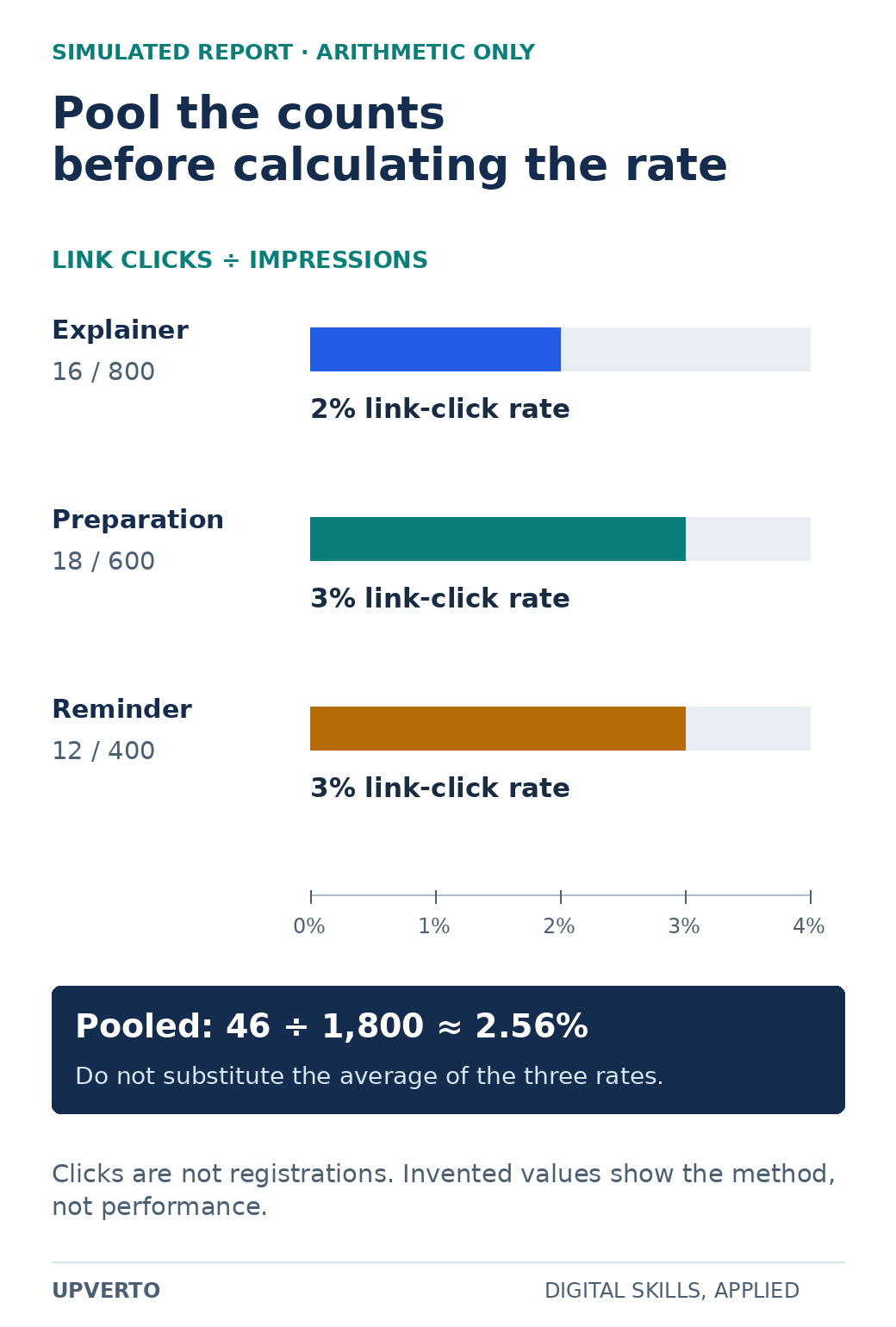
Read the text version: Calculate a pooled link-click rate
| Post | Impressions | Clicks | Defined link-click rate |
|---|---|---|---|
| Explainer | 800 | 16 | 2% |
| Preparation | 600 | 18 | 3% |
| Reminder | 400 | 12 | 3% |
Pooled rate = (16 + 18 + 12) / (800 + 600 + 400) = 46/1800 ≈ 2.56%. These invented metrics do not demonstrate registrations, sales or causal effects.
The reporting exercise uses invented values: the explainer has 800 impressions and 16 link clicks, the preparation post has 600 and 18, and the reminder has 400 and 12. The explicitly defined link-click rate is clicks divided by impressions. That gives 2%, 3% and 3%, respectively. Across the sample, 46 clicks divided by 1,800 impressions is approximately 2.56%; averaging the three percentages would answer a different question.
These numbers are arithmetic practice. They are not platform exports, reach estimates, customers or registrations. Impressions can include repeat exposure, and a click does not demonstrate a completed request. Even real differences between these three posts would not establish that one format caused better business results; timing, content and audience can vary together.
A useful report can say what is observable and what to inspect next. For the sample, you might propose checking whether the destination explains the request process clearly. You cannot conclude that the business should spend money on the apparent winning post. Keep the interpretation proportionate to the data and its limitations.
Use this operating checklist
- Before drafting: identify the reader question, approved facts, intended action and available assets.
- Before review: attach the full copy, visual, alternative text, destination and relevant claim sources.
- Before publishing: record approval, verify current details and confirm the authorised account and time zone.
- After publishing: save the actual post URL and check the visible result.
- During responses: use agreed answers, protect personal information and route unresolved issues to the owner.
- At review: report definitions, period, data source, useful observations and questions requiring more evidence.
For the practice portfolio, retain the brief, calendar, one complete post package and the sample report with a conspicuous “simulated data” label. Add a short decision note explaining why each post exists. Use choose portfolio projects for freelance services to keep the project focused on a service you might later offer.
Define a service around deliverables and boundaries
A limited planning service might deliver a calendar and six draft posts from owner-supplied information, with one review round. A publishing service adds approved scheduling and verification on named accounts. Community management adds response windows, escalation rules and a clear limit on the subjects you may address. Reporting adds the agreed data access and interpretation.
State which of these you include. Photography, video production, paid advertising, crisis response and around-the-clock inbox monitoring are separate responsibilities unless agreed. Do not promise follower growth, leads or sales that you cannot control. Your service can promise completed work and specified checks.
Use how to learn a digital skill to build the learning routine, then create freelance service packages to define inputs, outputs and review boundaries. A reliable small workflow is useful evidence of readiness; a large collection of unsourced post ideas is much harder to assess.
Frequently asked questions
Do I need a large personal following to practise this work?
No. You can demonstrate a well-researched brief, calendar, complete draft posts and a responsible reporting method without claiming audience results. Client requirements vary, so distinguish planning ability from a track record you do not yet have.
Can I practise by posting for a real business without asking?
Prepare a clearly labelled private sample instead. Publishing, accessing an account or representing a business requires its permission. Never invent an endorsement or imply that the business hired you.
Should every calendar include daily posts?
No. Choose a cadence based on the audience questions, available material, review capacity and agreed objective. Explain the reason for each post. The three-post exercise is a manageable practice scope, not a universal schedule.
Are clicks divided by impressions always called engagement rate?
No. Platforms and reports can use different numerators and denominators. The worked example calls its calculation link-click rate and states the formula. Use the current platform definition when reporting an actual platform metric.
Who should reply to a complaint or a sensitive message?
Agree an escalation route before managing responses. A basic service can acknowledge a message and send it to the authorised owner without requesting private details publicly or making a promise it cannot fulfil.
Can I include paid advertising in my first package?
Only if you separately understand and agree the budget authority, measurement, policy and ongoing monitoring responsibilities. Organic planning experience does not by itself establish readiness to manage a client’s advertising spend.