Part of Which Digital Skill Should You Learn? A Practical Selection Guide.
Learn SEO by understanding how search works, examining what a page helps a reader do, identifying evidence-based improvements, and measuring relevant changes. A responsible SEO service defines the work and its limits. It does not promise a particular ranking or a guaranteed amount of traffic.

In this guide
SEO means search engine optimisation. It can involve content, site structure, technical access, and measurement. This roadmap helps you build a practical foundation before offering a defined audit or implementation service.
Understand discovery, indexing, and results
Google describes three broad stages: crawling pages, analysing and indexing their content, and serving results for a search. A page may not pass through every stage, and inclusion is not guaranteed. Read its explanation of how Search works to distinguish these processes.
This distinction matters when investigating a problem. A page that cannot be accessed needs a different investigation from an accessible page that does not answer the reader’s question. An SEO score in a plugin does not establish which of these conditions applies.
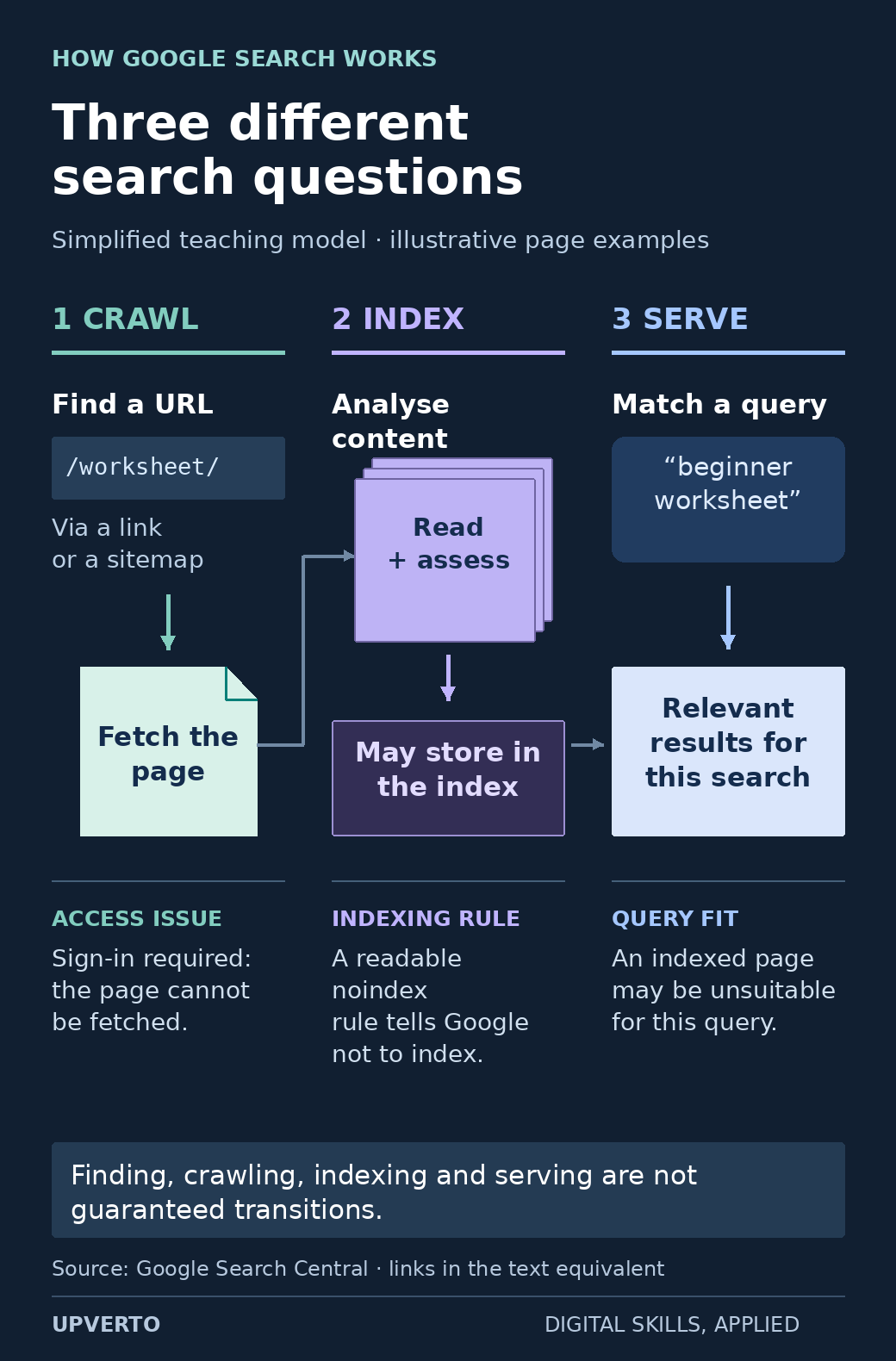
Read the text version: Separate crawling, indexing and serving
- Crawling: Google discovers URLs, for example through links or a sitemap, and may fetch their pages. A page that requires sign-in is an access problem.
- Indexing: Google analyses the fetched content and may store information in its index. A noindex rule tells Google not to index the page, but the crawler must be able to access the page and read that rule.
- Serving: for a query such as the fictional “beginner worksheet” example, Google selects results it considers relevant. An indexed page may not be shown for that query.
Google does not guarantee crawling, indexing or serving. These simplified examples illustrate different investigations; they are not screenshots or evidence about a real site.
Primary sources: Google’s explanation of Search and Google’s noindex documentation.
Practical summary
- Access: can the intended page be reached and understood?
- Purpose: does it answer a useful, defined reader need?
- Connections: do its links help people find related information?
- Evidence: what observations support the proposed change?
Build the core abilities
| Area | What to learn | Practice output |
|---|---|---|
| Search intent | Recognise what someone is trying to accomplish and compare relevant result types. | A short brief defining one page’s purpose and scope. |
| Content review | Examine clarity, completeness, evidence, and unnecessary overlap. | Specific recommendations tied to reader questions. |
| Site structure | Understand navigation, page relationships, and descriptive internal links. | A small map showing how useful pages connect. |
| Technical foundations | Learn URLs, status responses, indexing controls, and the site’s publishing system. | A documented finding with its actual evidence and limits. |
| Measurement | Read relevant search data and separate observation from attribution. | A report comparing appropriate periods and noting other possible influences. |
| Delivery | Prioritise changes, obtain approval, verify implementation, and report accurately. | A scoped audit or change record that another person can act on. |
Use Google’s SEO Starter Guide as a foundation. It explains common improvements and makes clear that there is no secret change that automatically ranks a site first.
Learn to define a page’s job
Write the reader’s main question and the decision or task the page should help complete. Then identify the supporting concepts needed to answer it. A guide to choosing a digital skill needs comparisons and a decision method. A course page needs accurate details about the actual product.
Search related queries and inspect the relevant results. Notice whether people are being served guides, tools, product pages, or other formats. Record what you observed rather than treating a quick search as proof of keyword volume or a guaranteed opportunity.
Do not create several pages that answer the same question merely because the wording changes. Compare the intent and the useful content each page would own. If two pages have the same job, consider improving or consolidating the answer instead.
Make page relationships useful
An internal link should explain why the destination is relevant. “Compare the required skills” is more informative than a vague instruction to click. Google’s link guidance describes crawlable links and descriptive anchor text.
For your practice site, draw a small map connecting an overview with detailed pages and appropriate next steps. Check that each important page is reachable through actual links and that the destination matches the promise in the link text.
Practice brief: a small-site audit
Practice scenario: Use a site you own or a private training site. You may inspect public pages for learning, but do not change someone else’s site, request private data, or run intrusive checks without permission.
Choose a small set of pages and define the review scope. For example, review five information pages for their purpose, content, headings, links, and visible usability. If you do not have access to search-performance or indexing data, state that limitation.
| Field | What to record |
|---|---|
| Page and intended purpose | The actual URL and the reader’s main task. |
| Observation | A specific finding, with the date and relevant evidence. |
| Effect | How the finding may affect the reader or the site’s operation. |
| Proposed change | A concrete action within the authorised scope. |
| Priority | The reason to act now or later, including effort and dependency. |
| Verification | How you will check the implemented change. |
| Limitations | Missing access, unmeasured outcomes, or questions still unresolved. |
Worked example: an observation with a clear next action
Fictional finding: A training business has a beginner guide that refers to a useful practice worksheet, but the reference is plain text and no navigation route leads to the worksheet page.
Recommendation: After confirming that the worksheet page exists and is suitable, add a descriptive link where the guide explains the exercise. Verification: open the saved guide, follow the link, and confirm the intended worksheet loads and matches the description.
This observation supports a navigation improvement. It does not establish how much traffic the change will produce. A report should preserve that difference between a verified implementation and an unmeasured business outcome.
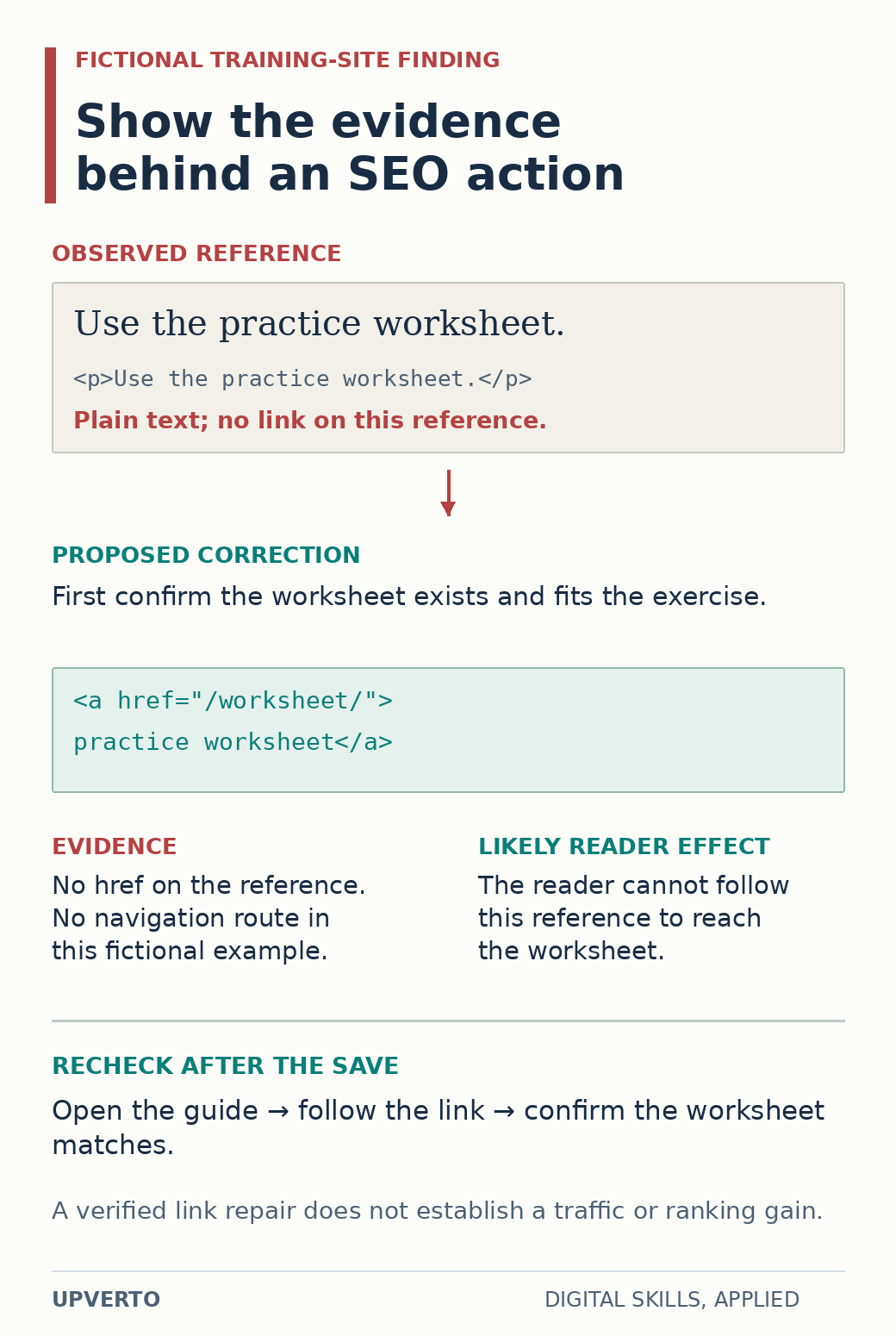
Read the text version: Turn one observation into a checkable correction
Fictional finding: a training guide says “Use the practice worksheet,” but the reference is plain text and there is no navigation route to the worksheet in this example.
- Evidence: the reference has no anchor element with an href; no navigation route is present in the reviewed example.
- Likely reader effect: the reader cannot follow that reference to reach the worksheet.
- Proposed correction: confirm that the worksheet page exists and matches the exercise, then add a descriptive link such as
<a href="/worksheet/">practice worksheet</a>. - Verification after saving: open the guide, activate the link, and confirm that the intended worksheet loads and matches the link’s description.
- Limit: this does not establish a change in search traffic, ranking or revenue.
The page path and code are illustrative. See Google’s link best practices for crawlable anchors and descriptive link text.
Understand measurement before promising results
Where access is authorised, Google Search Console’s Search results performance report provides information about search queries, pages, and performance over time. Learn what its metrics and filters mean before using them in a client report.
Record the baseline, date, scope, and implementation of a change. Compare suitable periods and note other changes, seasonality, or missing data. A rise after an edit is an observation; it does not by itself prove that the edit caused the entire rise.
A private practice site can demonstrate an audit process and technical checks. It cannot support invented claims about real search traffic or client revenue.
Define an SEO service you can support
An audit, content brief, internal-link review, implementation task, and ongoing advisory arrangement are different deliverables. Specify the pages, data, checks, outputs, access, and exclusions.
For a beginner’s narrowly scoped audit, the output might be a prioritised report with evidence and recommended next steps. Implementation should be separately agreed where it changes the site. More complex technical, migration, or business-critical work needs appropriate experience.
Read Google’s spam policies before proposing tactics. Its guidance identifies practices such as scaled low-value content produced to manipulate rankings. Useful work should improve the site’s value and explain the method honestly.
Frequently asked questions
Do I need expensive SEO tools to begin?
Begin by learning the questions, evidence, and manual checks involved in a small review. Use available official tools and documentation where appropriate. Evaluate a paid tool against a specific need and current access or pricing rather than treating a subscription as proof of expertise.
Can I guarantee a first-page ranking?
No. Define the analysis and implementation you can perform and report the evidence accurately. Search visibility depends on factors outside your control.
What should a beginner SEO practice project include?
Choose a small site you are authorised to inspect. Review the purpose of a few pages, their headings, internal links and relevant technical observations. Record evidence for each finding, explain its likely effect and propose a practical next step. Keep assumptions separate from confirmed observations.
How can I decide which SEO issue to address first?
Consider whether the issue prevents access or understanding, how many important pages it affects and how confident you are in the evidence. Check the effort and dependencies before proposing a change. Explain the reasoning instead of treating every warning from a tool as equally urgent.
How should I report SEO results honestly?
Record the work performed, the dates, the data source and the comparison period. Distinguish implementation from changes in search performance, and avoid claiming that one edit caused an outcome without adequate evidence. Use the Search Console guidance linked in this article when interpreting its reports.
How does learning SEO become a clearly defined service?
Offer a task you can perform and explain, such as a small-site review, a page-improvement brief or an agreed implementation task. Specify the pages, evidence, outputs and limits. Support the offer with a sample audit and avoid promising a particular ranking or traffic result.
Complete an audit you can explain
Use the learning cycle and the audit worksheet on a small practice site. Present the work as an honest portfolio case study, assess your readiness, and define a service package with clear limitations.