Writing for a client begins with a reader’s task and a deliverable the client can review. An informative article might help someone prepare for an activity. A landing page might help that person decide whether a particular service fits and take the next step. Both need accurate information, clear structure and editing; they differ in the decision they support.

In this guide
If you are comparing writing with other work, use which digital skill should I learn. This guide gives you two connected practice briefs for an invented workshop. The aim is to learn how to research, organise, write and check the work before selling a broad promise to “create content.”
Match the form to the reader’s need
Content writing often explains a subject, answers a question or supports a process. Copywriting often helps a reader evaluate an offer and choose an action. The categories overlap: a service page needs explanation, and a useful article may point to a next step. Decide the primary job of the specific piece rather than arguing about the label.
GOV.UK’s user-needs guidance encourages writing around what the person is trying to do. Translate that into a practical brief: who is reading, what they already know, what decision they face, which facts are available, and what a successful reading experience would let them do. “Improve awareness” is usually too vague to guide a first draft.
For the fictional Willow Workshop, the article’s task is to explain how to prepare for a beginner repair session. The service page’s task is to help a visitor judge the session’s fit and request a place. Neither task authorises an unsupported claim that the session will transform the visitor’s skills or guarantee a successful repair.
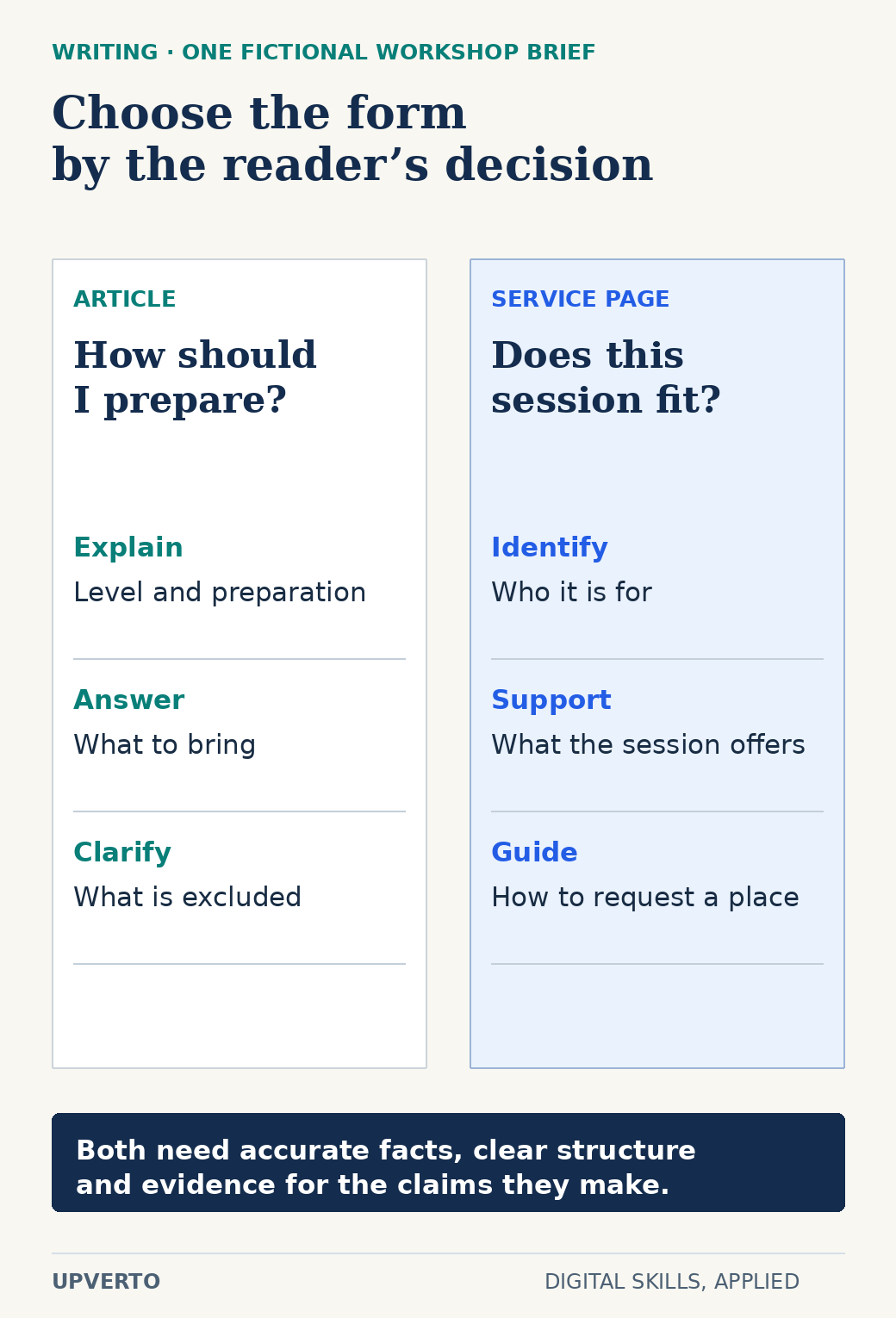
Read the text version: Distinguish an article from a service page
The fictional workshop article helps a reader prepare: explain the level, answer what to bring and clarify exclusions. The service page helps a reader judge fit: identify the audience, support the offer and guide the request action. Both require accurate facts, clear structure and evidence; neither supports invented outcomes.
Build a researched article brief
The article brief specifies a first-time attendee, a short practical explanation and the question “What do I need to know before I arrive?” Its inputs are a fictional owner brief and a sample equipment list. The outline covers who the session suits, what to bring, what the session includes, limitations and how to ask a question.
| Brief field | Worked practice entry |
|---|---|
| Reader | A beginner deciding whether their small item is suitable |
| Purpose | Prepare for the session and identify questions needing the organiser’s answer |
| Known information | Invented level, equipment list and request process supplied in the exercise |
| Missing information | Which items are excluded; whether tools are supplied |
| Deliverable | A structured draft with a source and query list, not a published claim |
| Review | Organiser verifies operational details before publication |
Do not fill missing facts with plausible detail. Put a visible question in the working draft, then route it to the person who can answer. If the subject includes health, safety, finance or other specialist advice, identify an appropriate expert reviewer and reliable sources. A general writer should not invent expertise to make a paragraph sound complete.
Research each factual claim at the source. Record the URL, publisher, date checked, relevant passage and the claim it supports. Prefer the organisation’s actual policy or documentation over an unsourced summary. Check whether the source applies to the location, version and audience in your draft. A citation is useful only when it supports the nearby statement.
Write the landing-page exercise
A vague opening might say: “Unlock amazing repair skills with the best workshop in town.” The exercise supplies no evidence for “best,” and “amazing” tells the reader little. A more inspectable draft is: “Bring one small household item to a guided beginner repair session. Check the item guidelines, choose a date and request a place.” This is fictional sample copy, not an advertisement for an available service.
Follow the opening with the information needed to assess fit: intended level, activities, location, date, price when actually confirmed, supplied materials and exclusions. Then explain the request process. If the organiser confirms places manually, use language that distinguishes requesting a place from completing a booking.
Persuasive writing can make a real benefit easier to understand, address an uncertainty and present evidence. It should not create invented urgency, testimonials, qualifications or results. If capacity is limited, verify the actual limit and current availability before saying so. If a previous participant’s comment is used, confirm permission and preserve its meaning.
Use a claim ledger before polishing
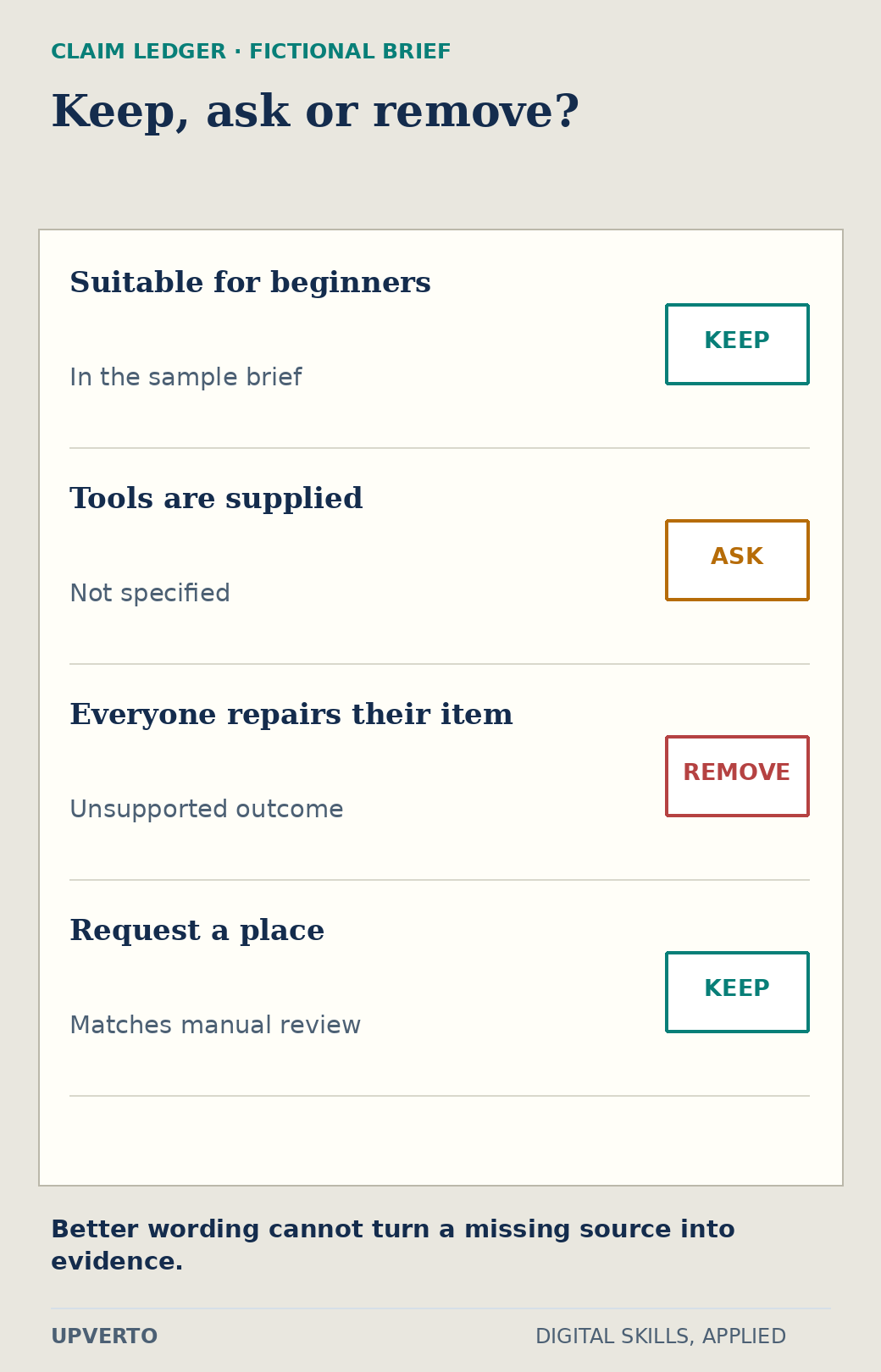
Read the text version: Inspect four draft claims
| Claim | Status | Action |
|---|---|---|
| Suitable for beginners | Specified by the fictional brief | Keep in the sample; verify in real work |
| Tools are supplied | Not specified | Ask |
| Everyone repairs their item | Unsupported outcome | Remove |
| Request a place | Matches the manual-review process | Keep |
| Draft claim | Evidence status | Editorial action |
|---|---|---|
| “Suitable for beginners” | Specified by the fictional brief | Keep in the sample; verify with the real organiser in live work |
| “Tools are supplied” | Not supplied in the brief | Ask; do not publish as a fact |
| “Everyone repairs their item” | No supporting evidence; outcomes depend on the item | Remove the promise; explain the session’s limits |
| “Request a place” | Matches the invented manual-review process | Keep and explain what happens after the request |
This ledger makes editing easier because it separates factual uncertainty from sentence quality. Rewriting an unsupported claim in more elegant language does not solve the evidence problem. For a portfolio, follow the guidance to show portfolio work honestly and label the business, brief and sample claims as fictional.
Edit in passes with a specific purpose
First check structure: does the opening identify the task, and does the order match the reader’s decisions? Next check facts and scope against the claim ledger. Then edit sentences for clear subjects, concrete verbs and unnecessary repetition. Finally check spelling, punctuation, names, numbers, links and the final format.
Read the draft aloud to find awkward transitions. Test whether each heading predicts the section below it. Replace internal business terminology when the reader needs a familiar term. Preserve necessary technical precision, but explain the term when it first appears. A short sentence is not automatically clear if it omits the condition the reader needs.
GOV.UK’s guidance on clear acceptance criteria offers a useful principle for reviewing any deliverable: define completion in language the involved people can understand. For this writing project, acceptance could require all specified questions to be answered, unresolved facts to be marked, and the request action to match the actual process. “Make it engaging” is harder to inspect on its own.
Keep an inspectable writing pack
Your practical resource is a five-part pack: the completed brief, outline, full draft, claim ledger and edit log. In the edit log, preserve one before-and-after paragraph and explain the reason for each substantive change. Add a source register and distinguish original writing from any permitted quotation. Do not copy a competitor’s wording or assume an image found online is free to use.
If you use an AI writing tool, treat its output as an unverified draft. Check facts, quotations and sources independently; remove fabricated references; protect confidential inputs; and follow the client’s requirements for tool use and disclosure. The ability to generate fluent paragraphs is not the same as being responsible for their accuracy or suitability.
Use how to learn a digital skill to practise one gap at a time: outlining, source checking, introductions or editing. When the sample is complete, use create freelance service packages to define an offer such as one researched article with an agreed brief, length range, source review and revision round. Define interviews, specialist review, design, uploading and ongoing updates separately.
Frequently asked questions
Should I choose content writing or copywriting first?
Start with one deliverable whose purpose you understand. An explanatory article helps you practise research and structure; a service page adds offer clarity and action. Compare your completed work and feedback before expanding your service label.
How can I create a sample without a client brief?
Write a clearly fictional brief that specifies the reader, task, inputs and exclusions. Mark invented operational details as part of the exercise. Do not present the fictional organisation as a real client or invent commercial results.
What should I do when a client supplies a claim without evidence?
Ask what supports it and whether the relevant reviewer can verify it. Mark the claim as unresolved in the draft. If it cannot be supported, remove or qualify it appropriately instead of polishing it into a stronger assertion.
Is a link at the bottom enough to support every fact?
A source should be connected to the claim it actually supports. Keep a claim ledger and use nearby references for statements that need verification. A general reading list does not make unrelated claims accurate.
Can I promise higher conversions from better copy?
You can promise the agreed writing process and deliverables. Conversion outcomes depend on the offer, audience, product, traffic and other conditions. A measured effect requires an appropriate evaluation; a fictional sample supplies no such evidence.
What belongs in a first writing-service package?
Specify the reader and purpose, required client inputs, deliverable format, research depth, factual review responsibility and revision boundary. Explain whether interviews, image sourcing, uploading or later updates are included rather than assuming they are.