Automation is useful when it moves a well-understood task through reliable steps. Connecting two apps is only part of the work. You also need to know which records qualify, what happens when the same event arrives twice, who reviews an uncertain result and how the owner stops or repairs the process.

In this guide
Compare this route with other directions in which digital skill should I learn. The practice project below routes fictional workshop requests into draft queues. It sends no messages, changes no client system and uses a local simulation to make the rules inspectable.
Map the existing process before choosing a tool
Write the trigger, inputs, decisions, actions and owner. For a workshop request, the trigger might be a submitted form. The required inputs might include an event ID and request category. The action might be creating a review task, not automatically confirming a booking. Ask what a human currently checks and why.
Do not automate an ambiguous process by guessing. If nobody agrees what “urgent” means, an automation will reproduce that disagreement at speed. Define a rule or route uncertain cases to a person. Record the information needed for that person to make the decision.
Learn data types, field mappings, conditions and identifiers before adding more integrations. Understand what each connection can read or change. Use the least access needed for the agreed task and avoid sharing account passwords in a workflow document. Keep credentials out of screenshots and public portfolio exports.
Design a reversible request-routing exercise
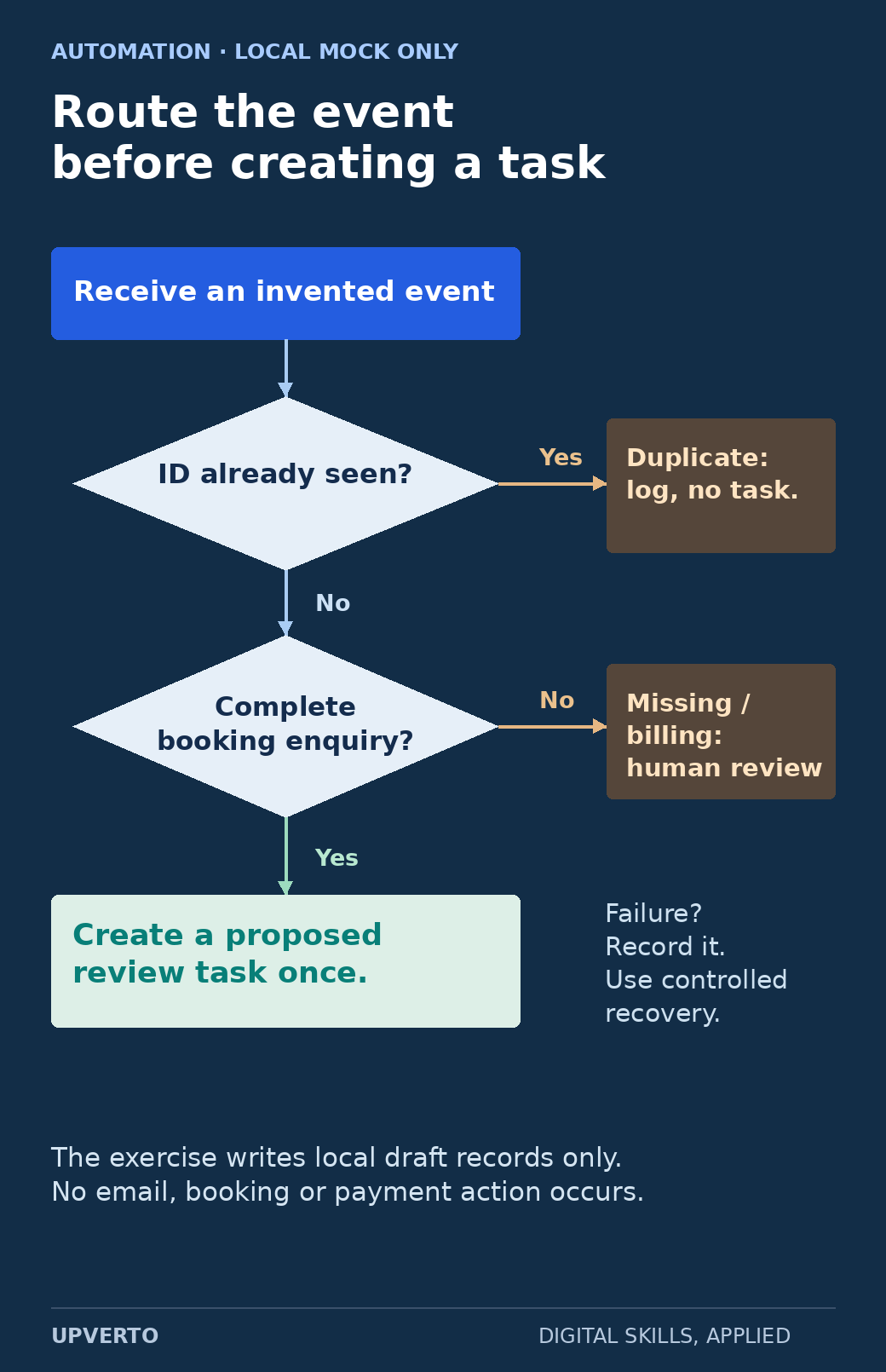
The fictional Willow workflow accepts five input events representing four unique request IDs. Booking enquiries can enter a draft review queue. Billing questions go to a person. A request without a category also goes to review. A repeated ID must not create another task.
Read the text version: Inspect a request-routing rule
- Receive an invented event.
- If its ID has already been seen, record a duplicate and create no task.
- For a new ID, check whether it is a complete booking enquiry.
- Missing category and billing questions go to human review.
- Eligible booking enquiries create one proposed task. Record failures and use controlled recovery.
This is a local mock; no external action occurs.
The action is deliberately reversible: create a local proposed task, then inspect it. There is no booking confirmation, external email or payment action. In a real platform, begin in an authorised test environment and use manual execution or disabled external actions where appropriate. n8n’s execution documentation distinguishes development execution modes; verify the current behaviour of the exact nodes you use.
| Input event | Condition | Expected result |
|---|---|---|
| R01, booking | New, complete request | One proposed booking-review task |
| R01, booking again | Repeated ID | No second task; duplicate recorded |
| R02, missing category | Insufficient information | Human-review queue |
| R03, billing | Outside automatic booking route | Human-review queue |
| R04, booking | Simulated temporary failure | Failure recorded; controlled retry creates one task |
Make failure behaviour part of the design
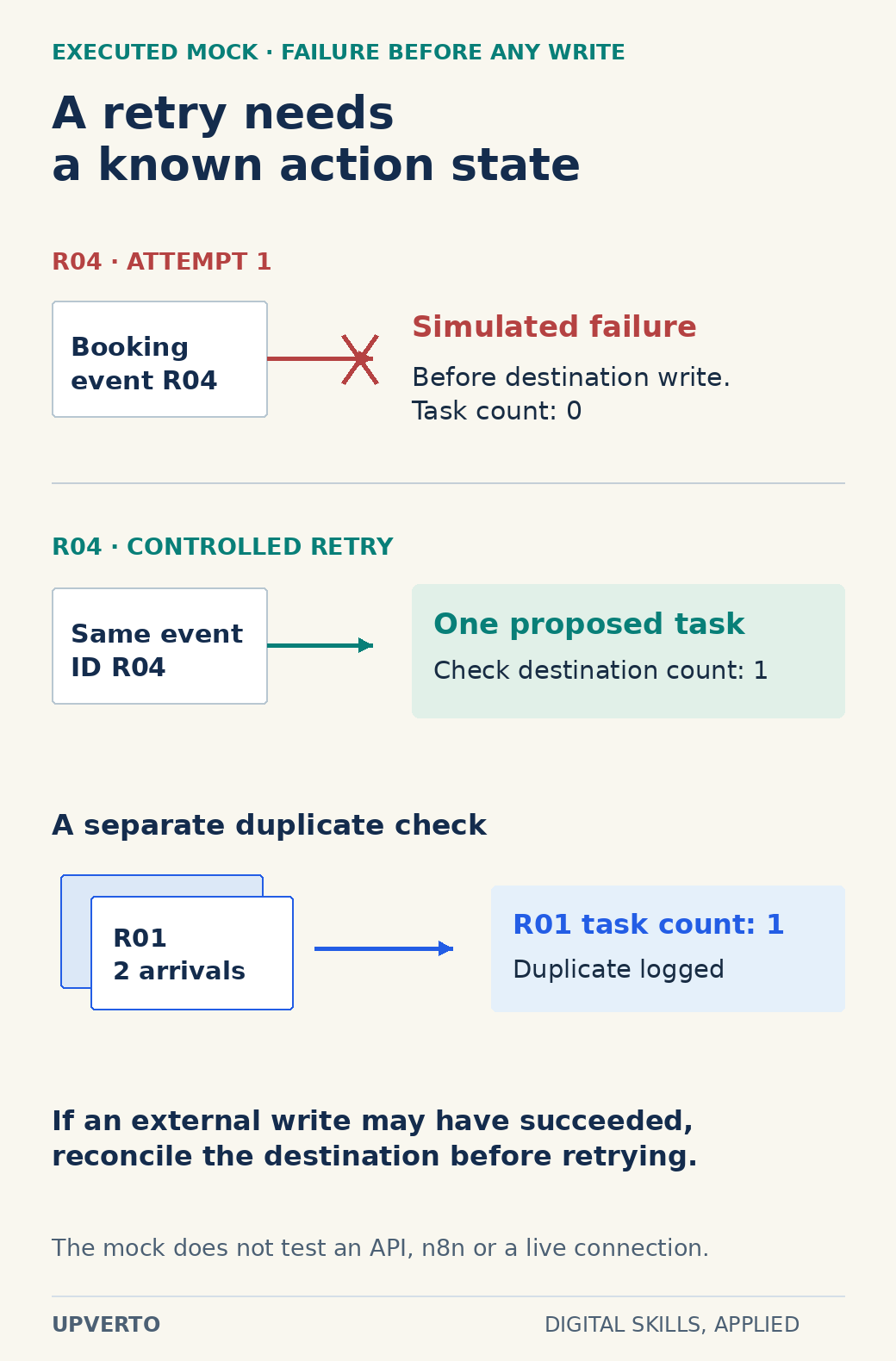
A workflow can fail before an action, during an action or after the destination has accepted it. Retrying without knowing which happened can create duplicates. A useful identifier lets you reconcile the intended action with the destination record. Do not claim that a simple local duplicate check solves every distributed-system failure; real integrations require their own confirmation and recovery design.
n8n’s error-handling documentation describes ways to handle failed executions explicitly. The general lesson is to make failure visible, preserve enough context to investigate and assign an owner. Avoid endless retries. A retry policy should name which failures are transient, how attempts are limited and when a person takes over.
Read the text version: Inspect a controlled retry and duplicate check
R04 attempt 1 deliberately fails before the destination write, leaving zero tasks. A controlled retry creates one proposed task. Separately, R01 arrives twice but produces one task and a duplicate log. These local cases passed the stated checks. They do not verify an API or live workflow; if an external write might have succeeded, reconcile its state before retrying.
In the local exercise, R04 is configured to fail once before any task is added. The retry then adds one proposed task. The script checks that R01 also appears only once, R02 and R03 are in human review, and the duplicate is recorded. This is an executed simulation of the stated rules. It is not a test of n8n, an email provider, an API connection or a production workflow.
For a real integration, test the harder boundary as well: the destination accepts a request but the acknowledgement is lost. Decide how you will identify an existing record before trying again. If that cannot be checked reliably, stop for review rather than pretending that the action is safe to repeat.
Add AI only when its role is clear
An AI step might suggest a request category from free text. It can be wrong. Keep a human review route for ambiguous or consequential cases, and test the categories with examples that resemble the actual task. Do not give model output unlimited authority to send, delete, purchase or change records.
Separate the suggested category from the rule that authorises an action. A model may label a message “booking,” but required fields and permission checks still apply. Log the relevant decision without unnecessarily retaining personal information. Discuss data use, retention, provider terms and cost with the owner before connecting a real service.
If you want to build the wider application, including retrieval, evaluations and deployment, see learn AI engineering for client applications. Configuring a bounded workflow and engineering a complete AI system require overlapping but different evidence of competence.
Use this workflow specification
Write a one-page specification with: purpose; trigger; input schema; required fields; unique event key; decision rules; authorised actions; human-review conditions; failure policy; retry limit; logs; pause method; and maintenance owner. Attach a table of normal, duplicate, incomplete and failed cases.
- Start with invented records and a destination that can be safely reset.
- Compare each observed output with the expected result before adding more steps.
- Repeat an event and verify whether the destination contains a duplicate.
- Simulate one failure at a time and inspect the record left for the owner.
- Check what happens when a field name changes or an expected value is missing.
- Document the account permissions, current integration versions and any usage limits.
Keep the workflow diagram, sample inputs, test log and failure notes with the project. Export only safe configuration details; remove credentials and real personal data. A screenshot of green execution indicators is insufficient evidence if it does not show whether the intended task was created once and in the correct place.
Define the handover and ongoing responsibility
A limited service might map a process and build a draft routing workflow in a test environment. A production service adds authorised deployment, monitoring, access changes and maintenance when connected apps change. Agree who investigates failures, who pays provider charges, and whether later adjustments are included.
Learn through how to learn a digital skill and compare the proposed responsibility with the ready for paid client work checklist. When a workflow cannot be explained, paused and checked by its owner, its apparent convenience can conceal an operational burden. Your first useful goal is a small process with visible decisions and recoverable failures.
Frequently asked questions
Does no-code mean I do not need technical understanding?
No. You still need to understand inputs, data types, permissions, conditions and failure behaviour. The interface may reduce handwritten code, but it does not remove responsibility for the actions the workflow performs.
What is the safest first automation to practise?
Choose a reversible task using invented data, such as creating proposed review records locally. Keep sending, deletion, payments and other consequential actions outside the exercise until you have the necessary competence and explicit authority.
Why is a repeated trigger a problem?
The same event can arrive more than once. If each arrival creates a fresh action, the destination may contain duplicate tasks or messages. Use an appropriate event identity and check the actual destination behaviour.
Should every failed action retry automatically?
No. Retry only under a defined policy for failures that may be temporary, with limits and a review route. An uncertain partial success can be especially risky because repeating the action may duplicate it.
Can an AI category directly decide what message to send?
That depends on the agreed risk and review design, but a beginner exercise should keep output as a suggestion for review. Required fields, permission rules and action boundaries must still apply even when the category looks plausible.
What does the local simulation prove?
It proves that the included mock rules produce the expected outputs for the supplied fictional cases. It does not establish that an external platform, API, credential configuration or live workflow will behave the same way.