Part of How to Make Money Online with Digital Skills: A Beginner’s Roadmap.
To find freelance clients, define work you can deliver, show relevant evidence, and approach people whose actual needs fit that work. Use a manageable channel, ask useful questions, and keep a record of what happens so you can improve the process.

In this guide
This guide is for people preparing to offer a digital service. If you are still learning the task, start with the readiness checklist. If you can do the work but struggle to explain it, complete a service definition and a clear package first.
Read the text version: Choose a route that matches your evidence
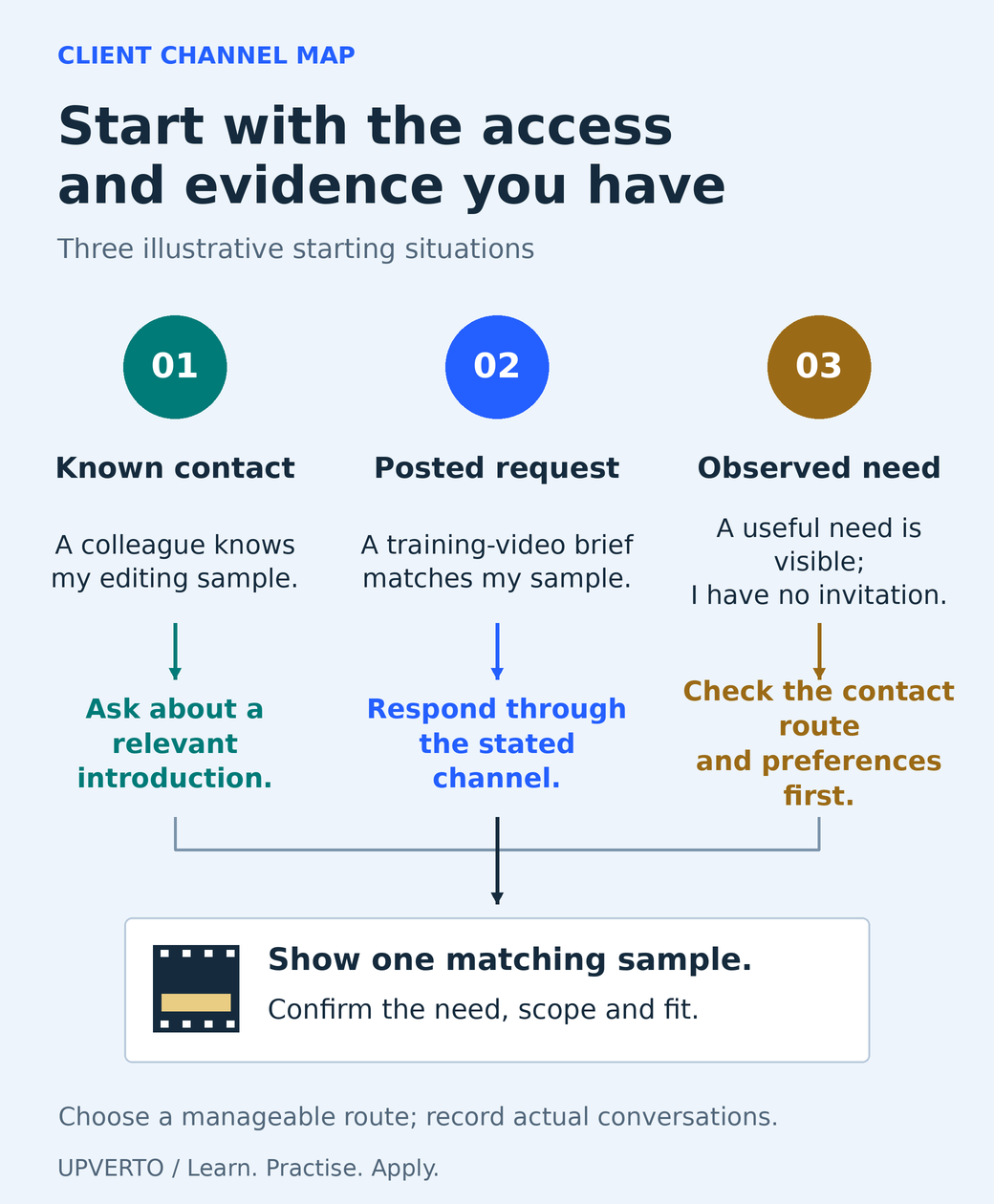
These are three illustrative situations for a beginner with a relevant editing sample.
- Known contact: if a colleague already knows your work, ask about an appropriate introduction or a real need that matches your service. Check that the conversation is welcome.
- Posted request: if a training-video brief matches your sample and capability, respond through the stated channel and follow its current rules.
- Observed need: if you see a potentially relevant business need but have no invitation, first check the appropriate contact route, preferences and applicable rules. Do not treat an assumption as a verified problem.
Whichever route you use, show one relevant sample and confirm the actual need, scope and fit. A concept sample should be labelled as such. Choose a manageable channel and record what really happens; no route guarantees a client.
Prepare the basics before looking for opportunities
You should be able to explain the task you handle, who it may suit, what the client receives, and what information you need. Prepare one relevant work sample with an honest explanation of its status and your contribution.
A simple description is enough to begin a sensible conversation. For example: “I edit supplied educational recordings into concise videos with checked captions.” The next questions concern the source material, audience, intended format, and review process.
Use the portfolio guide if you do not yet have client work. A clear concept sample can demonstrate your approach without invented testimonials or commercial results.
Choose a channel that fits the work
| Channel | How to use it thoughtfully | What to check |
|---|---|---|
| Existing professional or personal network | Explain a specific service and ask for relevant introductions or known needs. | Whether the conversation is welcome and whether the need actually matches. |
| Professional communities | Answer useful questions and respond to appropriate requests. | Community rules, solicitation limits, and the relevance of your contribution. |
| Freelance marketplaces | Study suitable briefs and submit focused responses through the required process. | Current eligibility, fees, payment rules, and communication policies. |
| Agencies and established providers | Offer a clearly defined task that could support their existing delivery. | Expected quality, confidentiality, capacity, and approval arrangements. |
| Direct business enquiries | Contact an appropriate business about a relevant, observed need. | Contact preferences, applicable marketing rules, and whether your assumptions are accurate. |
| Your own useful content and portfolio | Explain the problems you solve and make your work easy to inspect. | Whether the content reaches the intended audience and leads to a clear next conversation. |
Start with one primary channel you can manage. This is an organisation choice, not a claim that one channel always produces clients faster. Expand when you understand the work involved and have evidence that another channel is relevant.
Read the text version: Write a relevant first message
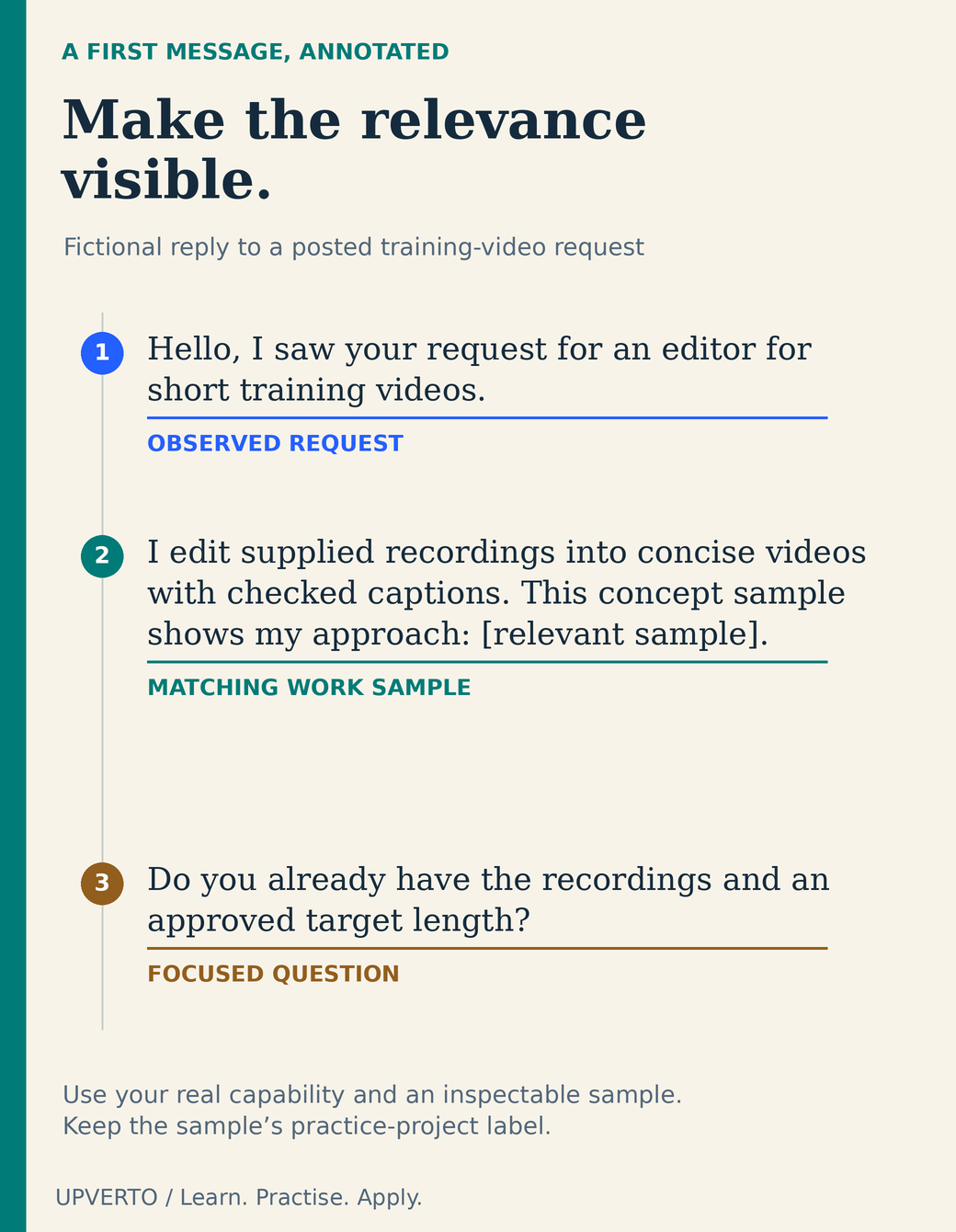
This fictional example responds to a posted request; it is not a message that has been sent.
Hello, I saw your request for an editor for short training videos.
I edit supplied recordings into concise videos with checked captions. This concept sample shows my approach: [relevant sample].
Do you already have the recordings and an approved target length?
The first sentence points to the actual request. The middle connects a specific capability with a relevant sample and keeps the concept-project label visible. The final question asks for inputs needed to assess fit. Replace the claims and sample placeholder with your real work, use the required response channel, and respect contact preferences.
Decide whether an opportunity fits before pitching
Read the request carefully. Identify the deliverable, source material, deadline, required experience, and any responsibility that changes the risk. Notice what is missing.
For a video request, ask whether the footage and approved wording exist. For a website task, identify the site environment and the exact functionality affected. For administrative work, understand the data and decisions involved before accepting access.
A suitable opportunity needs more than a familiar tool name. It should fit your demonstrated ability, available capacity, and delivery process. Decline or ask for a narrower scope when it does not.
- Relevance: establish a real task or request.
- Evidence: show one appropriate sample.
- Understanding: clarify the brief and constraints.
- Agreement: confirm scope and terms before production.
- Delivery: complete the agreed work and learn from the result.
Write a first message around the actual request
A useful first message connects an observed need to your relevant work and a clear question. Avoid a long autobiography, an unrelated list of tools, or claims about a business’s problems that you have not verified.
Fictional example responding to a posted request: “Hello, I saw your request for an editor for short training videos. I edit supplied recordings into concise videos with checked captions. This concept sample shows my approach to a similar educational format: [relevant sample]. Do you already have the recordings and an approved target length? That would help me confirm whether the project fits my service.”
Replace the example with your real capability and evidence. If you have not completed a similar task, do not claim that you have. For direct enquiries, explain the genuine reason for contacting that organisation and respect its contact preferences and any applicable rules.
Do not send the same generic message to a large scraped list. Relevance requires understanding who you are approaching and why the service might help. Stop when a recipient asks not to be contacted.
Use the conversation to understand the project
Before quoting, ask what the client needs to accomplish, who will use the output, what is already available, what must be delivered, and who approves the work. Clarify timing and any constraints that affect your approach.
Summarise what you heard in writing. Distinguish confirmed requirements from assumptions. If the request is too vague to price, gather the missing information or discuss an appropriately scoped discovery step.
A proposal should connect the client’s request to your deliverables, process, relevant evidence, estimate, and next step. Use the package worksheet to make the scope clear and the delivery workflow to prepare for implementation.
Keep a simple acquisition record
| Field | What to record |
|---|---|
| Opportunity | Business or request, source, and date. |
| Relevant need | The observed task and what remains uncertain. |
| Fit | Why your ability, sample, capacity, and scope match. |
| Contact permission or channel | The appropriate route and any rules or preferences. |
| Action | What you sent or discussed, using only necessary information. |
| Status | Researching / contacted / conversation / proposal / agreed / closed. |
| Next step | A relevant action and date, or a clear reason to stop. |
| Learning | What the response revealed about your offer or evidence. |
The purpose is to understand progress, not collect as much personal data as possible. Keep only information appropriate to the work and protect it.
Run a small, reviewable first cycle
As a planning exercise, research a small group of relevant opportunities and check each one against your service. Prepare a tailored response only where the fit is credible. Then review the responses and questions you receive.
If people do not respond, inspect the relevance of the opportunity, clarity of the offer, quality of the evidence, and suitability of the channel. If conversations happen but scope remains confused, improve the package. If projects are agreed but delivery is difficult, narrow the offer and strengthen the missing ability.
These observations help you choose what to improve. They do not establish a universal conversion rate or a guaranteed number of messages needed to win a client.
Recognise requests that need caution
Check unfamiliar identities and unusual payment instructions independently. The FTC’s job-scam guidance describes fake payment and recruitment schemes. Requests to forward money from a supposed payment or pay to unlock earnings should prompt you to stop and investigate.
Be cautious about large unpaid production tests, pressure to conceal the arrangement, demands for unnecessary account access, or work that clearly exceeds your scope. Follow a marketplace’s current rules when using that marketplace.
Frequently asked questions
Can I find clients with no paid experience?
You can begin relevant conversations using honest practice evidence. Whether someone hires you depends on the task and their requirements. Make the status of your samples clear and accept only work you can support.
Should I lower my price whenever someone says no?
First understand the mismatch. The scope, timing, relevance, trust, or budget may be the issue. If you change the price, make sure the agreed work and your delivery conditions remain sustainable.
Where should I look for my first freelance client?
Choose a channel that fits your service and available evidence. Relevant existing relationships, professional communities, direct enquiries, marketplaces and useful public work can each create opportunities. Start with a manageable approach, record what happens and review whether you are reaching people with a genuine need.
What should a first message to a potential client include?
Refer to the actual request or relevant context, explain briefly how your service may help and include one suitable example when useful. Ask a focused question or suggest a clear next step. Avoid unsupported promises, generic mass messages and assumptions about private information.
Should I offer a free sample to win work?
First consider whether your existing portfolio already answers the question. If you choose a sample, agree on its narrow purpose, limits and permitted use. Avoid doing an open-ended live project merely to compete for an unspecified opportunity, and do not present unpaid sample work as a confirmed commission.
How should I follow up after an enquiry?
Use the channel and timing appropriate to the conversation, with a concise reminder and a useful next step. Keep a record so you do not send repeated or conflicting messages. Respect a refusal or opt-out and review the fit of the opportunity instead of treating persistence as a guarantee of a sale.
Prepare for the project you are trying to win
Choose one service, one relevant sample, and one manageable acquisition channel. Use the worksheet for the first conversations. When an opportunity fits, move into a clear project-delivery process. After completing work, review how to build repeat work sustainably.