A credible online-work opportunity should survive ordinary questions about who is involved, what work is required and how payment works. Pressure to pay first, reveal credentials or trust an impressive earnings screenshot is a reason to stop and verify.
No checklist can establish that every offer is safe. Warning signs describe risk, and an unverified detail is not proof that a named person committed fraud. This guide gives you a way to preserve evidence, check claims independently and decline requests you cannot justify. It supports the broader path to make money online with digital skills without treating a promise of income as a substitute for real work.

In this guide
Read the text version: Separate a claim from verified evidence
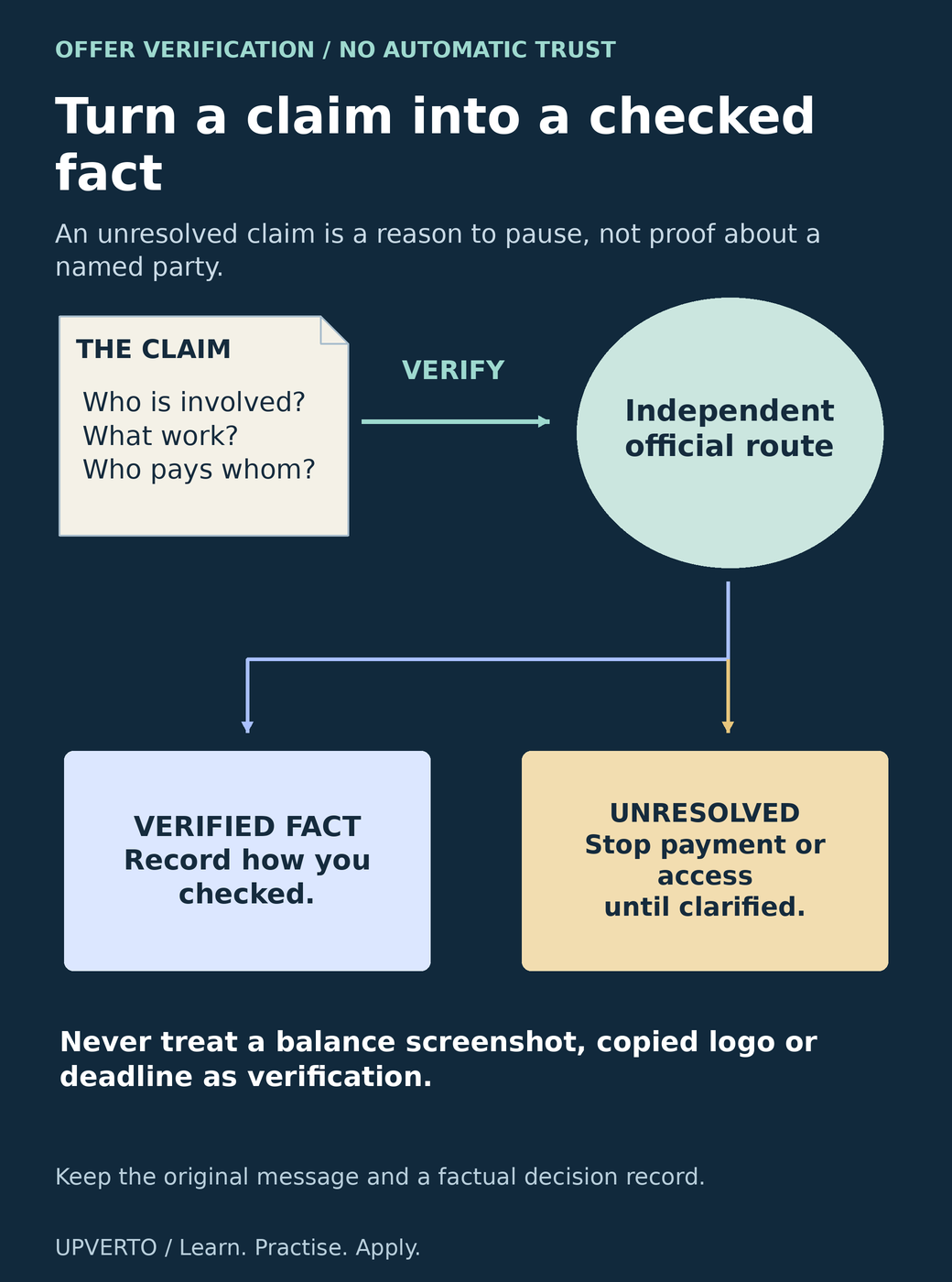
Inspect the claim: who is involved, what work is required and who pays whom? Verify through an independent official route, not only a link or number supplied in the message. If a fact is confirmed, record how you checked it. If the claim remains unresolved, pause payment or access until it is clarified. A balance screenshot, copied logo or urgent deadline is not independent verification. Preserve the original message and a factual decision record. An unresolved claim is not by itself proof of wrongdoing by a named person or organisation.
Separate the work offer from the income story
Ask what the buyer needs, what you would deliver and why they would pay for it. “Review ten product records against a supplied checklist” describes a task you can question. “Complete easy clicks and unlock your daily earnings” may describe a balance on a screen without explaining a legitimate buyer or a withdrawable payment.
An earnings claim needs context: the period, gross revenue versus costs, whether money was received, whose activity it describes and whether the result is typical. A screenshot alone cannot establish those facts. Testimonials may be unverifiable, selectively chosen or unrelated to the work being sold. Do not convert an exceptional story into a personal forecast.
The US Federal Trade Commission’s job-scam guidance describes false job offers, upfront payments and fake-check schemes. Its guidance is a primary source for these patterns, not a legal finding about every offer you encounter. If you are still establishing your first capability, start online work with no experience provides a practical preparation route that does not depend on a guaranteed job.
Check identity, task, money flow and access
| Area | Ask or inspect | Reason to pause |
|---|---|---|
| Identity | Can you verify the organisation and contact through a route you found independently? | A display name, copied logo or supplied link is the only evidence. |
| Task | Are the inputs, deliverables, review and decision-maker understandable? | The task remains vague while urgency increases. |
| Money flow | Who pays whom, for what, through which agreed process? | You must deposit money to unlock supposedly earned funds. |
| Access | What information or permissions are genuinely necessary? | Someone asks for a password, one-time code or unrelated remote access. |
| Claims | What evidence supports the promised income or result? | A dramatic screenshot replaces an explanation of work and costs. |
Type an organisation’s known address yourself or find its official contact independently. Do not use the suspicious message’s phone number as the only way to verify that message. A genuine organisation can also be impersonated; the existence of the business does not authenticate the person contacting you.
Keep identity checks proportionate. Do not request another person’s sensitive documents as an improvised verification system. If a platform requires your own verification, open its official account flow directly and follow the provider’s guidance rather than sending documents to someone in a chat.
Understand the difference between a disclosed cost and paying to unlock work
Some legitimate services have publicly documented charges, such as a software subscription or a marketplace’s proposal tokens. An unexpected recruiter directing you to a private payment account is a different situation. Check any claimed fee on the provider’s own official page and inside the account you opened independently.
The FTC’s task-scam alert warns about requests to deposit money in order to receive supposed earnings. Do not send more money because a balance appears to grow or because a previous small payment arrived. That does not establish that a later withdrawal request is legitimate.
Be equally cautious with an “overpayment” followed by an instruction to forward money elsewhere. A payment appearing in an account is not the same as an irreversible final settlement. Stop, contact the payment provider through its official channel and avoid becoming an intermediary for unexplained transfers.
Assess the work separately from the sales pitch. Use check demand for digital skills to look for actual buyer tasks and requirements instead of treating the seller of a course or opportunity as the only evidence that demand exists.
Worked example: an offer with an unexplained release fee
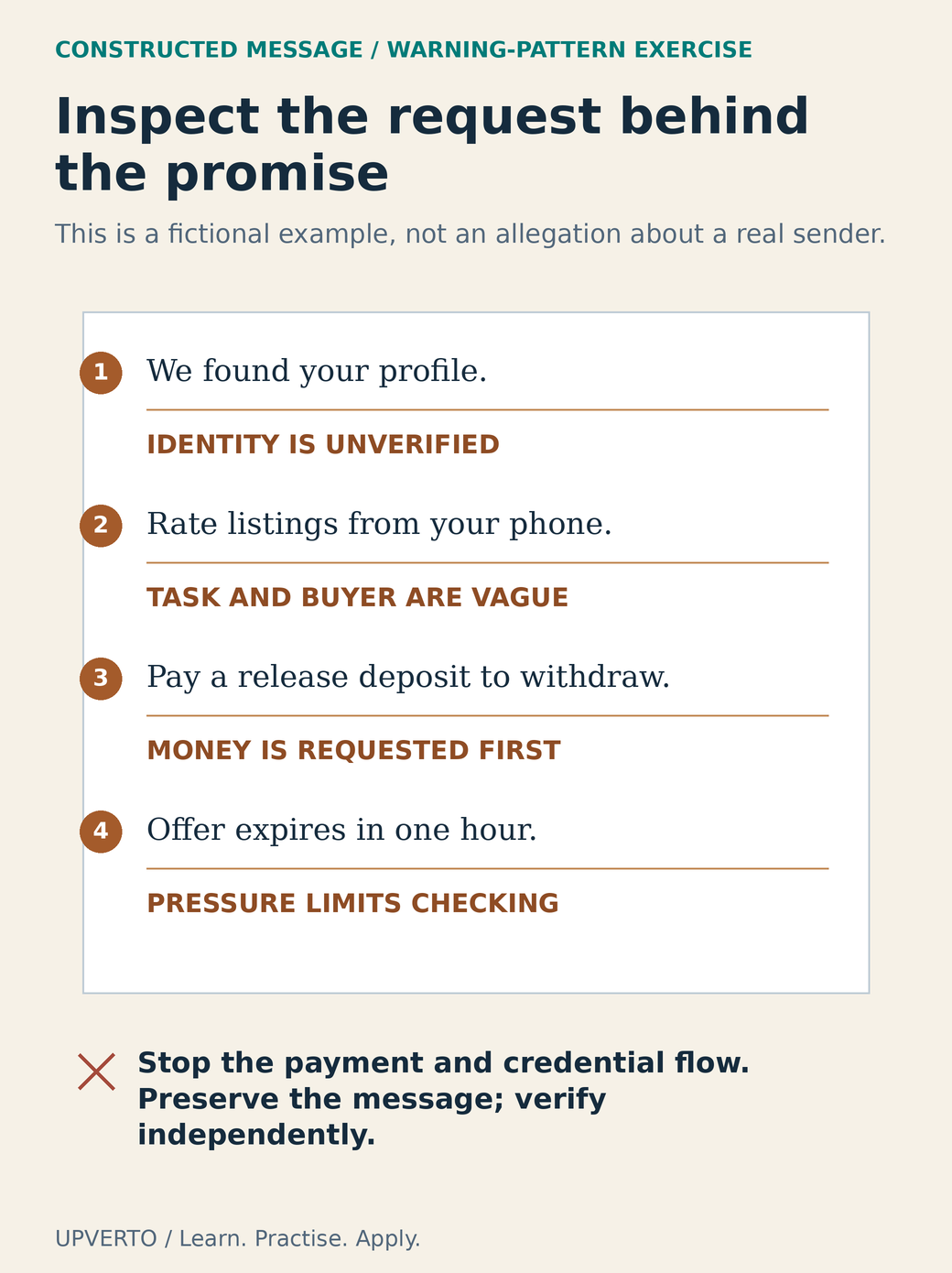
Fictional message: “We found your profile. Rate listings from your phone today. Your account already shows a bonus. Send a refundable release deposit to withdraw it. Offer expires in one hour.” This is an invented teaching example; it does not identify a real organisation.
Break it into claims. The message says the sender knows your profile, but gives no verifiable reason they selected you. It names a generic activity without explaining the real buyer or approved purpose. It displays a balance, but offers no reliable evidence of payment. It introduces a deposit and a deadline precisely when you ask to receive money.
The decision is to stop the payment and credential flow, preserve the message and inspect the claimed provider independently. You do not need to prove criminal intent before declining an arrangement you cannot verify. Do not continue the conversation merely to catch the sender or test how far they will go.
Read the text version: Annotate a fictional release-deposit offer
Constructed teaching message: “We found your profile. Rate listings from your phone. Pay a release deposit to withdraw. Offer expires in one hour.” The annotations identify four issues: identity is unverified; the task and real buyer remain vague; money is requested before supposed earnings are released; urgency discourages checking. Stop the payment and credential flow, preserve the message and verify independently. The example does not identify a real sender and is not a legal finding. A warning pattern is sufficient to pause an arrangement you cannot justify.
A contrasting fictional enquiry asks for two information-sheet layouts from supplied approved copy. It names the requester, provides a brief and proposes discussing scope through the original channel. That is more inspectable, but still requires identity checks, a suitable agreement, realistic payment arrangements and review of the supplied files. Clear wording is useful evidence, not a guarantee.
Keep a verification record and act on what you know
| Record | Entry to make |
|---|---|
| Original offer | Date, channel, sender identifier and the exact requested action |
| Independent check | Official address or contact route you found yourself |
| Verified facts | What you actually confirmed and how |
| Unresolved claims | Identity, task, fee or income claims still unsupported |
| Decision | Decline, report, ask a limited question or continue due diligence |
If you already shared credentials, use the genuine service’s recovery process, change affected passwords and review account access. If you paid, contact the payment provider promptly through an official route and preserve transaction details. Reporting options depend on your location and the service involved; use relevant consumer-protection or law-enforcement channels. Be wary of a new stranger promising guaranteed recovery for another upfront fee.
Keep reports factual. State what was requested and provide the evidence you hold, without adding accusations you cannot support. When you are ready to choose a legitimate acquisition route, compare freelance marketplaces vs direct clients and learn the rules of the channel you actually use.
Frequently asked questions
Does an unexpected work message automatically mean a scam?
No. An unexpected message is a reason to check context and identity, especially when it includes urgency or a payment request. Verify the sender independently and inspect the actual task. Do not assume that a familiar logo or professional-looking account authenticates the person.
Are all platform charges a warning sign?
A documented charge inside an official platform flow is different from a private request to pay someone to release earnings or secure a job. Verify the charge on the provider’s own current documentation and account screen. Do not follow a stranger’s payment link as your only source.
Can I trust an earnings screenshot?
Treat it as an unverified claim unless the underlying facts can be established. It may omit costs, time, failed attempts or whether the funds were received. Even a genuine result for someone else does not establish what you will earn.
What if the sender paid me a small amount first?
A small initial payment does not validate later requests. Review each new action, especially deposits, refunds to another account or requests for credentials. You do not have to continue because you have already invested time or received a small transfer.
How should I handle a request for identity documents?
Use only the official verification process of a service you have independently identified and chosen to use. Check why the information is required and how it is handled. Do not send identity documents, passwords or one-time codes to an unverified recruiter in a message.
Should I publicly name a suspicious sender?
Preserve the evidence and use the relevant reporting route. Describe verified facts accurately. A warning sign or unresolved identity does not by itself prove wrongdoing by the person or organisation whose name appears in the message; impersonation is possible.
Sources and review notes
Primary sources checked on 27 October 2026 (UTC). Check the current provider pages before relying on a changing feature, policy or price. Worked examples and worksheets are original teaching material; fictional examples are not evidence of client results.