LinkedIn and an existing professional network can help people understand the work you do and introduce you to relevant conversations. Begin with accurate evidence, a readable profile and a reason to engage. A large connection count does not establish trust, and no posting routine guarantees work. This is one route within how to find freelance clients.
Make the profile explain a real capability
A useful profile answers three questions: what work can this person do, what evidence can I inspect, and how should I start a relevant conversation? Write the headline around the work rather than a string of exaggerated titles. Your About section can explain the service, the kinds of inputs you need, a meaningful boundary and where the evidence lives.
Suppose Iman is practising document and spreadsheet organisation. “I organise supplied workshop enquiries into a clear tracker and handover note” is narrower and more assessable than “Business transformation expert.” If the examples are self-directed, say so beside them. Do not invent employment, client names, certifications or results to make an early profile look established.
Choose a suitable evidence format using portfolio website vs PDF vs profile. A concise PDF, a project page or a readable profile sample can all support a conversation when access works. The choice should reflect what a prospective client needs to inspect, not a claim that one format is favoured by an undisclosed algorithm.
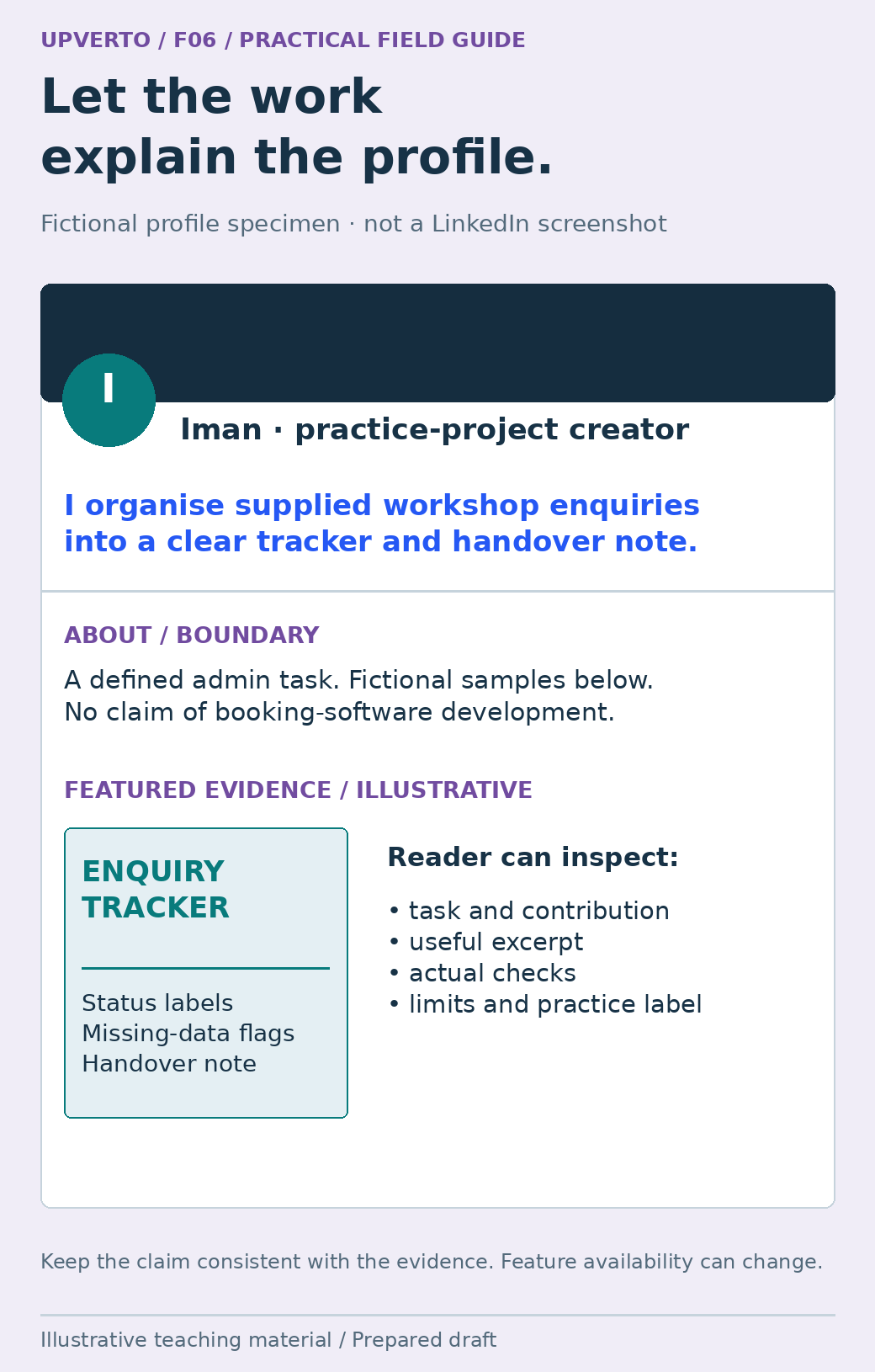
Read the text version: Build a profile around an inspectable capability
Fictional profile: Iman organises supplied workshop enquiries into a tracker and handover note. The About text limits the offer to a defined administrative task and does not claim booking-software development. A featured practice sample exposes status labels, missing-data flags and instructions, with the task, contribution, checks and limits. Verify current account features using official LinkedIn help.
Curate a small amount of inspectable work
LinkedIn’s official Featured-section help explains how work samples can be added and managed. Consult the current help and controls available to your account rather than relying on an old screenshot. This guide does not require a paid feature or promise that adding a sample changes your ranking.
For each sample, include the task, your contribution, a useful excerpt, the checks you performed and the limits. Open the link as a reader would and check whether it needs an unnecessary sign-in. An impressive cover image cannot replace access to the actual evidence. If you share a client example, confirm permission for the material and the wording first.
Use tailor portfolio to client niche when selecting which evidence belongs at the front. A person seeking help with a workshop catalogue should not have to infer relevance from ten unrelated practice files. You can keep other projects elsewhere while making the relevant one easy to find.
Review the profile when your offer changes. A headline promising a broad service and a sample demonstrating a narrow task can create a misunderstanding before a conversation begins. Keep contact preferences current and do not describe a service as available if you have stopped offering it.
Start with real relationships and useful context
Map people you actually know from work, study, professional events or community projects. Write down the shared context accurately. A former colleague is different from a stranger whose article you read, and both are different from someone who has asked for a supplier recommendation. Those distinctions should appear in your approach.
You can reconnect by describing what you are working on and asking about a relevant topic, without treating every contact as a buyer. Read and respond to someone’s work only when you have a useful point to add. A thoughtful question or a specific contribution is easier to understand than a generic compliment followed immediately by a sales pitch.
The Professional Community Policies prohibit unwanted promotional messaging, invitation misuse and artificial engagement. The User Agreement restricts scraping and unauthorised automated activity. Avoid bots, purchased contact lists, shared accounts and arrangements to manufacture engagement. Work through the platform’s permitted features and respect a person’s decision not to engage.
Worked example: reconnecting without invented familiarity
Fictional scenario: Iman and Dev worked together on a volunteer workshop. Iman has since made a fictional enquiry-tracker practice project. Dev has not agreed to introduce anyone, and no paid work has resulted. The following draft demonstrates a proportionate reconnection, not a tested message formula.
Hi Dev, we worked together on the spring workshop registration desk. I have been practising enquiry tracking and recently made a small example with status labels, missing-information flags and a handover note. It uses fictional records.
You mentioned that workshop administration was becoming more complex. If that is still relevant, I would be interested to hear which part takes the most coordination. No problem if it is no longer on your list.
The draft states the real relationship within the fictional scenario, explains the work and asks one relevant question. It does not say “I know exactly what you need,” attach a large unrequested file or ask Dev to promote a service they have not assessed. If Dev replies, the next step is to understand the situation, not immediately send a price.
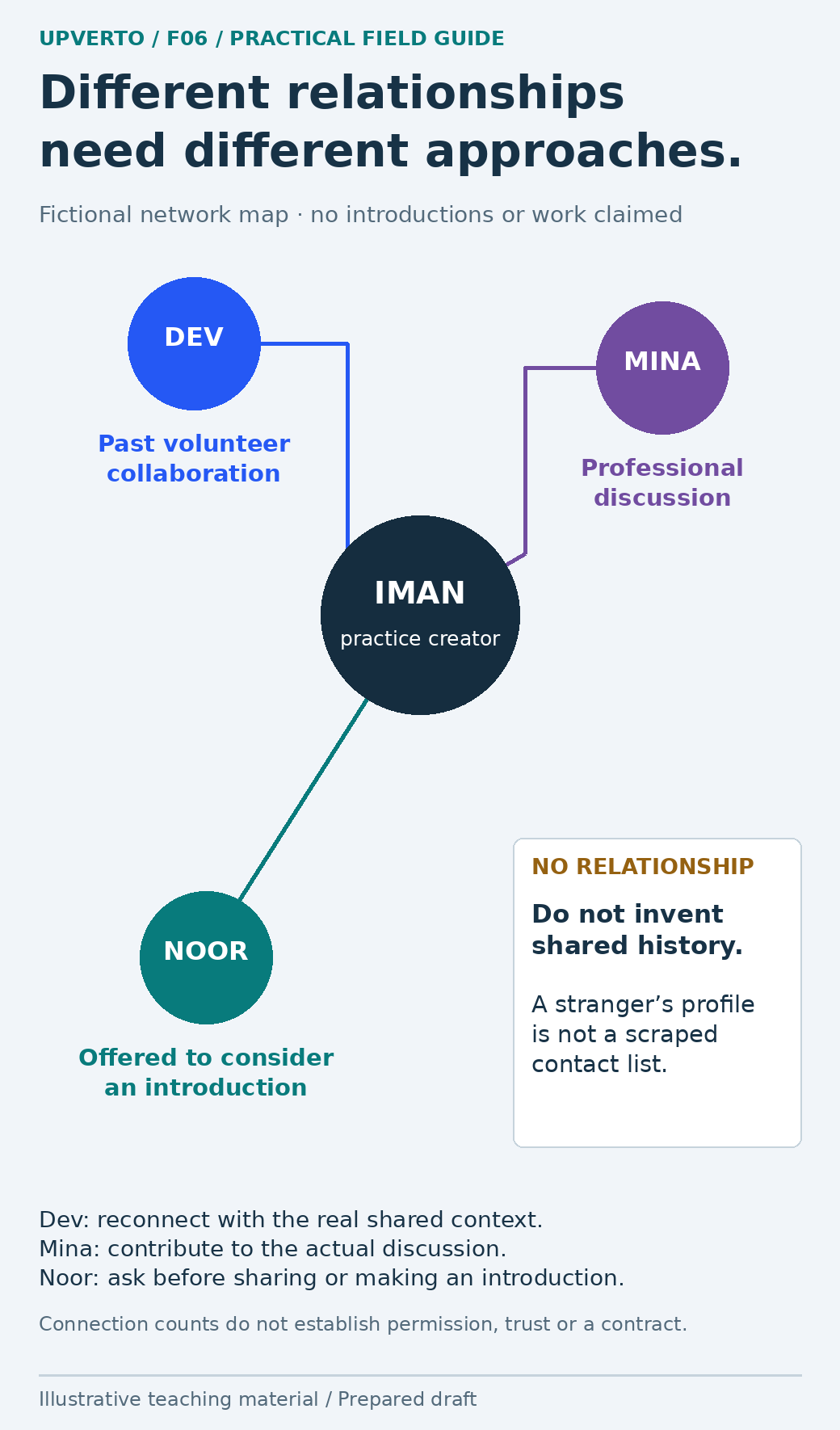
Read the text version: Match a networking approach to the real relationship
In this fictional map, Dev is a past volunteer collaborator, Mina is a professional discussion contact, and Noor has offered to consider an introduction. Reconnect using the actual shared context, contribute to the real discussion, and ask before sharing details or making an introduction. A stranger’s profile is not permission to scrape data or invent familiarity.
For someone you do not know, do not substitute a fabricated shared experience. Follow the context of their public invitation or professional discussion. A promotional pitch should not be hidden inside a connection invitation. If there is no suitable route, useful public participation and improving your evidence remain available actions.
Use a profile-and-network review sheet
| Review item | What to inspect | Action if unclear |
|---|---|---|
| Headline | A specific capability consistent with the evidence | Rewrite the service in ordinary language |
| About section | Audience, outputs, inputs, boundaries and contact preference | Remove unsupported expertise or results |
| Work sample | Your role, practice/client status, checks and limits | Add context and verify permission |
| Reader access | The sample opens and is understandable | Fix access or use another suitable format |
| Relationship note | How you actually know the person | Avoid invented familiarity |
| Conversation purpose | A relevant question or useful contribution | Do not contact merely to hit a target |
| Next action | An agreed response, closure or introduction request | Respect silence and explicit declines |
A compact relationship log can contain name, genuine shared context, last relevant conversation, an agreed next action and any preference not to be contacted. It does not need private family details or a scraped profile archive. Keep the information proportionate and secure, and follow the applicable privacy requirements.
A referral can begin with a forwardable description: the task you handle, who it helps and one accessible evidence link. Ask whether the person is comfortable making an introduction. Do not ask them to disclose someone else’s private address or imply that they endorse results they have not observed.
Review conversations, not vanity metrics
At a sensible review point, read the actual replies. Did people understand the service? Could they inspect the example? Were the conversations relevant to a real need? Record a correction such as “people thought I maintained booking software; clarify that this offer is an enquiry tracker.” That is more actionable than interpreting every change in impressions as evidence of an algorithm.
When a conversation becomes a genuine project enquiry, use freelance discovery call questions to clarify the goal, constraints and decision-maker. Keep the professional relationship valuable even when no project follows. A profile and network can support discovery; they do not replace delivery ability or create an obligation for others to refer you.
Frequently asked questions
Do I need a premium subscription before I can find relevant work?
This approach does not depend on a paid plan. Start with accurate profile information, accessible evidence and appropriate conversations. Check current feature availability for your account before paying for something, and do not assume a subscription produces enquiries.
What can I put in my headline without client experience?
Describe the task you are developing and demonstrate it with honestly labelled practice work. You can state a real capability without claiming seniority, employment or outcomes you have not earned.
Should I send a pitch with every connection invitation?
No. LinkedIn’s community policies restrict using invitations for promotional messages to people you do not know. Keep the relationship and context accurate, use appropriate channels, and avoid treating acceptance as permission for repeated pitches.
Can I use an automation extension to grow my network?
Do not use bots, scraping or unauthorised automation that conflicts with LinkedIn’s terms. An extension being available for purchase does not establish that its actions are permitted.
What if someone offers to introduce me?
Give them a short, accurate description they can forward, and let the prospective contact choose whether to engage. Confirm what may be shared. Do not present the introduction as a guarantee or an endorsement of unobserved results.
How often should I post?
Choose a sustainable rhythm only when you have useful work, observations or questions to share. There is no evidenced universal posting schedule in this guide. Assess the relevance of the conversations rather than chasing an arbitrary frequency.
Sources and scope
The worked examples, worksheets and diagrams are original fictional teaching materials. They are not reports of client results. Primary references were checked during preparation; verify current rules and account-specific features before acting.