A full calendar and a large invoice total can hide very different situations. You may have completed valuable work but be waiting for payment. You may have cash in the bank that must cover costs already committed. You may have free hours next week but no suitable space for a deadline tomorrow.
A small operational tracker should help you answer those questions separately. It does not need to predict your entire business. It needs clear definitions, supporting records and a regular review. This is one practical part of learning to grow a sustainable freelance business.
Give each number a precise meaning
Use revenue for the value of work recognised in the period under the basis you are using, expenses for the costs included on that same basis, and cash received for money actually collected. Profit is a result after the relevant expenses; it is not another name for the bank balance. Specify the period and the accounting basis before comparing totals.
The US Small Business Administration’s finance guide distinguishes cash and accrual recording. This article uses a deliberately simplified earned-work view alongside actual cash movements to make the difference visible. It does not select an accounting method for your jurisdiction or provide a tax return calculation.
Capacity is a separate measure: time that you can realistically commit after existing work and necessary business activities. A payment does not create an extra hour, and an empty hour does not create revenue.
| Field | Record | Do not substitute |
|---|---|---|
| Revenue basis | What work is recognised, when, and why | Every quote or enquiry |
| Included costs | Cost, category, period and supporting record | Only expenses paid today |
| Cash movement | Actual receipt or payment and matching reference | An invoice marked sent |
| Capacity | Available time less specific commitments | Every waking hour |
Connect the tracker to evidence
Start with freelance invoices payments records: invoice references, actual receipts, provider fees where applicable, and the record of what was agreed. Give each project a stable reference so a part payment does not become a second sale in your tracker.
Keep a transaction date and a work-period field when those differ. For a cost, record both what it relates to and whether it has been paid. For money received, connect it to the relevant invoice or other basis and record any unmatched amount for investigation. Do not quietly force a transfer to fit an invoice because the numbers are similar.
Personal contributions, borrowing, withdrawals and transfers between your own accounts need separate treatment from customer revenue. If those occur, add distinct categories and obtain suitable accounting guidance. The example below excludes them so the arithmetic is inspectable.
Worked example: one period, two money views
All figures here are fictional monetary units. The sample has completed work valued at 1,200 and associated included operating costs of 360. For this teaching model, those are the period’s entire revenue and operating costs; taxes, financing, capital purchases and personal transfers are outside the scenario. This is not a real business’s profit statement.
| Sample item | Recognised in this model | Cash movement this period | Unsettled at period end |
|---|---|---|---|
| Completed work | 1,200 revenue | 900 received | 300 receivable |
| Associated costs | 360 expense | 250 paid | 110 payable |
| Difference | 840 before tax in this model | 650 net cash increase | Timing explains the difference |
The model result is 1,200 − 360 = 840. Actual net cash movement is 900 − 250 = 650. The 190 difference comes from 300 not yet collected, offset by 110 of costs not yet paid: 840 − 300 + 110 = 650.
With opening cash of 500 and no other movements, closing cash would be 1,150. That is 500 + 650, not 500 + 840. The unpaid 110 still needs attention, and the receivable 300 is not available cash. Neither number establishes what the owner can safely withdraw.
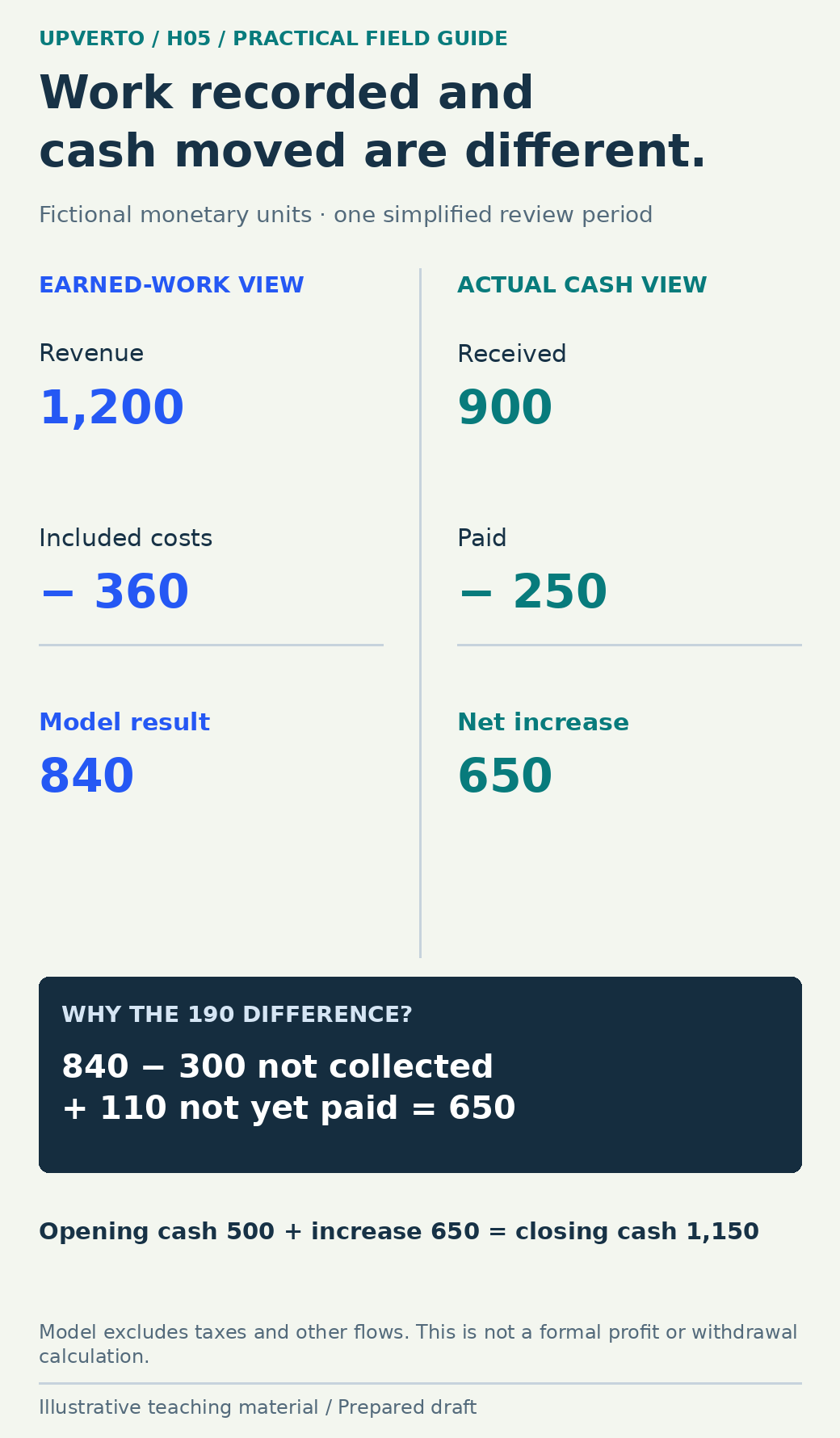
Read the text version: Reconcile an earned-work result with cash movement
Fictional period: completed-work revenue 1,200 and included costs 360 produce a model result of 840 before tax. Actual cash received is 900 and paid is 250, so cash increases 650. Reconciliation: 840 minus 300 uncollected plus 110 unpaid equals 650. Opening cash 500 plus 650 gives closing cash 1,150. The model excludes tax and other flows and is not a formal profit statement or a withdrawal recommendation.
Use a separate time budget
Now consider a fictional coming week with 24 available working hours after personal commitments. Ten are committed to projects, including their review and final checks. Four are reserved for administration, two for learning, and four for uncertainty. That leaves four uncommitted hours.
Check the placement of those hours as well as their total. Four scattered hours may support short edits but may not support an uninterrupted production task. An input-dependent project also needs time after the input arrives. Do not promise the same reserve to two clients or silently remove checking time when estimating new work.
| Time category | Hours | Meaning in this example |
|---|---|---|
| Existing project commitments | 10 | Includes coordination, revisions and quality checks for those projects |
| Business administration | 4 | Records, invoicing and necessary business tasks |
| Learning | 2 | Planned skill development |
| Uncertainty reserve | 4 | Not already promised to another task |
| Uncommitted | 4 | Inspect dates and dependencies before offering it |
| Total available | 24 | A planning assumption, not a recommended schedule |
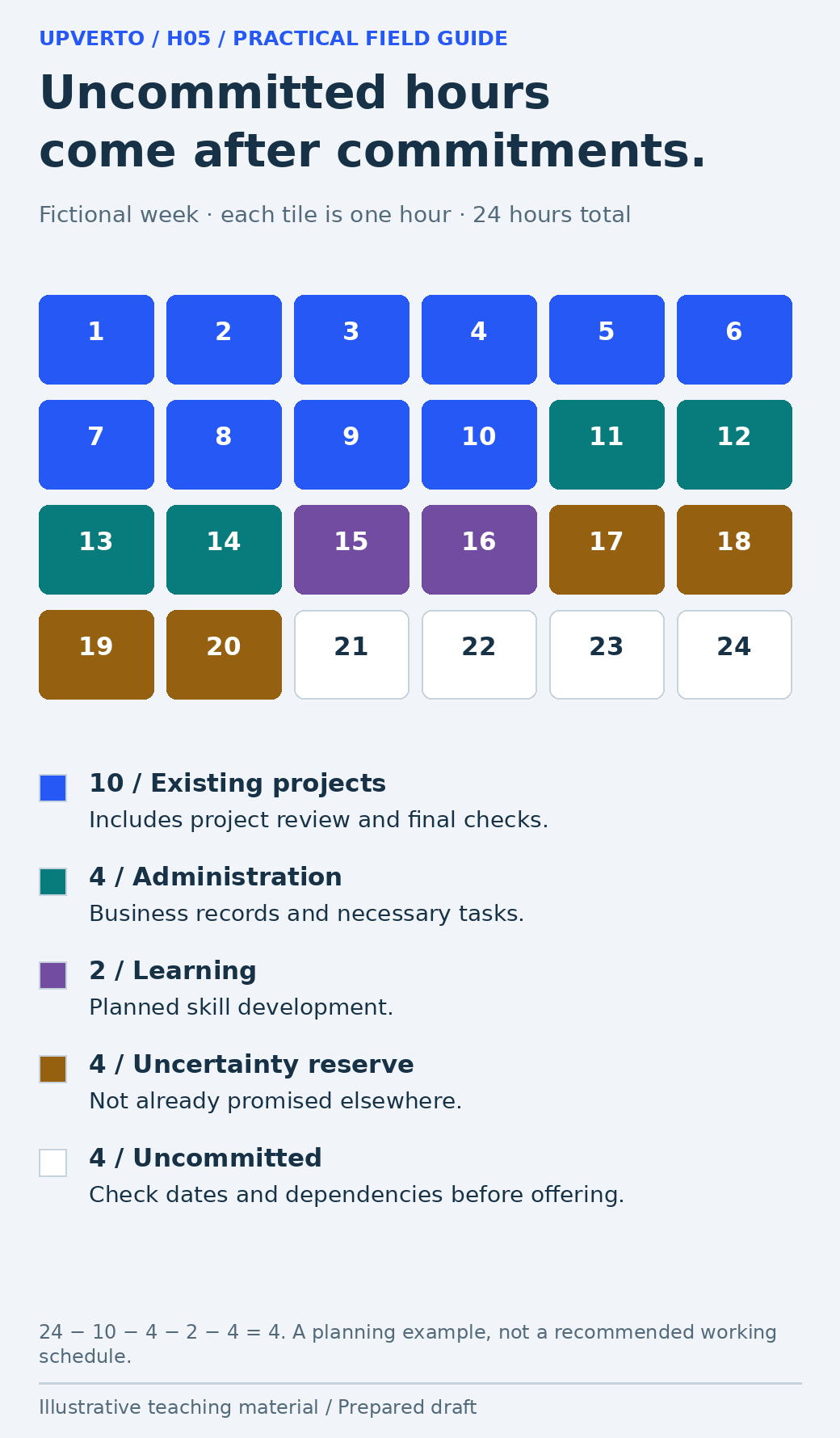
Read the text version: Build a realistic weekly capacity budget
Fictional available week: 24 hours. Existing projects use 10 hours including their checks, business administration 4, learning 2, and uncertainty reserve 4. Four hours remain uncommitted. Each tile is one hour. Calculation: 24 − 10 − 4 − 2 − 4 = 4. Check the placement of hours and required inputs before offering the remainder. This is not a recommended work schedule.
Copy the income, cost and capacity tracker
Use three linked views rather than one total labelled “income.” Copy these fields into your preferred table or notebook. Keep the source records accessible to you and restrict any client details to the people who need them.
- Work and invoices: project reference; period; recognised-work basis; amount; invoice reference; amount collected; amount outstanding; next action.
- Costs and cash: transaction reference; category; related project or overhead; amount included in the period; actual payment date; amount paid; balance payable; receipt or statement reference.
- Time: week; available hours; existing project hours including checks; administration; learning; reserve; remaining hours; input dependencies; date of next review.
Add a short reconciliation note: “These cash totals match these statement lines; these two entries remain unmatched.” A difference is a question to resolve, not a reason to overwrite the source. Keep currencies separate unless you have a documented conversion basis; adding different currencies directly produces a meaningless total.
For time, compare planned and recorded categories after the week. If project checks repeatedly use the reserve, include them more accurately in the next estimate. Record a correction to the process rather than treating all variation as personal failure.
Use the records to choose one action
If work is completed but cash is delayed, review the payment records and agreed process. If cash is healthy only because important costs remain unpaid, look at those commitments. If work consumes more time than the offer allowed, examine scope and delivery assumptions before changing the price.
The guide to how to price freelance work connects the offer to the work and costs it must support. When records justify a change for future proposals, use them to raise freelance prices responsibly. A single small sample should prompt investigation rather than a confident forecast.
Set a review rhythm that you can maintain. At each review, reconcile the money, update the time commitments and choose a specific next action with an owner and date. The tracker earns its place when it improves a decision, not when it contains the largest number of columns.
Frequently asked questions
Is an unpaid invoice income?
That depends on the basis and purpose of the record. In an earned-work view, qualifying completed work can be recorded before payment; a cash view records actual receipt. Label the basis and retain the unpaid balance. This operational distinction does not determine the accounting or tax treatment required for your situation.
Can I treat the bank balance as profit?
No. It may contain opening cash, loans or personal contributions, and it may still need to cover unpaid costs. Profit requires a consistent revenue-and-expense calculation for a defined period. Reconcile the bank balance separately and identify outstanding commitments before drawing conclusions.
Where should payment-processing fees go?
Record the customer’s payment, the fee and the net deposit as connected but distinct amounts. Whether a fee is yours or the customer’s depends on the actual arrangement and applicable rules. Do not turn a lower net deposit into extra customer debt without a valid basis.
Do I need to track every minute?
Use enough detail to answer the question you are investigating. Broad categories such as production, review, coordination and business administration may be sufficient. If a repeated estimate is wrong, temporarily record that activity more closely. Avoid a tracking system whose maintenance exceeds its usefulness.
Is all uncommitted time available for new work?
Check the dates, concentration needed, dependencies and your uncertainty reserve first. The fictional four hours are a remainder in a plan, not automatic permission to accept any four-hour request. Keep time for essential checks and commitments that have not yet reached their delivery stage.
How should I use this for taxes?
Treat it as an operational starting point, not a filing guide. Tax categories, timing, rates and record-retention requirements depend on the relevant jurisdiction and circumstances. Use current local official guidance and qualified help where needed; keep the underlying documents so the records can be interpreted correctly.
Sources and scope
The worked examples, worksheets and diagrams are original fictional teaching materials. They are not reports of client results. Primary references were checked during preparation; verify current rules and account-specific features before acting.