A useful freelance service package explains what the client receives, what they must supply, how review works, and where the work ends. It turns a broad service into an agreement that can be discussed and checked.
A package can be a single project, a repeatable task, or a defined period of support. It does not need a clever name or three pricing tiers. It needs a clear relationship between the client’s request, your work, and the deliverables.

In this guide
Read the text version: Write a package someone can check
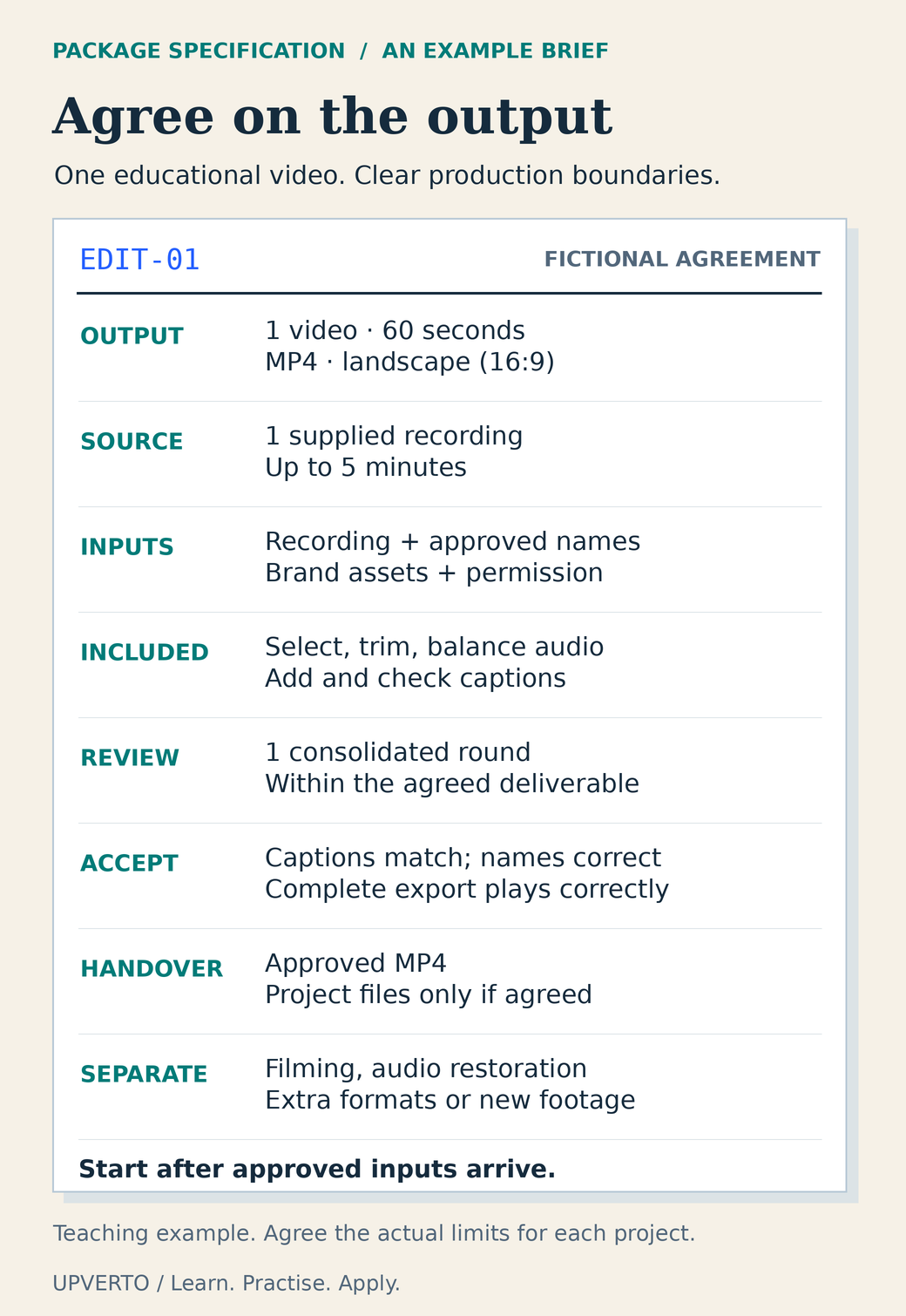
This is a fictional educational-video package, not a report of client work. The example brief specifies one 60-second landscape MP4 from one supplied recording of up to five minutes. These are illustrative limits, not platform requirements or a standard market package.
- Client inputs: recording, approved names, brand assets and permission to use the material.
- Included work: selection, trimming, basic sound balancing, and adding and checking captions.
- Review: one consolidated round within the agreed deliverable.
- Acceptance: captions match speech, names are correct, and the complete exported file plays correctly.
- Handover: the approved MP4; project files are included only if explicitly agreed.
- Separate work: filming, extensive audio restoration, extra formats or new footage.
Production starts after the approved inputs arrive. Agree the actual limits, timing and commercial terms for the real project.
Include the parts that prevent ambiguity
| Part | What to specify |
|---|---|
| Purpose | The task the package helps the client complete. |
| Deliverables | Quantities, formats, dimensions, pages, records, or other relevant units. |
| Inputs | Approved copy, source files, access, permissions, and decisions the client supplies. |
| Included work | The activities required to produce and check those deliverables. |
| Exclusions | Related work that needs a separate agreement. |
| Timing | Start conditions, milestones, review windows, and dependencies. |
| Revisions | What counts as a revision, how feedback is consolidated, and what changes the scope. |
| Acceptance | Observable checks for the agreed output and the review process. |
| Handover | Final exports, source files if agreed, instructions, and any support period. |
| Commercial terms | The quote, payment arrangement, and applicable terms for this engagement. |
Begin with a clear service definition. Then fill in the details appropriate to the actual work. A package worksheet is useful for discussion; it does not replace the legal or tax requirements that may apply to your particular engagement.
Separate inputs from outputs
Many misunderstandings begin with missing inputs. A client may expect a designer to write the copy, a video editor to find all the footage, or a website specialist to configure a service that was never mentioned.
List the materials and decisions needed before production begins. State who supplies them and what happens if they are incomplete. If you offer to create a missing input, include that work in the scope and estimate.
- Before: approved inputs and a confirmed brief.
- During: defined production, checks, and review.
- After: agreed deliverables and handover.
- Change: new requirements are discussed before extra work begins.
Example: a short-video editing package
Fictional teaching package: one concise educational video edited from one supplied recording. The final length, source-footage limit, aspect ratio, caption format, and export requirements are confirmed in the brief.
- Client supplies: the recording, approved names and technical terms, brand assets, and permission to use the material.
- Included: selection and trimming, basic sound balancing within the condition of the supplied recording, checked captions, one agreed export, and one consolidated review round.
- Separate work: filming, scriptwriting, complex animation, extensive audio restoration, additional formats, and replacement footage.
- Acceptance checks: the agreed message is preserved; captions match speech; names are checked; the complete export plays correctly; no unapproved material appears.
- Handover: the approved export and any project files explicitly included in the agreement.
The particular limits should come from the actual task and your demonstrated capability. The example does not establish a standard market package or price. Use the editing roadmap to identify the skills behind the service.
Example: a small website-content update
Fictional teaching package: update approved text and images on a named set of information pages in an existing WordPress site. Review the changes in a suitable draft or staging workflow before any authorised live update.
Specify the pages, supplied content, image permissions, layout changes allowed, required backup, access arrangements, and the person approving the result. Check the affected navigation, readability, links, and any functionality the change touches.
Separate content editing from new custom functionality, payment changes, migrations, and ongoing maintenance unless those are actually included and within your capability. The WordPress roadmap explains why a small visible edit can still involve important operational responsibilities.
Define revisions with examples
A revision refines the agreed work. A new requirement changes what is being produced. The distinction depends on the brief, so write examples that fit the package.
For an event graphic, correcting a supplied venue detail within the agreed layout may be a revision. Requesting a new campaign concept or three additional formats may change the scope. If the provider made an error against the approved brief, correcting that error should not be disguised as an optional extra.
Ask for consolidated feedback from an agreed decision-maker. Confirm which comments are approved, record the version, and explain any effect on the schedule before proceeding.
Read the text version: Classify a request against the brief
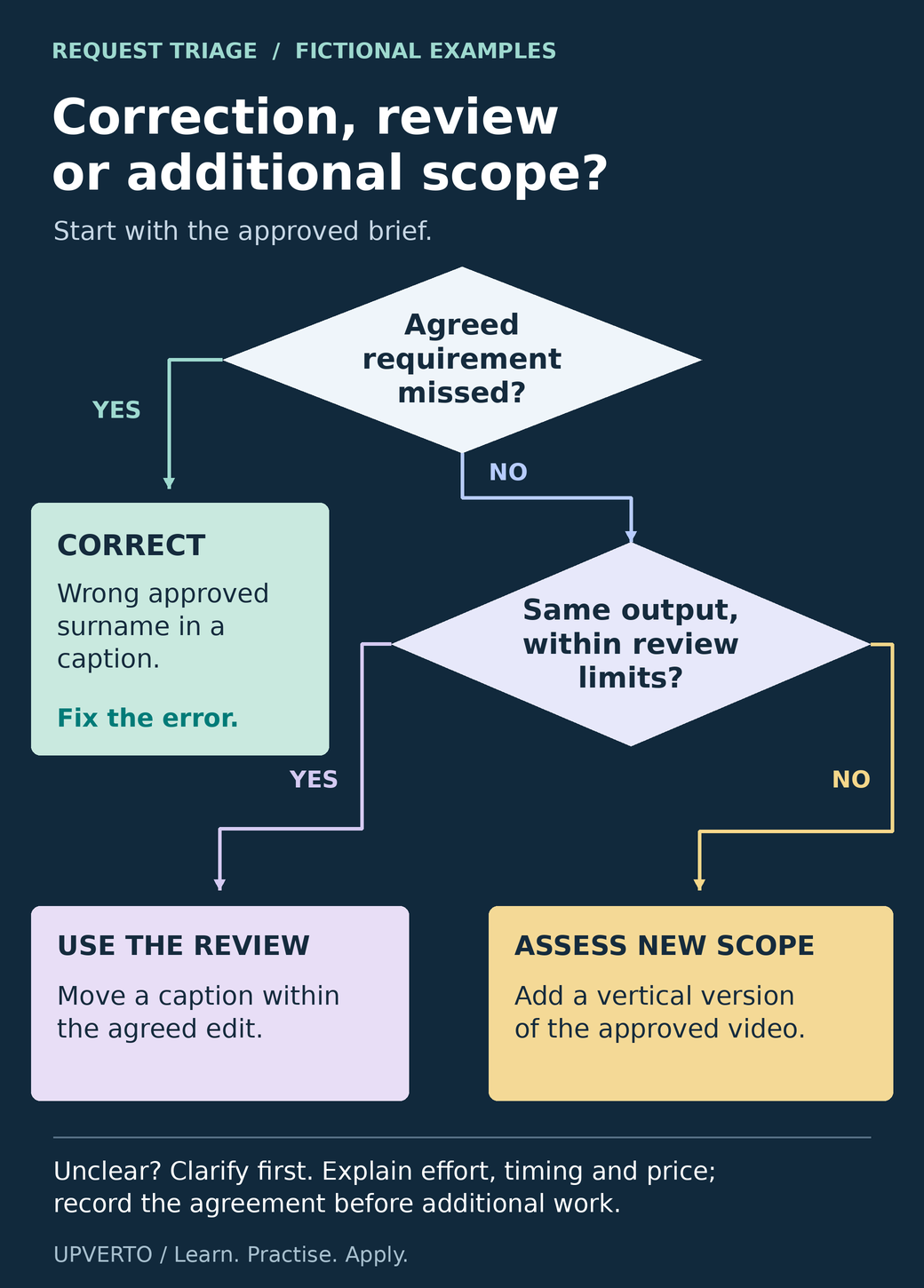
Begin by comparing the request with the approved brief and version. If an agreed requirement was missed—for example, the editor used the wrong approved surname in a caption—correct the error.
If no agreed requirement was missed, ask whether the request changes the same deliverable within the defined review limits. Moving a caption within the agreed edit may belong to that review process.
An additional output, such as a vertical version of a video whose agreed export was landscape, needs a scope assessment. Explain the effect on work, timing and price and record the agreement before producing the extra version. If the brief is unclear, clarify it before classifying the request. The examples guide the discussion; the actual agreement defines the boundary.
Connect timing and price to the actual work
A delivery estimate should state when the clock starts and what it depends on. “After receipt of approved copy and access” is clearer than a date that assumes those inputs already exist. Include time for your own checks and for the agreed client review.
Build the quote from the work, expected effort, costs, uncertainty, and commercial arrangement. If the scope is too unclear to estimate sensibly, ask further questions or define a separate discovery task. Do not invent a low price and rely on unexpected charges to make the project workable.
Check whether another person can understand the package
- Ask them to list the outputs they believe are included.
- Ask what they must supply before work begins.
- Give one revision example and one possible scope change.
- Ask how they would decide whether the deliverable meets the brief.
- Ask what happens after handover.
If their answers differ materially from your intention, rewrite the package. This review tests clarity; it does not replace checking your ability to perform the work.
Frequently asked questions
Should I offer unlimited revisions?
Only make commitments you can define and sustain. A clear review process with agreed boundaries makes effort easier to estimate. If a client needs a flexible arrangement, discuss how work is prioritised, recorded, and paid rather than leaving the commitment undefined.
Should source files be included?
Agree on this explicitly. A final export and an editable project are different deliverables. Consider third-party assets, licences, and the recipient’s ability to open the files before promising a particular handover.
What should every freelance service package explain?
Describe the client need, required inputs, exact outputs, review arrangements, acceptance checks and handover. Include exclusions and the assumptions behind timing and price. A reader should understand both what is included and which decisions still need to be agreed.
What is the difference between a revision and new scope?
A revision adjusts the agreed deliverable within the defined review process. A new output, a changed purpose or an additional format may create new scope. Use examples in the package and discuss the effect on effort, timing and price before doing the extra work.
When should the delivery schedule begin?
Define the start conditions in the agreement. These may include receiving approved source material, access and required decisions. Explain how missing inputs or delayed feedback affect the schedule so that the promised timing matches the actual workflow.
Can one package work for every client?
A reusable package can provide a starting structure, but check it against each request. Adjust the deliverables and assumptions when the context differs. Do not force an unsuitable project into a fixed description or quietly add responsibilities that the package does not cover.
Use the package in a real delivery process
Complete the worksheet for one task, verify your readiness, and connect it to a relevant portfolio sample. When a suitable client agrees, use the project workflow to manage the brief, review, checks, and handover.