To make money online with a digital skill, learn to complete a useful piece of work, build evidence that you can do it, and connect with people who need that work. The internet helps you find opportunities and deliver results. The value comes from the problem you can solve.
You might edit a creator’s videos, organise a business owner’s records, improve a website, or design clear marketing materials. Each path requires a different skill. All of them also require practice, communication, and reliable delivery. This guide explains the whole journey and helps you choose a practical starting point.

In this guide
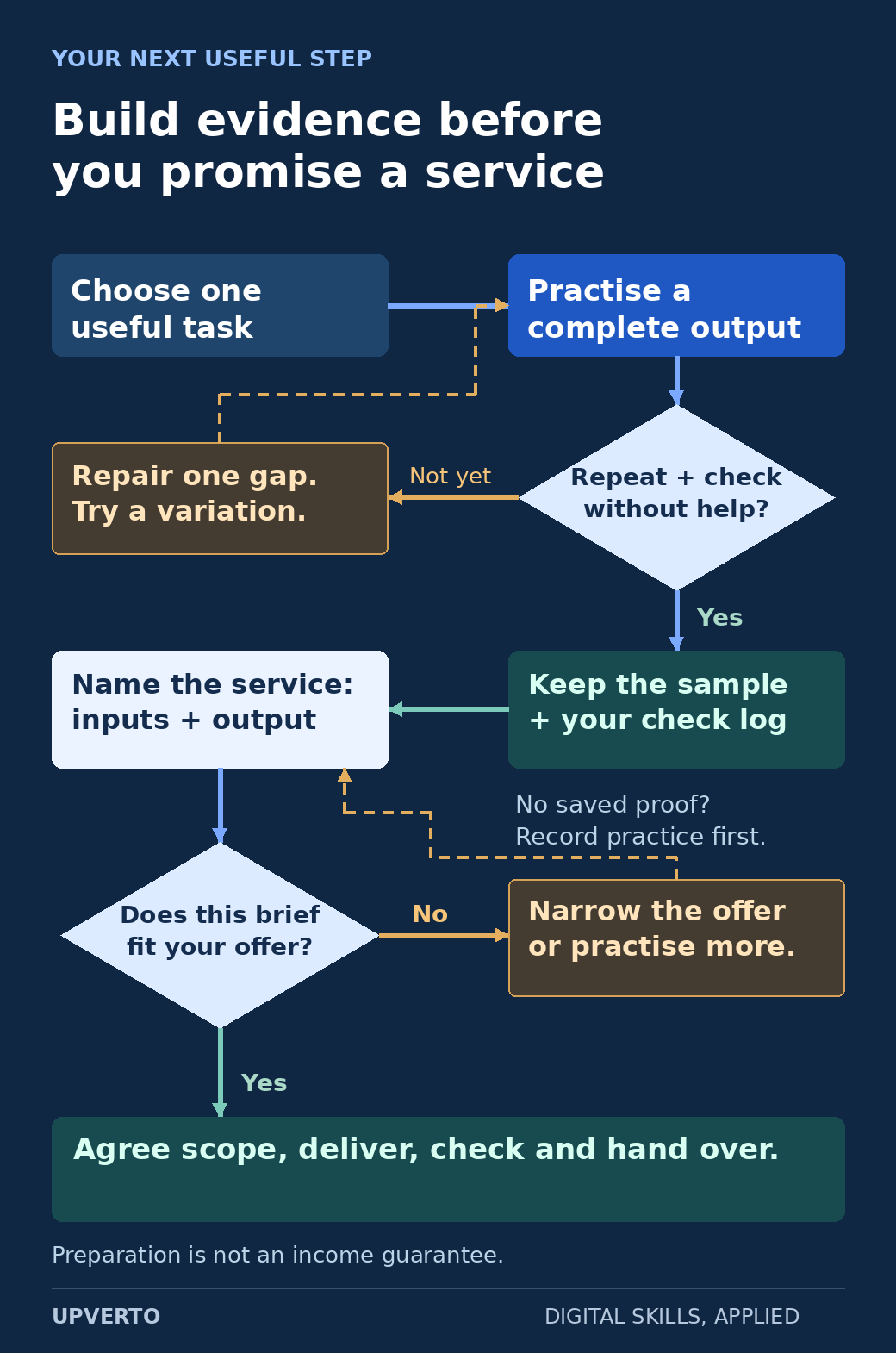
Read the text version: Find the next useful step
- Choose one useful task and practise a complete output.
- Ask whether you can repeat the task and check the result. If not, repair one specific gap and try a variation.
- Keep the practice sample and a record of your checks. If you have no saved evidence, document the practice before making claims.
- Define the service through its required inputs and finished output.
- Compare a potential client brief with that service. If it does not fit, narrow the offer or practise further rather than accepting unsupported responsibility.
- For work that fits your demonstrated ability, agree the scope, deliver it, check it and hand it over.
The route describes preparation and delivery. It does not promise an income or a timetable for finding clients.
Practical summary
- Choose: a skill and a type of problem you want to solve.
- Practise: complete a small task with clear requirements.
- Prove: show your work and explain your decisions.
- Offer: define what a client will receive.
- Connect: find relevant opportunities and discuss the brief.
- Deliver: check the work, hand it over, and learn from feedback.
Understand the different ways digital skills can earn income
Start by choosing a route to investigate. You do not need to pursue every option at once.
| Route | What you provide | What you need to prepare |
|---|---|---|
| Freelance services | A defined piece of work for a client, such as an edited video or a website update. | Relevant ability, work samples, a clear scope, and a way to manage client projects. |
| Remote employment | Ongoing work within an employer’s role and team. | The skills and evidence required by the particular role, plus an application and interview process. |
| Digital products | A reusable item, such as an original template or software product. | A useful product, rights to its contents, a way to reach buyers, and arrangements for support. |
| Content-led business | Useful content that develops an audience and supports a defined business model. | Subject knowledge, consistent production, distribution, and the requirements of the chosen revenue method. |
These routes can overlap, but they are different businesses. Selling services does not require building a large public audience first. Selling a reusable product still requires finding customers. A remote job may have location, working-hours, or eligibility requirements even when the work happens online.
This roadmap concentrates on skills and client services because that gives you a concrete sequence to practise. The same portfolio and communication work may also support an employment application, provided it matches the role.
Choose a skill by examining the actual work
Imagine a normal working session, including its less exciting parts. A video editor may spend time organising footage and correcting captions. A designer may revise spacing and prepare exports. A virtual assistant may check a spreadsheet for missing details. A website specialist may reproduce a problem before changing anything.
Choose work you are willing to practise, check, and improve. Our digital-skill selection guide compares different families and includes small trial tasks. For a closer look, explore graphic design, video editing, SEO, virtual assistance, or WordPress services. These are examples of possible directions, not a ranking of guaranteed earners.
Write down your current equipment, available study time, confidence with files and documents, and the kinds of tasks you enjoy. If you only have a phone, test whether your intended workflow can be completed on it before buying training or promising a service. Reading lessons on a phone and producing a complete client deliverable are separate questions.
Learn the foundations and practise a defined task
A useful first learning objective describes something you can produce. “Learn design” is broad. “Create a readable event announcement with a clear date, location, and booking instruction” gives you a task to complete and inspect.
Identify the prerequisites: managing files, using the relevant application, understanding the brief, and recognising a correct result. Follow a worked example, explain what you did, then change the requirements and attempt the task again. Use the practical learning guide to build this sequence.
Keep a small record of mistakes and fixes. If an exported video has missing audio, investigate the export settings and check the next export. If a layout becomes unreadable at a smaller size, revise it and compare the result. These records will help you see which tasks you can complete reliably.
A course can organise the learning, but you still need to perform the work. Before enrolling anywhere, examine the prerequisites, practice tasks, actual course scope, and support that is explicitly included. Choose training that addresses your next learning gap.
Build evidence before presenting yourself to clients
You can create useful samples before anyone hires you. Write a fictional brief, use material you own or have permission to use, and complete the work against the brief. Label it as a practice or concept project wherever you show it.
A convincing sample explains the problem, the intended audience, your decisions, the finished deliverable, and the checks you performed. A screenshot can show appearance. It cannot prove that a form works, a spreadsheet formula is correct, or a client earned more revenue.
Use the portfolio guide for people without clients to organise your evidence. If you are unsure what to build, choose a portfolio project that matches the service you want to offer. Avoid copying another person’s project and presenting the result as independent work.
Turn a skill into something a client can understand
A client needs to know what you can complete for them. “I use editing software” describes a tool. “I edit a supplied interview into one short video with checked captions and an agreed export format” describes a deliverable.
Teaching example: Mina is a fictional beginner who wants to edit short educational videos. She first practises with footage she records herself. Her sample brief asks for a concise explanation, intelligible speech, accurate captions, and a clear ending. She keeps the original recording, the edit, and notes explaining what she changed.
After she can repeat that task independently, she defines a small service: one agreed edit from a limited amount of client-supplied footage, one review round, and a named export. Filming, scriptwriting, new graphics, and extra versions are separate unless included. This is a planning example, not a report of earnings or a recommendation that every beginner sell the same package.
Follow the guide to turning a digital skill into a service, then use the service-package worksheet to define inputs, outputs, boundaries, and acceptance checks.
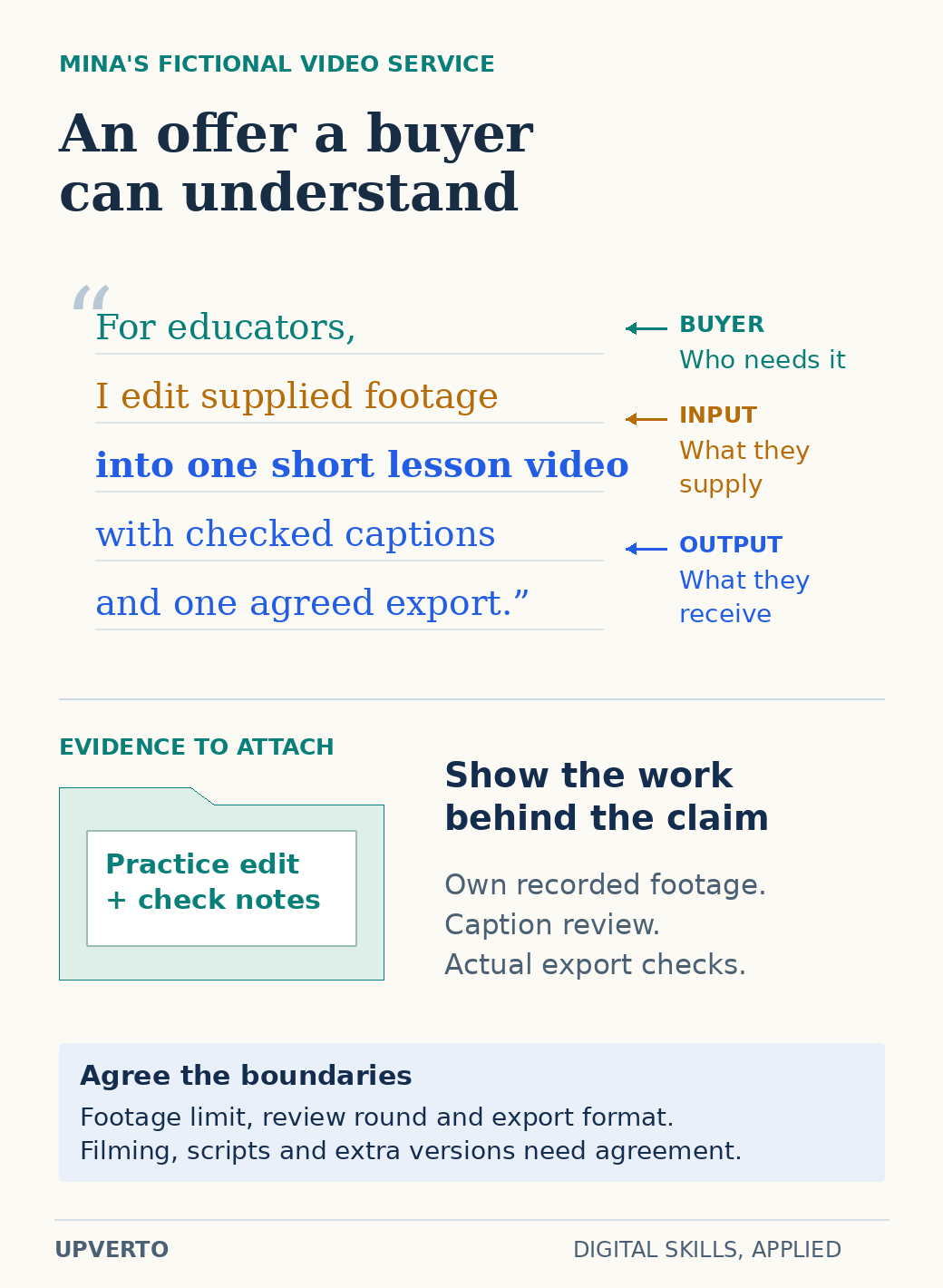
Read the text version: Read the anatomy of a useful offer
Fictional offer: “For educators, I edit supplied footage into one short lesson video with checked captions and one agreed export.”
- Buyer: educators who need a lesson video.
- Input: footage the client supplies.
- Deliverable: one short lesson video, checked captions and an agreed export.
- Evidence: Mina’s own practice edit, caption-review notes and checks of the actual export. These support a claim about the task she completed, not earnings or client results.
- Boundaries to agree: the footage limit, review round and export format. Filming, scriptwriting and extra versions are separate unless expressly included.
Look for relevant opportunities
Study real requests for the kind of work you can perform. Record the task, expected output, required experience, supplied materials, and questions you would need to ask. A request for an experienced specialist is useful market information even when you are not ready to apply.
Possible channels include people you already know, professional communities, agencies that need support, direct business enquiries, and freelance marketplaces. Choose a manageable channel and learn its rules. A profile alone does not establish demand for your particular offer.
When you contact a potential client, connect their actual problem to one relevant sample and a clear next question. Do not invent a problem you have not verified or claim results you cannot support. Our client-finding guide explains how to prepare, qualify opportunities, and keep track of conversations.
Accept work you can deliver and manage it clearly
Before agreeing to a project, confirm the deliverables, client inputs, permissions, review process, timing assumptions, and commercial arrangements. If the task involves sensitive data or a business-critical system, the responsibility may be greater than the visible editing task suggests.
Use the readiness checklist to examine your ability to execute, check, troubleshoot, communicate, and hand over this specific task. You may be ready for a narrow service while still learning more advanced work.
Once work begins, keep a clear brief and version history, raise missing information early, and review the finished output against agreed requirements. The project-management guide covers the route from brief to handover. Later, the sustainable-growth guide helps you review capacity, repeat work, and the improvements your business needs.
Keep costs and opportunity claims in perspective
Make a small starting budget for equipment you actually need, connectivity, software, learning, and any channel costs. Check current official prices and eligibility before committing. Avoid buying a collection of tools simply because someone includes them in a recommended setup.
Income depends on factors such as your ability, the work available, how you reach buyers, and whether projects are completed and paid. This guide cannot predict when you will earn or how much. If you need immediate income, treat learning as a separate project with uncertain timing rather than relying on it to meet an imminent bill.
The US Federal Trade Commission’s job-scam guidance describes fake jobs that request money or use fraudulent cheques. Verify an unfamiliar opportunity independently, especially if someone asks you to pay to release earnings or forward part of a payment to another person.
Your starting-point worksheet
| Decision | Write your answer |
|---|---|
| My current stage | Exploring / learning / building evidence / preparing an offer / finding clients / delivering. |
| One skill to investigate | Name the skill and a specific task you want to try. |
| My constraints | Available equipment, realistic study sessions, budget, and access needs. |
| My first practice output | Describe a finished item and how you will check it. |
| My evidence | Keep the brief, your work, checks, and explanation of decisions. |
| My next action | Choose one small step that moves your present stage forward. |
Questions people ask before starting
Do I have to learn coding?
No. Design, editing, writing, marketing, and administrative services involve different kinds of ability. Some paths use code; others do not. Compare the actual tasks and prerequisites before choosing.
Should I learn several skills at once?
Begin with a defined task and the skills needed to complete it. Add a complementary skill when it solves a specific gap. Collecting unrelated introductory courses can leave you without a complete piece of work to show.
Can I start without paying for a course?
You can investigate a skill and begin practising with suitable free resources and tools. Availability depends on the skill and your equipment. Pay for structured learning when its actual contents address a gap you understand.
How soon can I start earning from a digital skill?
There is no reliable timetable that applies to everyone. First choose a specific task, practise it, check your results and create relevant evidence. You can then discuss suitable work with potential clients. A learning schedule helps you practise consistently, but it does not guarantee a paid project.
Do I need a powerful computer to begin?
Check the requirements of the task and the tools you plan to use. Writing, research and some administrative tasks have different needs from large video projects or development environments. Try a small complete workflow on your current equipment before committing to a course or buying hardware.
How do I avoid suspicious online-work offers?
Check who is offering the work, what the task involves and how payment is supposed to work. Be cautious about guaranteed earnings, requests to pay to obtain a job, or instructions to move money for someone else. Use the job-scam guidance linked in this article and verify an opportunity before sharing sensitive information.
Choose the next step that fits you
If you are still exploring, begin with choosing a digital skill. If you have already chosen, make a practical learning plan. If you can complete a useful task independently, build an honest portfolio and define a clear service. You do not need to complete every stage today; you need a useful next action and a way to check your progress.