Category: Find clients

  • Discovery Call Questions to Ask Before Quoting a Project

    Discovery Call Questions to Ask Before Quoting a Project

    A discovery conversation should reduce the uncertainty that prevents a responsible estimate. Learn what problem needs solving, who is affected, which inputs exist and how the result will be accepted. The output is a clearer decision about the project, not a long questionnaire or an obligation to quote immediately. This step follows a genuine enquiry in how to find freelance clients.

    Prepare a short question plan

    Read the enquiry and any materials the client has deliberately supplied for review. Write what you already know, what you are assuming and the few questions that could change the work substantially. If the request is “make the registration process easier,” the important uncertainty may be whether the work concerns page wording, an existing form or an entirely new booking system.

    Keep the service described in your proposal consistent with the conversation. The guide to write freelance proposal helps present a possible engagement; discovery tests the assumptions behind that offer. Do not turn a preliminary proposal into a fixed commitment while essential dependencies are unknown.

    Agree who should attend, the purpose of the discussion and the way notes will be shared. Ask before recording and check the applicable consent, privacy and platform requirements. A written summary is often enough. Avoid collecting passwords, private customer records or unrelated personal information simply because a call provides an opportunity to ask.
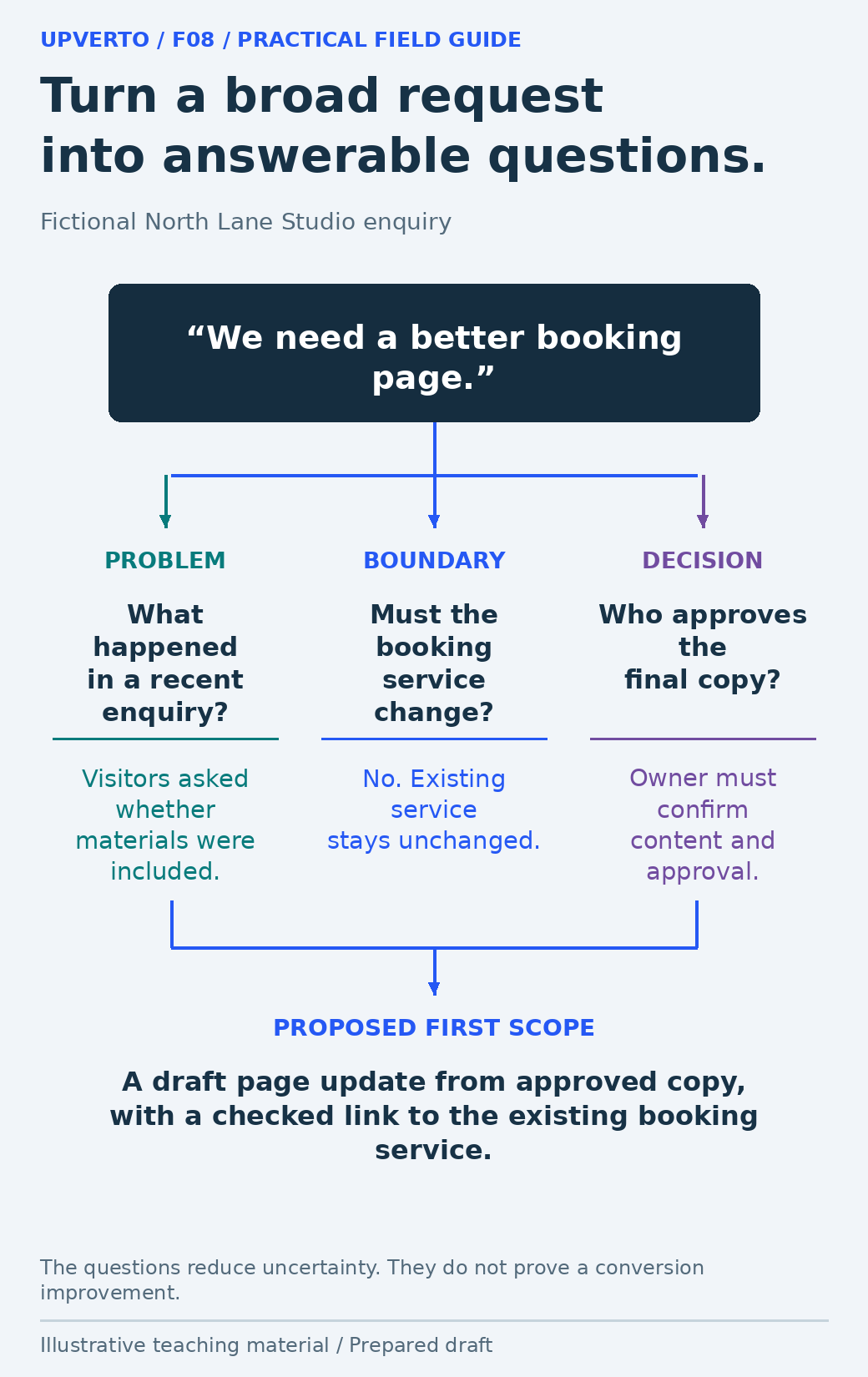
    A broad fictional booking-page request branches into questions about a recent problem, the existing service boundary and final approval, then converges on a draft page update.
    Clarify a broad booking-page request — Ask questions whose answers materially change the proposed work. Use the enlarged view, then swipe or use arrow keys to inspect. View full-size infographic.
    Read the text version: Clarify a broad booking-page request

    North Lane Studio’s fictional request for a better booking page is investigated through three questions. A recent enquiry concerns whether materials are included. The existing booking service must remain. The owner must confirm approved copy and final approval. These answers support a proposed draft content/layout update with a checked link, not a booking-system rebuild or a promised sales improvement.

    Ask about actual work before proposed features

    The GOV.UK guidance on in-depth interviews focuses on people’s circumstances and experiences. For a small client project, an original practical adaptation is to ask for a recent example: “Talk me through the last registration you handled.” Concrete events can expose missing inputs and exceptions that an abstract wish list misses.

    QuestionWhat the answer changes
    What happens now, and where does it become difficult?The problem definition and whether your service fits
    Who uses the result, including people with different access needs?Audience, formats and required checks
    What would a satisfactory result allow them to do?Observable acceptance conditions
    Who supplies content and who approves the final version?Dependencies and decision ownership
    Which systems, files and permissions already exist?Feasibility, access and discovery work
    What date matters, and what is driving it?Scheduling and consequences of delay
    What budget range or approval process should the estimate respect?Whether a suitable scope is possible

    Budget context is useful because it helps both sides choose a realistic scope. It is not a reason to pressure someone into a number or promise that any budget can support the same result. If they cannot state a range, explain the information you need to prepare options and what would remain uncertain.

    Follow the answer and separate facts from assumptions

    Listen for contradictions and unresolved owners. “The administrator can approve it” is not the same as an identified administrator agreeing to review a particular version. “The data is ready” may mean a file exists, not that the fields are accurate or suitable for the intended use. Ask to inspect a safe, representative sample through an authorised process when it is necessary to estimate the work.

    Repeat your understanding in ordinary language: “You want the existing enquiry form explained more clearly; replacing the form service is not currently included.” Give the client a chance to correct it. Mark an assumption as provisional rather than silently treating it as a decision. A useful call can end with a smaller proposed scope or a decision not to proceed.

    When uncertainty affects effort, use estimate freelance project scope to distinguish a bounded estimate from a guess. If a deeper investigation is needed, define that investigation as a separate piece of work with its own output. Do not quote an uninspected integration as if its compatibility were already proven.

    Worked example: an event-registration enquiry

    Fictional scenario: North Lane Studio asks for “a better booking page” before a new workshop series. During the conversation, the freelancer learns that the existing booking service must stay, the text is not approved, and two people believe they have final approval. No real call or implementation is claimed.

    Initial statementClarifying questionRecorded result
    “The page is confusing.”Which step caused difficulty in a recent enquiry?Visitors asked whether materials were included; the cause is not yet independently tested
    “Keep the booking system.”Can we link to the existing service without changing its configuration?Proposed boundary: page content and layout only
    “The copy is ready.”Who approves the final materials list and cancellation wording?Studio owner supplies approved text
    “Both of us will review.”Who resolves conflicting instructions?Name one final approver before scheduling
    “Finish next week.”When will approved content and access be available?Delivery timing remains dependent on those inputs

    The resulting proposal is a draft page update with approved wording, a visible materials section and a checked link to the existing booking service. It excludes payment-system changes and any claim that the redesign will increase bookings. The freelancer still needs the actual approved copy, suitable access and confirmed review arrangements before committing to production.
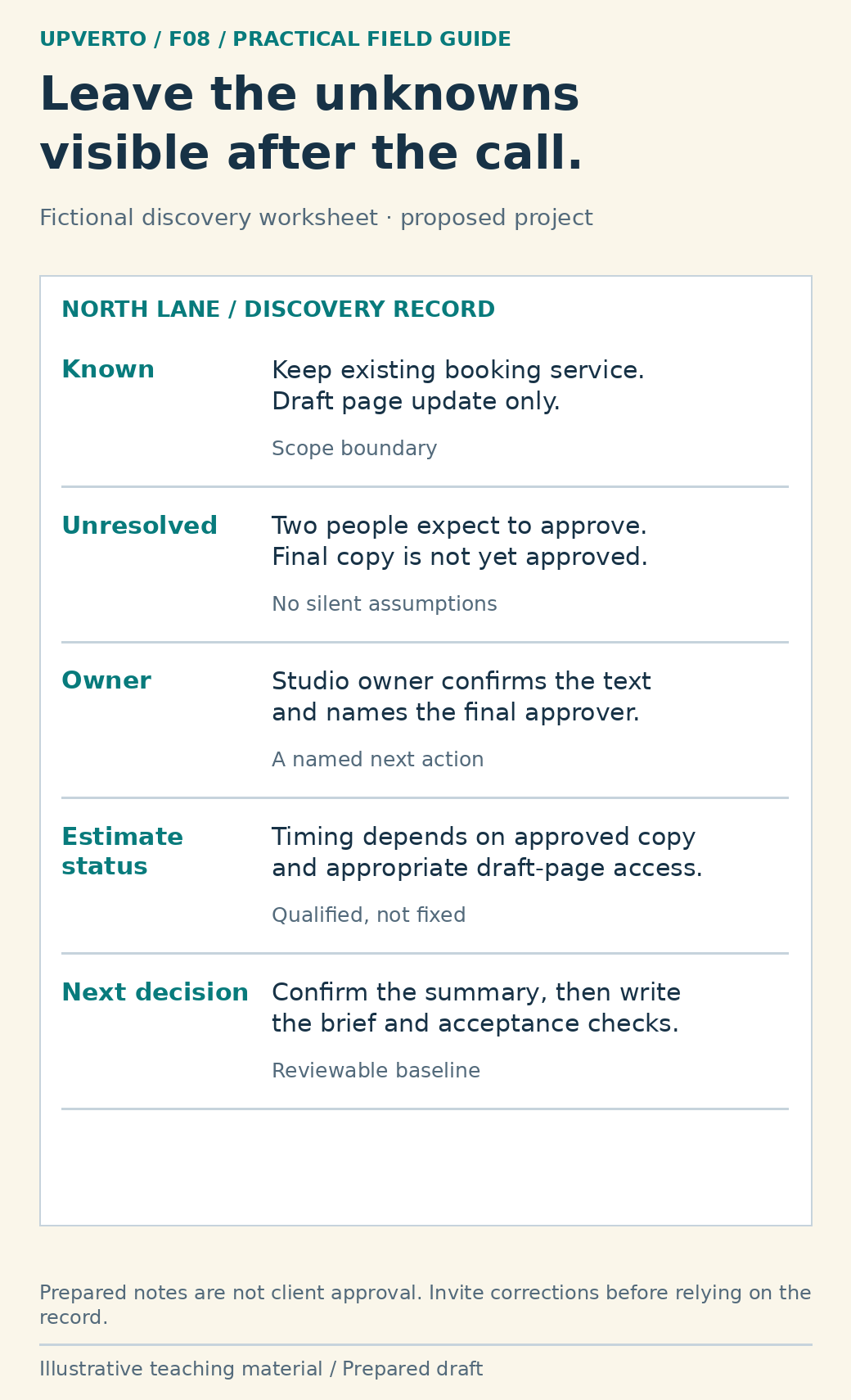
    A filled fictional discovery sheet records known scope, unresolved approval and copy, the owner of each next action, a qualified estimate status and the next brief decision.
    Keep discovery facts and unresolved decisions separate — An unresolved field is useful information; it should not be converted into assumed approval. Use the enlarged view, then swipe or use arrow keys to inspect. View full-size infographic.
    Read the text version: Keep discovery facts and unresolved decisions separate

    The fictional worksheet confirms a draft page update with the existing booking service retained. Final copy and the final approver remain unresolved. The studio owner must confirm both. Timing depends on those inputs and suitable draft-page access. The next step is to confirm the summary and prepare the brief and acceptance checks. No response is not approval.

    Copy the discovery worksheet

    Use the following fields as a one-page note. Fill the “evidence or owner” column so that the record contains more than a list of aspirations. Leave missing information visible. The worksheet is an operational preparation tool, not a contract or a substitute for specialist review where the work requires it.

    FieldWhat to record
    Problem and present workflowA recent example, source and what remains unverified
    Audience and intended useWho uses the output and in what situation
    Deliverables and exclusionsNamed outputs, formats and work outside the proposal
    Inputs and accessRequired files, source of approval and access owner
    Decision-makerWho approves and resolves conflicting comments
    AcceptanceWhat will be checked, by whom and in which final format
    Timing and dependenciesRequired dates, input deadlines and unresolved constraints
    Commercial contextBudget process and questions to settle separately
    Next decisionQuote, narrower option, investigation, referral or decline

    After the conversation, send a concise summary through the agreed route. Identify decisions, assumptions, missing information and who owns each next action. Ask for corrections to the summary before relying on it. A note saying “no response received” is more honest than marking an assumption approved because time has passed.

    Decide whether you can quote responsibly

    You can prepare a defined quote when the important outputs, dependencies, responsibilities and acceptance conditions are understood well enough for the commitment. If a material question remains open, state what it prevents you from estimating and propose the smallest useful way to resolve it. A range without assumptions is often just an unclear promise.

    Use write project brief acceptance criteria to turn the confirmed understanding into a reviewable project baseline. Keep legal terms, payment arrangements and later changes in their appropriate agreements and guides. Discovery is successful when it improves the decision, including a well-explained decision to narrow or decline the task.

    Frequently asked questions

    Must every project have a video call?

    No. A short, clear request may be resolved through an agreed written exchange. Use a call when discussion will reduce important uncertainty, and keep an accessible alternative available when needed.

    Should I ask about budget early?

    Ask enough to understand whether an appropriate scope is feasible and how approval works. Explain why the information matters. If the client cannot give a range, outline the unknowns and suitable options instead of forcing a premature quote.

    Can I record a discovery call?

    Only through an agreed process consistent with applicable consent, privacy and platform requirements. Explain the purpose, access and handling of the recording. Do not record silently; a written decision summary may be sufficient.

    What if the client does not know what they need?

    Ask about the present workflow, a recent problem and the result they want. You may propose a small investigation or a limited first step. Do not use uncertainty as permission to invent a large feature list.

    Should I quote before seeing the files?

    If the files can materially change effort or feasibility, inspect an authorised representative sample or make the dependency explicit. Avoid treating unknown file quality, missing content or unverified integrations as settled facts.

    What should I send after the conversation?

    A short summary of the proposed problem, outputs, exclusions, decisions, assumptions and next actions with owners. Invite corrections. Use the confirmed summary to prepare the brief or an appropriately qualified estimate.

    Sources and scope

    The worked examples, worksheets and diagrams are original fictional teaching materials. They are not reports of client results. Primary references were checked during preparation; verify current rules and account-specific features before acting.
  • How to Find Relevant Prospects and Write Useful Personalised Outreach

    How to Find Relevant Prospects and Write Useful Personalised Outreach

    Useful outreach begins with a defensible reason to contact one particular business. Identify a relevant problem, separate what you observed from what you guessed, and offer a manageable next step through an appropriate channel. Personalisation is the substance of that connection, not inserting a name into a mass message. The broader guide to how to find freelance clients explains where outreach fits among other ways of finding work.

    Find a reason that survives inspection

    Start with a service you can explain and deliver. “I help anyone with anything online” gives you no basis for selecting a prospect. A more workable offer names an output, an audience and a boundary: updating supplied workshop details on an existing website, with a review copy for approval before any live change.

    If that description is still unclear, first write a freelance service page. You can also use the guide to choose freelance client niche to narrow the kind of business whose workflow you understand. A niche is a working choice to investigate, not permission to assume that every business in it has the same problem.

    Look at information the organisation intentionally makes public for the relevant purpose: its service description, a public request for suppliers, its stated application process or an event page. Record the exact page and date. Read enough surrounding material to avoid treating an archived event, an intentional design choice or an already answered question as a defect.

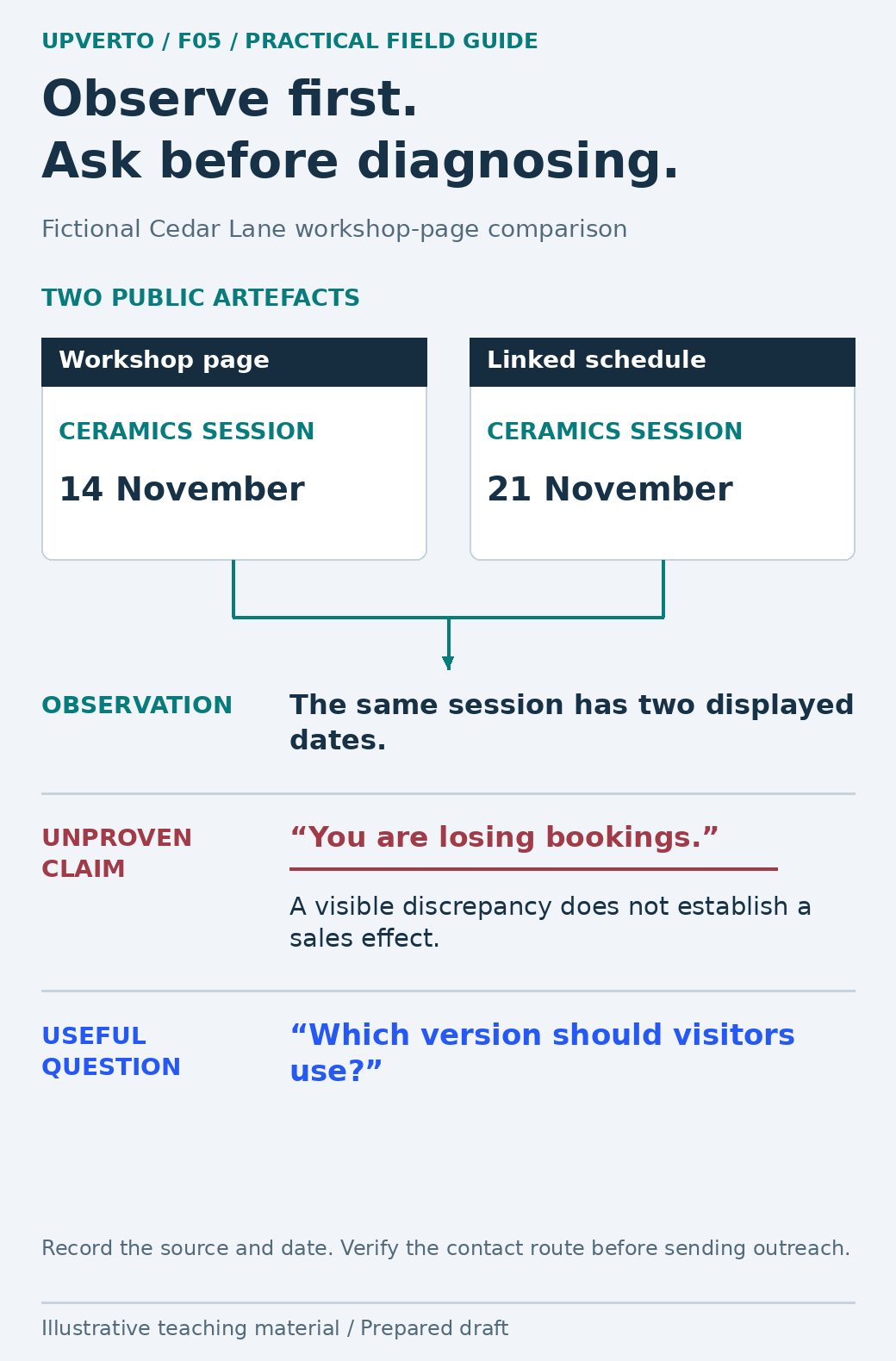
    Two fictional workshop artefacts show different dates. The diagram distinguishes that observation from an unproved lost-bookings claim and asks which date is current.
    Separate observable evidence from a prospecting claim — A precise observation supports a focused question; it does not prove a business outcome. Use the enlarged view, then swipe or use arrow keys to inspect details. View full-size infographic.
    Read the text version: Separate observable evidence from a prospecting claim

    Fictional example: a Cedar Lane workshop page says 14 November and the linked schedule says 21 November. The observable fact is a disagreement between dates. A claim that this is losing bookings is not established. Ask which version visitors should use, and check the appropriate contact route before sending anything.

    Separate observation, hypothesis and question

    An observation describes something another person could inspect. “The workshop page lists 14 November and the downloadable schedule lists 21 November” is an observation in our fictional example. “You are losing customers” is an unsupported outcome claim. “Which date should visitors use?” is a useful question that the business can answer.

    The distinction changes your behaviour. If you cannot verify the cause or effect, do not present a diagnosis as established fact. Offer to check a small, relevant issue rather than declaring the whole business broken. Do not run intrusive scans, submit fake enquiries, access private accounts or modify files to manufacture evidence for a pitch.

    Reject weak prospects before drafting a message. A visible issue may already have an internal owner, be outside your ability or have no meaningful connection to your service. A record marked “not suitable” is useful because it prevents repeated irrelevant contact. You do not need to collect employees’ private details to make that decision.

    Check whether and how contact is appropriate

    Channel permission and business relevance are separate questions. A publicly visible address does not settle the rules for using it. The UK ICO’s business-to-business marketing guidance distinguishes recipient types and explains that personal-data rules may apply in a business context. That is a UK example, not a worldwide permission rule. Check the applicable location, recipient category and channel requirements before sending commercial messages.

    Follow the receiving organisation’s published process. A supplier application form is different from an emergency support address or a private employee account. On LinkedIn, the Professional Community Policies prohibit spam and using invitations for promotional messages to people you do not know. Its User Agreement also restricts scraping and unauthorised automation. Do not use a tool to turn a small relevance exercise into a scraped contact list.

    Keep only the information needed to explain the fit, record the appropriate contact route and avoid recontacting someone who declined. Limit access to your log and review whether old records are still needed. If you cannot establish an appropriate route, use another acquisition method or wait for a public request; an unresolved permission question is a reason to pause that message.

    Worked example: a workshop-page discrepancy

    Fictional scenario: Cedar Lane Workshops publishes two different dates for the same session. A designer has an honestly labelled practice example showing how event details can be grouped and checked. No real organisation was inspected, and the following message was not sent. Assume the recipient has invited relevant supplier enquiries through its stated channel.

    Subject: Which date should the ceramics workshop page use?

    Hello Cedar Lane team, your workshop page lists 14 November, while the linked schedule lists 21 November. I may be looking at an older schedule. Is there a preferred version?

    I prepare small website-content updates from approved copy, including a review draft and a check of the affected links. My linked example is a self-directed practice project, not client work. If updating this page is on your list, would a short discussion of the required changes be useful?

    If this is not relevant, I will leave it there. Thank you, Amira.

    The opening identifies the exact discrepancy without claiming lost sales. The uncertainty is visible. The offer matches the observed task, the evidence is labelled, and the question can be answered without committing to a project. The message does not invent familiarity, praise the business generically or imply that a free audit has uncovered hidden problems.

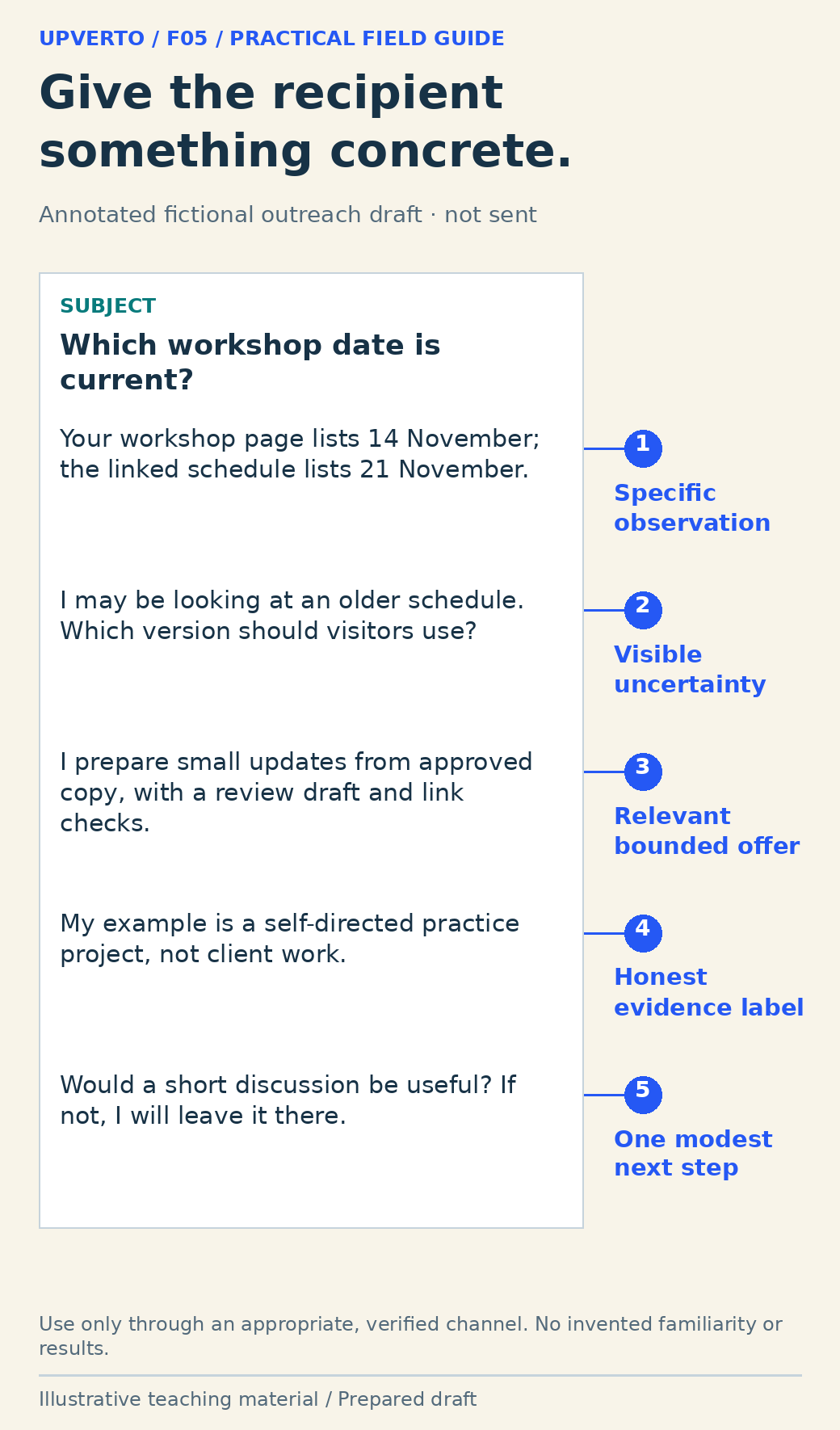
    A fictional outreach letter identifies a date discrepancy, uncertainty, a bounded content-update offer, a practice-project label and one modest next step.
    Annotate a relevant outreach message — The draft explains why the message is relevant and what remains unknown. Use the enlarged view, then swipe or use arrow keys to inspect details. View full-size infographic.
    Read the text version: Annotate a relevant outreach message

    This fictional draft has five parts: a specific difference between displayed dates; an acknowledgement that one schedule may be old; a small service based on approved copy; an honest self-directed-practice label; and a request for a short discussion without pressure. The message is not sent, and appropriateness of contact must be checked separately.

    Copy this prospect log and message check

    FieldFictional filled example
    Organisation and public sourceCedar Lane Workshops; workshop page and linked schedule; inspected date recorded in your own log
    ObservationThe same session has two displayed dates
    UnknownWhich schedule is current; whether an update is wanted
    Service fitA small approved-copy update; no booking-system rebuild
    EvidenceClearly labelled practice page and checking note
    Contact basis and routeRecord the actual invitation or other verified appropriate basis before sending
    Status and next actionPrepared only; verify dates and contact route
    Do-not-contact noteRecord a decline or request to stop; do not override it

    Before sending, remove any claim you cannot substantiate. Check the recipient, reference link, spelling, offer boundaries and contact requirements. Read the message as the recipient: can they see why it concerns their work, what evidence you have and what decision you are requesting? A technically personalised message can still be irrelevant.

    Use the log to organise decisions, not to assign invented lead scores. Keep “researched,” “appropriate to contact,” “sent,” “replied” and “closed” distinct. A prepared draft is not a sent message; a reply is not a qualified project. These differences matter when you later review whether the offer or channel needs to change.

    Handle replies and silence proportionately

    A useful reply may correct your observation, decline the offer or identify a different owner. Thank the person and update the record. When someone asks you to stop, stop. Do not shift to another channel to evade that choice. Silence does not establish interest, consent or a commitment to read further messages.

    There is no universal follow-up count that makes contact appropriate. Consider the channel rules, the original invitation and whether you have a legitimate new reason to write. If a follow-up is appropriate, keep it brief and make the connection to the earlier message clear. Do not add urgency you cannot justify or send an automated sequence indefinitely.

    When there is genuine interest, move to freelance discovery call questions to clarify the task before quoting. The goal of the first message is an informed conversation about a plausible need. It does not guarantee a response, a contract or any income.

    Frequently asked questions

    How many prospects should I contact each day?

    Use the number you can research and handle responsibly, within the relevant channel rules. A daily target that encourages weak relevance or ignored objections is counterproductive. Record why each prospect fits before counting them as appropriate to contact.

    Can I say a website problem is costing the business money?

    Only if you have adequate evidence for that particular claim. A visible inconsistency does not establish lost revenue. Describe the observable issue and ask about its importance instead of inventing a business impact.

    Is a public business email address permission to send a pitch?

    Not by itself. Recipient type, location, applicable marketing rules and the stated purpose of the address matter. Check current official requirements and the organisation’s contact instructions before sending.

    Can AI personalise my outreach?

    It can help edit your own verified notes, but you remain responsible for relevance, accuracy and the channel rules. Do not upload confidential data, invent shared history or allow a tool to scrape contacts and send messages automatically.

    What should I do after a polite rejection?

    Record the answer and close the opportunity unless the person explicitly invites a future conversation. Do not treat a rejection as an objection you must overcome or continue through a different account.

    Can a practice project support an outreach message?

    Yes, if it demonstrates the relevant task and is clearly labelled as practice. Explain your actual contribution and checks. Do not imply a client commissioned it or attach invented results to it.

    Sources and scope

    The worked examples, worksheets and diagrams are original fictional teaching materials. They are not reports of client results. Primary references were checked during preparation; verify current rules and account-specific features before acting.

  • How to Use LinkedIn and Your Network to Find Relevant Work

    How to Use LinkedIn and Your Network to Find Relevant Work

    LinkedIn and an existing professional network can help people understand the work you do and introduce you to relevant conversations. Begin with accurate evidence, a readable profile and a reason to engage. A large connection count does not establish trust, and no posting routine guarantees work. This is one route within how to find freelance clients.

    Make the profile explain a real capability

    A useful profile answers three questions: what work can this person do, what evidence can I inspect, and how should I start a relevant conversation? Write the headline around the work rather than a string of exaggerated titles. Your About section can explain the service, the kinds of inputs you need, a meaningful boundary and where the evidence lives.

    Suppose Iman is practising document and spreadsheet organisation. “I organise supplied workshop enquiries into a clear tracker and handover note” is narrower and more assessable than “Business transformation expert.” If the examples are self-directed, say so beside them. Do not invent employment, client names, certifications or results to make an early profile look established.

    Choose a suitable evidence format using portfolio website vs PDF vs profile. A concise PDF, a project page or a readable profile sample can all support a conversation when access works. The choice should reflect what a prospective client needs to inspect, not a claim that one format is favoured by an undisclosed algorithm.

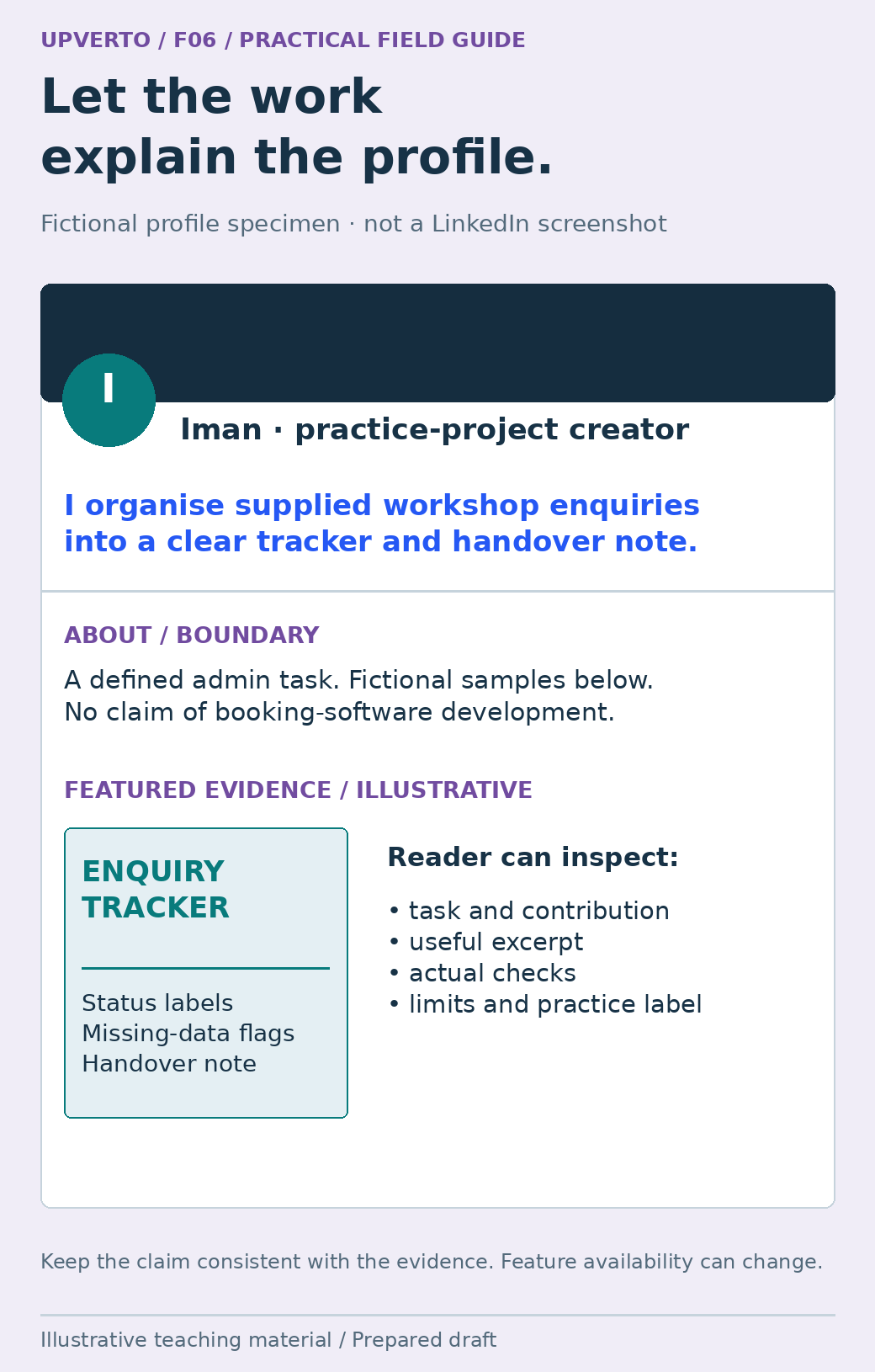
    A fictional Iman profile uses a narrow enquiry-tracking headline, an explicit boundary and a labelled practice sample with a task, excerpt, checks and limitations.
    Build a profile around an inspectable capability — The specimen illustrates content decisions rather than a platform interface or ranking technique. Use the enlarged view, then swipe or use arrow keys to inspect. View full-size infographic.
    Read the text version: Build a profile around an inspectable capability

    Fictional profile: Iman organises supplied workshop enquiries into a tracker and handover note. The About text limits the offer to a defined administrative task and does not claim booking-software development. A featured practice sample exposes status labels, missing-data flags and instructions, with the task, contribution, checks and limits. Verify current account features using official LinkedIn help.

    Curate a small amount of inspectable work

    LinkedIn’s official Featured-section help explains how work samples can be added and managed. Consult the current help and controls available to your account rather than relying on an old screenshot. This guide does not require a paid feature or promise that adding a sample changes your ranking.

    For each sample, include the task, your contribution, a useful excerpt, the checks you performed and the limits. Open the link as a reader would and check whether it needs an unnecessary sign-in. An impressive cover image cannot replace access to the actual evidence. If you share a client example, confirm permission for the material and the wording first.

    Use tailor portfolio to client niche when selecting which evidence belongs at the front. A person seeking help with a workshop catalogue should not have to infer relevance from ten unrelated practice files. You can keep other projects elsewhere while making the relevant one easy to find.

    Review the profile when your offer changes. A headline promising a broad service and a sample demonstrating a narrow task can create a misunderstanding before a conversation begins. Keep contact preferences current and do not describe a service as available if you have stopped offering it.

    Start with real relationships and useful context

    Map people you actually know from work, study, professional events or community projects. Write down the shared context accurately. A former colleague is different from a stranger whose article you read, and both are different from someone who has asked for a supplier recommendation. Those distinctions should appear in your approach.

    You can reconnect by describing what you are working on and asking about a relevant topic, without treating every contact as a buyer. Read and respond to someone’s work only when you have a useful point to add. A thoughtful question or a specific contribution is easier to understand than a generic compliment followed immediately by a sales pitch.

    The Professional Community Policies prohibit unwanted promotional messaging, invitation misuse and artificial engagement. The User Agreement restricts scraping and unauthorised automated activity. Avoid bots, purchased contact lists, shared accounts and arrangements to manufacture engagement. Work through the platform’s permitted features and respect a person’s decision not to engage.

    Worked example: reconnecting without invented familiarity

    Fictional scenario: Iman and Dev worked together on a volunteer workshop. Iman has since made a fictional enquiry-tracker practice project. Dev has not agreed to introduce anyone, and no paid work has resulted. The following draft demonstrates a proportionate reconnection, not a tested message formula.

    Hi Dev, we worked together on the spring workshop registration desk. I have been practising enquiry tracking and recently made a small example with status labels, missing-information flags and a handover note. It uses fictional records.

    You mentioned that workshop administration was becoming more complex. If that is still relevant, I would be interested to hear which part takes the most coordination. No problem if it is no longer on your list.

    The draft states the real relationship within the fictional scenario, explains the work and asks one relevant question. It does not say “I know exactly what you need,” attach a large unrequested file or ask Dev to promote a service they have not assessed. If Dev replies, the next step is to understand the situation, not immediately send a price.

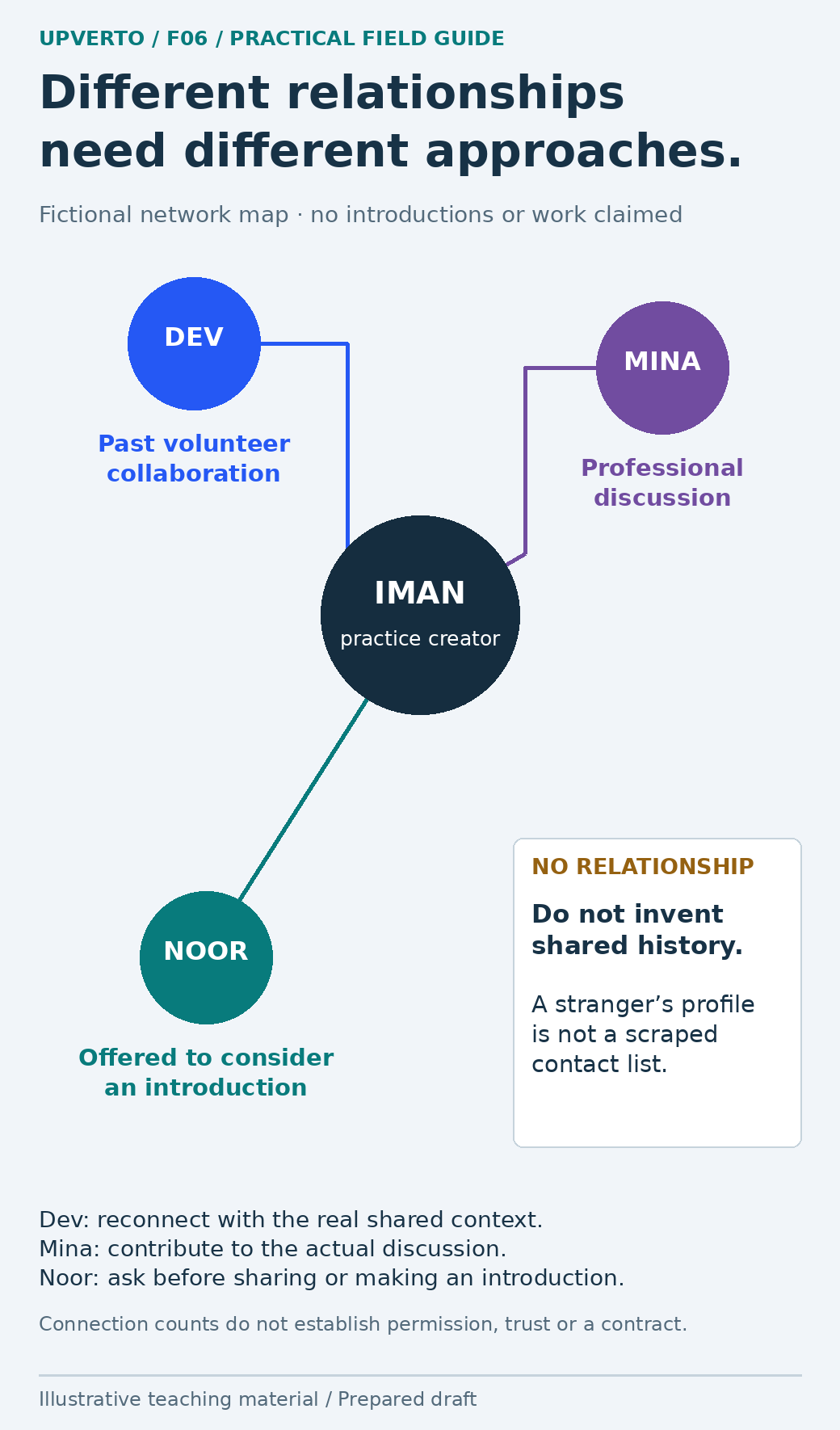
    A fictional network links Iman to a former collaborator, a professional discussion and a possible introduction. A separate note warns against inventing shared history with strangers.
    Match a networking approach to the real relationship — Describe the actual connection and let the other person choose whether to engage. Use the enlarged view, then swipe or use arrow keys to inspect. View full-size infographic.
    Read the text version: Match a networking approach to the real relationship

    In this fictional map, Dev is a past volunteer collaborator, Mina is a professional discussion contact, and Noor has offered to consider an introduction. Reconnect using the actual shared context, contribute to the real discussion, and ask before sharing details or making an introduction. A stranger’s profile is not permission to scrape data or invent familiarity.

    For someone you do not know, do not substitute a fabricated shared experience. Follow the context of their public invitation or professional discussion. A promotional pitch should not be hidden inside a connection invitation. If there is no suitable route, useful public participation and improving your evidence remain available actions.

    Use a profile-and-network review sheet

    Review itemWhat to inspectAction if unclear
    HeadlineA specific capability consistent with the evidenceRewrite the service in ordinary language
    About sectionAudience, outputs, inputs, boundaries and contact preferenceRemove unsupported expertise or results
    Work sampleYour role, practice/client status, checks and limitsAdd context and verify permission
    Reader accessThe sample opens and is understandableFix access or use another suitable format
    Relationship noteHow you actually know the personAvoid invented familiarity
    Conversation purposeA relevant question or useful contributionDo not contact merely to hit a target
    Next actionAn agreed response, closure or introduction requestRespect silence and explicit declines

    A compact relationship log can contain name, genuine shared context, last relevant conversation, an agreed next action and any preference not to be contacted. It does not need private family details or a scraped profile archive. Keep the information proportionate and secure, and follow the applicable privacy requirements.

    A referral can begin with a forwardable description: the task you handle, who it helps and one accessible evidence link. Ask whether the person is comfortable making an introduction. Do not ask them to disclose someone else’s private address or imply that they endorse results they have not observed.

    Review conversations, not vanity metrics

    At a sensible review point, read the actual replies. Did people understand the service? Could they inspect the example? Were the conversations relevant to a real need? Record a correction such as “people thought I maintained booking software; clarify that this offer is an enquiry tracker.” That is more actionable than interpreting every change in impressions as evidence of an algorithm.

    When a conversation becomes a genuine project enquiry, use freelance discovery call questions to clarify the goal, constraints and decision-maker. Keep the professional relationship valuable even when no project follows. A profile and network can support discovery; they do not replace delivery ability or create an obligation for others to refer you.

    Frequently asked questions

    Do I need a premium subscription before I can find relevant work?

    This approach does not depend on a paid plan. Start with accurate profile information, accessible evidence and appropriate conversations. Check current feature availability for your account before paying for something, and do not assume a subscription produces enquiries.

    What can I put in my headline without client experience?

    Describe the task you are developing and demonstrate it with honestly labelled practice work. You can state a real capability without claiming seniority, employment or outcomes you have not earned.

    Should I send a pitch with every connection invitation?

    No. LinkedIn’s community policies restrict using invitations for promotional messages to people you do not know. Keep the relationship and context accurate, use appropriate channels, and avoid treating acceptance as permission for repeated pitches.

    Can I use an automation extension to grow my network?

    Do not use bots, scraping or unauthorised automation that conflicts with LinkedIn’s terms. An extension being available for purchase does not establish that its actions are permitted.

    What if someone offers to introduce me?

    Give them a short, accurate description they can forward, and let the prospective contact choose whether to engage. Confirm what may be shared. Do not present the introduction as a guarantee or an endorsement of unobserved results.

    How often should I post?

    Choose a sustainable rhythm only when you have useful work, observations or questions to share. There is no evidenced universal posting schedule in this guide. Assess the relevance of the conversations rather than chasing an arbitrary frequency.

    Sources and scope

    The worked examples, worksheets and diagrams are original fictional teaching materials. They are not reports of client results. Primary references were checked during preparation; verify current rules and account-specific features before acting.
  • How to Write a Freelance Proposal Around the Client’s Problem

    How to Write a Freelance Proposal Around the Client’s Problem

    A useful freelance proposal helps a client decide whether you understand the task and can deliver the required work. It should connect their problem to your approach, evidence and boundaries. A long biography or a generic promise of quality makes that decision harder if it does not explain the actual project.

    In this guide

    The guide to how to find freelance clients covers the wider search for opportunities. This article focuses on the proposal itself. The example is fictional, has not been sent to anyone and does not represent a winning application or a real client result.

    Read the brief for the decision the client needs to make

    Extract the problem, deliverables, inputs, constraints and open questions. Identify what is explicitly stated and what you are assuming. If the brief says that visitors cannot find current workshop dates, do not immediately propose a complete website rebuild. First understand the information path and the owner’s desired scope.

    Look for the evidence the client requests: a relevant sample, a technical explanation, availability or a particular qualification. Check eligibility and platform rules before investing in a detailed response. If the work is outside your competence, narrow the proposed role or decline rather than exaggerating experience.

    Use create freelance service packages to clarify your own deliverable. A proposal is easier to write when you already know what inputs you need, what you will hand over and what is excluded. You can then adapt the service to the brief instead of inventing a new offer in every opening paragraph.

    Organise the proposal around six useful parts

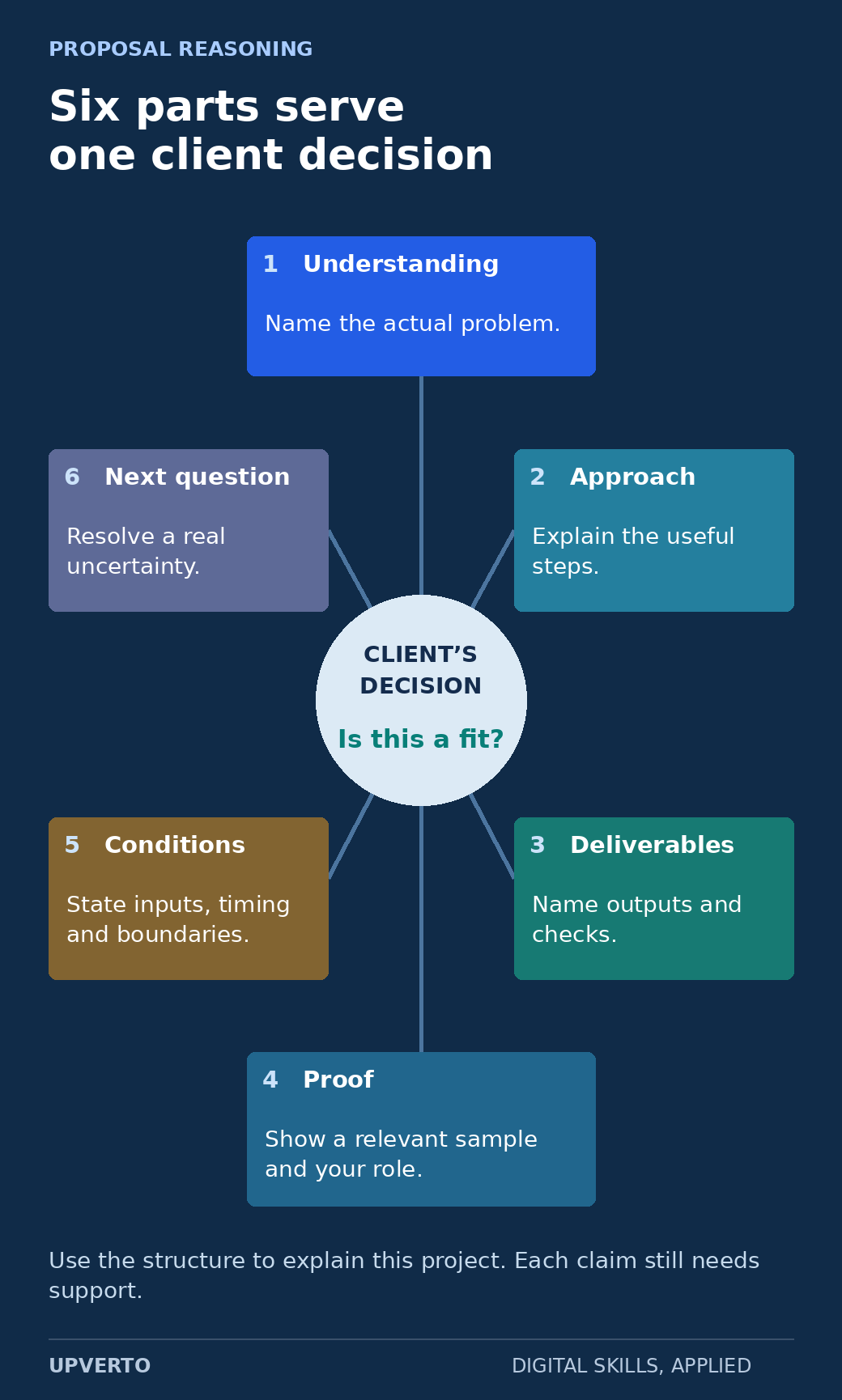
    Six proposal components radiate around the client’s fit decision: understanding, approach, deliverables, proof, conditions and a useful next question.
    Organise a proposal around the client decision — The structure supports an assessment of fit. It does not imply a winning proposal or a universal platform form. Use the enlarged view, then swipe or use arrow keys to inspect details. View full-size infographic.
    Read the text version: Organise a proposal around the client decision
    1. Understanding: name the actual problem.
    2. Approach: explain the useful steps.
    3. Deliverables: name outputs and checks.
    4. Proof: show a relevant sample and your role.
    5. Conditions: state inputs, timing and boundaries.
    6. Next question: resolve a real uncertainty.

    Each part helps the client assess fit; claims still require support and the channel may impose its own submission requirements.

    Begin with your understanding of the problem. Describe a short approach that addresses it. Name the deliverables and checks. Attach or link relevant evidence with your role clearly stated. Explain the timeline assumptions and boundaries. End with a question or next step that resolves a real uncertainty.

    GOV.UK’s guidance on clear acceptance criteria offers a useful principle: describe completion in language the involved people can understand. In a proposal, “three reviewed event pages with current details and checked links” is easier to assess than “a premium digital experience.”

    Keep platform submission mechanics separate from the proposal’s reasoning. For example, Upwork’s current proposal help describes its own fields and process. Follow the current requirements of the channel you are using, including attachment and communication rules. This guide does not assume that every platform has the same form.

    Worked example: a fictional page-update proposal

    The invented client brief asks for three workshop information pages updated from approved copy and images. The owner wants consistent dates, clear request instructions and a readable mobile layout. There is an existing website, but access and the final asset set have not yet been confirmed. No booking-system changes are requested.

    Your brief describes three workshop pages whose dates and request instructions need to be consistent and easy to find. I propose updating those pages from your approved copy and images, then checking their links and layout on the agreed screen sizes.

    I would first confirm the page list and access, prepare the updates in a draft or staging environment, and send one consolidated review set. The handover would include the three approved pages and a short record of the checks and remaining questions.

    My attached sample is a fictional information-page project. I created its layout and check log; it demonstrates this task, not a live client outcome.

    The proposed schedule is four working days after access and final inputs are ready, subject to confirmation. One consolidated revision round is included. Copywriting, new forms and booking-system changes would need separate agreement.

    Who will approve the content, and are the three page URLs and final assets ready to share through the agreed channel?

    This example deliberately uses conditional timing. It does not promise to finish four days after an unknown start or assume that missing assets will appear. A real proposal also needs the appropriate price or terms where requested, but those should follow an actual scope estimate rather than a copied number.

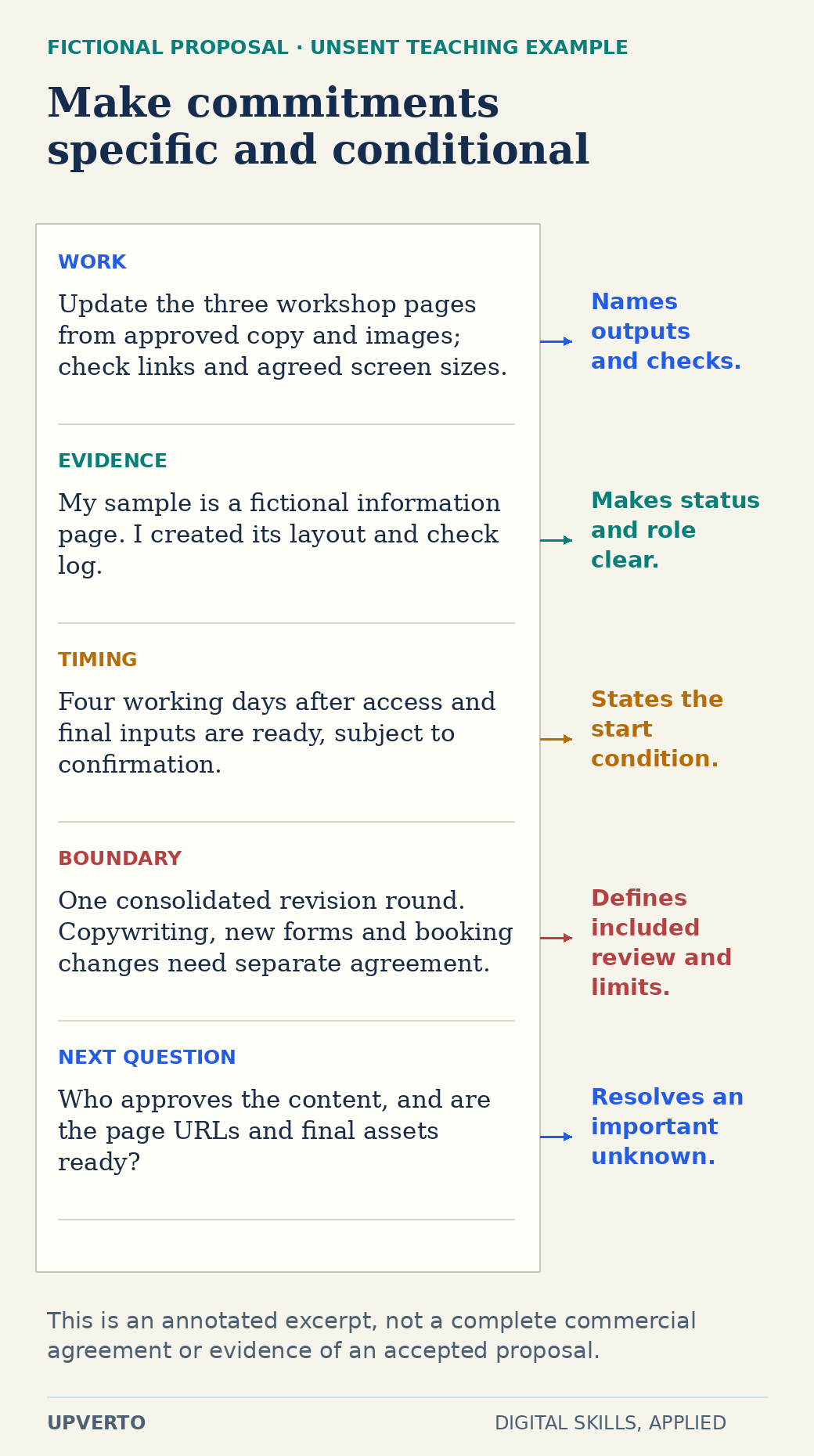
    Five annotated proposal excerpts identify three-page work, a fictional sample and role, conditional timing, one consolidated revision boundary and the owner-and-assets question.
    Inspect a fictional proposal’s commitments — The unsent example demonstrates a bounded proposal. Actual pricing, terms and channel requirements still depend on the assignment. Use the enlarged view, then swipe or use arrow keys to inspect details. View full-size infographic.
    Read the text version: Inspect a fictional proposal’s commitments
    Work
    Update three workshop pages from approved copy and images, then check links and agreed screen sizes.
    Evidence
    Identify the information-page sample as fictional and state responsibility for the layout and check log.
    Timing
    Propose four working days after access and final inputs are ready, subject to confirmation.
    Boundary
    Include one consolidated revision round; copywriting, new forms and booking changes need separate agreement.
    Next question
    Ask who approves the content and whether page URLs and final assets are ready.

    This is an unsent teaching excerpt, not an accepted proposal or a complete commercial agreement.

    Use evidence that matches the claim

    Choose one or two relevant samples and explain the connection in a sentence. A page-update sample with a check log is more relevant to this brief than a large unrelated collection. If the project was collaborative, identify what you did. If it was fictional, say so before the reader has to infer it.

    Do not claim client experience you do not have or invent an improvement percentage. You can demonstrate a method and a finished practice output honestly. Use tailor portfolio to client niche to select the evidence most relevant to the buyer’s task.

    Explain limitations that affect the decision. A static mockup can show layout reasoning but cannot prove that a real form submits correctly. A screenshot can show appearance but cannot prove a link works. Attach evidence that supports the specific capability you are offering.

    Ask questions that change the work

    A useful question resolves scope, access, authority or timing. “Who approves the final content?” affects review. “Are the supplied images cleared for use?” affects asset readiness. “Does the request button lead to an existing process?” affects implementation. These questions show attention to the task without pretending to have audited a system you have not seen.

    Avoid sending a long discovery questionnaire when one uncertainty determines whether the project is suitable. Start with the few questions needed to take the next step. Save deeper investigation for an agreed discussion or paid discovery stage when appropriate.

    The guide to freelance discovery call questions develops that conversation. A proposal does not need to solve every unknown before the client responds, but it should identify assumptions that materially affect your commitment.

    Use the proposal self-review checklist

    CheckQuestion to answer before sending
    UnderstandingHave I described the actual problem without adding an unsupported diagnosis?
    ApproachDoes each proposed step help produce the requested deliverable?
    EvidenceCan the sample support the claim, and is my role clear?
    ScopeAre inputs, outputs, checks and revisions understandable?
    TimingHave I stated dependencies and realistic availability?
    Next stepDoes the final question resolve a useful uncertainty?

    Read the proposal from the client’s perspective. Remove sentences that could be sent unchanged to any project and add detail only when it helps the decision. Check names, links, files, stated availability and any platform-specific requirements. Do not include confidential material as proof of competence.

    Keep the proposal connected to the agreed work

    If the client replies with changed requirements, update the scope and assumptions before treating the proposal as settled. Preserve the agreed version. A conversation can clarify the work, but scattered messages can also create contradictory expectations if nobody records the final decision.

    After an unsuccessful proposal, review whether the opportunity fit, whether the evidence was relevant and whether the response answered the brief. A rejection does not prove that the whole skill is unsuitable. Avoid inventing reasons when the client gives no feedback; record what is known and improve the parts you can inspect.

    Frequently asked questions

    How long should a freelance proposal be?

    Use enough space to explain understanding, approach, deliverables, evidence, assumptions and the next step. Follow the channel’s requirements. Length should follow the complexity of the decision, not a universal word count.

    Can I use a proposal template?

    Use a structure or checklist, then write the substance for the actual brief. Remove generic claims and verify every detail. A template should help you remember important questions, not conceal that you have not understood the task.

    What should I say when I have no client experience?

    Describe the relevant practice project honestly, identify your role and show the output and checks. Do not invent a client or commercial result. Offer only the responsibility your evidence can support.

    Should I provide a complete solution before being hired?

    Explain enough of your approach for the client to assess fit, but distinguish a proposal from a full discovery or implementation deliverable. Clarify unknowns and any paid investigation needed before making detailed commitments.

    How do I state a deadline when inputs are missing?

    State the dependency and a proposed duration after the required inputs and access are ready. Confirm availability before agreement. Avoid presenting a conditional estimate as an unconditional delivery promise.

    What if the client asks for extra work after the proposal?

    Clarify whether it changes the agreed deliverables, effort or timeline. Update the scope and terms through the appropriate process before doing the additional work. Keep a clear record of the version both sides accepted.

  • Freelance Marketplaces or Direct Clients: How to Choose a Channel

    Freelance Marketplaces or Direct Clients: How to Choose a Channel

    Choose a client channel by how well it connects your demonstrated service with a real buyer task. A marketplace provides its own discovery, communication and transaction system. Direct work requires you to establish those arrangements through another appropriate route.

    Neither channel guarantees clients or removes the need for clear scope and reliable delivery. The guide to how to find freelance clients covers the overall strategy; this guide focuses on choosing where to begin.

    In this guide
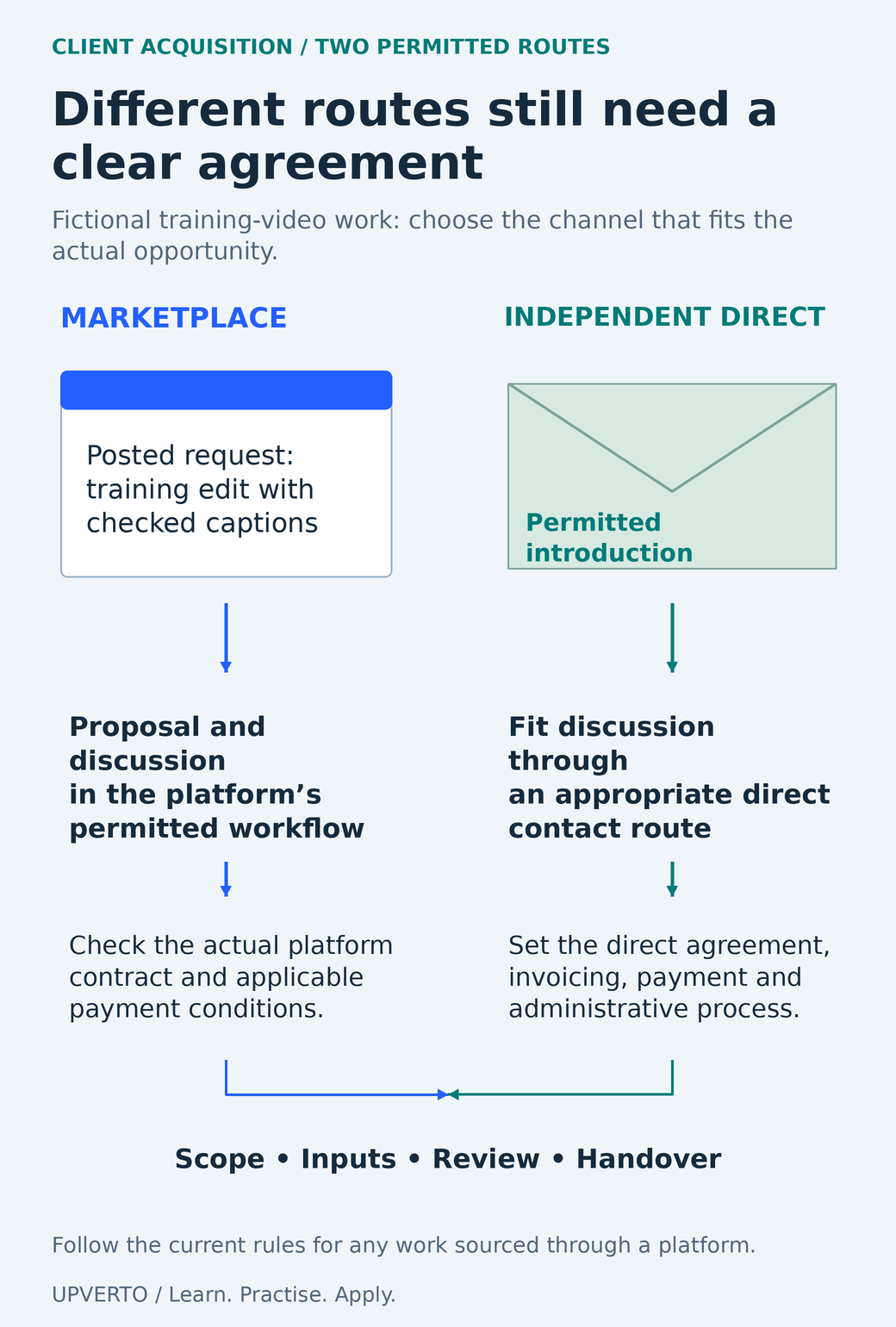
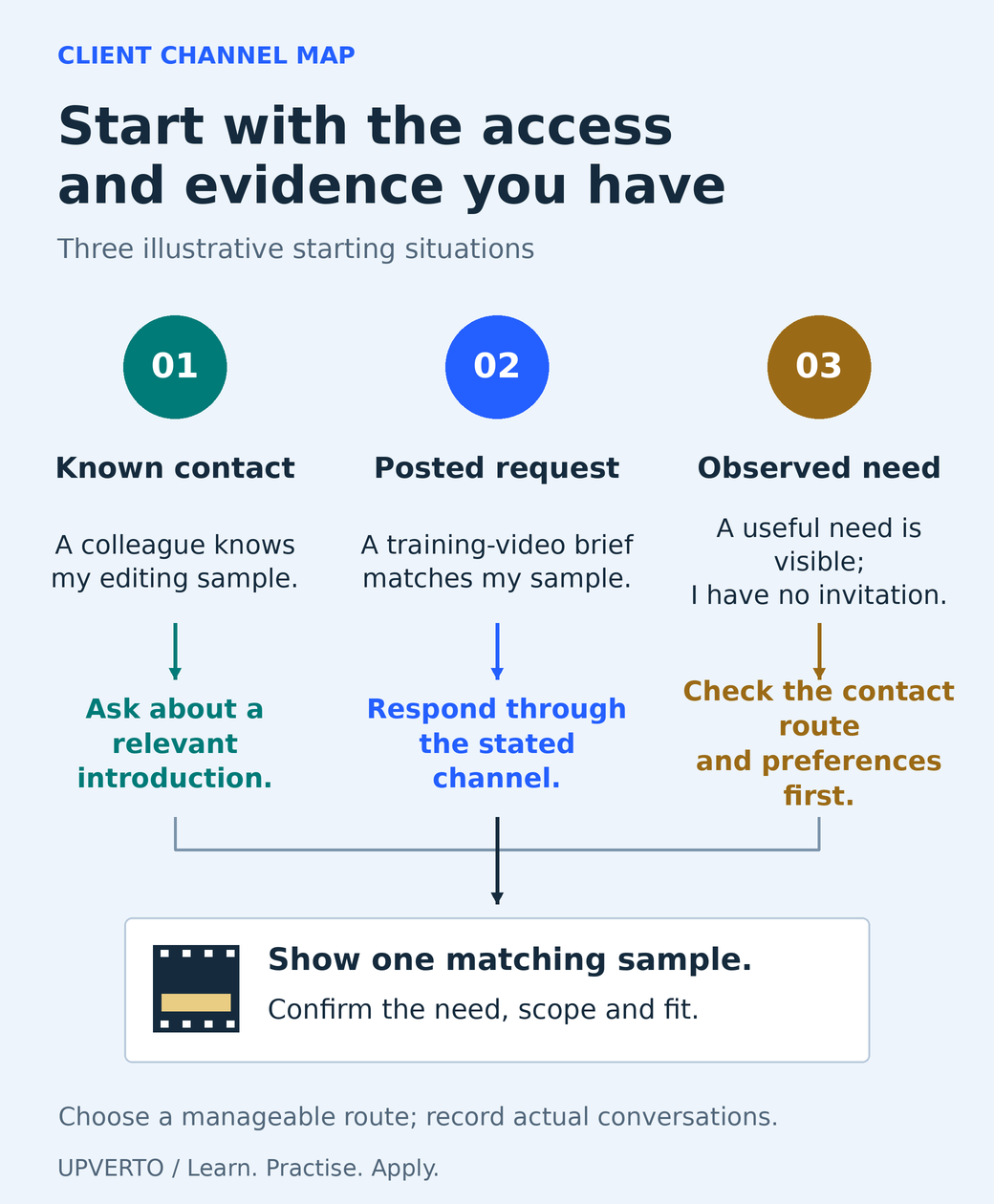
    Two acquisition paths begin with a posted platform request and a permitted direct introduction, then retain their own discussion and agreement processes before converging on a clear project scope.
    Trace independent marketplace and direct-client routes — Two acquisition paths begin with a posted platform request and a permitted direct introduction, then retain their own discussion and agreement processes before converging on a clear project scope. View full-size infographic.

    Compare the work each channel asks you to do

    Decision areaMarketplaceDirect route
    Access to opportunitiesSearch, listings or discovery inside a provider’s systemReferrals, permitted outreach, communities or incoming enquiries
    PreparationEligible account, relevant profile and supported samplesClear offer, inspectable evidence and an appropriate contact route
    CostsProvider fees, proposal or optional promotion costs, payout costs where applicableTime, payment processing and any tools or administration you choose
    CommunicationProvider rules and records applyYou agree suitable communication and recordkeeping
    Agreement and paymentPlatform contract or order workflow with defined conditionsYou arrange scope, terms, invoicing and payment processes
    ControlFields, visibility and policies depend on the providerMore choice of process, with more responsibility to maintain it

    These categories are not scores. A marketplace may expose relevant briefs while still requiring substantial filtering. A direct route may begin with a trusted introduction while still requiring a proper agreement. Compare the actual work involved in your situation.

    Check current eligibility and costs before committing

    Official pages checked on 27 October 2026 show different rules. Upwork requires users to be at least eighteen or the age of majority if older, with location and work-authorisation conditions. Fiverr’s account guidance has its own age rules, including a limited parent or guardian account route for users aged thirteen to seventeen. Do not assume eligibility on one service establishes eligibility on another.

    Upwork’s freelancer service fee currently ranges from 0% to 15% per contract, with the applicable percentage shown before commitment. Purchased Connects currently cost US$0.15 each; proposal requirements vary. Fiverr’s earnings guidance credits freelancers 80% of the purchase amount, including extras and tips. These are provider mechanics, not income forecasts.

    Verify the exact account and transaction conditions, payout method, currency conversion and applicable taxes. Direct work is not automatically free of transaction or administrative costs. Do not compare a platform percentage with a direct arrangement while ignoring the work and costs you must arrange yourself.

    Choose a route you can support with relevant evidence

    Define the buyer and task using choose freelance client niche. Then identify a realistic route to that buyer. If a marketplace has suitable posted requests and you can meet its rules, a small proposal exercise may be reasonable. If you have an appropriate introduction to someone with a real need, a direct conversation may be more relevant.

    Prepare an evidence format that the channel supports. Use portfolio website vs PDF vs profile to decide how the reader will inspect the sample. Keep concept labels and permissions intact when moving material between formats.

    Read communication policies before contacting people. Marketplace discovery is not permission to extract contact details and bypass the provider. Upwork and Fiverr have specific off-platform rules. A direct-client strategy should use legitimately independent relationships and permitted contact routes, not an attempt to evade an existing platform agreement.

    Worked example: two realistic starting points

    Fictional learner: Rowan can edit a short training recording and has a clearly labelled concept sample with checked captions. Rowan finds a posted marketplace request for that task and also knows a community organiser who has previously asked about editing.

    For the posted request, Rowan checks eligibility, the required Connects, the displayed fee, source-footage assumptions and the permitted proposal route. The sample fits the task, but no response or contract is assumed. Rowan sets a limited proposal budget and records the actual activity.

    For the known contact, Rowan asks whether the need still exists and whether a discussion is welcome. The conversation begins with the task and available recording, not a bulk promotional message. If there is a fit, scope and payment arrangements still need to be agreed.

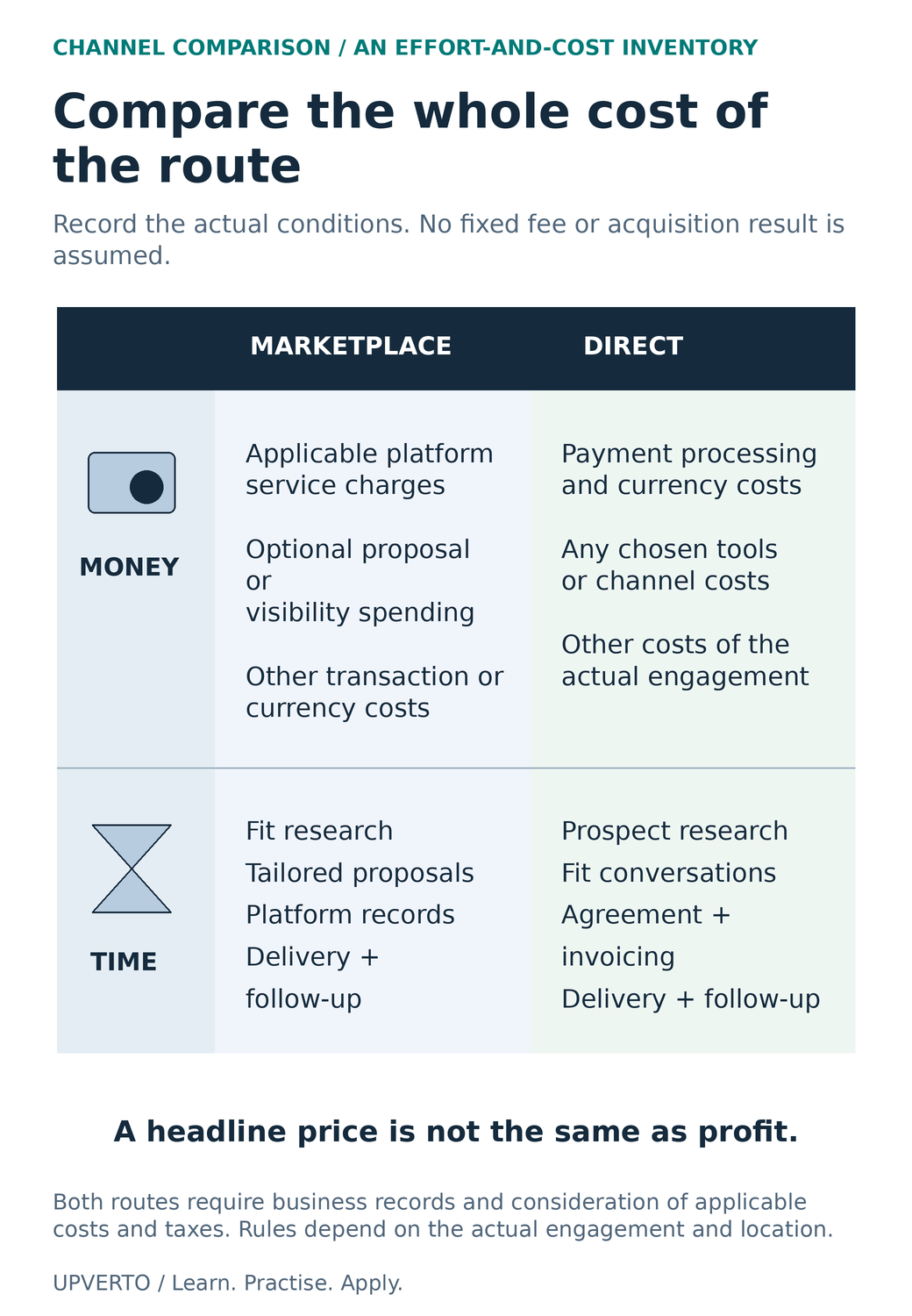
    A two-by-two cost inventory compares possible monetary costs and time commitments for marketplace and independent direct work without assigning invented prices or conversion rates.
    Inventory money and time across client-acquisition routes — A two-by-two cost inventory compares possible monetary costs and time commitments for marketplace and independent direct work without assigning invented prices or conversion rates. View full-size infographic.

    Rowan chooses one route for the next bounded effort based on current access and capacity. The exercise does not declare a universal winner or invent a success rate. The record can later show actual costs, conversations and reasons a request was unsuitable.

    Use a channel-selection worksheet

    QuestionYour evidence
    Which task am I offering?Defined output and relevant checked sample
    Can I legitimately use this channel?Eligibility, account, location and contact rules checked
    Where is the buyer need visible?Specific request, introduction or appropriate enquiry
    What will the attempt cost?Time, proposal charges, provider fees and other verified costs
    What process must I maintain?Communication, scope, payment and delivery records
    What will I review?Actual activity, fit, costs and unresolved obstacles

    Review the route after a defined amount of manageable effort. A lack of response can have several causes, including poor fit, unclear evidence, timing or competition. Do not assume it proves that the whole skill has no demand or that more paid promotion will solve the problem.

    If direct contact is appropriate, use find freelance prospects and write outreach to prepare a relevant message. Keep the route small enough to support with good judgement and delivery capacity. The aim is a suitable working relationship, not activity for its own sake.

    Frequently asked questions

    Are marketplaces easier than finding direct clients?

    They provide a structured place to find requests and transact, but they also have eligibility, competition, costs and policies. Direct work may begin through an existing relationship but needs its own agreements and administration. Compare your actual access and service fit rather than assuming one route is easier for everyone.

    Are direct clients always more profitable?

    You cannot conclude that from the absence of a marketplace fee. Direct work can involve acquisition time, payment charges, administration and other costs. Inspect the complete arrangement and avoid treating gross payment as profit or assuming a particular channel guarantees better earnings.

    Can I use both routes at once?

    You can if you have capacity to maintain the different processes and follow applicable rules. Starting with one bounded route may make learning easier. Keep independent direct relationships distinct from clients introduced through a platform and respect the provider’s terms.

    Should I pay to boost proposals or listings immediately?

    First check whether the offer, sample and target task fit. Optional promotion adds cost and does not guarantee work. Understand the provider’s current mechanism and set a limit you can afford without relying on an unconfirmed future contract.

    Can I contact a marketplace client through their public email?

    Do not assume a public address overrides the platform’s pre-contract communication or anti-circumvention rules. Use the official permitted route and read the current policy. A direct-client strategy should not be built on bypassing obligations created by a marketplace introduction.

    How do I know when to change channels?

    Review actual fit, costs, access and the quality of conversations after a bounded effort. Identify the obstacle before changing direction. A channel may be unsuitable because of eligibility or the kind of work available, while unclear evidence may need repair wherever you look.

    Sources and review notes

    Primary sources checked on 27 October 2026 (UTC). Check the current provider pages before relying on a changing feature, policy or price. Worked examples and worksheets are original teaching material; fictional examples are not evidence of client results.

  • Starting on Upwork: Profile, Work Samples and Relevant Proposals

    Starting on Upwork: Profile, Work Samples and Relevant Proposals

    Starting on Upwork means preparing a credible account, matching evidence to a real request and understanding the commitment before you submit or accept anything. A completed profile is a starting point, not a guarantee of interviews or work.

    This guide uses official Upwork documentation checked on 27 October 2026. Interface labels and policies can change, so verify the current pages and your actual account. For the broader client strategy, use how to find freelance clients.

    In this guide
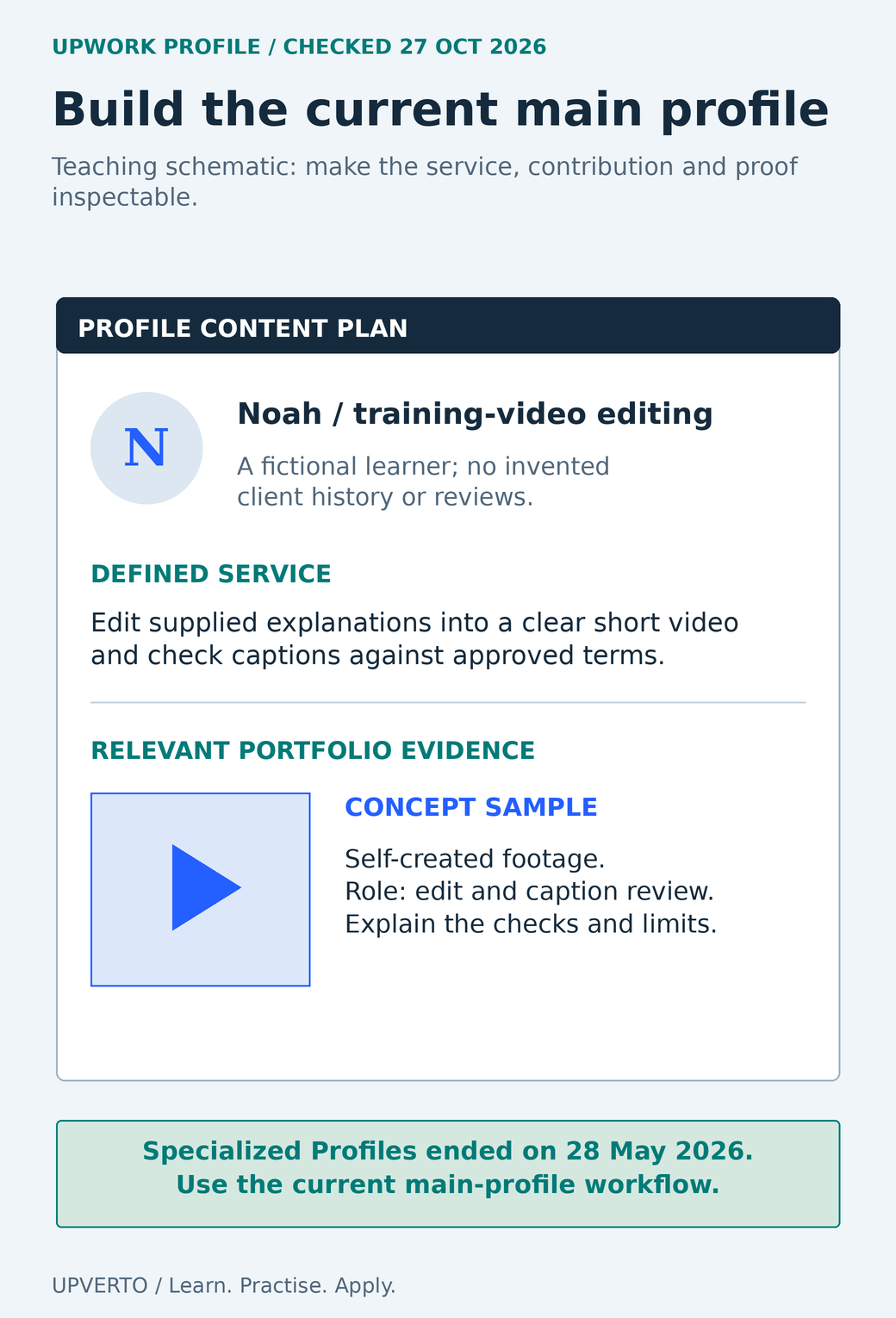
    A fictional main-profile content plan shows a defined training-video service and a labelled concept sample, with Upwork’s 28 May 2026 Specialized Profiles change stated explicitly.
    Prepare truthful content for Upwork’s current main profile — A fictional main-profile content plan shows a defined training-video service and a labelled concept sample, with Upwork’s 28 May 2026 Specialized Profiles change stated explicitly. Use the enlarged view, then swipe or use arrow keys to inspect details. View full-size infographic.
    Read the text version: Prepare truthful content for Upwork’s current main profile

    The teaching schematic uses fictional learner Noah. It defines the task as editing supplied explanations into a short video and checking captions against approved terms. Its concept sample uses self-created footage and identifies the contribution as editing and caption review, with actual checks and limitations to be explained. No client history, review or result is invented. Upwork’s official guidance checked on 27 October 2026 states that Specialized Profiles ended on 28 May 2026; use the current main-profile workflow and verify the live provider guidance.

    Check eligibility and the account flow first

    Upwork’s eligibility guidance requires eighteen years of age or the age of majority in your country, whichever is older. Location restrictions and work-authorisation responsibilities also apply. Check the official current list rather than assuming that being able to open the website means you may use the service.

    Use accurate identity and experience information. Complete verification only through the official account process. Do not buy an account, invent a location or send credentials to a person who claims they can approve you. A client message is not a substitute for the provider’s verification flow.

    Before investing in proposals, confirm that the account can support the work and payment arrangements you need. Keep your contact and recovery details current, and read any account-specific notices. If an eligibility or verification issue remains unresolved, address it through official support rather than attempting to bypass it.

    Build the main profile around a defined task

    Use a title and introduction that describe the work you can demonstrate. “Short training-video editing and checked captions” is a clearer starting point than an unsupported expert label across several unrelated services. Explain the inputs you work with, the output you produce and a useful boundary.

    Current guidance matters here: Upwork removed Specialized Profiles on 28 May 2026. Its current system uses the main profile and surfaces relevant material. Do not follow an older tutorial that instructs you to create a new Specialized Profile.

    The official portfolio guidance provides fields for project context, role, description, skills and media. Use them to make your contribution inspectable. A personal or concept project can be relevant if it is labelled accurately. Do not invent past contracts, reviews, credentials or results to fill an empty section.

    Use the freelance portfolio review checklist before relying on a sample. Open the actual material, verify permission and check whether it demonstrates the task named in the profile.

    Understand Connects and the displayed service fee

    Purchased Connects currently cost US$0.15 each. The number needed for a proposal varies by job and can change while the post is open. Free Connects and promotional offers have eligibility conditions; do not budget on the assumption that every freelancer receives the same monthly allocation.

    Optional boosting and other advertising features can spend additional Connects. They are separate decisions, not a requirement to prove that you are serious. Set an affordable limit and record actual spend.

    The freelancer service fee currently ranges from 0% to 15% per contract, with the applicable fee shown in the proposal or offer workflow. Inspect that percentage before agreeing terms. Consider any other applicable transaction, currency and tax effects separately; the amount after a platform fee is not automatically business profit.

    Prepare the proposal before pressing Send

    Read the request for outputs, source material, constraints and missing information. Choose a relevant sample, identify a sensible approach and ask only questions that affect fit or scope. Use write freelance proposal for the general writing method.

    The current Upwork submission guide covers terms, duration, the cover letter or applicable interview flow, screening questions and work samples or profile highlights. Check the actual fields shown for that job. Review the amount, assumptions and sample before submission, and treat an optional boost as a separate cost decision.

    Keep pre-contract discussion in the permitted Upwork tools. The contact-information policy describes narrow exceptions for certain information needs, but these do not generally permit moving job or payment discussion off-platform before a contract. Do not add an external email or meeting link simply because an old proposal template includes one.

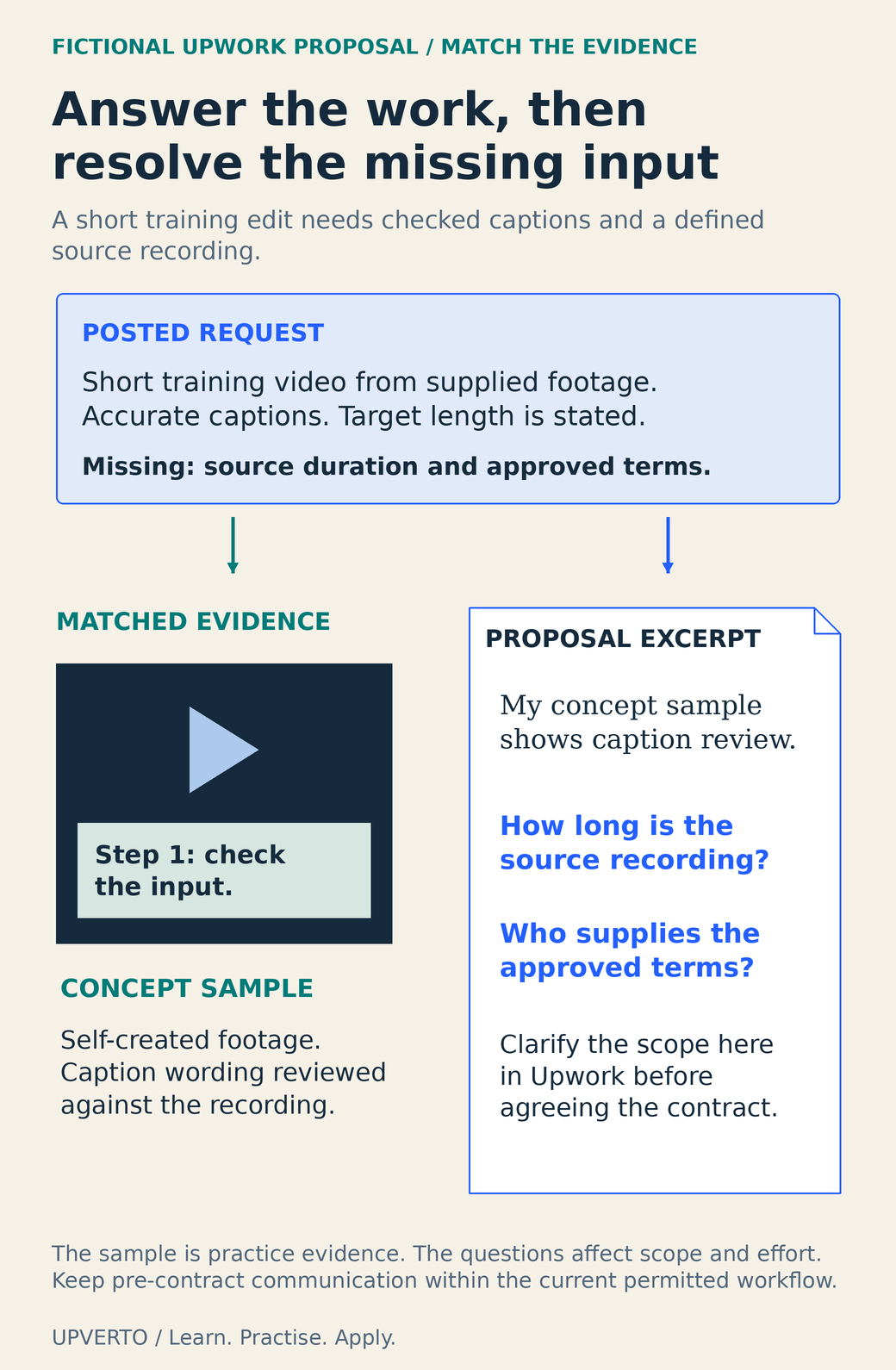
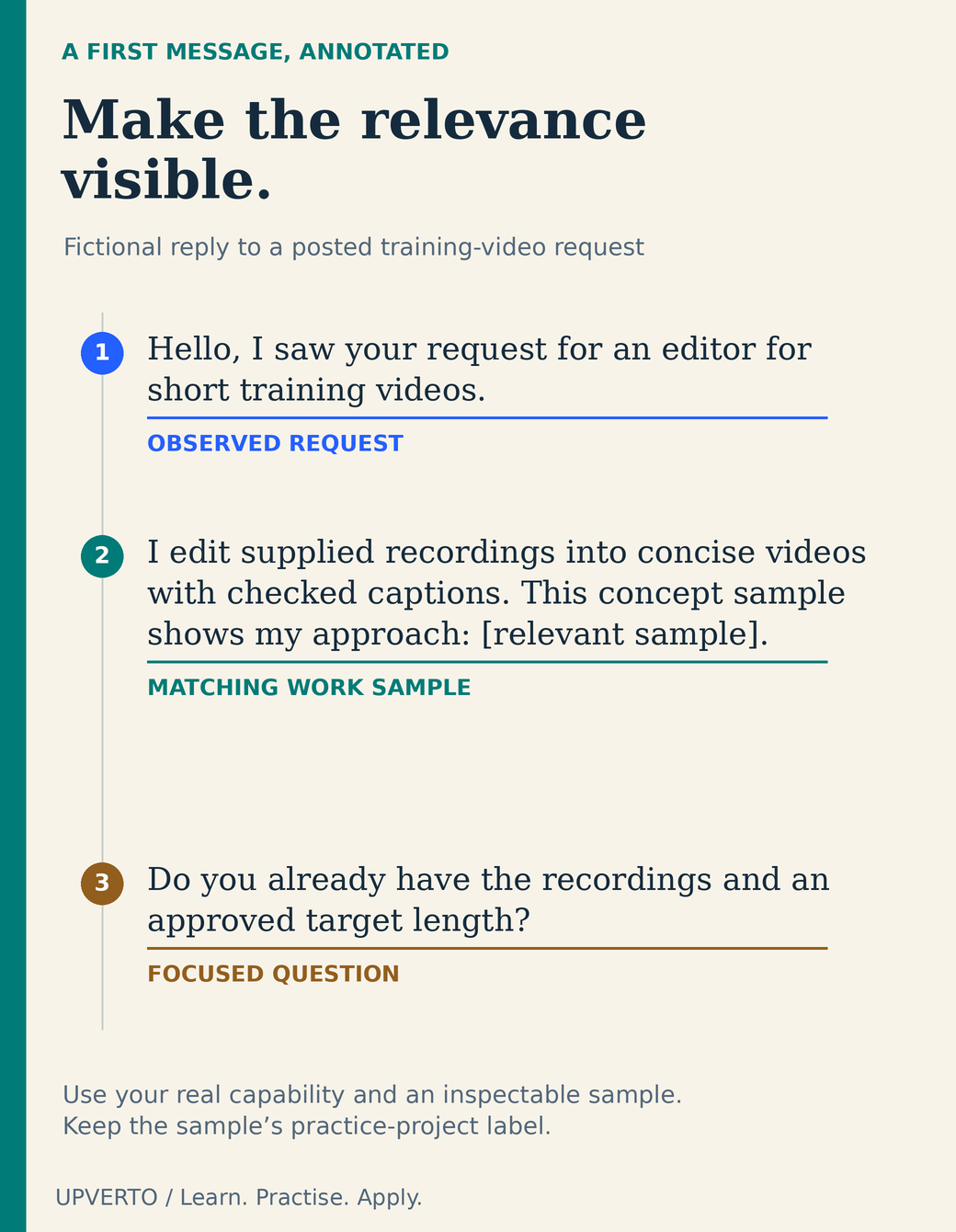
    A fictional posted training-video request branches to a labelled caption-review concept sample and a proposal excerpt asking about source duration and approved technical terms.
    Build a specific proposal from the request and a relevant sample — A fictional posted training-video request branches to a labelled caption-review concept sample and a proposal excerpt asking about source duration and approved technical terms. Use the enlarged view, then swipe or use arrow keys to inspect details. View full-size infographic.
    Read the text version: Build a specific proposal from the request and a relevant sample

    The fictional request asks for a short training edit from supplied footage, with accurate captions and a stated target length. Source duration and approved technical terms remain missing. A relevant concept sample uses self-created footage and demonstrates caption wording reviewed against the recording. The proposal explains that context and asks: how long is the source recording, and who supplies the approved terms? Clarify scope in Upwork before agreeing the contract. This is a preparation example, not a submitted bid, client result or guaranteed response. Follow current pre-contract communication rules and inspect the actual contract before beginning work.

    Worked example: a relevant training-video request

    Fictional request: a client wants a short training video from supplied footage, with accurate captions. The target length is stated, but the source duration and approved technical terms are missing. The learner has a clearly labelled concept sample using self-created footage.

    Hello, your request describes a short training edit with checked captions. My attached concept sample shows how I organise a supplied explanation and review caption wording; it is practice work, not a client result.

    I would first confirm the source footage and approved terms, then create the agreed edit, review the captions against the recording and inspect the complete export. How long is the source recording, and will you provide the approved spelling of names and technical terms?

    If the scope fits, we can clarify the deliverables and review process here in Upwork before agreeing the contract.

    The example identifies the task, explains the evidence and asks questions that affect effort. It does not claim a success rate, offer unlimited free production or move the conversation to another channel. A real proposal must also contain appropriate actual terms in the relevant fields; this teaching text is not a submitted bid.

    If the discussion progresses, use freelance discovery call questions to resolve the brief. Before starting work, inspect the actual contract, payment arrangement and applicable protection conditions. Upwork’s protection programmes have requirements and exclusions; the existence of a job post or message does not by itself establish protected work.

    Use the profile-and-proposal preparation checklist

    StageEvidence to check
    AccountEligibility, truthful information and official verification notices
    Main profileDefined service, accurate experience and relevant samples
    Job fitRequired output, inputs, constraints and unresolved scope questions
    Cost decisionConnects required, optional spend and displayed service fee
    ProposalRelevant explanation, screening answers, permitted sample and realistic terms
    Before workActual contract, payment conditions, approved brief and review process

    Keep a private record of the jobs considered, reasons for fit or rejection, actual costs and responses. Do not invent a conversion target or interpret every silence as a reason to spend more. Review the quality of the match and the evidence before changing the offer.

    Frequently asked questions

    Do I need Specialized Profiles to offer different services?

    No. Upwork’s official update says Specialized Profiles were removed on 28 May 2026. Use the current main-profile system and keep the actual service evidence clear. Verify current documentation when following a tutorial recorded before that change.

    Does every freelancer receive free monthly Connects?

    No universal allocation should be assumed. Upwork describes eligibility-based offers and rewards, and the account’s Connects history shows what applies. Purchased Connects currently cost US$0.15 each; check the current job requirement and any optional spend before submitting.

    Is Upwork’s freelancer fee always ten percent?

    No. The official page checked for this guide gives a 0%–15% range per contract and shows the applicable fee during the proposal or offer process. Inspect your actual terms instead of relying on an older flat-fee explanation.

    Can I use a concept project as a work sample?

    Yes, when it is relevant, permitted and clearly labelled. Explain the brief, your role and checks. Do not imply that it was an Upwork contract or attach invented reviews, earnings or client outcomes to make the profile appear established.

    Can I send a client my email before a contract?

    Follow Upwork’s current contact-information policy. Pre-contract communication generally stays on Upwork, with narrowly described exceptions for certain information needs. Do not treat an exception as permission to move job or payment discussions outside the platform.

    Should I submit to every job in my category?

    Choose requests that match your demonstrated capability and capacity. Read the inputs, constraints and costs before spending Connects. A relevant sample and a specific question are more useful than a large number of generic submissions, and no submission volume guarantees work.

    Sources and review notes

    Primary sources checked on 27 October 2026 (UTC). Check the current provider pages before relying on a changing feature, policy or price. Worked examples and worksheets are original teaching material; fictional examples are not evidence of client results.

  • Creating a Fiverr Service Listing with Clear Scope and Proof

    Creating a Fiverr Service Listing with Clear Scope and Proof

    A useful Fiverr listing tells the buyer exactly what service is offered and what information is needed to deliver it. The title, package, description, requirements and gallery should describe the same bounded task. A clear listing does not guarantee visibility or orders.

    This guide uses official Fiverr documentation checked on 27 October 2026. Verify the live rules and fields for your category before creating or changing a listing. For the broader acquisition strategy, use how to find freelance clients.

    In this guide
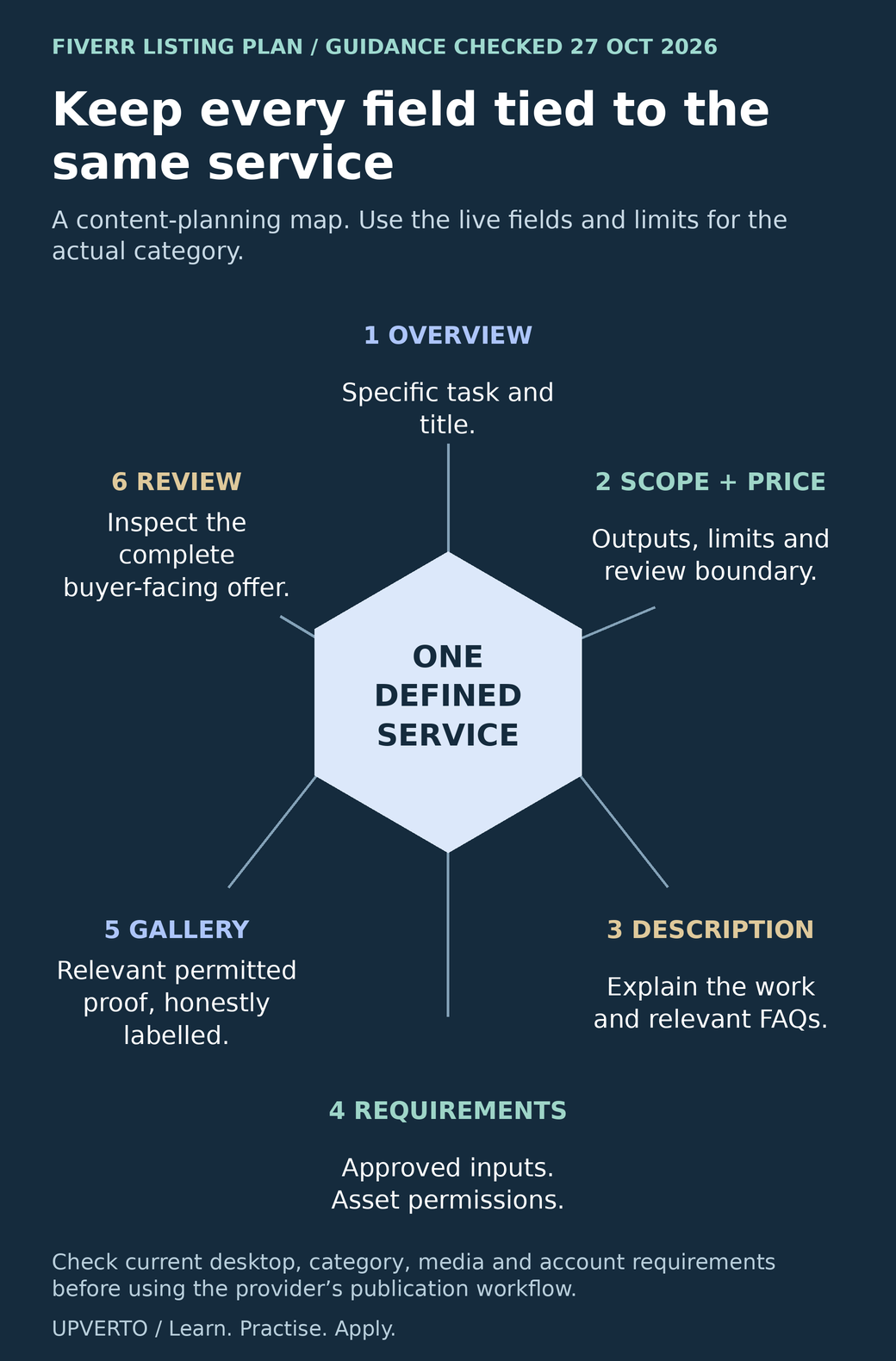
    Six connected content areas surround one defined service: overview, scope and price, description and FAQs, buyer requirements, gallery evidence and final review.
    Map one defined service across Fiverr listing fields — Six connected content areas surround one defined service: overview, scope and price, description and FAQs, buyer requirements, gallery evidence and final review. Use the enlarged view, then swipe or use arrow keys to inspect details. View full-size infographic.
    Read the text version: Map one defined service across Fiverr listing fields
    1. Overview: a specific task and relevant title.
    2. Scope and pricing: outputs, quantities, limits and review boundary.
    3. Description and FAQs: an accurate explanation of the work and likely questions.
    4. Requirements: approved inputs and necessary permissions.
    5. Gallery: relevant permitted proof with honest project labels.
    6. Review: inspect the whole buyer-facing offer for consistency.

    This is a planning map, not a screenshot of the live interface. Official Fiverr guidance checked on 27 October 2026 should be rechecked for current desktop, account, category and media requirements. Review and platform approval do not guarantee orders.

    Check account eligibility and desktop access

    Fiverr’s account guidance requires users to be eighteen and of legal age to form a binding contract. Users aged thirteen to seventeen may use the service only through a parent or legal guardian’s account under its policy; under-thirteen use is prohibited. Check the full requirements rather than assuming a minor can independently open a seller account.

    Current official guidance says freelancer activation and Gig creation require desktop access. The Gig-creation guide also says editing is done on desktop. Prepare your material in advance and use the supported workflow instead of relying on an old mobile tutorial.

    Provide accurate identity and business information and complete required verification through the official account process. Fiverr may require identity or phone verification. Do not send credentials, payment details or documents to an unverified person in a message who claims they can activate the listing.

    Write the service brief before filling the fields

    Use create freelance service packages to define the actual offer. Name the output, quantity, source material, included operations, revision process and handover. Decide what is outside the scope before a buyer asks for it.

    Field to prepareDecision to make
    Task and buyer contextWhat specific work can you reliably deliver?
    OutputsQuantity, format, dimensions or duration as relevant
    InputsApproved copy, recordings, assets and permissions the buyer supplies
    Included workOperations and checks needed for the stated outputs
    ReviewWhat a revision means and what changes the scope
    TimingA realistic commitment that fits the platform’s order process
    ProofRelevant permitted samples with honest context
    ExclusionsExtra formats, new source material or specialist work requiring a different agreement

    A package label such as Basic is not a scope definition. If you offer more than one package, make the differences concrete and sustainable. Do not use a low entry package that omits an essential element while the gallery implies a complete result.

    Map the brief to the current Gig fields

    Fiverr’s current creation workflow groups the listing into overview, scope and pricing, description and FAQs, requirements, and gallery before review. Use the actual fields and limits shown for your category. Some services have category-specific conditions, so a generic tutorial cannot establish every requirement.

    The Gig guidelines emphasise a relevant title and category, an English description and permission for uploaded material. Write a title that names the service, and use tags that actually describe it. Do not imply that unrelated keywords, fake badges or copied listings create legitimate proof.

    Requirements should ask for the information needed to start and check the work. Mark required information appropriately in the available workflow. Do not ask for account passwords in a generic text field; when authorised access is necessary, discuss a suitable secure process and minimum permissions.

    Preview the complete listing as a buyer. Confirm that the gallery, title and package do not promise different quantities or formats. Save and review before choosing to publish. Platform approval is a separate process and does not guarantee that buyers will order.

    Worked example: an information-sheet layout Gig

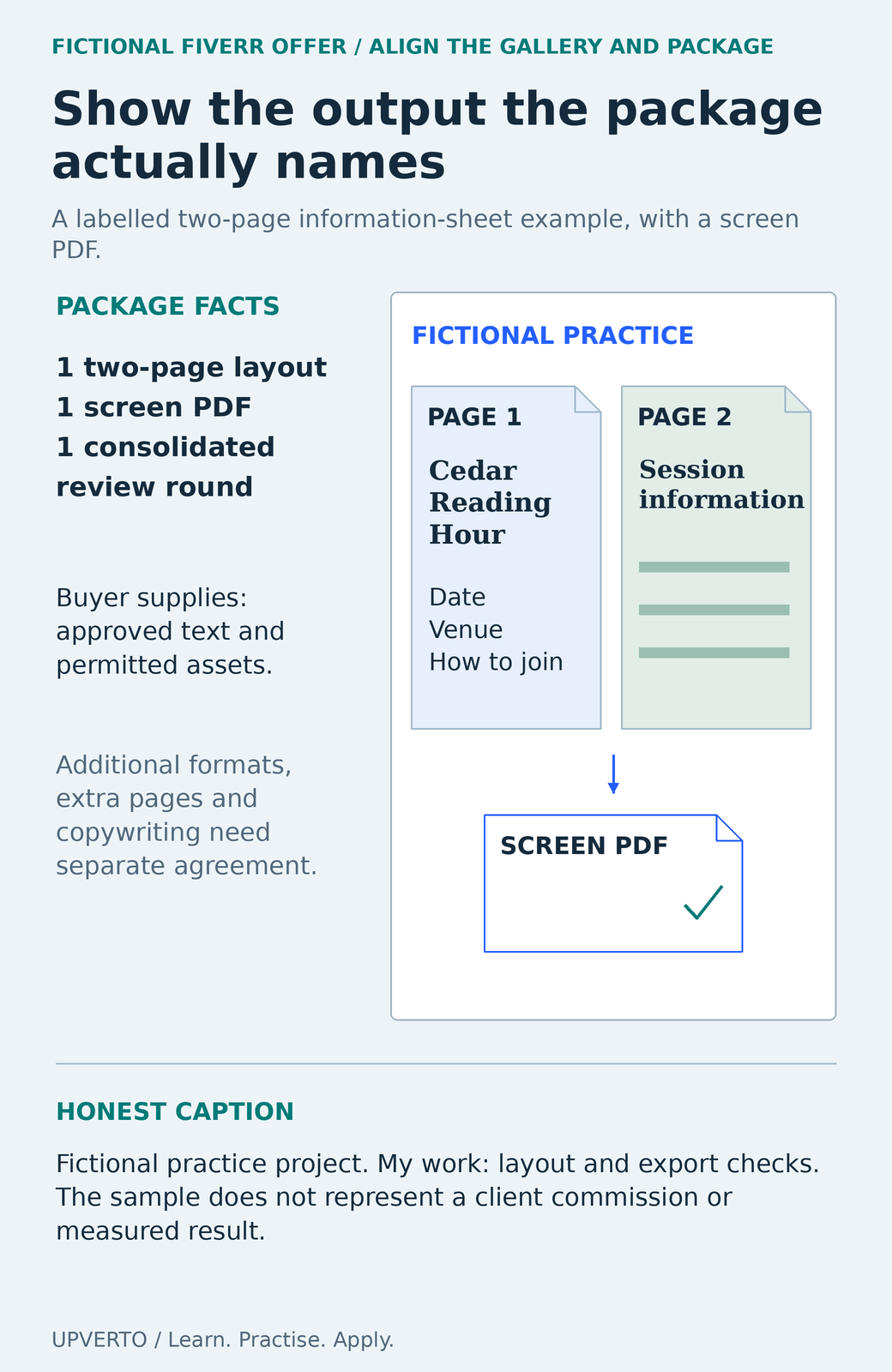
    Fictional listing brief: “I will format your approved text into a clear information sheet.” The sample package covers one two-page layout with a screen PDF, one consolidated revision round and checks against the supplied copy. This is a teaching example; verify category requirements and use limits you can actually deliver.

    Description: “This service is for buyers who already have approved wording and permitted images. I arrange the information with clear headings, spacing and image placement. The package includes the stated two-page layout and PDF export. Copywriting, translation, new illustration, extra pages and additional formats are separate tasks.”

    Buyer requirements: approved text; intended audience and use; required page size; permitted images or logo; exact names and contact details; and the person who will consolidate feedback. If printing is required, obtain the actual printer specifications before agreeing a print-ready output.

    Gallery proof: show a readable fictional Cedar Reading Hour sample with its practice label. Include a short note identifying the layout work and checks. Use show portfolio work honestly to preserve that context. Do not add a client logo, review or result that did not occur.

    A fictional package specification names a two-page layout, screen PDF and one review round; its gallery visibly contains two labelled pages and a matching PDF output with honest practice context.
    Check that a Fiverr gallery demonstrates the stated output — A fictional package specification names a two-page layout, screen PDF and one review round; its gallery visibly contains two labelled pages and a matching PDF output with honest practice context. Use the enlarged view, then swipe or use arrow keys to inspect details. View full-size infographic.
    Read the text version: Check that a Fiverr gallery demonstrates the stated output

    The fictional package covers one two-page layout, one screen PDF and one consolidated review round. The buyer supplies approved text and permitted assets. Additional formats, extra pages and copywriting need a separate agreement. The gallery shows two pages of a Cedar Reading Hour information sheet and the corresponding screen-PDF output. The caption identifies a fictional practice project, with layout and export checks as the creator’s contribution. It does not represent a client commission, review or measured result. The gallery demonstrates the output; the review-round boundary remains an explicit package term.

    The listed review round refines the approved layout within scope. An extra page or replacement copy may require another agreement. Correcting a provider error against the approved brief should not be disguised as a paid add-on.

    Understand fees and keep the order process coherent

    Fiverr’s earnings page currently states that freelancers receive 80% of the purchase amount, including extras and tips. That is before any other applicable costs or taxes; it is not a take-home-income promise. Consider the actual fee and payout conditions when assessing whether the scope and price are sustainable.

    Use the platform’s communication and payment rules. Fiverr’s off-platform policy permits third-party communication only after an order has been placed and prohibits moving payments off-platform. Where outside communication is permitted, keep a suitable record on the platform. Do not use contact details in the listing to bypass the order system.

    After a suitable order, confirm the supplied requirements and use client onboarding checklist to organise the brief, access and review. Check the actual order status and deadlines rather than assuming that a friendly message changes the platform’s timing.

    Review the listing against the delivery you can perform

    Review questionEvidence
    Do all fields describe one service?Title, package, description and gallery agree.
    Can the buyer provide the inputs?Requirements are specific and proportionate.
    Is the proof honest and permitted?Project labels, contribution and asset rights are clear.
    Can the timing and review be sustained?Scope fits demonstrated capability and available capacity.
    Are current platform rules satisfied?Category, media, account, communication and fee conditions checked.

    Keep a copy of the listing brief and sample files so that future edits remain consistent. Change a field because it clarifies the real offer or fixes a demonstrated problem. Do not treat a change in wording as a guaranteed ranking technique or invent orders to make the listing appear established.

    Frequently asked questions

    Can I create or edit a Fiverr Gig entirely on my phone?

    The official guidance checked for this article says Gig creation and editing require desktop access. Prepare the content and use the currently supported workflow. Recheck the provider page if the interface changes rather than relying on an older tutorial.

    Do I need three packages for a Fiverr Gig?

    The platform supports package options, but your offer should remain understandable and sustainable. Follow the actual category and account fields. If you offer multiple packages, distinguish them by real quantities, formats or included work rather than vague promises of quality.

    Can a concept sample appear in my Gig gallery?

    Use relevant material you are permitted to share and label its context honestly. Explain your contribution and do not invent a buyer, review or business result. Check the current gallery and category rules before uploading the exact files.

    Does Fiverr take twenty percent of tips too?

    The official earnings guidance checked for this article says the freelancer receives 80% of the purchase amount, including extras and tips. Verify the current terms and any other applicable costs or taxes before relying on a net amount.

    What should I do when a buyer asks for something outside the listing?

    Clarify the request and compare it with the agreed output and review limits. Discuss the appropriate platform-supported change or separate offer before doing additional work. Do not conceal a known required task as a surprise charge after the order begins.

    Will keywords or a perfect gallery guarantee orders?

    No. A clear title and relevant evidence help a buyer understand the offer, but they do not guarantee visibility, ranking or purchases. Follow the platform’s rules and review actual fit and delivery capability instead of making unsupported outcome claims.

    Sources and review notes

    Primary sources checked on 27 October 2026 (UTC). Check the current provider pages before relying on a changing feature, policy or price. Worked examples and worksheets are original teaching material; fictional examples are not evidence of client results.

  • How to Find Freelance Clients: A Practical Beginner’s Guide

    How to Find Freelance Clients: A Practical Beginner’s Guide

    Part of How to Make Money Online with Digital Skills: A Beginner’s Roadmap.

    To find freelance clients, define work you can deliver, show relevant evidence, and approach people whose actual needs fit that work. Use a manageable channel, ask useful questions, and keep a record of what happens so you can improve the process.

    In this guide

    This guide is for people preparing to offer a digital service. If you are still learning the task, start with the readiness checklist. If you can do the work but struggle to explain it, complete a service definition and a clear package first.

    Three routes connect a known contact to a relevant introduction, a matching posted request to its stated response channel, and an observed need to checking contact preferences; all end at a relevant sample and a fit check.
    Choose a route that matches your evidence — Use your actual evidence and buyer access to choose a manageable starting route. These examples describe decisions, not success rates. Use the enlarged view, then swipe or use arrow keys to inspect details. View full-size infographic.
    Read the text version: Choose a route that matches your evidence

    These are three illustrative situations for a beginner with a relevant editing sample.

    • Known contact: if a colleague already knows your work, ask about an appropriate introduction or a real need that matches your service. Check that the conversation is welcome.
    • Posted request: if a training-video brief matches your sample and capability, respond through the stated channel and follow its current rules.
    • Observed need: if you see a potentially relevant business need but have no invitation, first check the appropriate contact route, preferences and applicable rules. Do not treat an assumption as a verified problem.

    Whichever route you use, show one relevant sample and confirm the actual need, scope and fit. A concept sample should be labelled as such. Choose a manageable channel and record what really happens; no route guarantees a client.

    Prepare the basics before looking for opportunities

    You should be able to explain the task you handle, who it may suit, what the client receives, and what information you need. Prepare one relevant work sample with an honest explanation of its status and your contribution.

    A simple description is enough to begin a sensible conversation. For example: “I edit supplied educational recordings into concise videos with checked captions.” The next questions concern the source material, audience, intended format, and review process.

    Use the portfolio guide if you do not yet have client work. A clear concept sample can demonstrate your approach without invented testimonials or commercial results.

    Choose a channel that fits the work

    ChannelHow to use it thoughtfullyWhat to check
    Existing professional or personal networkExplain a specific service and ask for relevant introductions or known needs.Whether the conversation is welcome and whether the need actually matches.
    Professional communitiesAnswer useful questions and respond to appropriate requests.Community rules, solicitation limits, and the relevance of your contribution.
    Freelance marketplacesStudy suitable briefs and submit focused responses through the required process.Current eligibility, fees, payment rules, and communication policies.
    Agencies and established providersOffer a clearly defined task that could support their existing delivery.Expected quality, confidentiality, capacity, and approval arrangements.
    Direct business enquiriesContact an appropriate business about a relevant, observed need.Contact preferences, applicable marketing rules, and whether your assumptions are accurate.
    Your own useful content and portfolioExplain the problems you solve and make your work easy to inspect.Whether the content reaches the intended audience and leads to a clear next conversation.

    Start with one primary channel you can manage. This is an organisation choice, not a claim that one channel always produces clients faster. Expand when you understand the work involved and have evidence that another channel is relevant.

    A fictional three-part reply highlights the posted training-video request, a clearly labelled concept sample with checked captions, and a question about the recordings and approved target length.
    Write a relevant first message — Read the message itself, then identify the observation, matching evidence and question that make it useful. Use the enlarged view, then swipe or use arrow keys to inspect details. View full-size infographic.
    Read the text version: Write a relevant first message

    This fictional example responds to a posted request; it is not a message that has been sent.

    Hello, I saw your request for an editor for short training videos.

    I edit supplied recordings into concise videos with checked captions. This concept sample shows my approach: [relevant sample].

    Do you already have the recordings and an approved target length?

    The first sentence points to the actual request. The middle connects a specific capability with a relevant sample and keeps the concept-project label visible. The final question asks for inputs needed to assess fit. Replace the claims and sample placeholder with your real work, use the required response channel, and respect contact preferences.

    Decide whether an opportunity fits before pitching

    Read the request carefully. Identify the deliverable, source material, deadline, required experience, and any responsibility that changes the risk. Notice what is missing.

    For a video request, ask whether the footage and approved wording exist. For a website task, identify the site environment and the exact functionality affected. For administrative work, understand the data and decisions involved before accepting access.

    A suitable opportunity needs more than a familiar tool name. It should fit your demonstrated ability, available capacity, and delivery process. Decline or ask for a narrower scope when it does not.

    A useful client conversation
    1. Relevance: establish a real task or request.
    2. Evidence: show one appropriate sample.
    3. Understanding: clarify the brief and constraints.
    4. Agreement: confirm scope and terms before production.
    5. Delivery: complete the agreed work and learn from the result.

    Write a first message around the actual request

    A useful first message connects an observed need to your relevant work and a clear question. Avoid a long autobiography, an unrelated list of tools, or claims about a business’s problems that you have not verified.

    Fictional example responding to a posted request: “Hello, I saw your request for an editor for short training videos. I edit supplied recordings into concise videos with checked captions. This concept sample shows my approach to a similar educational format: [relevant sample]. Do you already have the recordings and an approved target length? That would help me confirm whether the project fits my service.”

    Replace the example with your real capability and evidence. If you have not completed a similar task, do not claim that you have. For direct enquiries, explain the genuine reason for contacting that organisation and respect its contact preferences and any applicable rules.

    Do not send the same generic message to a large scraped list. Relevance requires understanding who you are approaching and why the service might help. Stop when a recipient asks not to be contacted.

    Use the conversation to understand the project

    Before quoting, ask what the client needs to accomplish, who will use the output, what is already available, what must be delivered, and who approves the work. Clarify timing and any constraints that affect your approach.

    Summarise what you heard in writing. Distinguish confirmed requirements from assumptions. If the request is too vague to price, gather the missing information or discuss an appropriately scoped discovery step.

    A proposal should connect the client’s request to your deliverables, process, relevant evidence, estimate, and next step. Use the package worksheet to make the scope clear and the delivery workflow to prepare for implementation.

    Keep a simple acquisition record

    FieldWhat to record
    OpportunityBusiness or request, source, and date.
    Relevant needThe observed task and what remains uncertain.
    FitWhy your ability, sample, capacity, and scope match.
    Contact permission or channelThe appropriate route and any rules or preferences.
    ActionWhat you sent or discussed, using only necessary information.
    StatusResearching / contacted / conversation / proposal / agreed / closed.
    Next stepA relevant action and date, or a clear reason to stop.
    LearningWhat the response revealed about your offer or evidence.

    The purpose is to understand progress, not collect as much personal data as possible. Keep only information appropriate to the work and protect it.

    Run a small, reviewable first cycle

    As a planning exercise, research a small group of relevant opportunities and check each one against your service. Prepare a tailored response only where the fit is credible. Then review the responses and questions you receive.

    If people do not respond, inspect the relevance of the opportunity, clarity of the offer, quality of the evidence, and suitability of the channel. If conversations happen but scope remains confused, improve the package. If projects are agreed but delivery is difficult, narrow the offer and strengthen the missing ability.

    These observations help you choose what to improve. They do not establish a universal conversion rate or a guaranteed number of messages needed to win a client.

    Recognise requests that need caution

    Check unfamiliar identities and unusual payment instructions independently. The FTC’s job-scam guidance describes fake payment and recruitment schemes. Requests to forward money from a supposed payment or pay to unlock earnings should prompt you to stop and investigate.

    Be cautious about large unpaid production tests, pressure to conceal the arrangement, demands for unnecessary account access, or work that clearly exceeds your scope. Follow a marketplace’s current rules when using that marketplace.

    Frequently asked questions

    Can I find clients with no paid experience?

    You can begin relevant conversations using honest practice evidence. Whether someone hires you depends on the task and their requirements. Make the status of your samples clear and accept only work you can support.

    Should I lower my price whenever someone says no?

    First understand the mismatch. The scope, timing, relevance, trust, or budget may be the issue. If you change the price, make sure the agreed work and your delivery conditions remain sustainable.

    Where should I look for my first freelance client?

    Choose a channel that fits your service and available evidence. Relevant existing relationships, professional communities, direct enquiries, marketplaces and useful public work can each create opportunities. Start with a manageable approach, record what happens and review whether you are reaching people with a genuine need.

    What should a first message to a potential client include?

    Refer to the actual request or relevant context, explain briefly how your service may help and include one suitable example when useful. Ask a focused question or suggest a clear next step. Avoid unsupported promises, generic mass messages and assumptions about private information.

    Should I offer a free sample to win work?

    First consider whether your existing portfolio already answers the question. If you choose a sample, agree on its narrow purpose, limits and permitted use. Avoid doing an open-ended live project merely to compete for an unspecified opportunity, and do not present unpaid sample work as a confirmed commission.

    How should I follow up after an enquiry?

    Use the channel and timing appropriate to the conversation, with a concise reminder and a useful next step. Keep a record so you do not send repeated or conflicting messages. Respect a refusal or opt-out and review the fit of the opportunity instead of treating persistence as a guarantee of a sale.

    Prepare for the project you are trying to win

    Choose one service, one relevant sample, and one manageable acquisition channel. Use the worksheet for the first conversations. When an opportunity fits, move into a clear project-delivery process. After completing work, review how to build repeat work sustainably.