Category: Build a portfolio

  • How to Show Your Work Without Inventing Clients or Results

    How to Show Your Work Without Inventing Clients or Results

    You can show useful work before you have paid clients, provided the reader can understand what the work actually represents. A concept project can demonstrate a decision. A tutorial exercise can show learning. Neither needs an invented client or sales result to become inspectable.

    The guide to build freelance portfolio without clients explains how to develop the work itself. This guide focuses on the labels, permissions and evidence that let someone interpret it accurately.

    In this guide
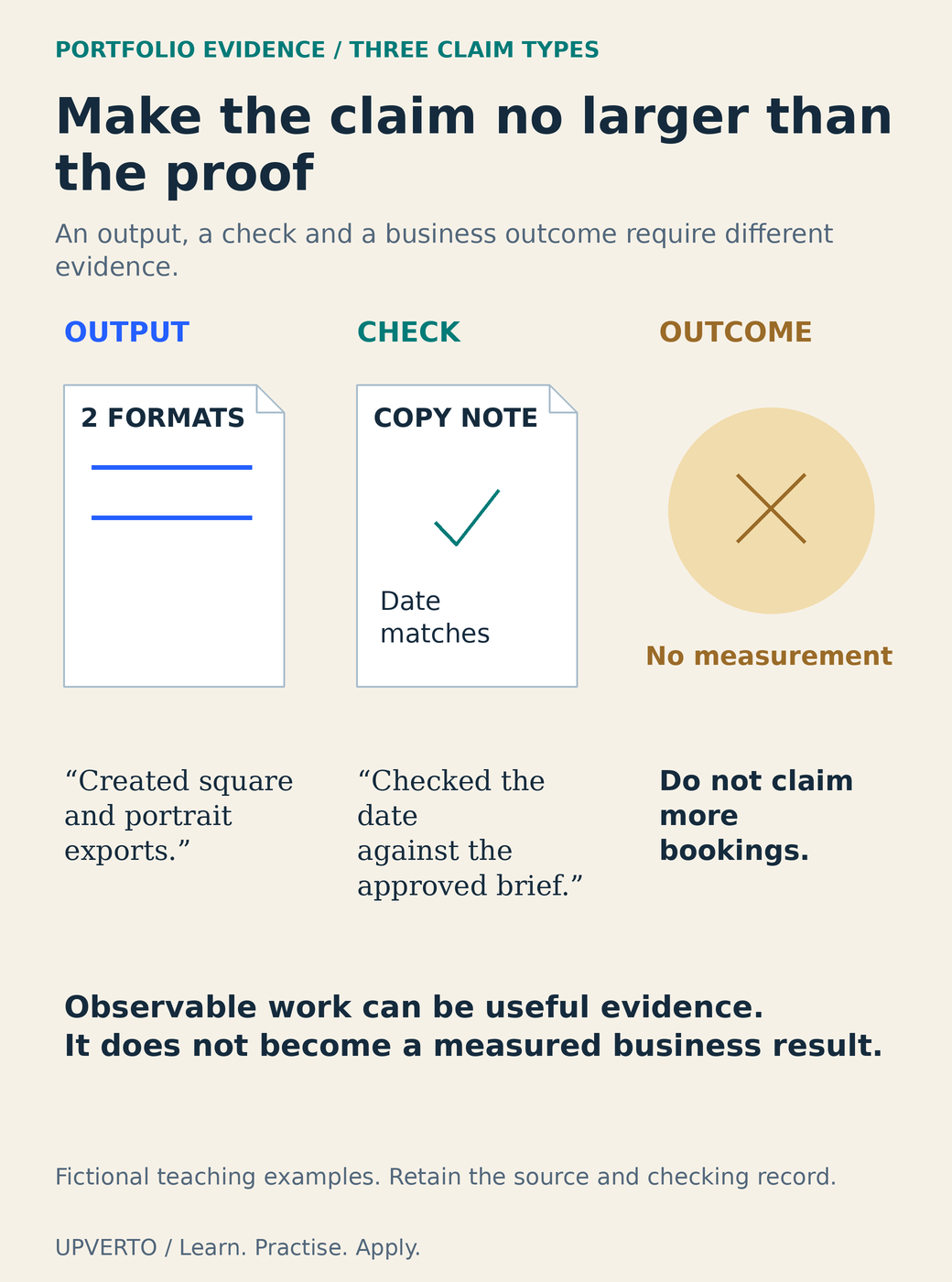
    Two output files, a copy-check record and an absent measurement illustrate why producing and checking a design does not prove more bookings.
    Match three types of portfolio claim to evidence – Two output files, a copy-check record and an absent measurement illustrate why producing and checking a design does not prove more bookings. Use the enlarged view, then swipe or use arrow keys to inspect details. View full-size infographic.
    Read the text version: Match three types of portfolio claim to evidence

    Output evidence can support the claim that square and portrait exports were created. A copy-check record can support the statement that the date was compared with the approved brief. Neither establishes a business outcome such as increased bookings. Without an appropriate measurement, do not claim that outcome. These are fictional teaching examples; retain the actual source files and checking record for real work. Useful evidence can describe observable production and checks without inventing a client result.

    Name the type of project at the point of inspection

    Put the label beside the sample or near the case-study introduction, where the reader will see it before drawing conclusions. “Fictional concept project created for practice” is clearer than a small disclaimer at the bottom of a site. Use a fictional organisation and contact details when you do not have permission to represent a real one.

    Project typeUseful labelWhat else to explain
    Self-directed conceptFictional practice brief; no client commissionConstraints you chose and what you tested
    Tutorial-based exerciseLearning exercise based on the named lessonSupplied material and your independent changes
    Volunteer projectVolunteer work for the named organisation, with permissionYour agreed role and what may be shown
    Collaborative projectTeam project; my contribution was the stated partOther contributors and permitted attribution
    Paid client projectClient work shared with the appropriate permissionScope, role, confidentiality and evidence limits

    A label should survive reuse. If a sample becomes a thumbnail, PDF or platform portfolio entry, keep the context there too. Do not rely on a separate biography to correct an impression created by the sample itself.

    Match each claim to the evidence you hold

    Separate an output, an observed check and a business outcome. “Created two export formats” describes an output. “The final PDF opens and the approved date matches the brief” describes a check. “Increased event attendance” is a business outcome that would need evidence, an appropriate measurement method and permission to disclose.

    A before-and-after image can demonstrate changed hierarchy or spacing. It does not establish that customers behaved differently. A faster run on your practice file can be recorded with the actual setup and method, but it should not become a universal productivity promise. Keep the wording as narrow as the observation.

    When writing write a portfolio case study, distinguish the brief’s goal from the result. “The concept aimed to make the booking instruction easier to find” states an intention. “The redesign doubled bookings” states a measured claim. If you did not measure it, do not use it.

    Record sources and permissions, including dependencies

    Keep a source ledger for photographs, fonts, icons, templates, code and any AI assistance. Record where the material came from, the applicable licence or permission, the date checked and what you changed. Attribution and permission are related but different: credit does not by itself authorise a use.

    For example, the Creative Commons Attribution 4.0 deed requires appropriate credit, a licence link and an indication of changes, and warns that other rights can still matter. That is a description of that licence, not a rule that every online image can be reused with a credit. Read the actual terms for the specific asset and intended use.

    Do not imply endorsement by the source creator, client or platform. If a template supplied the layout, explain the substantive changes you made. If another person wrote the code or copy, identify your contribution accurately. If confidentiality prevents enough explanation, use a different permitted sample instead of making a vague claim impossible to inspect.

    Worked example: repair an overstated case-study caption

    Fictional concept: a learner creates an announcement for Cedar Reading Hour. The initial caption says, “Client redesign that boosted bookings.” There was no client, no live event and no booking data. The claim is unsupported even if the design itself is strong.

    A useful replacement is: “Fictional practice project for Cedar Reading Hour. I wrote the brief and created square and portrait layouts using original simple shapes. I grouped the date and venue and increased the visibility of the booking instruction. I checked wording and exported dimensions. No live campaign or booking outcome was measured.”

    This version gives a reviewer several things to inspect: the two formats, the changed grouping, the exact copy and the stated limits. It does not apologise for being practice work. It describes the evidence accurately.
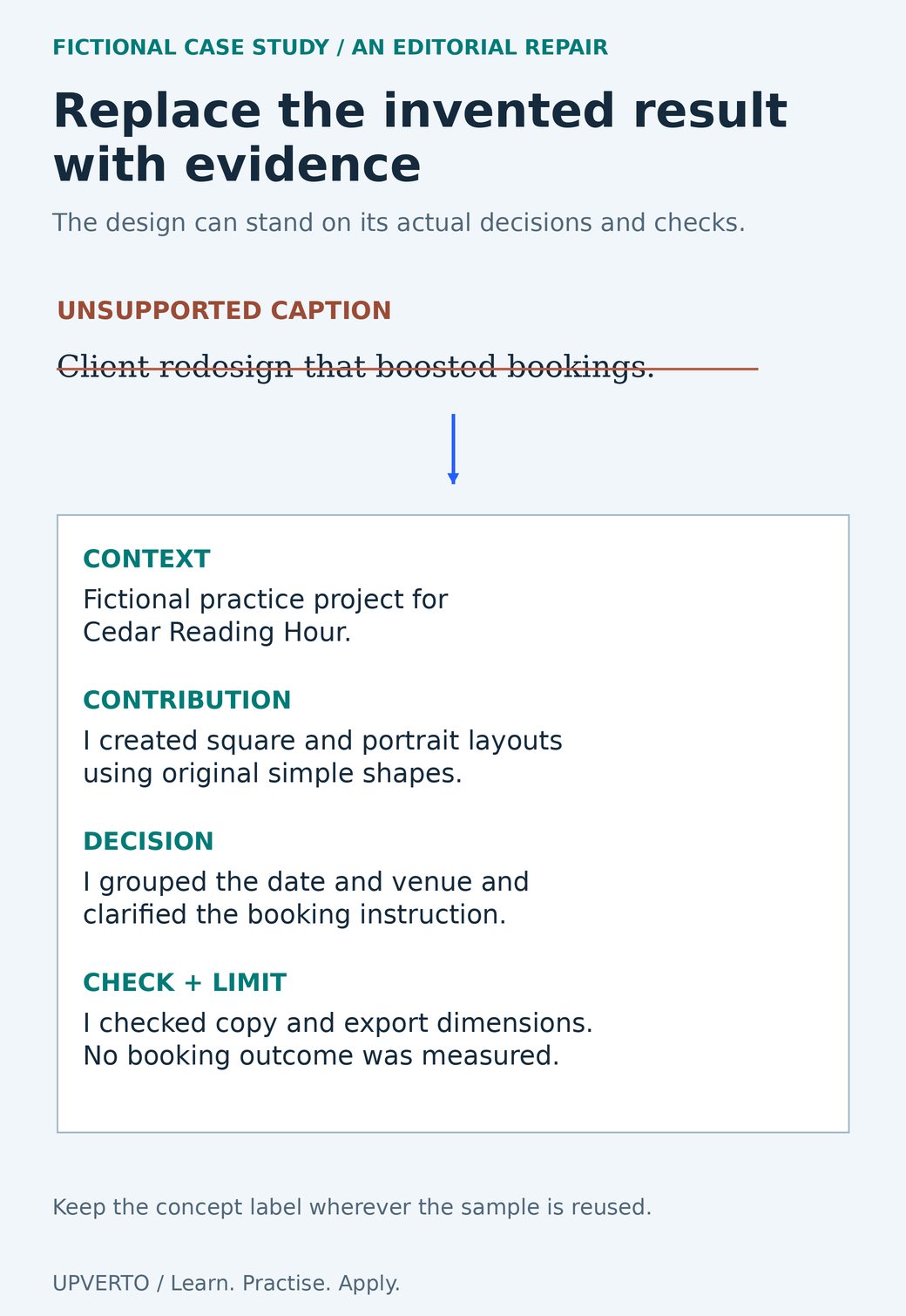
    A crossed unsupported client-and-bookings claim is replaced by a visible fictional label, contribution, design decision, actual checks and a measurement limit.
    Repair an overstated case-study caption – A crossed unsupported client-and-bookings claim is replaced by a visible fictional label, contribution, design decision, actual checks and a measurement limit. Use the enlarged view, then swipe or use arrow keys to inspect details. View full-size infographic.
    Read the text version: Repair an overstated case-study caption

    The unsupported caption says “Client redesign that boosted bookings.” There was no client or measured booking result in this fictional exercise. The corrected account identifies the context as a fictional Cedar Reading Hour practice project, names the creation of square and portrait layouts using original simple shapes, explains grouping the date and venue and clarifying the booking instruction, and records copy and export-dimension checks. It states that no booking outcome was measured. Preserve that context wherever the sample is reused.

    If the learner later asks a peer to find the date, they can add the actual observation: what task was given, what the peer did and what changed afterwards. They should not convert one informal review into a population-wide claim or invent a percentage improvement.

    Copy the evidence and attribution checklist

    Claim or materialEvidence to keepPublic wording
    Project contextBrief and whether it was fictional, volunteer, paid or collaborativeA visible accurate project label
    My contributionSource files, role record and collaboration notesThe specific work you performed
    Third-party assetsSource, licence or permission and modification recordRequired credit and clear dependencies
    Output checksActual export, test or review notesChecks performed and remaining limitations
    Outcome claimMeasurement method, period, context and disclosure permissionA narrow supported statement, or no outcome claim

    Review the ledger before publishing or sending a sample. Remove personal information that is not needed, including comments, hidden document properties and screenshots of private accounts. Check the file itself; a cleaned-up page description does not remove sensitive content from an attached source.

    If you want experience with a real organisation, use volunteer projects for freelance portfolio to set boundaries and permissions before starting. Then use the freelance portfolio review checklist to inspect whether another person can understand the work without being misled. Honest evidence is easier to maintain than an impressive story you cannot support.

    Frequently asked questions

    Will a concept label make my portfolio look weak?

    It tells the reader how to interpret the work. A clearly explained concept can demonstrate relevant decisions and checks. An invented client or result creates a false impression and leaves you unable to answer ordinary questions about the project.

    Can I redesign a real company’s website as practice?

    You may study public material, but displaying logos, assets or a redesign can raise permission and representation questions. A fictional brief using permitted material is often simpler. Do not imply a commission, endorsement or access to private business results that you did not have.

    Is credit enough to use an image?

    No. First establish permission or a licence that covers the intended use, then satisfy its conditions. Different licences have different requirements, and privacy or other rights may still apply. A credit line does not turn an unauthorised asset into authorised material.

    How should I describe AI assistance?

    Explain the material role it played where that affects interpretation or an agreement requires disclosure. For example, distinguish your layout and checking work from generated draft imagery or text. Verify permissions and accuracy, and do not claim independent authorship of parts you did not create.

    Can I say a design is better if I did not measure results?

    Describe the observable change and the criterion: clearer grouping, larger readable text or corrected information. You can explain your rationale without claiming increased sales, conversions or satisfaction. Business outcomes require separate evidence.

    What if a client will not let me share the work?

    Respect the restriction. Ask whether a specific redacted excerpt or general process description is permitted, without assuming silence is consent. If useful evidence cannot be shared, build a separate fictional sample with your own or permitted material.

    Sources and review notes

    Primary sources checked on 27 October 2026 (UTC). Check the current provider pages before relying on a changing feature, policy or price. Worked examples and worksheets are original teaching material; fictional examples are not evidence of client results.
  • A Portfolio Review Checklist Before You Contact Clients

    A Portfolio Review Checklist Before You Contact Clients

    A portfolio is ready to share when its intended reader can inspect relevant evidence and understand what it proves. That requires more than attractive thumbnails. The sample must open, the project label must be clear and your contribution must be distinguishable from the work of others.

    This is a presentation review. It does not establish that you can deliver every service mentioned in the portfolio. Use build freelance portfolio without clients to develop the underlying evidence, then use the checks below to make that evidence understandable.

    In this guide
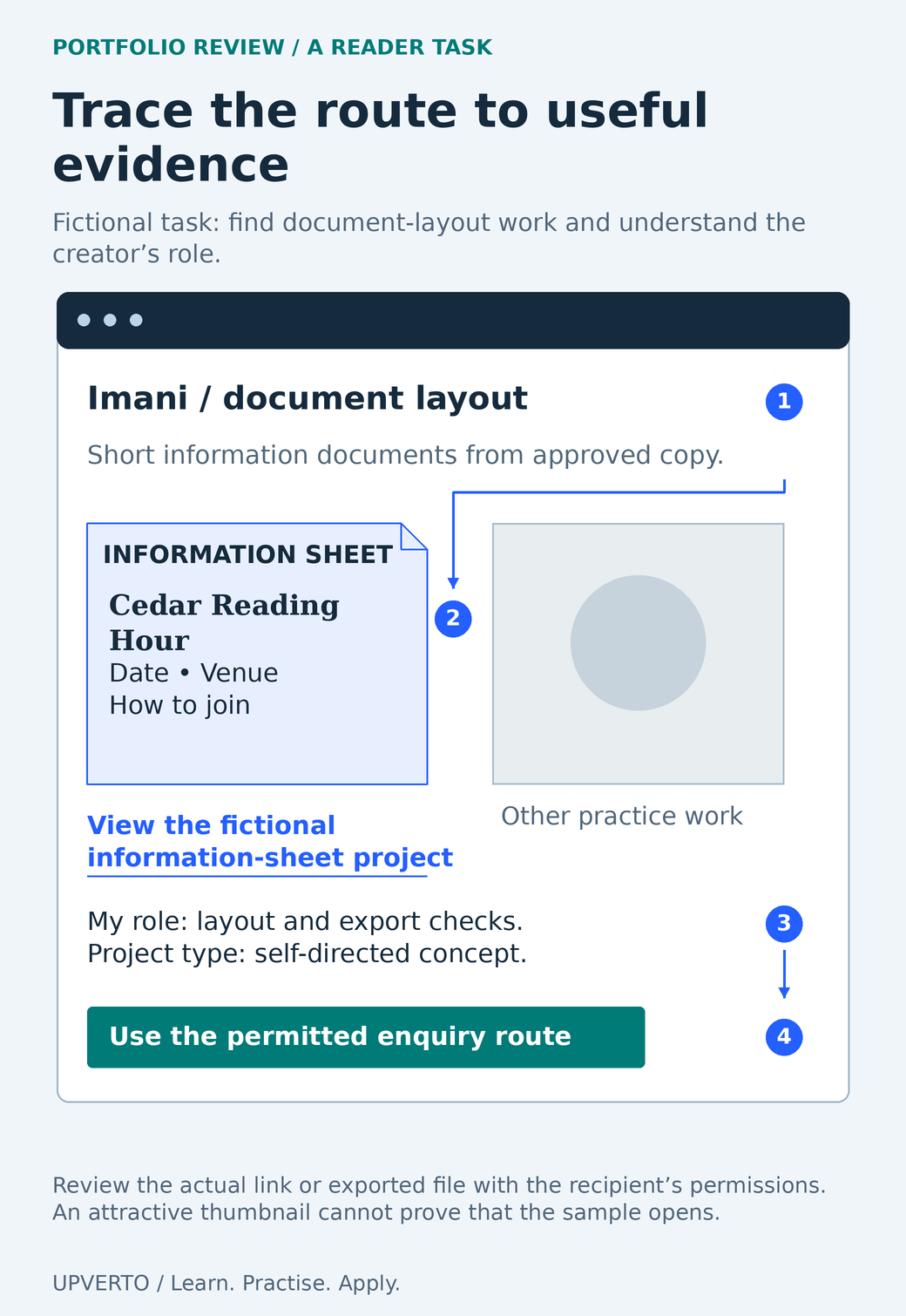
    A fictional portfolio marks four inspection points: the relevant service, an accessible sample, the creator’s role and project label, and a permitted enquiry route.
    Inspect the route from service to sample and next action — A fictional portfolio marks four inspection points: the relevant service, an accessible sample, the creator’s role and project label, and a permitted enquiry route. Use the enlarged view, then swipe or use arrow keys to inspect details. View full-size infographic.
    Read the text version: Inspect the route from service to sample and next action
    1. Identify the offered task: short document layout from approved copy.
    2. Open the relevant Cedar Reading Hour sample through a descriptive link.
    3. Read the contribution and context: layout and export checks, labelled as a self-directed concept.
    4. Find the appropriate permitted enquiry route.

    Test the exact link or exported file with the recipient’s actual access permissions. The schematic demonstrates a review task, not a tested conversion result or a complete accessibility evaluation.

    Review the portfolio as a reader with a job to do

    Choose a fictional but specific reader task: “Find an example of a short information document, identify what the creator did and locate the permitted way to enquire.” Open the same link or attachment you plan to send. Do not begin inside the editor or an account that has extra permissions.

    Notice the first explanation a reader receives. A list of tools does not tell them what you can produce. A row of images without labels does not tell them whether the work was a commission, collaboration or concept. Ask whether the service and the strongest relevant sample can be found without your spoken explanation.

    When choosing the presentation itself, compare portfolio website vs PDF vs profile. Each format creates a different access test. A public site needs navigation; a PDF needs a clear current file; a platform entry needs the permitted media and next action.

    Use a rubric with evidence, not an invented score

    AreaObservable checkRecord
    RelevanceA sample matches the task you want to offer.Which sample and which requirement?
    ContextThe brief, audience and project type are stated.Missing or ambiguous context
    ContributionYour role and supplied material are distinguishable.Claim requiring clarification
    EvidenceThe actual output and checks can be inspected.Supported claim or unsupported outcome
    PermissionsShared material and credits fit the permission held.Asset or disclosure needing correction
    UsabilityThe sample opens and relevant content is readable.Device, link, navigation or format issue
    Next actionThe reader can use a suitable permitted contact route.Broken or inappropriate destination

    Mark each row as ready, needs revision or not applicable, with a reason. Do not average a broken access link into a reassuring percentage. Some issues block the entire task even when the rest of the presentation is polished.

    Separate blocking problems from improvements. A confidential screenshot should be removed before sharing. A broken sample link should be repaired before outreach. A minor spacing preference can wait until the evidence and access are sound.

    Perform the access and accessibility checks

    Open links from the actual exported document or published preview, and inspect the permission offered to the intended recipient. Check that the file or page contains the latest version. A signed-in owner can see material that a prospective client cannot. Use a suitable recipient-access test without exposing private content publicly.

    Try the relevant small-screen view, enlarge text and move through the page with a keyboard. Check that headings describe the sections, links make sense and informative images have useful alternatives. The W3C Easy Checks resource provides an initial review method and explicitly says these checks are not a comprehensive accessibility evaluation.

    For a PDF, inspect the actual file, including reading order and usable text. For a video, check the complete playback and captions where needed. Do not infer accessibility or quality from the fact that an upload succeeded.

    Worked example: a strong sample with a blocked path

    Fictional review: Imani wants to offer short document-layout work. The portfolio opens with a decorative collage and a button labelled “See more.” The relevant community-information sheet is in a private folder. Its description says “Client project,” although it was a self-directed concept.

    The review finds three concrete problems. The route to the relevant task is unclear, the sample cannot be opened by the intended reader and the label misrepresents the context. Changing the colour scheme would not fix any of those problems.

    Imani places the information-sheet sample first, changes the link text to “View the fictional information-sheet project” and provides an authorised readable export. The introduction now says what she created, which source material she used and what she checked. She verifies the link using the actual review permission.

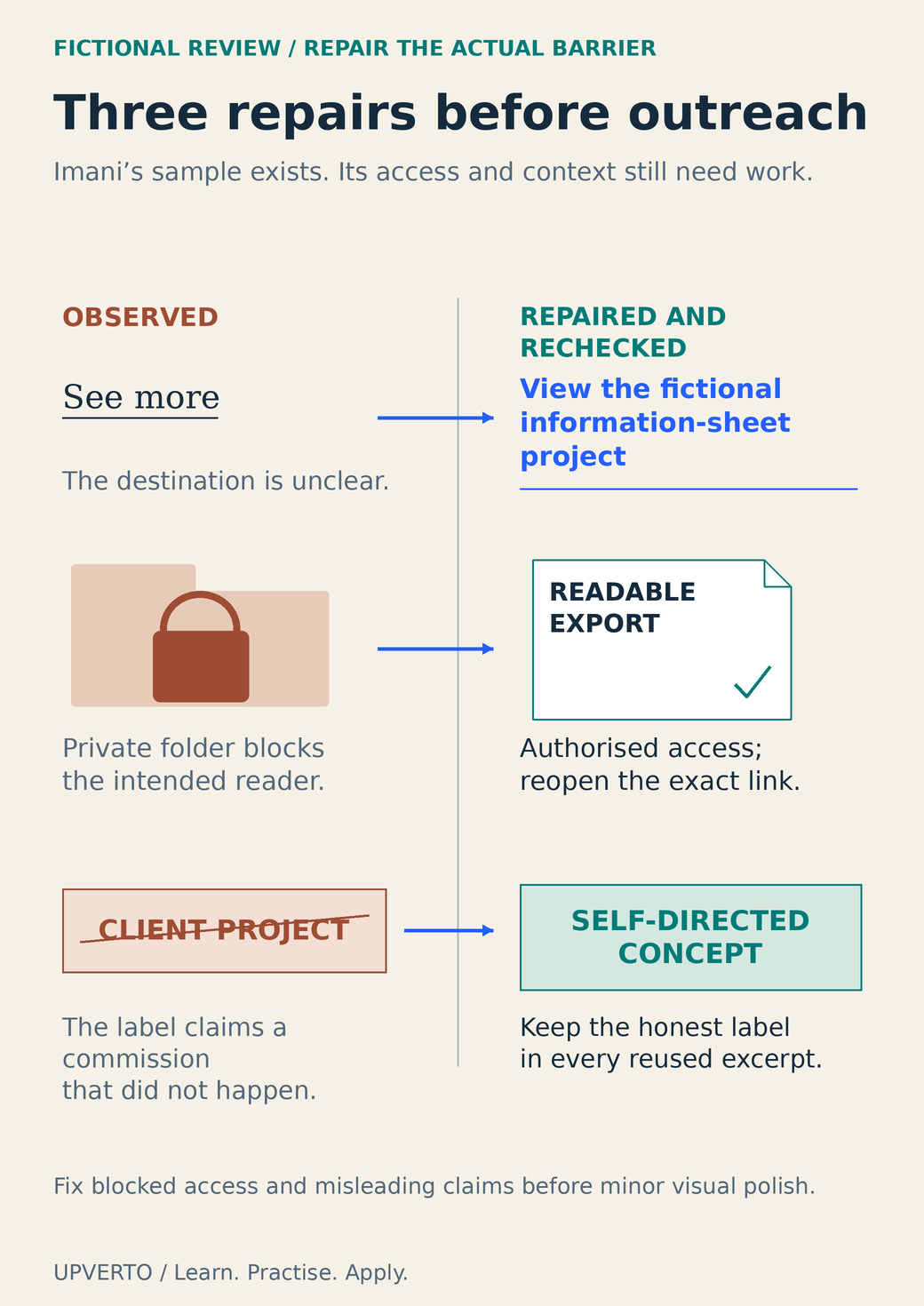
    A before-and-after inspection repairs an ambiguous link, a private-folder access block and a false client-project label in a fictional portfolio.
    Repair three barriers in a portfolio sample — A before-and-after inspection repairs an ambiguous link, a private-folder access block and a false client-project label in a fictional portfolio. Use the enlarged view, then swipe or use arrow keys to inspect details. View full-size infographic.
    Read the text version: Repair three barriers in a portfolio sample
    Observed barrierRepair and recheck
    The link says “See more”.Use “View the fictional information-sheet project” and check its destination.
    A private folder blocks the intended reader.Provide an authorised readable export and reopen the exact link with the correct permission.
    A concept is labelled “Client project”.Change it to “Self-directed concept” and retain that context in every reused excerpt.

    These are fictional observations and repairs. They demonstrate inspectability, not a measured change in enquiries or client acquisition.

    The revised portfolio is more inspectable. The review does not claim that it will win work, improve rankings or increase a conversion rate. It records the specific barriers removed.

    Ask for useful feedback and keep a repair log

    Give a reviewer the same task a prospective client would have. Ask them to find the relevant sample and explain what they think you contributed. Avoid narrating the page as they use it. Record the point where they hesitate and the wording they interpret differently from your intention.

    ObservationEffect on the readerRepair and recheck
    Sample link requests accessThe work cannot be inspected.Provide authorised access; reopen the exact link.
    Concept appears to be client workThe reader draws an unsupported conclusion.Add visible project context wherever the sample appears.
    Contribution is unclearThe reader cannot assess your capability.Name your role and supplied assets; ask the reviewer to restate it.
    Contact route is unsuitableThe next action fails or violates channel rules.Use the appropriate current route and test it.

    Keep a version note after repairs. If you maintain a site, PDF and profile, update the shared facts in every copy. A correct case-study page does not fix an old attachment that still contains an unsupported claim.

    Review delivery capability separately with the ready for paid client work checklist. A portfolio can be well presented while the underlying service remains too broad. Once both evidence and capability fit, use how to find freelance clients to choose a manageable next action rather than waiting for a visually perfect portfolio.

    Frequently asked questions

    How many projects should my portfolio contain?

    Enough relevant work to support the service you are proposing, without padding it with unrelated pieces. There is no universal count. A small set with clear context, contribution and checks can be more useful than a large gallery that leaves the reader guessing.

    Should I ask friends whether the portfolio looks professional?

    Ask them to perform a specific task instead: locate a relevant sample, identify your role and find the next action. Their observations can reveal confusion. A general compliment does not establish that the access, evidence or service fit is clear.

    Is a broken link more important than a design inconsistency?

    A broken link can prevent the reader from inspecting the work at all, so it is a blocking issue. Fix access, confidentiality and misleading claims before polishing minor visual preferences. Then recheck the exact version you intend to share.

    Does a polished portfolio prove I am ready for paid work?

    No. Presentation review and delivery readiness are different. You also need to perform the task, estimate effort, handle feedback, check outputs and complete handover. Use the readiness checklist for those responsibilities.

    Can I hide weak work instead of improving it?

    You can select the evidence most relevant to the service, provided the selection does not create misleading claims. Keep learning experiments privately if they do not support the offer. Improve a sample when its gap affects the capability you need to demonstrate.

    When should I review the portfolio again?

    Review after changing the service, adding a sample, altering permissions or replacing a file. Recheck the link before a specific enquiry. Set a reasonable maintenance routine for public material so old claims, dependencies and contact details do not remain unnoticed.

    Sources and review notes

    Primary sources checked on 27 October 2026 (UTC). Check the current provider pages before relying on a changing feature, policy or price. Worked examples and worksheets are original teaching material; fictional examples are not evidence of client results.

  • Volunteering and Practice Projects: Set Boundaries Before You Start

    Volunteering and Practice Projects: Set Boundaries Before You Start

    A real practice project can teach useful collaboration when its responsibilities and limits are clear. Volunteering does not make the brief, review process, data handling or ending optional. It also does not create an obligation to keep supplying unpaid work.

    You can build evidence through fictional projects as well. The guide to build freelance portfolio without clients offers that route. Choose a volunteer project because the specific work and relationship make sense, not because someone says unlimited free work is the required price of becoming a professional.

    In this guide
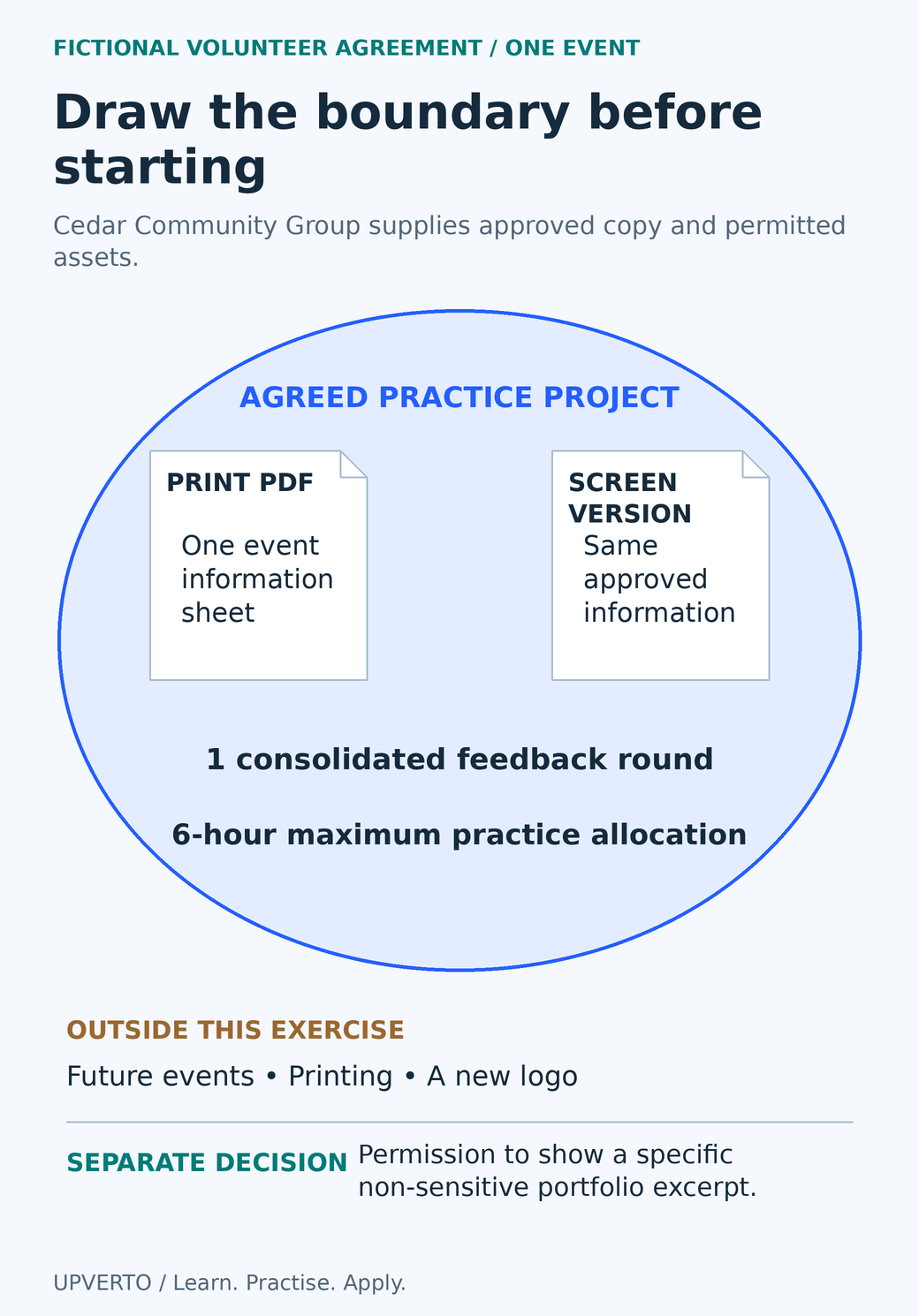
    A large agreement boundary contains one print PDF, one screen version, one feedback round and a six-hour practice limit; future events, printing and a new logo sit outside it.
    Separate a volunteer project boundary from portfolio permission — A large agreement boundary contains one print PDF, one screen version, one feedback round and a six-hour practice limit; future events, printing and a new logo sit outside it. Use the enlarged view, then swipe or use arrow keys to inspect details. View full-size infographic.
    Read the text version: Separate a volunteer project boundary from portfolio permission

    In this fictional Cedar Community Group agreement, the scope covers one event information sheet supplied as a printable PDF and a screen version, one consolidated feedback round and a six-hour maximum practice allocation. The group supplies approved copy and permitted assets. Future event updates, printing and a new logo are outside the exercise. Portfolio display is a separate decision covering a specific non-sensitive excerpt, attribution and any restrictions. The diagram is an operational example, not a universal legal contract.

    Choose a contained task with a responsible contact

    Look for a task small enough to understand and finish: one information sheet, a limited set of approved captions or a defined correction to a document. Avoid taking responsibility for an organisation’s entire website, marketing or data system just to obtain a sample.

    Identify who can supply the inputs and approve the result. A volunteer coordinator may know the need but lack authority to approve wording, publish material or grant portfolio permission. Clarify those roles before production. If no one can make the necessary decisions, the project may not be ready to start.

    Use choose portfolio projects for freelance services to assess relevance. A project can be worthwhile service to a community without being suitable portfolio evidence. Decide honestly which purpose you are pursuing and whether the scope fits your available capacity.

    Write a limited practice-project agreement

    PartWhat to agree
    Purpose and statusThe work is volunteer or practice support; state any payment or expense arrangement clearly.
    OutputsNamed deliverables, quantities and formats
    Inputs and accessApproved copy, permitted assets and the minimum access required
    Time boundaryA limited allocation, start conditions and an agreed review date
    ReviewOne decision-maker, consolidated feedback and defined revision limits
    PermissionsWhat may be used in production and what may later be shown publicly
    Handover and endingFinal files, dependencies, access removal and the point support ends

    This is an operational checklist, not a universal legal contract. Employment, volunteering, intellectual-property and data rules vary by place and circumstances. If a project creates responsibilities you do not understand, obtain appropriate local advice or choose a simpler task.

    Write exclusions as concretely as inclusions. A flyer exercise might exclude copywriting, printing, photography, live publishing and future event updates. If the organisation needs those tasks, discuss who will handle them instead of silently assuming they belong to you.

    Separate permission to do the work from permission to display it

    An organisation can approve a deliverable without approving public screenshots of its internal drafts, staff details or participants. Ask separately what you may show, where, when and with which attribution. Keep a record of the answer. Avoid asking for a blanket endorsement as a condition of helping.

    If you speak with people or observe how they use a draft, explain the activity and ask whether they agree to participate. The GOV.UK user-research consent guide is a useful primary operational reference for making purpose and use understandable. Its government context does not create a universal legal template for your project.

    Minimise the information you collect. You usually do not need a real attendee list to practise layout. Use invented details for early examples, and restrict access to any real material necessary for the agreed work. Do not place private drafts or identifying feedback in a portfolio folder by default.

    Worked example: one event information sheet

    Fictional agreement: Cedar Community Group asks a learner to format an information sheet for one reading event. The group supplies approved copy and a permitted logo. The learner agrees to one printable PDF and one screen version, one consolidated feedback round and a six-hour maximum practice allocation.

    The six hours are an illustrative boundary, not an estimate for all such work. The learner plans one hour for brief and setup, three for layout, one for review changes and one for export checks and handover. If the inputs are incomplete or the task cannot fit, the learner will discuss a smaller output before continuing.

    The coordinator approves the copy. Another named representative decides whether the final non-sensitive excerpt may be shown in the learner’s portfolio. Publication of the actual event material remains with the group. Future event updates, printing and a new logo are outside the exercise.

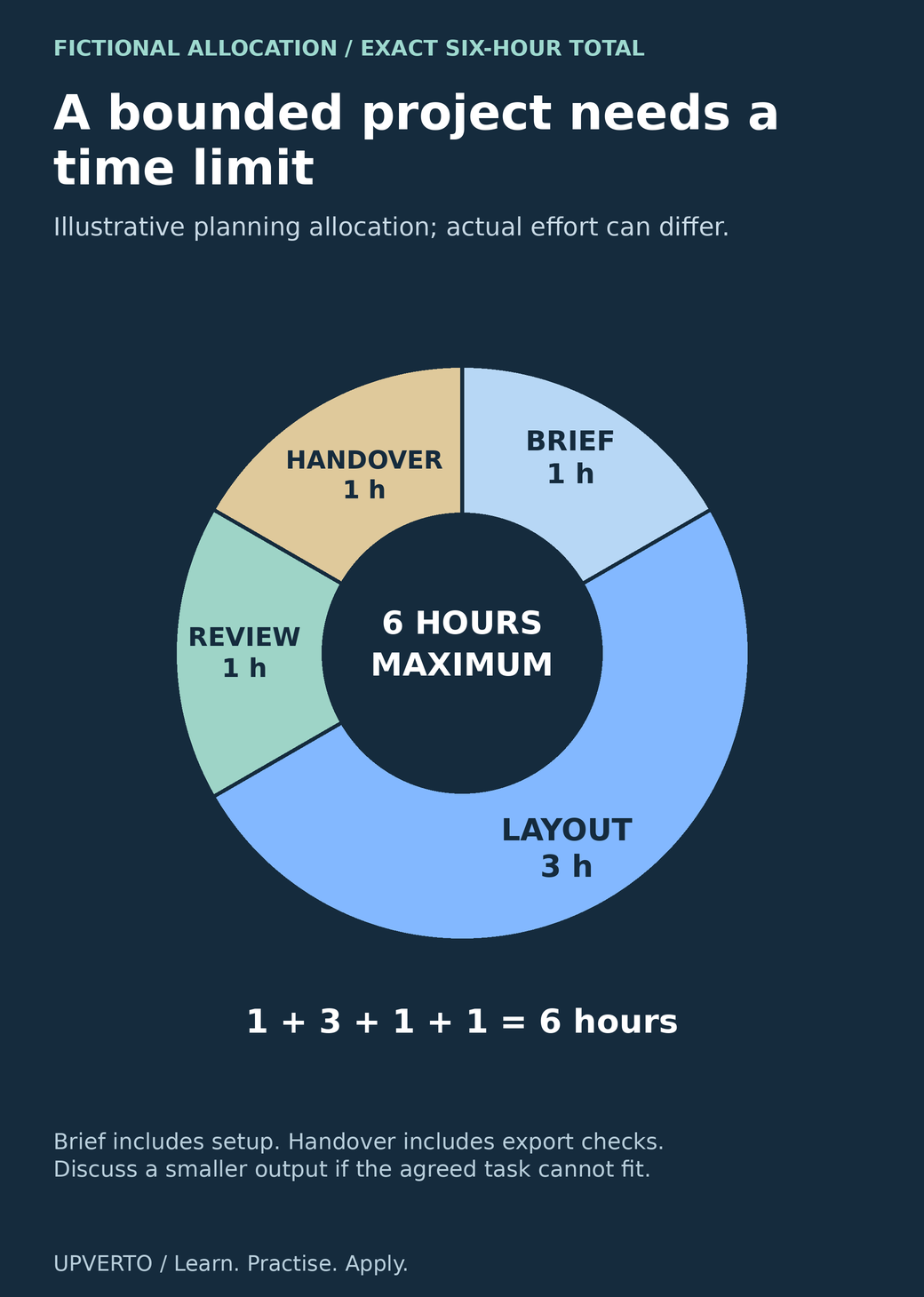
    A proportional ring divides six illustrative hours into one hour of brief and setup, three of layout, one of review and one of export checks and handover.
    Allocate a fictional six-hour practice project — A proportional ring divides six illustrative hours into one hour of brief and setup, three of layout, one of review and one of export checks and handover. Use the enlarged view, then swipe or use arrow keys to inspect details. View full-size infographic.
    Read the text version: Allocate a fictional six-hour practice project
    ActivityHoursShare of six hours
    Brief and setup11/6; 60 degrees
    Layout31/2; 180 degrees
    Review changes11/6; 60 degrees
    Export checks and handover11/6; 60 degrees

    The sum is 6 hours. The ring sectors are proportional to the stated hours. This is an invented practice boundary, not a benchmark for all information-sheet work. If inputs or outputs change, discuss a smaller scope or a new agreement before continuing.

    When the group later asks for a second event, the learner can discuss a new agreement or decline. The initial promise has an ending. A useful response is: “The agreed reading-event files are handed over. The second event is a new task, so we need to discuss its scope and whether I have capacity.”

    Handle changes and finish cleanly

    If a request changes the output, stop and compare it with the agreement. A correction to your own error is different from a new campaign. Use estimate freelance project scope to define tasks and review limits before starting; do not wait until the relationship is strained to explain the boundary.

    At handover, identify the final files and any dependencies. Confirm who owns the next operational step, such as printing or publishing. Remove access that is no longer needed through the appropriate authorised process, and follow the agreed handling of source material and backups.

    Closeout checkRecord
    Outputs checked and deliveredFinal filenames, formats and acceptance notes
    Responsibility transferredWho will publish, print or maintain the material?
    Support ends clearlyAgreed ending and any narrowly defined follow-up
    Portfolio permission confirmedSpecific excerpt, attribution and limits, or no display
    Learning capturedOne decision, one difficulty and one improvement for next time

    Use show portfolio work honestly to describe the completed project. State that it was volunteer work, identify your contribution and include only supported observations. A real organisation’s involvement does not justify inventing testimonials, attendance figures or business results.

    Frequently asked questions

    Do I have to volunteer before charging for work?

    No. A well-designed fictional project can provide useful evidence. Volunteering is one optional way to practise collaboration, and it should have a sensible purpose and boundary. It is not a requirement to supply indefinite unpaid work before you can offer a service.

    Should the agreement mention that I am learning?

    Yes, where that affects expectations. Be clear about your demonstrated capability, the task you can support and any need for review. Do not accept responsibility for high-consequence work that you cannot check simply because the arrangement is unpaid.

    Can I use the project publicly because I did it for free?

    No automatic permission follows from working without payment. Agree separately on display rights, confidentiality and attribution. The organisation may approve the output while restricting drafts, personal information or public use of its name and assets.

    What if the organisation keeps asking for extras?

    Refer to the agreed outputs and ending. Discuss a new scope, a smaller alternative or a referral, and decline if you lack capacity. Do not quietly expand the project while assuming the additional work will eventually produce a testimonial or paid opportunity.

    Can the organisation reimburse expenses?

    Clarify any expense arrangement before spending, including which costs are approved and how they will be documented. Rules and tax treatment depend on the circumstances and location. Do not assume that every cost you incur will be repaid.

    What if portfolio permission is refused after completion?

    Respect the permission you actually have. Keep a private learning record consistent with the agreement and applicable requirements. You can create a separate fictional sample using your own or permitted material, rather than exposing the restricted project.

    Sources and review notes

    Primary sources checked on 27 October 2026 (UTC). Check the current provider pages before relying on a changing feature, policy or price. Worked examples and worksheets are original teaching material; fictional examples are not evidence of client results.
  • How to Tailor Your Portfolio to a Client’s Industry

    How to Tailor Your Portfolio to a Client’s Industry

    Tailoring a portfolio means selecting and explaining relevant evidence for a particular buyer. It does not require a new website for every industry, and it does not justify rewriting a concept project as if it were commissioned by that industry.

    Start with the work you actually have. The guide to build freelance portfolio without clients explains how to create honest samples. Here, the task is to connect those samples to a prospective client’s needs while keeping the limits visible.

    In this guide
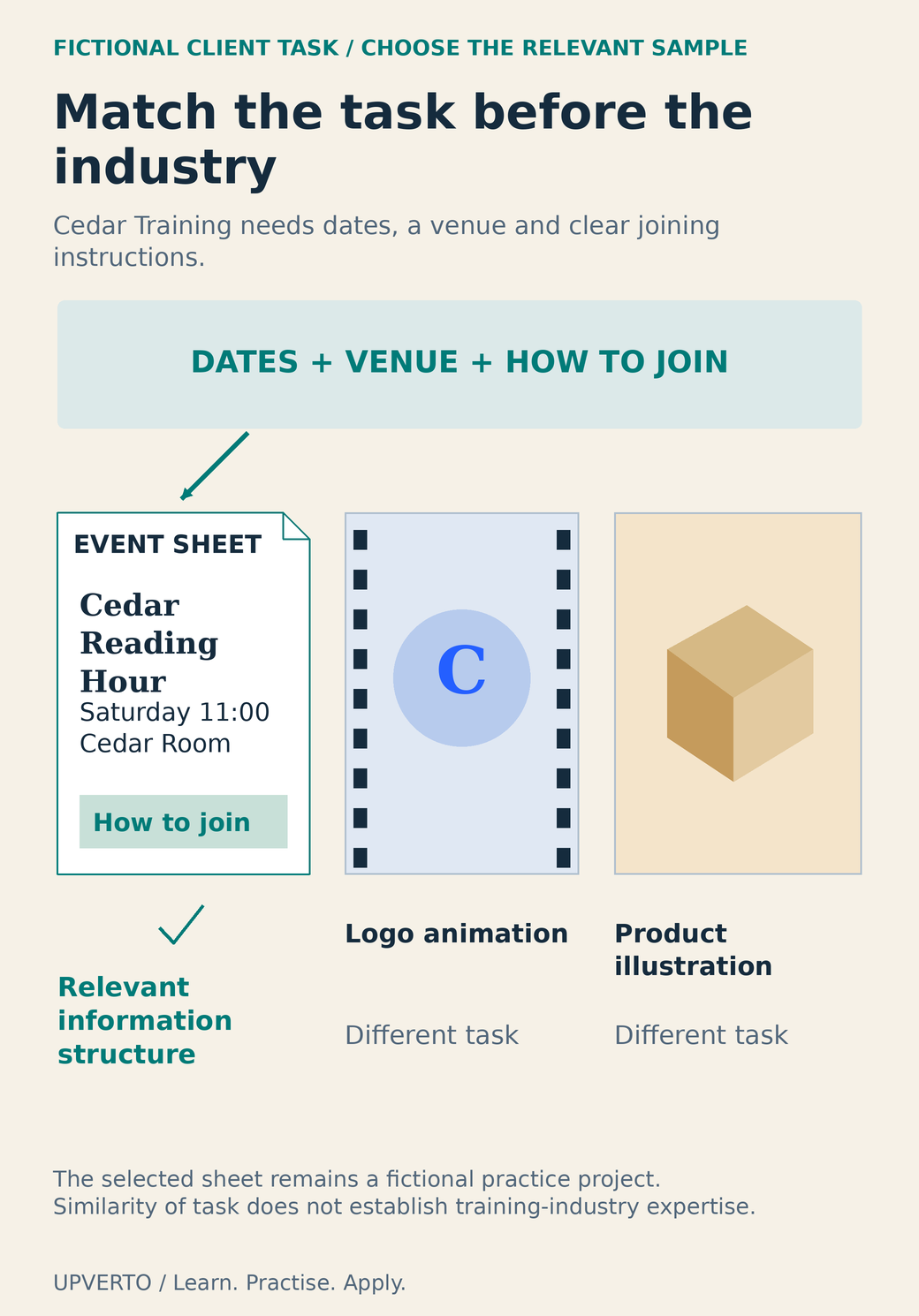
    Three fictional sample types are compared against Cedar Training’s need for dates, a venue and joining instructions; the event sheet is relevant to that task.
    Select the sample that matches the information task — Three fictional sample types are compared against Cedar Training’s need for dates, a venue and joining instructions; the event sheet is relevant to that task. Use the enlarged view, then swipe or use arrow keys to inspect details. View full-size infographic.
    Read the text version: Select the sample that matches the information task

    The fictional Cedar Training request concerns arranging dates, a venue and joining instructions. A Cedar Reading Hour event-information sheet demonstrates related grouping and hierarchy decisions. A logo animation and a product illustration demonstrate different tasks, so they are not the strongest evidence for this particular request. The selected event sheet must retain its fictional practice label. Selecting related work does not establish industry knowledge, specialist approval or a business result.

    Translate the industry label into a task

    “Education client” is a broad category. The request might be a captioned training video, a printable parent information sheet, an enrolment form or a monthly reporting process. Each requires different evidence. Identify the audience, input, output, constraints and checks before choosing samples.

    Use public information and the client’s stated brief. Do not pretend to know private priorities or diagnose a business from a logo and a website. If something is uncertain, make it a question. “Will the information sheet be printed or read mainly on phones?” is more useful than claiming that every organisation in the sector needs the same design.

    The guide to choose freelance client niche covers the broader focus decision. Portfolio tailoring is the narrower activity of selecting evidence for a specific conversation. It should not turn into a claim that you have expertise in every industry you approach.

    Match evidence at three levels

    LevelWhat matchesWhat to explain
    Same task and contextA permitted project with comparable audience and constraintsYour role and any differences in the new brief
    Same task, different contextA similar output for another audience or a fictional briefThe transferable decisions and the context still to learn
    Adjacent capabilityA sample showing part of the required workflowWhat it demonstrates and what it does not establish

    A sample with matching colours but an unrelated task may be less useful than a plain sample showing accurate information hierarchy or checked captions. Select for the decision the client must make: can you perform the defined work and understand its constraints?

    Specialist contexts can add responsibilities. A health, legal or financial organisation may need expert review, controlled wording or particular privacy arrangements. A visually similar concept does not qualify you to write regulated advice or handle sensitive data. State which work you perform and who supplies or approves specialist content.

    Write a short relevance note beside the sample

    Use three sentences: what the sample is, which part relates to the prospective task and what remains different. Keep its original project label. This is clearer than changing the fictional client’s name to match the prospect’s sector.

    For example: “This is a fictional community information-sheet project. It shows how I grouped dates, locations and an action instruction across a screen version and a printable PDF. Your organisation’s approved terminology, audience needs and production specifications would need to be confirmed in a separate brief.”

    Use clear headings and descriptive links so the reader can reach the relevant work. W3C’s writing guidance supports meaningful structure and link text. The editorial decision to select a particular sample is your own reasoning, and it should be justified by the task rather than presented as a research-backed guarantee of conversion.

    Worked example: choosing evidence for a training organisation

    Fictional prospect: Cedar Training needs a short participant information sheet from approved copy. The requirements mention session dates, venue, accessibility contact and joining instructions. The learner has three samples: a fictional reading-event sheet, an abstract logo animation and a practice product illustration.

    The reading-event sheet is the closest match because it handles a similar information task. The logo animation may demonstrate motion skills, but it does not show that a reader can find a date or joining instruction. The product illustration is also less direct evidence for this particular request.

    The learner selects the event sheet, adds a readable extract showing the information grouping and explains the export checks. The note states that it is a concept project for a different audience. The learner asks the prospect who approves the accessibility contact wording and which final formats are needed.

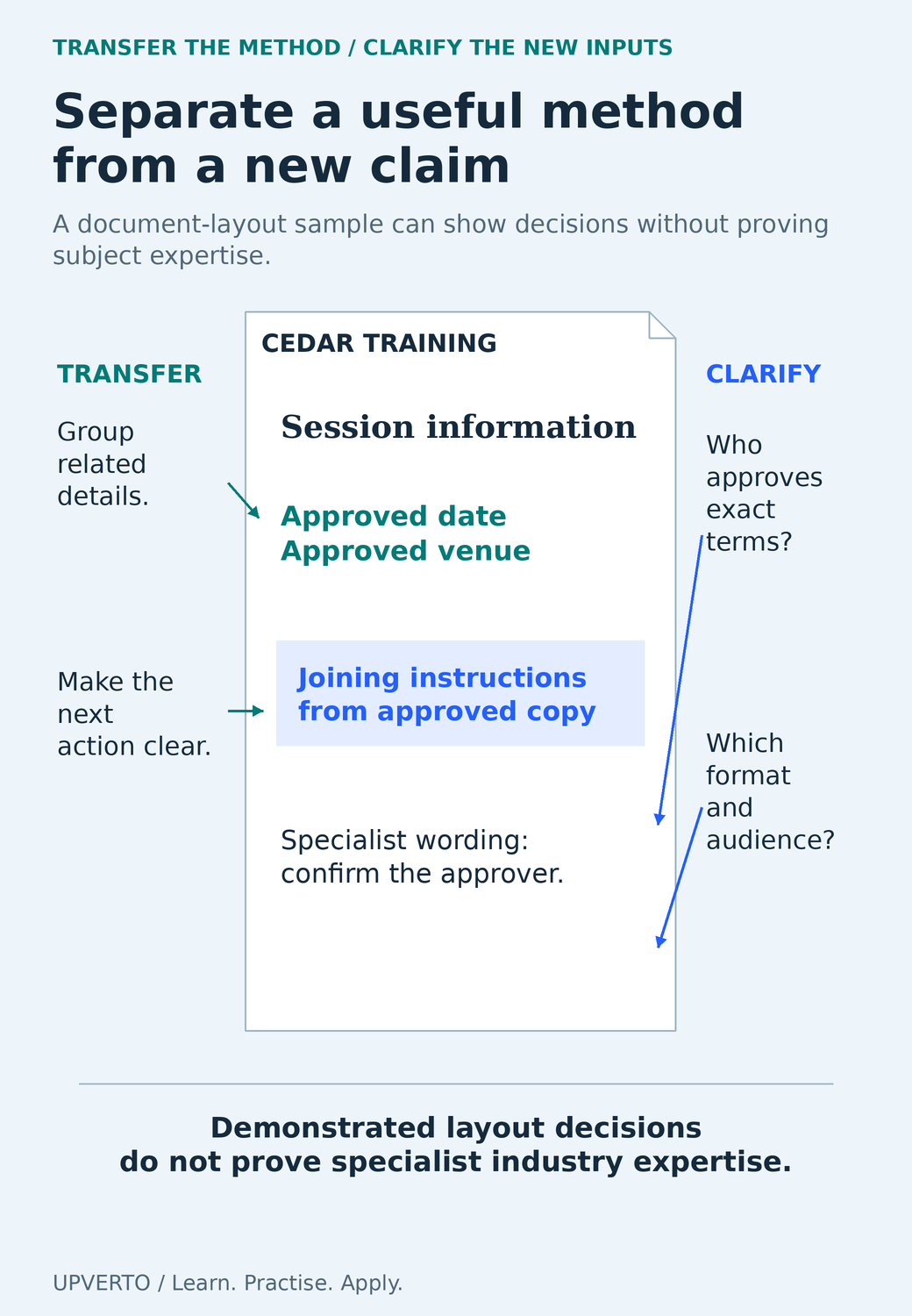
    An annotated fictional training information sheet separates transferable grouping and action hierarchy from new questions about approved terminology, audience and output format.
    Distinguish transferable layout decisions from client-specific knowledge — An annotated fictional training information sheet separates transferable grouping and action hierarchy from new questions about approved terminology, audience and output format. Use the enlarged view, then swipe or use arrow keys to inspect details. View full-size infographic.
    Read the text version: Distinguish transferable layout decisions from client-specific knowledge
    Transferable evidenceNew input to clarify
    Grouping related date and venue detailsExact approved wording and the person who approves it
    Making the joining instruction easy to findThe intended audience and required output format

    The Cedar Training sheet is a fictional teaching schematic. A previous document sample can demonstrate layout decisions. It does not establish expertise in training content, regulation or specialist terminology. Preserve the original project label and state where subject-matter approval belongs.

    No new client history is invented. The learner does not claim experience in training compliance or promise that the design will improve attendance. The tailored presentation simply makes the relevant existing evidence easier to inspect.

    Use the portfolio-selection worksheet

    FieldEntry
    Prospective taskNamed output, audience and current source of the requirement
    Important constraintsFormat, approved terminology, access, privacy and review
    Candidate sampleActual project title and honest project type
    Evidence of relevanceSpecific decision, output or check the reader can inspect
    Difference or gapContext, input or responsibility the sample does not cover
    PermissionWhether this exact material may be shown to this recipient
    Next questionOne uncertainty that affects fit or scope

    Keep the master case study accurate, then tailor the selection and introductory note. This avoids maintaining multiple contradictory versions of your experience. If an industry-specific concept would teach a useful new constraint, create it as a new fictional brief and label it accordingly. Do not add a sector name only to target a keyword.

    For a fuller explanation of the work, use write a portfolio case study. When a prospect has a real brief, use write freelance proposal to connect the evidence with a defined approach, assumptions and next step. A tailored portfolio supports that discussion; it does not replace discovery or an agreement.

    Frequently asked questions

    Can I approach an industry without a project from that industry?

    You can show a relevant task sample and explain the transferable capability, while stating the context you have not worked in. Ask about specialist requirements. Do not present a concept or adjacent task as proof of industry experience you do not have.

    Should I make a separate portfolio site for every niche?

    Usually a clear master portfolio with selected case studies and a relevant introductory note is easier to maintain. Separate sites create update and consistency work. Use them only when there is a concrete audience or access reason, not simply to repeat industry keywords.

    What if the closest sample is fictional?

    Keep the fictional label visible and explain the task it demonstrates. The reader can still inspect hierarchy, formatting, code or delivery checks. Do not rename the fictional organisation to resemble the prospect or imply that the sample had a real client outcome.

    Should I hide the parts of a project that are unrelated?

    Select a useful excerpt while preserving enough context to avoid misleading the reader. Explain your role and provide access to further relevant detail when appropriate. Do not crop out a concept label, collaborator credit or limitation that changes the meaning of the sample.

    How do I handle a regulated or specialist industry?

    Separate your production capability from subject-matter responsibility. Confirm who supplies and approves specialist wording and what data you may handle. Seek qualified support or decline parts outside your competence; a similar-looking sample is not evidence of regulatory expertise.

    How many samples should I send to a prospect?

    Send the smallest useful selection that addresses the task and the recipient’s requested format. Explain why each item matters. A long unrelated gallery can make the client do the matching work you should have done before sending it.

    Sources and review notes

    Primary sources checked on 27 October 2026 (UTC). Check the current provider pages before relying on a changing feature, policy or price. Worked examples and worksheets are original teaching material; fictional examples are not evidence of client results.
  • How to Build a Freelance Portfolio Without Clients

    How to Build a Freelance Portfolio Without Clients

    Part of How to Make Money Online with Digital Skills: A Beginner’s Roadmap.

    You can build a freelance portfolio without clients by completing realistic self-directed projects and explaining them honestly. Show the brief, your contribution, the finished work, and the checks you performed. Label practice work clearly so a reader can distinguish a demonstration from a paid engagement.

    In this guide

    A portfolio helps a potential client judge whether your work is relevant to their needs. It does not need to pretend you have a long history. It needs enough useful evidence to support the specific service you are considering.

    Decide what the portfolio should prove

    Start with a narrow question: “What would someone need to see before discussing this task with me?” A client seeking short interview edits needs different evidence from a client seeking bookkeeping assistance or a custom web application.

    Define the type of work, the intended buyer, and a plausible brief. If the service is still vague, use the service-definition guide. If you are still learning the task itself, use the practical learning process before worrying about a polished portfolio website.

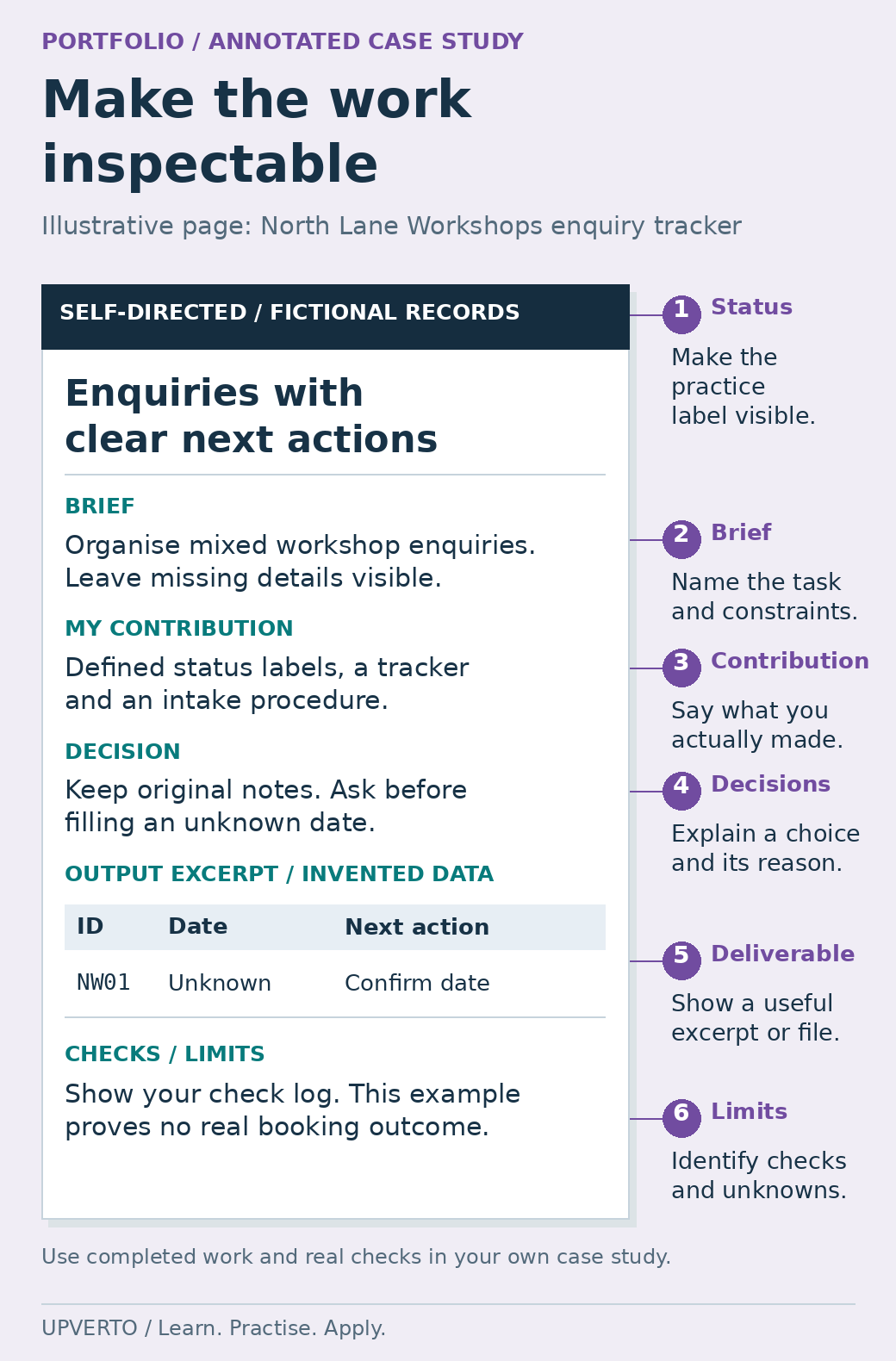
    An illustrative fictional North Lane Workshops case-study page identifies its practice status, brief, contribution, decisions, sample enquiry row and limits with six annotations.
    Annotate a case study a reader can inspect — This example shows how to frame a practice project honestly. Replace its illustrative content with your own completed work and recorded checks. Use the enlarged view, then swipe or use arrow keys to inspect details. View full-size infographic.
    Read the text version: Annotate a case study a reader can inspect

    The annotated page is an illustrative case study for North Lane Workshops, a fictional training business. The example record NW01 has an unknown date and the next action “Confirm date”; the date is not guessed.

    1. Status: self-directed practice using fictional records.
    2. Brief: organise workshop enquiries while keeping missing details visible.
    3. Contribution: explain the tracker, status labels and intake procedure you actually created.
    4. Decisions: show why original notes are preserved and why an unknown date is referred for clarification.
    5. Deliverable: provide a useful excerpt or accessible file.
    6. Checks and limits: provide your actual check log and identify what was not tested or measured.

    This drawing is an example of presentation, not a fabricated software screen or proof that a real client project was completed. Do the work before making its claims.

    Practical summary
    Evidence a portfolio can show
    • Brief: the problem and constraints you worked with.
    • Decisions: what you chose and why.
    • Output: the deliverable a reader can inspect.
    • Checks: what you tested and what remains unverified.
    • Contribution: which parts are your work and which came from others.

    Choose an honest way to create samples

    Sample typeHow it worksWhat to disclose
    Fictional projectCreate an invented business or scenario and solve a written brief.State that it is a self-directed concept project and that its business details are fictional.
    Personal projectSolve a real problem for yourself, such as organising a personal reading log.Describe the actual context and remove private information before sharing.
    Course or guided projectComplete an exercise, then add a clearly identified independent extension.Credit the exercise or source and explain your own contribution.
    Permission-based volunteer workAgree on a limited piece of work for an organisation.Obtain permission to use the work and describe the unpaid relationship accurately.

    Volunteer work is one option, not a requirement. Keep its scope, deadlines, data access, and permission to show the result clear. Do not perform unsolicited changes on another organisation’s website or systems simply to create a sample.

    If you create an unsolicited redesign of an existing brand, avoid implying that the brand commissioned or approved it. A fictional brief often makes ownership and endorsement easier to explain, though the assets you use still need appropriate rights.

    Build a small set of relevant projects

    Choose each project for a reason. One might demonstrate the core task, another a meaningful variation, and another the handling of a constraint. Three is a possible starting structure, not a minimum required by employers, marketplaces, or search engines.

    For video editing, a variation might change the audience or delivery format. For virtual assistance, it might introduce incomplete information that must be flagged. For a website, it might require a clear mobile navigation path and a tested handover.

    Avoid adding several nearly identical samples just to increase the count. Use the project-selection worksheet to connect each sample to a buyer problem and the evidence it will provide.

    Explain each project as a short case study

    A case study gives context to the work. Use plain language and let the reader inspect the most relevant evidence.

    SectionWhat to include
    Project and statusA descriptive title and an honest label: concept, personal, guided, volunteer, or commissioned.
    BriefThe audience, problem, supplied information, constraints, and requested output.
    My contributionThe parts you completed, collaborators, reused assets, and material tool assistance.
    Key decisionsTwo or three choices that changed how the work served the brief.
    DeliverableRelevant screenshots, files, excerpts, or a working demonstration.
    Checks and limitationsWhat you verified, how you verified it, and what you did not measure.
    What I would improveA specific next improvement rather than a vague claim of perfection.

    Keep outcomes precise. “The exported file contains the required text and opens correctly” is a check you can perform. “The design increased sales” needs actual evidence from a real context. A fictional project cannot establish a real commercial result.

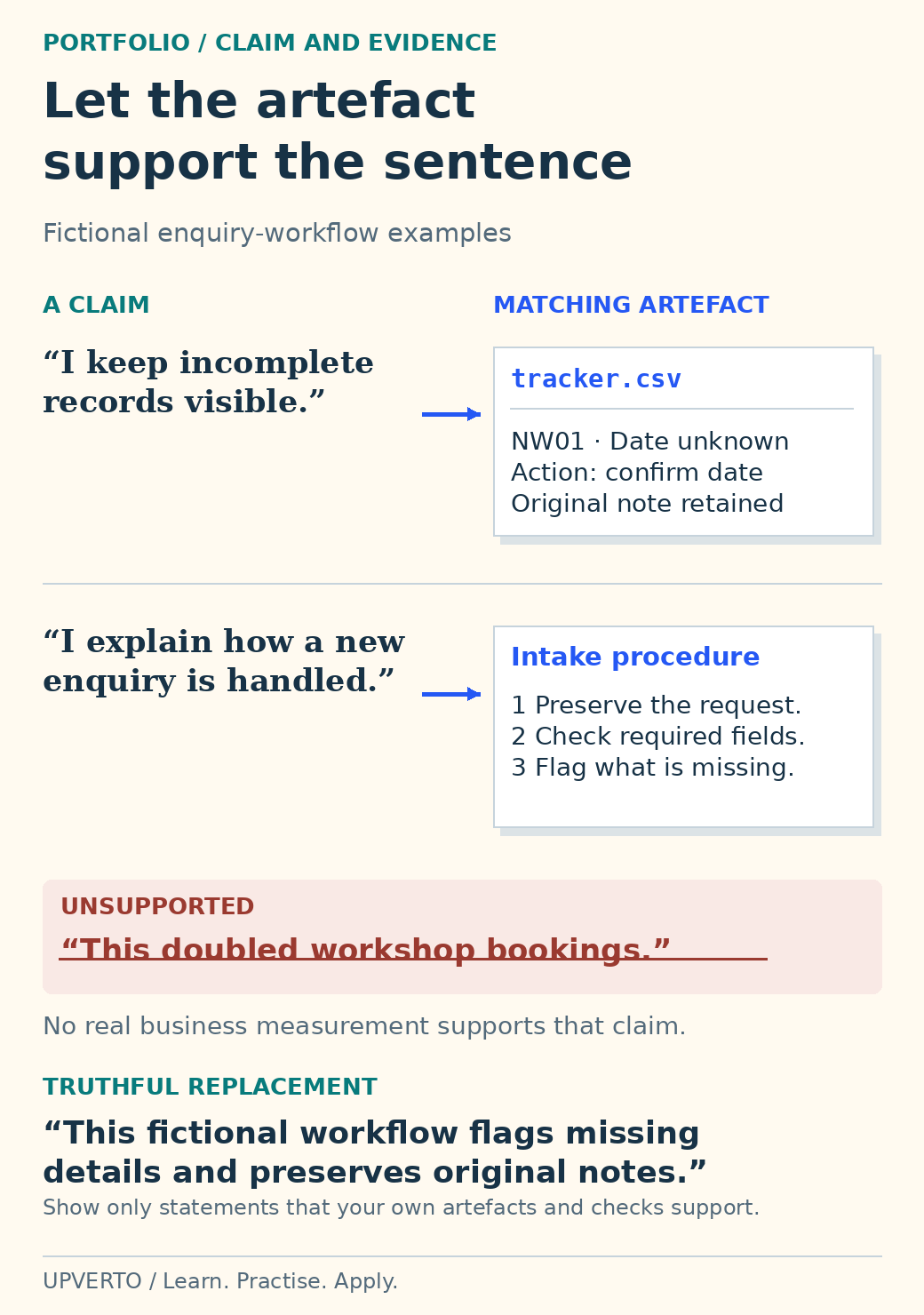
    Two example portfolio claims connect to a tracker excerpt and intake procedure. An unsupported claim about doubled bookings is crossed out and replaced with a precise statement about fictional workflow behaviour.
    Connect portfolio claims to evidence — A useful portfolio claim points to something a reader can inspect. Fictional work cannot establish a real commercial improvement. Use the enlarged view, then swipe or use arrow keys to inspect details. View full-size infographic.
    Read the text version: Connect portfolio claims to evidence

    These are fictional examples of claim-to-evidence matching.

    • Claim: “I keep incomplete records visible.” Matching artefact: a tracker excerpt showing NW01 with an unknown date, a confirm-date next action and its original note.
    • Claim: “I explain how a new enquiry is handled.” Matching artefact: an intake procedure that preserves the request, checks required fields and flags missing information.

    Unsupported claim: “This doubled workshop bookings.” No real business measurement supports that statement. A truthful replacement is: “This fictional workflow flags missing details and preserves original notes.”

    For your own portfolio, inspect the actual files and report only checks you performed. The illustrative snippets here are not evidence of a real client engagement.

    Worked example: a fictional operations project

    Project: Organising enquiries for North Lane Workshops, a fictional training business. Status: self-directed practice using invented records.

    Brief: Turn a mixed set of workshop enquiries into a tidy tracking sheet. Each record needs a request date, workshop, contact status, next action, and owner. Missing details must remain visible rather than being guessed.

    Decisions: Use a short set of status labels, keep original notes in a separate field, and flag records that need clarification. Create a one-page procedure explaining how a new enquiry is added and reviewed.

    Evidence to produce: the fictional input, completed sheet, procedure, and a check log showing how duplicates and incomplete entries were handled. Limit: this demonstrates an administrative workflow; it does not prove experience with a real client’s systems or sensitive customer information.

    This is an example of how to frame a project. The completed sheet and results belong in your portfolio only after you have actually created and checked them.

    Choose a presentation format you can maintain

    A simple website, a PDF, or a suitable platform profile can all hold useful evidence. Choose a format that lets the intended reader understand the work and access the relevant files without unnecessary friction.

    A website can support a working demonstration. A PDF can provide a focused selection for a particular conversation. A marketplace profile may have its own format and content rules, which should be checked in the platform’s current official guidance.

    Use descriptive project titles and readable text. Where an image conveys information, explain that information in the surrounding text and provide an appropriate text alternative. The W3C images tutorial explains how alternatives depend on an image’s purpose.

    Check rights, permissions, and confidential information

    Before sharing, examine every screenshot, filename, visible account detail, and sample record. Use fictional data for practice. For real work, obtain the relevant permission and remove information the client has not agreed to disclose.

    Record where images, fonts, templates, code, and media came from and what reuse is permitted. Do not assume an asset is reusable because it was downloadable or appeared in a search result. Keep required attribution and explain substantial third-party contributions.

    Testimonials must come from the person whose words they represent. A sample review written for a fictional business should never look like a real client endorsement.

    Review the portfolio as a prospective client

    1. Can a reader identify the service or task you are demonstrating?
    2. Is the project’s real status clear?
    3. Can they see your contribution and inspect a useful part of the output?
    4. Do the links and files open in the intended viewing conditions?
    5. Are the text and images readable on a smaller screen?
    6. Are claims limited to what the evidence establishes?
    7. Is there a clear way to discuss a suitable project with you?

    If a sample exposes a gap in your ability, improve the work before adding stronger marketing language. The readiness rubric helps distinguish attractive presentation from the ability to deliver.

    Frequently asked questions

    Do I need a personal website before finding clients?

    Not necessarily. Use a format that suits the channel and allows a relevant buyer to inspect your evidence. A simple, accessible presentation can be useful while a larger website is still being developed.

    Can I include a tutorial project?

    Yes, when you clearly credit the source and explain what you followed and what you contributed. Add an independent variation if you want the project to demonstrate more than the ability to follow instructions.

    How many projects should I put in my first portfolio?

    Choose a small set that supports the work you want to offer. Each project should show a distinct relevant ability and include enough context to assess your contribution. Improve incomplete or repetitive examples before adding more. The count matters less than the relevance and quality of the evidence.

    How should I label a fictional portfolio project?

    State that it is a practice project, concept or fictional brief near the project description. Explain the imagined audience, the constraints and the work you completed. Avoid wording, logos or testimonials that imply the business hired you or approved the result.

    What can I say about results when I have no client metrics?

    Report what you can actually demonstrate: completed deliverables, checks performed, changes made and lessons learned. Explain why you made important decisions. Do not invent revenue, traffic or conversion improvements. A clear account of the work is stronger evidence than an unsupported performance claim.

    How do I turn a portfolio project into a service offer?

    Identify the buyer problem and deliverables demonstrated by the project. Define a matching service with clear scope, required inputs and review conditions, then link to the relevant case study. Make sure the offer stays within the abilities and workflow that the evidence supports.

    Build one case study you can stand behind

    Choose a project that matches your intended work, complete it, and write the case study with honest limitations. Then connect it to a clearly defined service and prepare for relevant client conversations.

  • How to Choose Portfolio Projects That Match the Work You Want

    How to Choose Portfolio Projects That Match the Work You Want

    Choose a portfolio project by starting with the work you want to be hired to do. Identify a plausible buyer, a specific problem, a realistic deliverable, and the evidence the project can produce. The result should help someone judge your ability to handle a similar task.

    A project can look impressive while answering none of a client’s questions. A complicated application may be less relevant to a small website-editing service than a carefully documented, accessible information site. This guide helps you choose purposeful samples.

    In this guide

    Connect a buyer problem to a practice brief

    Write one sentence: “A [type of buyer] needs [task completed] because [practical problem].” Keep the problem specific and avoid inventing research. You can describe a fictional scenario for practice without claiming a real business has this need.

    Then define what the buyer would receive and how they could assess it. A visual deliverable needs communication and export checks. A spreadsheet needs data and calculation checks. A website needs functional as well as visual checks.

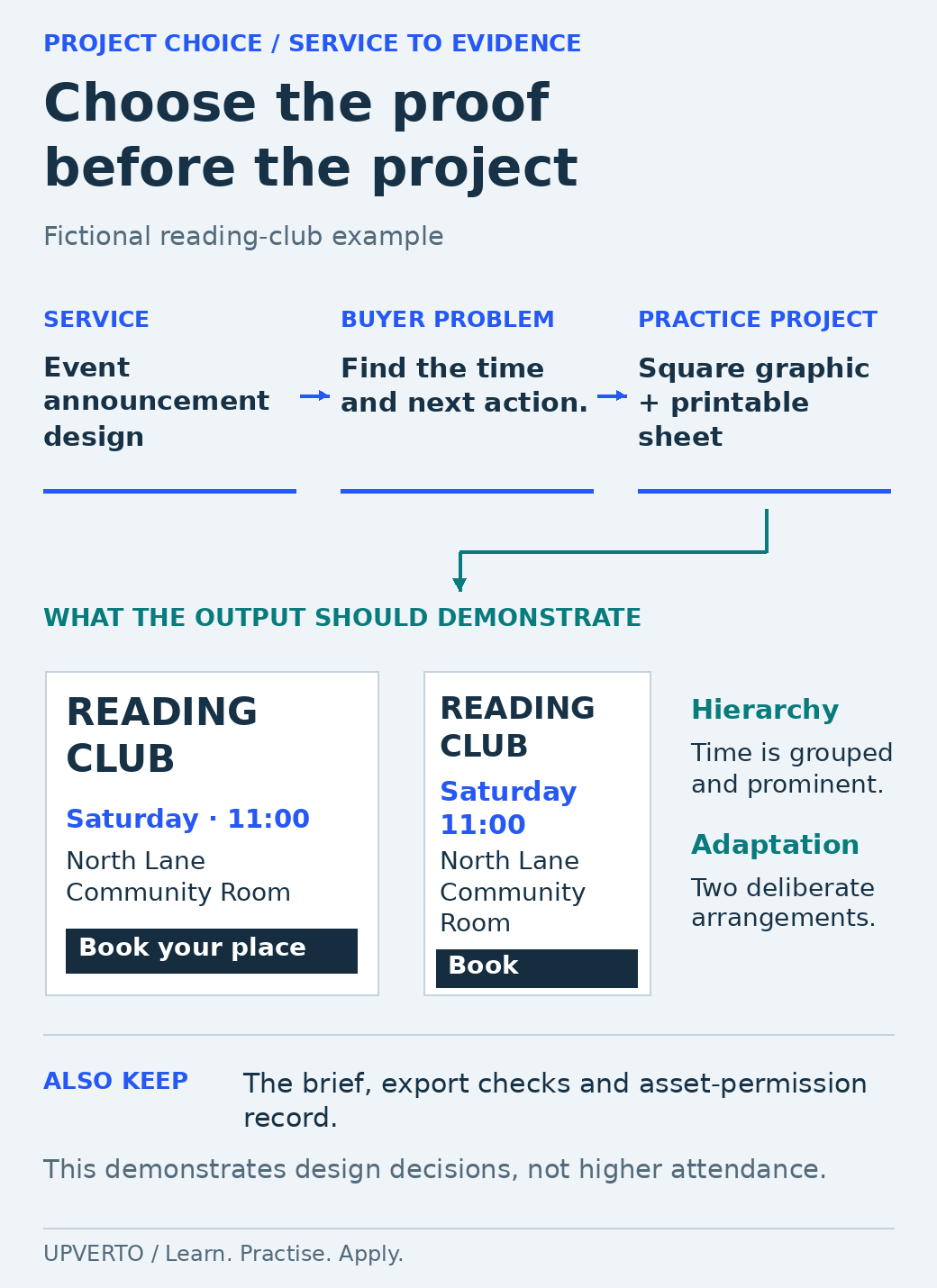
    An event-announcement service connects to a reader’s need to find time and booking details, then to a fictional square and printable project. Different layouts demonstrate hierarchy and adaptation.
    Map a service to the proof a project should produce — Choose a project because its finished work can demonstrate the service. Keep the brief and checks alongside the visual outputs. Use the enlarged view, then swipe or use arrow keys to inspect details. View full-size infographic.
    Read the text version: Map a service to the proof a project should produce

    Service: event-announcement design. Fictional buyer problem: readers need to find when an event happens and how to book. Practice project: create one square announcement and a separate printable information sheet for a fictional reading club.

    The example drawings group Saturday and 11:00, give the long venue name deliberate space, and adapt the information to different proportions. They illustrate hierarchy and adaptation; they are not finished production files.

    Keep the brief, the actual exported outputs, the export-check record and asset permissions. These support an explanation of design choices. They do not establish increased attendance or any other commercial result. Confirm actual placement and print specifications for real work.

    Practical summary
    A project worth building
    • Relevant: it resembles a task in your intended service.
    • Complete: the output has a defined beginning and end.
    • Checkable: you can verify meaningful requirements.
    • Explainable: you can describe your decisions and limitations.

    Five project briefs across different skills

    SkillFictional practice briefUseful evidence
    Graphic designCreate an event announcement with supplied wording, then adapt it to a second placement.Hierarchy decisions, versions, export checks, and the reason for layout changes.
    Video editingTurn your own short recording into a concise explanation with accurate captions.Source and final excerpts, edit decisions, caption checks, and an organised handover.
    WordPressBuild a small service-information site in a practice environment.A written brief, working navigation, device checks, and a maintenance handover.
    SEOReview a practice site and propose a limited set of improvements.Observed evidence, prioritisation, proposed changes, and clearly stated measurement limits.
    Virtual assistanceOrganise fictional enquiries and meeting requests into a repeatable workflow.A clean tracker, unresolved questions, scheduling checks, and a written procedure.

    Use the related roadmaps for the prerequisites: design, editing, WordPress, SEO, and virtual assistance. The examples are starting briefs; they are not completed work samples or evidence of commercial outcomes.

    Add a useful constraint

    Constraints reveal judgement. An event graphic may need to work with a long venue name. A video may have an unclear sentence that requires a question rather than an invented caption. An administrative task may include two requests for the same time.

    Choose a constraint that resembles the intended work. Avoid adding unnecessary complexity just to make the project sound advanced. If the constraint prevents you from finishing, reduce the scope or learn the missing prerequisite first.

    Keep a record of what you did when the information was incomplete. Asking a well-formed clarification question can be part of professional evidence; silently inventing missing details usually weakens it.

    Use the project-selection worksheet

    FieldWrite before starting
    Intended serviceThe narrow task this project will support.
    ScenarioThe fictional or permission-based context and intended audience.
    ProblemWhat needs to become clearer, easier, more accurate, or more usable?
    InputsText, data, media, access, and permissions available to you.
    DeliverablesThe exact files, pages, or documented outputs you will produce.
    ConstraintsFormats, accessibility needs, limits, and a realistic complication.
    Acceptance checksObservable conditions that define a satisfactory result.
    Portfolio evidenceWhat you will show and explain, with permissions and limitations.
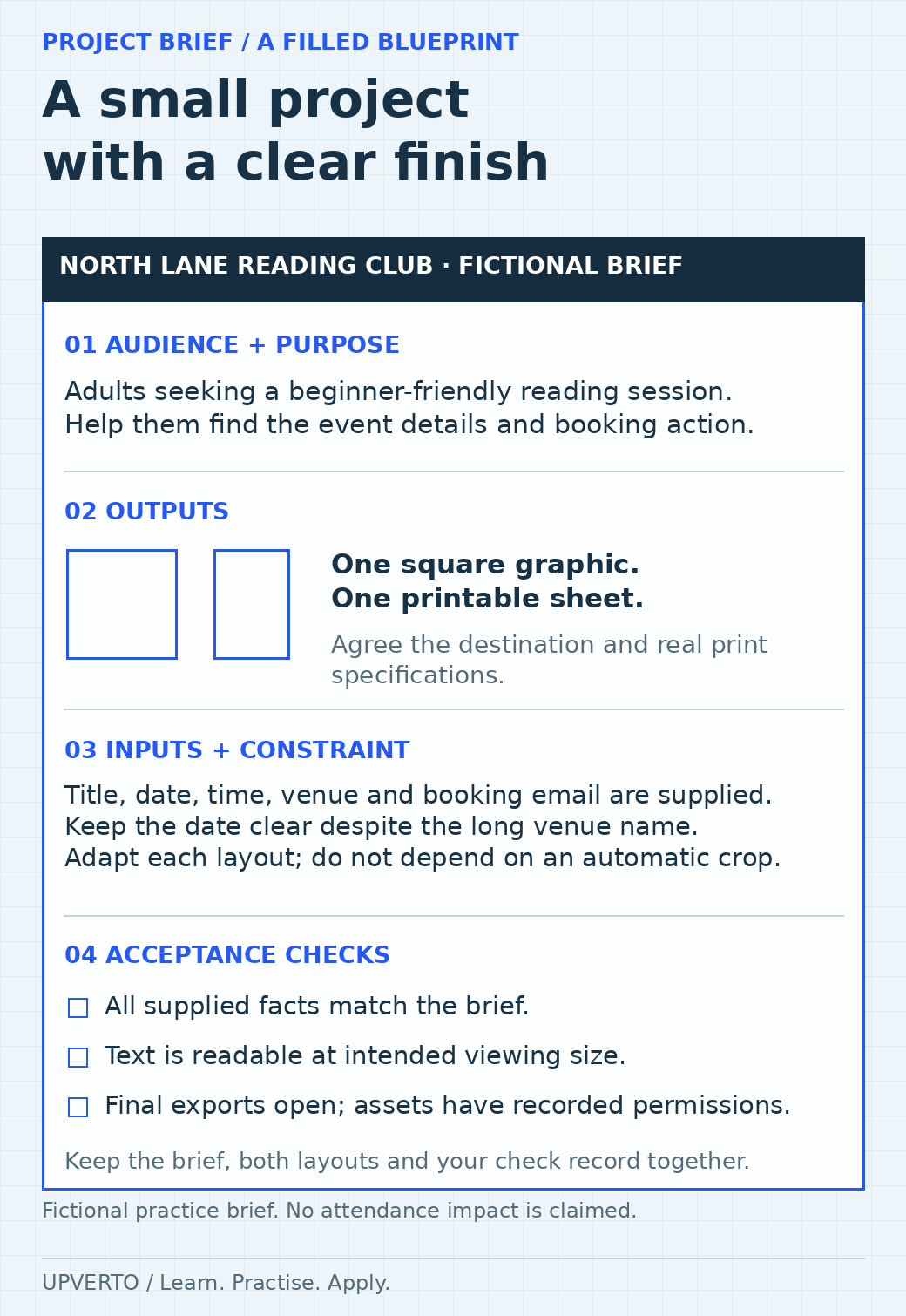
    A completed blueprint-style fictional reading-club brief specifies audience, square and printable outputs, supplied information, a long-venue-name constraint and acceptance checks.
    Fill a brief before building the portfolio project — Adapt this filled example to a project whose output and checks you can complete. Actual print and placement requirements must be confirmed. Use the enlarged view, then swipe or use arrow keys to inspect details. View full-size infographic.
    Read the text version: Fill a brief before building the portfolio project

    Fictional brief: North Lane Reading Club.

    Audience and purpose
    Adults seeking a beginner-friendly reading session. Help them locate the event details and booking action.
    Outputs
    One square announcement and one printable information sheet. Agree the intended destinations and confirm actual print specifications before real production.
    Inputs
    Supplied event title, date, time, long venue name and booking email, plus permitted assets.
    Constraint
    Keep the date easy to find despite the long venue. Adapt each layout deliberately rather than automatically cropping one version.
    Acceptance checks
    All supplied information matches the brief, the text is readable at intended size, the final exports open correctly and asset permissions are recorded.

    Retain the brief, both outputs and your actual check record. The fictional project can demonstrate design decisions; it cannot establish attendance results.

    Worked example: a small project with a clear purpose

    Fictional scenario: A community reading club needs an announcement for its next session. The supplied text contains a title, date, time, location, and booking email. The requested deliverables are a square graphic and a simple printable version.

    Constraint: The location name is long, and the date must remain easy to find. The designer chooses a clear hierarchy, groups related details, and adapts the layout for each format rather than shrinking one version automatically.

    Checks: Compare the content with the supplied text, inspect readability at intended size, verify the exports, and record the assets used. The portfolio can then explain those decisions and show the two versions. It cannot claim increased event attendance without real measurement.

    The project is useful because its purpose, decisions, and checks are visible. Adding ten unrelated graphics would not automatically make the evidence stronger.

    Review the brief before spending time on it

    Ask whether the sample resembles your intended service, can be completed with available resources, uses permitted material, and will demonstrate something beyond copying a tutorial. If you cannot explain its relevance, revise the brief.

    When selecting a second project, add a meaningful difference: another audience, a different input condition, or an additional delivery requirement. Keep the connection to the service clear.

    Frequently asked questions

    Should I redesign a famous brand?

    You can learn from analysing existing work, but an unsolicited redesign must not imply employment or approval. Check asset rights and use a clear concept label. A fictional brief can let you demonstrate similar decisions with less ambiguity.

    What if my first project is too basic?

    Assess whether it is useful, complete, and appropriate to the task you want to demonstrate. Improve its checks and explanation before adding complexity. A simple project may still reveal important learning gaps.

    How do I choose between several portfolio project ideas?

    Compare each idea with the service you want to demonstrate. Ask whether it has a clear audience, an inspectable deliverable and a realistic scope for your current ability. Prefer the project that will produce useful evidence and reveal an important learning gap.

    Should every portfolio project use a different tool?

    No. Choose tools because the brief needs them. Several projects using the same tool can demonstrate different decisions, constraints and outputs. Changing software for its own sake may distract from finishing and checking the work.

    What constraints make a fictional project more useful?

    Add constraints that resemble the task: a defined audience, supplied wording, a required format, accessibility needs or a limited set of approved assets. Keep them manageable and explain how they affected your decisions. Avoid adding complexity that has no connection to the intended service.

    When is a portfolio project complete enough to present?

    Compare the result with the brief, open the final exports and resolve material issues. Include a short explanation of your contribution, decisions, checks and limitations. If an important part remains unfinished, label its status clearly rather than presenting it as a complete deliverable.

    Finish the work and explain it

    Complete the brief, keep your check results, and use the portfolio case-study structure to present it honestly. Assess your ability with the readiness rubric, then connect the evidence to a defined service package.

  • How to Write a Portfolio Case Study: Brief, Decisions and Results

    How to Write a Portfolio Case Study: Brief, Decisions and Results

    A portfolio case study helps someone understand what you were asked to do, what you decided and what the available evidence shows. It is more useful than a gallery of screenshots because it makes your contribution inspectable. It is also more credible when it states what the project cannot prove.

    In this guide

    Use the broader guide to build freelance portfolio without clients if you are building your first collection. Before writing the case study, choose portfolio projects for freelance services so you have one bounded project with a clear task and deliverable. This guide focuses on telling that project’s story accurately.

    Open with the task and your role

    Give the reader the context in a few sentences: who the work was for, what problem it addressed, which deliverable you owned and the constraints that mattered. If the project is fictional, say so near the beginning. If you worked with others, identify your contribution instead of using “we” to imply responsibility for everything.

    A useful opening for a practice project is: “I created a spreadsheet cleanup and summary exercise using six synthetic order rows. I defined the cleaning rules, built the summary and checked the totals. There was no client, live business dataset or commercial outcome.” This is specific without apologising for being a practice sample.

    Explain what completion meant. GOV.UK’s user-story guidance treats acceptance criteria as checkable outcomes. For the spreadsheet example, completion means preserving the input, identifying duplicates and missing values, and reconciling the reported total with the included records. It does not mean proving a business became more profitable.

    Build the case around decisions and evidence

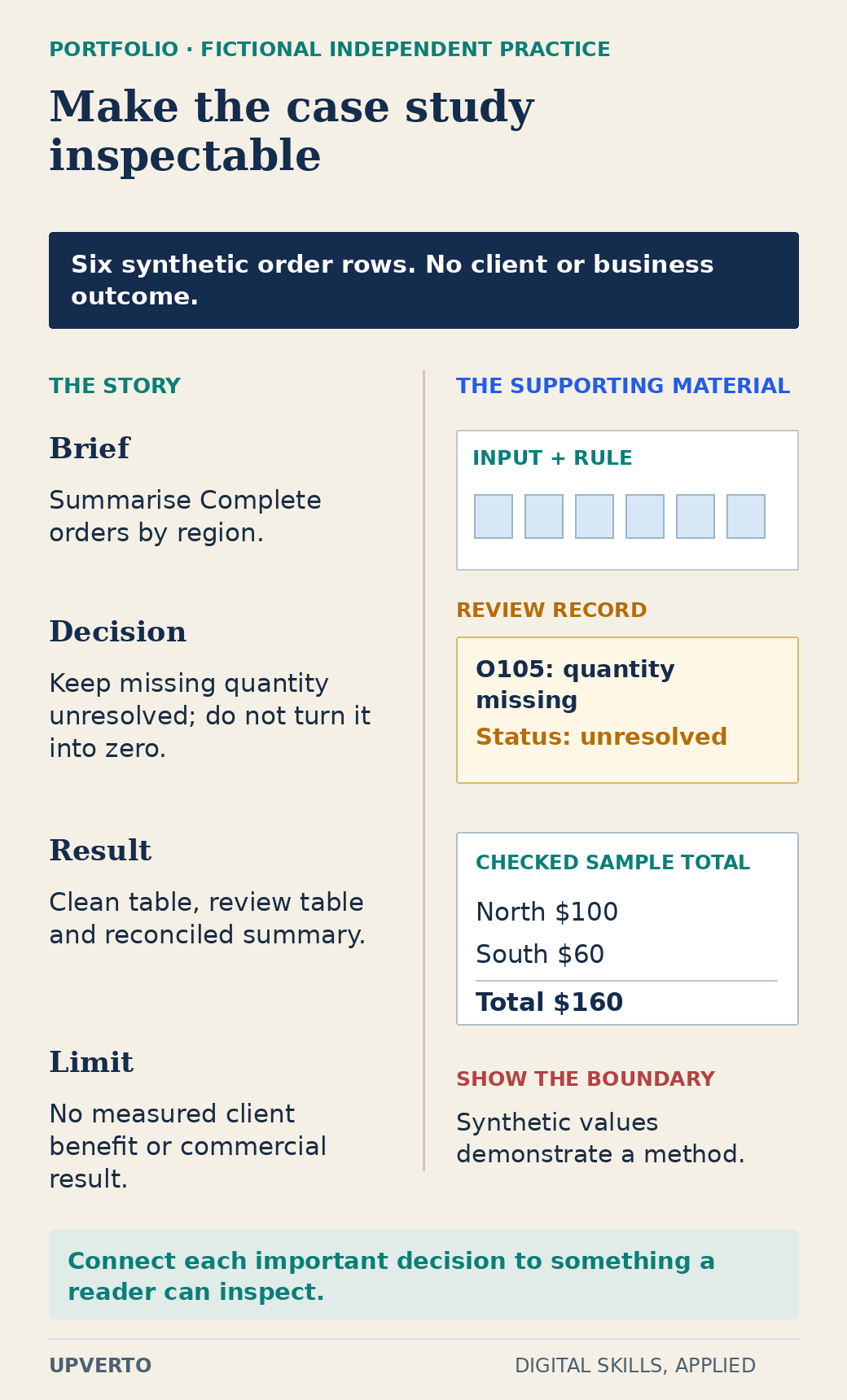
    A two-column case-study spread connects brief, decision, result and limitation to six input rows, an unresolved quantity record and a checked USD 160 regional total.
    Connect a portfolio narrative to inspectable evidence — This fictional spreadsheet case demonstrates work and checking without inventing a client or commercial result. Use the enlarged view, then swipe or use arrow keys to inspect details. View full-size infographic.
    Read the text version: Connect a portfolio narrative to inspectable evidence
    Brief
    Summarise Complete orders by region from six synthetic rows.
    Decision
    Keep a missing quantity unresolved rather than treating it as zero. Show O105 in a review table.
    Result
    Provide the clean table, review table and checked summary: North USD 100, South USD 60, total USD 160.
    Limit
    No real client benefit or commercial outcome was measured.

    The accompanying input, rule and calculation make the narrative inspectable.

    SectionReader’s questionUseful material
    BriefWhat was the task?Purpose, inputs, deliverable and acceptance criteria
    ConstraintsWhat shaped the work?Data limits, time, tools, access and exclusions
    DecisionsWhy did you choose this approach?One or two meaningful alternatives and reasons
    EvidenceWhat can I inspect?Sample files, relevant views, calculations or actual test records
    ResultWhat was completed or observed?A precise account of the finished output and checks
    Limits and next stepWhat remains uncertain?Unresolved issues, untested conditions and the next useful check

    Do not narrate every click. Choose the decisions that reveal judgment: how you handled a conflicting record, why you changed a task flow, or how you defined the handover. A tool list can provide context, but it does not explain why the work is useful.

    Worked example: a synthetic spreadsheet case

    The fictional brief asks for complete-order value by region. The input contains an exact duplicate, a pending order and a complete order with a missing quantity. The analyst keeps the raw file, removes the exact duplicate under a documented rule and places the missing quantity in a review table.

    The important decision is not “I used a spreadsheet.” It is: “I treated missing quantity as unresolved rather than zero, so the summary would not hide uncertainty.” Show the affected row and the rule. Explain that a conflicting duplicate would require investigation rather than automatic deletion.

    The result is a checked summary of three complete synthetic orders, with a total of USD 160. North contributes USD 100 and South USD 60. The case can show the three included records and the arithmetic. It cannot claim increased revenue, time saved for a real client or satisfaction from people who never used it.

    A concise result paragraph might read: “The final sample contains a clean working table, a review table and a regional summary. The included values reconcile to USD 160. One pending order is outside the reporting rule and one quantity remains unresolved. This is an invented dataset used to demonstrate the method.”

    Match the strength of the claim to the evidence

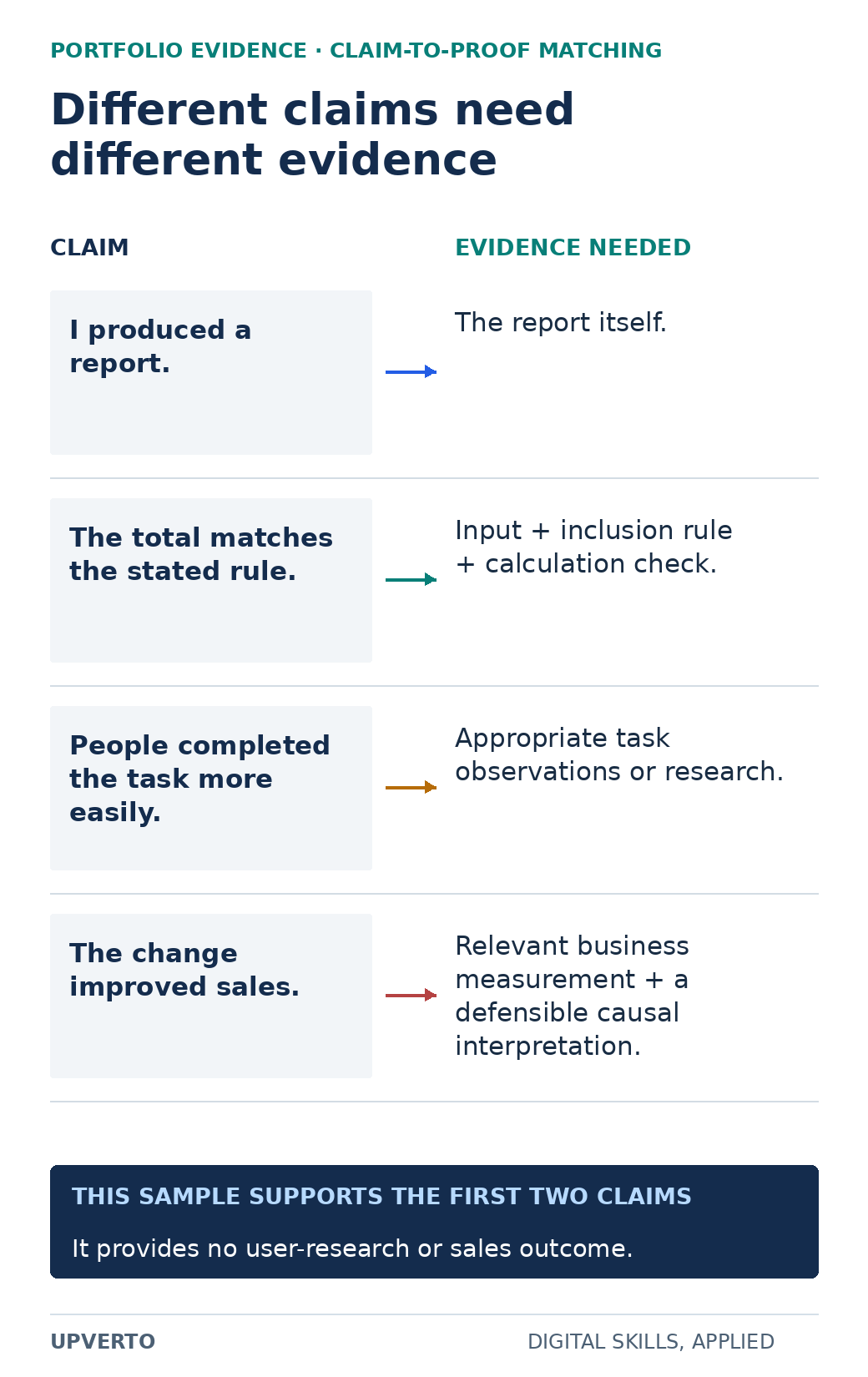
    Four claim-to-evidence connections distinguish a report artifact, a reconciled calculation, task research and business measurement with causal interpretation; the synthetic case supports only the first two.
    Match each portfolio claim to its evidence — The wording of a claim determines what evidence is required. A polished report cannot substitute for measured user or business outcomes. Use the enlarged view, then swipe or use arrow keys to inspect details. View full-size infographic.
    Read the text version: Match each portfolio claim to its evidence
    ClaimEvidence needed
    I produced a report.The report itself.
    The total matches the stated rule.The input, inclusion rule and calculation check.
    People completed the task more easily.Appropriate observations or research.
    The change improved sales.Relevant business measurement and a defensible interpretation of cause.

    The synthetic spreadsheet case supports the first two claims, not user or commercial outcomes.

    “I produced a report” needs the report. “The total matches the stated rule” needs the input, rule and calculation check. “People completed the task more easily” needs appropriate observations or research. “The change improved sales” needs relevant business measurement and a defensible interpretation of cause. These are different claims, not interchangeable ways to describe a polished output.

    GOV.UK’s usability-testing guidance describes observing people attempt tasks. If your project involved such sessions, report who participated in broad relevant terms, what they attempted, what was observed and the limitations of the sample. Do not turn an informal comment into a measured usability result.

    When no outcome measurement exists, state the completed deliverable and the checks actually performed. You can also describe a hypothesis for future evaluation, clearly labelled as a hypothesis. Honest limits make it easier for a reader to understand where your evidence ends.

    Choose visuals that explain a decision

    Use a screenshot, diagram or table because it answers a question. Annotate the relevant portion and explain what changed. A before-and-after comparison is useful only when the versions are genuinely related and the annotation identifies the reason for the change. Keep text readable and provide a text explanation of important information.

    For the spreadsheet case, show the duplicate and unresolved row beside the cleaning rule, then the reconciled summary. For a design case, show a task state and the observation that motivated a revision. For a technical case, show a boundary or test result rather than a wall of code unrelated to the claim.

    Confirm that you have permission to display client material. Remove confidential details without changing the meaning of the evidence. If permission is unavailable, use a clearly described synthetic reconstruction or choose another project. Follow the guide to show portfolio work honestly when labelling sources, roles and practice work.

    Copy the annotated case-study template

    Project label: real client, personal project or fictional practice. Task: the reader or buyer problem. My role: exactly what you owned. Inputs and constraints: what was available and excluded. Completion criteria: observable checks agreed or defined before the work.

    Decision one: the problem, alternatives and chosen approach. Evidence: the file, view or test that supports the explanation. Result: completed outputs and actual observations. Limit: what was not tested or measured. Next step: the most useful improvement or validation.

    • Can every numerical claim be traced to a source or calculation?
    • Does the opening make the project’s status and your role clear?
    • Are fictional data and illustrative observations labelled where they appear?
    • Does each visual explain something the prose alone makes harder to inspect?
    • Have you separated output quality from commercial outcomes?
    • Can a reader identify the service capability this project demonstrates?

    Make the case study useful to a prospective buyer

    End by connecting the demonstrated work to a bounded capability. For the example, that might be organising a small permitted dataset and producing a checked summary under agreed rules. It does not automatically qualify the analyst for financial auditing, forecasting or an enterprise data migration.

    When you have a coherent offer, use the guide to write a freelance service page to connect the case study with the service. Keep the case focused on the work and evidence. A reader should finish knowing what you can show, how you think and which responsibilities still need separate discussion.

    Frequently asked questions

    Can a fictional project have a strong case study?

    Yes. It can show a clear brief, original work, thoughtful decisions and actual checks. Label the project and data as fictional, and avoid inventing a client, testimonial or commercial result.

    How long should a case study be?

    Use enough detail to explain the task, your role, key decisions, evidence and limits. Remove activity that does not help a reader assess the work. A narrow project usually needs a narrower narrative than a complex collaborative one.

    What if I have no business results to report?

    Report the deliverables and checks you actually completed. State that business outcomes were not measured. You can propose a future evaluation, but do not turn that proposal into a claimed result.

    Should I show every step of my process?

    No. Select decisions that explain how you handled an important constraint or uncertainty. A long sequence of software actions is less useful than one well-supported explanation of why you chose an approach.

    Can I use a client screenshot after removing the name?

    Removing a name may not be sufficient. Obtain the appropriate permission and consider whether the remaining content is confidential or identifiable. If necessary, use a clearly labelled synthetic example instead.

    How do I describe team work honestly?

    Identify the shared context and then state your own responsibilities, outputs and decisions. Credit other contributors appropriately. Do not imply that a complete product or outcome was solely your work when it was not.

  • Portfolio Website, PDF or Platform Profile: What Should You Use?

    Portfolio Website, PDF or Platform Profile: What Should You Use?

    The right portfolio format makes relevant work easy for the intended reader to inspect. A website, PDF and platform profile each support different access and maintenance needs. You do not need all three before showing a clear, honest sample.

    Start with the evidence itself: what the project was, what you contributed and what someone can check. The guide to build freelance portfolio without clients explains how to create that evidence. This guide helps you package it without turning presentation work into an endless website project.

    In this guide
    A browser window, layered PDF pages and a platform profile show different evidence capabilities and the maintenance responsibilities attached to each.
    Compare the access responsibilities of portfolio formats – A browser window, layered PDF pages and a platform profile show different evidence capabilities and the maintenance responsibilities attached to each. Use the enlarged view, then swipe or use arrow keys to inspect details. View full-size infographic.
    Read the text version: Compare the access responsibilities of portfolio formats

    A website can hold linked case studies and working interactions, with responsibilities for links, hosting and access. A PDF is a bounded document that can be read offline, requiring checks of version, reading order and file size. A platform profile uses provider-supported fields and media, so current provider rules apply. Choose around the reader’s inspection task. A screenshot does not demonstrate every interaction, and successful uploading does not establish usability or accessibility.

    Define the reader and the inspection task

    Imagine a specific recipient. They may be reviewing a marketplace proposal, opening an email on a phone or discussing a document during a meeting. Ask what they need to see first and what action follows. A beautiful format is unhelpful if it requires an unexpected login or hides the sample behind several unrelated pages.

    Choose the smallest complete presentation that supports the decision. For a document-formatting service, a concise PDF with readable samples and a contribution note may be useful. For an interactive website, a live demonstration and code context may be necessary. A static screenshot cannot prove that a form or keyboard interaction works.

    Record confidentiality and permission constraints before selecting the format. A public website is inappropriate for material you may share only with a named reviewer. A downloadable PDF can be forwarded. A platform profile is governed by that platform’s rules and may not support every kind of media or contact route.

    Compare the three formats by practical tradeoffs

    FormatUseful whenResponsibilities and limits
    WebsiteYou need linked case studies, interactive examples or a public destination you maintain.Hosting, updates, accessibility, working links and a safe contact route need attention.
    PDFYou need a bounded document that can be attached, downloaded or reviewed offline.File size, version control, readable layout, structure and recipient compatibility need checking.
    Platform profileThe client is already reviewing people inside that platform.Fields, media, contact rules and account access depend on the provider.

    These are capabilities to investigate, not a ranking. A simple site can be excellent; an elaborate site can obscure the work. A PDF can be accessible or difficult to use. A platform profile can contain relevant proof or an unsupported list of skills.

    Maintenance is part of the choice. If a project changes, which copies must you update? A website link can point to an updated case study, while an emailed PDF remains the old version. Keep a date or version where it helps recipients distinguish copies, and retain a master source for the material.

    Make the content usable in its chosen format

    For a website, use a logical heading structure, descriptive links and appropriate text alternatives. W3C’s structure guidance explains how semantic organisation supports navigation. The W3C images tutorial distinguishes informative image descriptions from decoration. A portfolio sample needs enough explanation for a reader who cannot obtain its meaning from the image alone.

    For a PDF, check more than the page appearance. Selectable text, reading order, tags and meaningful links can affect use. Adobe’s PDF accessibility guidance describes a verification workflow. Export settings and source-document structure matter, and an automatic check does not remove the need to inspect the result.

    For a platform profile, work within the available fields and provide clear descriptions of each sample. Confirm the current media and contact policies in official documentation. This format comparison does not replace platform-specific instructions or imply that an external contact button is permitted everywhere.

    Worked example: one body of evidence, two delivery contexts

    Fictional example: Noah offers short information-document formatting. The portfolio contains a two-page fictional community guide, an annotated revision and a short note describing the brief, role and checks. There are no client testimonials or measured business results.

    For a direct enquiry that asks for an attachment, Noah prepares a compact PDF. The first page states the service and project context; the next pages show readable extracts and the revision explanation. The file is named noah-document-sample-v02.pdf. Noah opens the actual attachment on the recipient’s likely device type, checks links and confirms it contains no private notes.

    For a marketplace proposal, Noah uses the platform’s supported portfolio fields and attaches the relevant sample through the permitted route. The same underlying work remains labelled as fictional. Noah does not invent a separate client story or remove the concept label to make the platform version appear more experienced.

    A master fictional case study branches into a readable PDF attachment for a direct enquiry and supported platform fields, preserving the same project label.
    Package one honest case study for two contexts – A master fictional case study branches into a readable PDF attachment for a direct enquiry and supported platform fields, preserving the same project label. Use the enlarged view, then swipe or use arrow keys to inspect details. View full-size infographic.
    Read the text version: Package one honest case study for two contexts

    Noah’s fictional document-layout evidence contains the brief, role, output and checks. For a direct enquiry requesting an attachment, it becomes a PDF with readable extracts, a revision explanation and the fictional-project label. For a marketplace, it is adapted into supported fields and media with the same contribution note and label. Keep facts, permissions and project context consistent in both versions. The diagram does not imply that every platform permits external contact or the same attachment types.

    A website can follow later if a maintained public destination becomes useful. The decision is based on access and evidence, not the assumption that a custom domain creates professional competence.

    Use the format-selection and access checklist

    QuestionRecord the answer
    Where will the reader encounter the work?Platform, direct enquiry, meeting or public search
    What must they inspect?Image, readable document, working interaction, code or process record
    What access can they use?Device, connection, download permission and login constraints
    What may be shared?Public, named-recipient only or withheld material
    Who will maintain it?Owner, source file, update routine and current version
    What did the access test show?Actual opening, navigation, links and contact-route results

    Ask a reviewer to perform a task rather than rate the design: find a relevant sample, identify your contribution and locate the allowed next action. Watch where they hesitate and record the problem. A single informal review is not a full usability study, but it can reveal a broken link or missing explanation.

    Use the freelance portfolio review checklist to inspect the complete presentation. Then compare freelance marketplaces vs direct clients to choose where that evidence belongs. Keep the core case study consistent across formats so that title, scope and claimed contribution do not drift.

    Frequently asked questions

    Do I need a portfolio website before contacting anyone?

    No universal rule requires a website. You need relevant, honest work that the intended recipient can open and inspect. A suitable PDF or platform profile may meet that need. Build a website when its access, interaction or maintenance benefits justify the additional work.

    Can a PDF demonstrate a website project?

    It can explain the brief, screenshots and your decisions, but it cannot demonstrate every interaction. Where permission and hosting allow, include a working example or another inspectable record. Describe what is simulated, unavailable or outside the sample rather than implying a screenshot proves functionality.

    Should I put the same projects in every format?

    You can reuse a consistent source case study while selecting the most relevant material for each context. Preserve labels, permissions and contribution details. Avoid maintaining unnecessary copies that become outdated or contradict one another.

    How large should a portfolio PDF be?

    There is no universal file-size target. It must be readable and practical for the recipient’s connection, device and submission limits. Compress images without making the work impossible to inspect, and test the actual final file rather than relying on the editor preview.

    Is a public link always easier than an attachment?

    It may be easier to update, but it can create login, permission or confidentiality problems. An attachment can be useful offline but can also be forwarded and become outdated. Choose deliberately and test the actual access path.

    Does an accessibility checker prove my portfolio is accessible?

    No. Automated checks can identify some issues, while reading order, meaningful descriptions and real interaction need further review. Use appropriate primary guidance and test relevant tasks. Describe the checks you performed without claiming a comprehensive audit you did not conduct.

    Sources and review notes

    Primary sources checked on 27 October 2026 (UTC). Check the current provider pages before relying on a changing feature, policy or price. Worked examples and worksheets are original teaching material; fictional examples are not evidence of client results.