Category: Grow sustainably

  • How to Track Freelance Income, Costs and Available Time

    How to Track Freelance Income, Costs and Available Time

    A full calendar and a large invoice total can hide very different situations. You may have completed valuable work but be waiting for payment. You may have cash in the bank that must cover costs already committed. You may have free hours next week but no suitable space for a deadline tomorrow.

    A small operational tracker should help you answer those questions separately. It does not need to predict your entire business. It needs clear definitions, supporting records and a regular review. This is one practical part of learning to grow a sustainable freelance business.

    Give each number a precise meaning

    Use revenue for the value of work recognised in the period under the basis you are using, expenses for the costs included on that same basis, and cash received for money actually collected. Profit is a result after the relevant expenses; it is not another name for the bank balance. Specify the period and the accounting basis before comparing totals.

    The US Small Business Administration’s finance guide distinguishes cash and accrual recording. This article uses a deliberately simplified earned-work view alongside actual cash movements to make the difference visible. It does not select an accounting method for your jurisdiction or provide a tax return calculation.

    Capacity is a separate measure: time that you can realistically commit after existing work and necessary business activities. A payment does not create an extra hour, and an empty hour does not create revenue.

    FieldRecordDo not substitute
    Revenue basisWhat work is recognised, when, and whyEvery quote or enquiry
    Included costsCost, category, period and supporting recordOnly expenses paid today
    Cash movementActual receipt or payment and matching referenceAn invoice marked sent
    CapacityAvailable time less specific commitmentsEvery waking hour

    Connect the tracker to evidence

    Start with freelance invoices payments records: invoice references, actual receipts, provider fees where applicable, and the record of what was agreed. Give each project a stable reference so a part payment does not become a second sale in your tracker.

    Keep a transaction date and a work-period field when those differ. For a cost, record both what it relates to and whether it has been paid. For money received, connect it to the relevant invoice or other basis and record any unmatched amount for investigation. Do not quietly force a transfer to fit an invoice because the numbers are similar.

    Personal contributions, borrowing, withdrawals and transfers between your own accounts need separate treatment from customer revenue. If those occur, add distinct categories and obtain suitable accounting guidance. The example below excludes them so the arithmetic is inspectable.

    Worked example: one period, two money views

    All figures here are fictional monetary units. The sample has completed work valued at 1,200 and associated included operating costs of 360. For this teaching model, those are the period’s entire revenue and operating costs; taxes, financing, capital purchases and personal transfers are outside the scenario. This is not a real business’s profit statement.

    Sample itemRecognised in this modelCash movement this periodUnsettled at period end
    Completed work1,200 revenue900 received300 receivable
    Associated costs360 expense250 paid110 payable
    Difference840 before tax in this model650 net cash increaseTiming explains the difference

    The model result is 1,200 − 360 = 840. Actual net cash movement is 900 − 250 = 650. The 190 difference comes from 300 not yet collected, offset by 110 of costs not yet paid: 840 − 300 + 110 = 650.

    With opening cash of 500 and no other movements, closing cash would be 1,150. That is 500 + 650, not 500 + 840. The unpaid 110 still needs attention, and the receivable 300 is not available cash. Neither number establishes what the owner can safely withdraw.
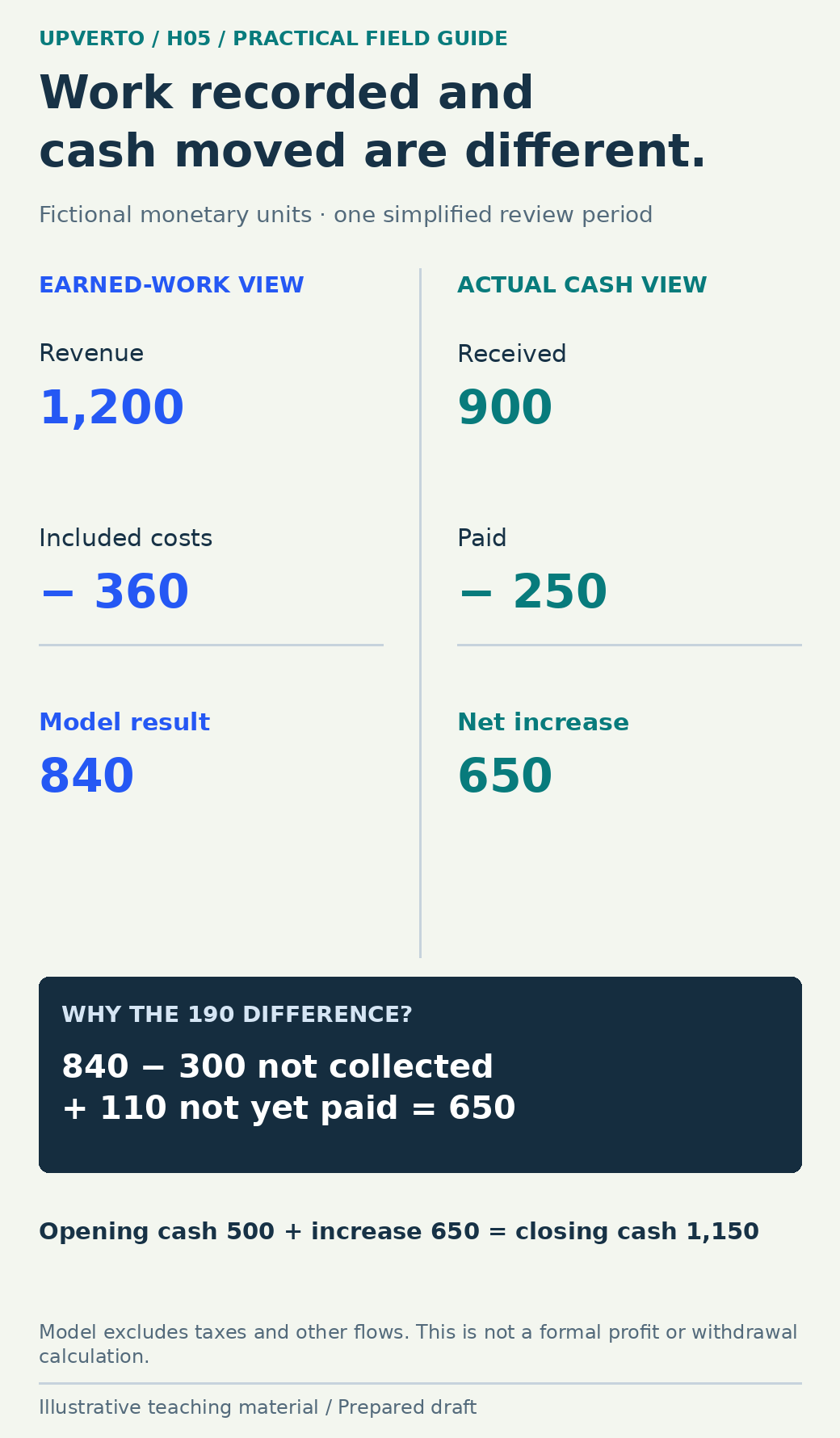
    Parallel ledgers show 1,200 revenue less 360 costs equals 840 in a simplified earned-work model, while 900 cash received less 250 paid equals 650. Uncollected 300 and unpaid 110 reconcile the difference.
    Reconcile an earned-work result with cash movement — The fictional 840 model result and 650 cash increase answer different questions. Use the enlarged view, then swipe or use arrow keys to inspect. View full-size infographic.
    Read the text version: Reconcile an earned-work result with cash movement

    Fictional period: completed-work revenue 1,200 and included costs 360 produce a model result of 840 before tax. Actual cash received is 900 and paid is 250, so cash increases 650. Reconciliation: 840 minus 300 uncollected plus 110 unpaid equals 650. Opening cash 500 plus 650 gives closing cash 1,150. The model excludes tax and other flows and is not a formal profit statement or a withdrawal recommendation.

    Use a separate time budget

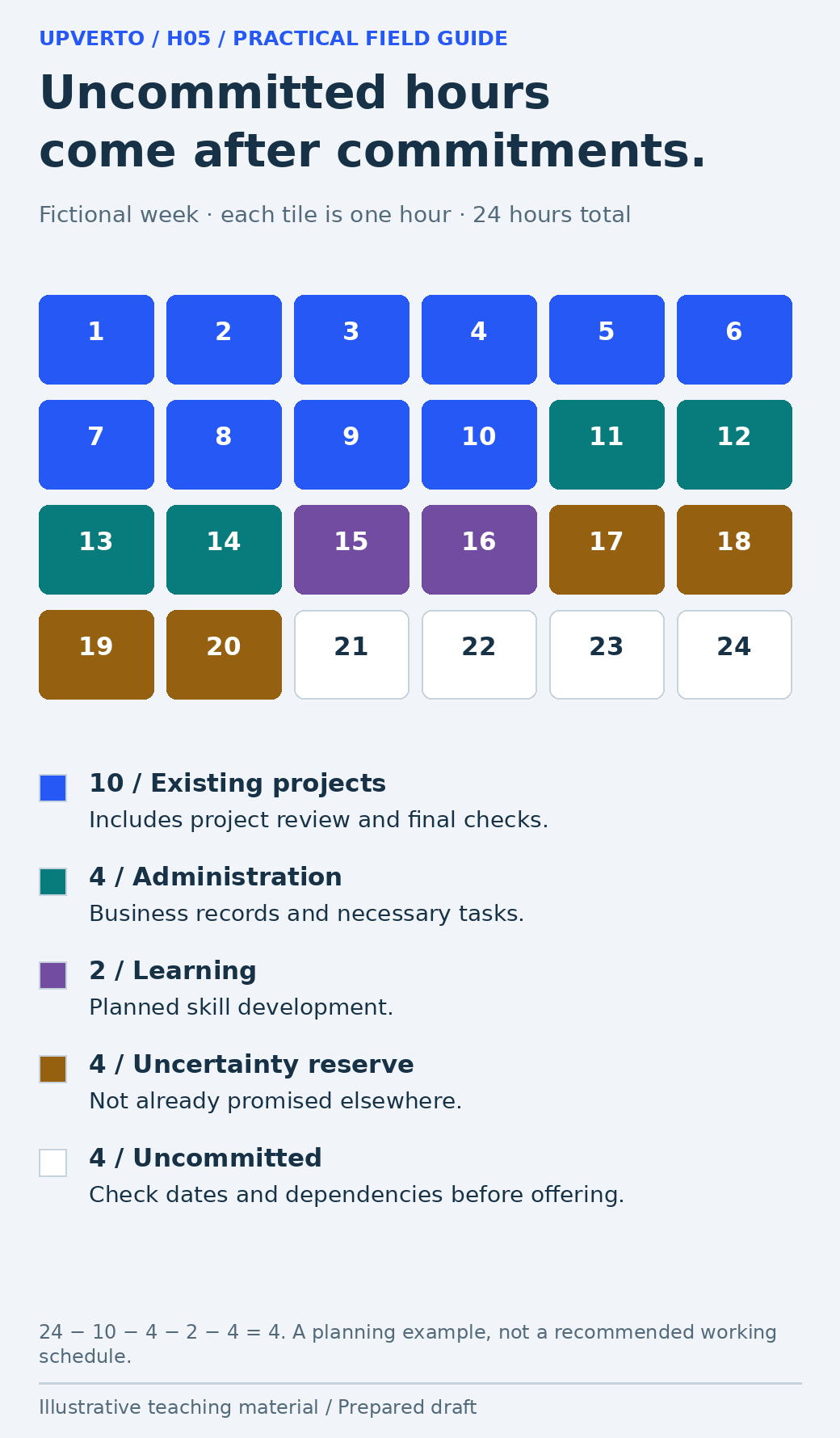
    Now consider a fictional coming week with 24 available working hours after personal commitments. Ten are committed to projects, including their review and final checks. Four are reserved for administration, two for learning, and four for uncertainty. That leaves four uncommitted hours.

    Check the placement of those hours as well as their total. Four scattered hours may support short edits but may not support an uninterrupted production task. An input-dependent project also needs time after the input arrives. Do not promise the same reserve to two clients or silently remove checking time when estimating new work.

    Time categoryHoursMeaning in this example
    Existing project commitments10Includes coordination, revisions and quality checks for those projects
    Business administration4Records, invoicing and necessary business tasks
    Learning2Planned skill development
    Uncertainty reserve4Not already promised to another task
    Uncommitted4Inspect dates and dependencies before offering it
    Total available24A planning assumption, not a recommended schedule
    A 24-tile time budget allocates ten hours to projects, four to administration, two to learning, four to reserve and four to uncommitted time. Each tile represents one hour.
    Build a realistic weekly capacity budget — The remainder is a planning input; dates and dependencies still matter. Use the enlarged view, then swipe or use arrow keys to inspect. View full-size infographic.
    Read the text version: Build a realistic weekly capacity budget

    Fictional available week: 24 hours. Existing projects use 10 hours including their checks, business administration 4, learning 2, and uncertainty reserve 4. Four hours remain uncommitted. Each tile is one hour. Calculation: 24 − 10 − 4 − 2 − 4 = 4. Check the placement of hours and required inputs before offering the remainder. This is not a recommended work schedule.

    Copy the income, cost and capacity tracker

    Use three linked views rather than one total labelled “income.” Copy these fields into your preferred table or notebook. Keep the source records accessible to you and restrict any client details to the people who need them.

    1. Work and invoices: project reference; period; recognised-work basis; amount; invoice reference; amount collected; amount outstanding; next action.
    2. Costs and cash: transaction reference; category; related project or overhead; amount included in the period; actual payment date; amount paid; balance payable; receipt or statement reference.
    3. Time: week; available hours; existing project hours including checks; administration; learning; reserve; remaining hours; input dependencies; date of next review.

    Add a short reconciliation note: “These cash totals match these statement lines; these two entries remain unmatched.” A difference is a question to resolve, not a reason to overwrite the source. Keep currencies separate unless you have a documented conversion basis; adding different currencies directly produces a meaningless total.

    For time, compare planned and recorded categories after the week. If project checks repeatedly use the reserve, include them more accurately in the next estimate. Record a correction to the process rather than treating all variation as personal failure.

    Use the records to choose one action

    If work is completed but cash is delayed, review the payment records and agreed process. If cash is healthy only because important costs remain unpaid, look at those commitments. If work consumes more time than the offer allowed, examine scope and delivery assumptions before changing the price.

    The guide to how to price freelance work connects the offer to the work and costs it must support. When records justify a change for future proposals, use them to raise freelance prices responsibly. A single small sample should prompt investigation rather than a confident forecast.

    Set a review rhythm that you can maintain. At each review, reconcile the money, update the time commitments and choose a specific next action with an owner and date. The tracker earns its place when it improves a decision, not when it contains the largest number of columns.

    Frequently asked questions

    Is an unpaid invoice income?

    That depends on the basis and purpose of the record. In an earned-work view, qualifying completed work can be recorded before payment; a cash view records actual receipt. Label the basis and retain the unpaid balance. This operational distinction does not determine the accounting or tax treatment required for your situation.

    Can I treat the bank balance as profit?

    No. It may contain opening cash, loans or personal contributions, and it may still need to cover unpaid costs. Profit requires a consistent revenue-and-expense calculation for a defined period. Reconcile the bank balance separately and identify outstanding commitments before drawing conclusions.

    Where should payment-processing fees go?

    Record the customer’s payment, the fee and the net deposit as connected but distinct amounts. Whether a fee is yours or the customer’s depends on the actual arrangement and applicable rules. Do not turn a lower net deposit into extra customer debt without a valid basis.

    Do I need to track every minute?

    Use enough detail to answer the question you are investigating. Broad categories such as production, review, coordination and business administration may be sufficient. If a repeated estimate is wrong, temporarily record that activity more closely. Avoid a tracking system whose maintenance exceeds its usefulness.

    Is all uncommitted time available for new work?

    Check the dates, concentration needed, dependencies and your uncertainty reserve first. The fictional four hours are a remainder in a plan, not automatic permission to accept any four-hour request. Keep time for essential checks and commitments that have not yet reached their delivery stage.

    How should I use this for taxes?

    Treat it as an operational starting point, not a filing guide. Tax categories, timing, rates and record-retention requirements depend on the relevant jurisdiction and circumstances. Use current local official guidance and qualified help where needed; keep the underlying documents so the records can be interpreted correctly.

    Sources and scope

    The worked examples, worksheets and diagrams are original fictional teaching materials. They are not reports of client results. Primary references were checked during preparation; verify current rules and account-specific features before acting.

  • How to Turn Repeated Work into Reusable Templates and Processes

    How to Turn Repeated Work into Reusable Templates and Processes

    Repeated work becomes easier to manage when the reliable parts are written down. A reusable template can hold the structure of a handover note. A process can explain when that note is ready to send, which checks come first and what to do when an input is missing.

    The useful starting point is a task you already understand, not a promise to automate your whole business. Reuse should preserve quality and make decisions visible. It is one way to grow a sustainable freelance business while keeping each client’s information and rights in view.

    Choose a stable, repeated task

    Look for work with a recognisable trigger, similar inputs and an output you can check. Examples include preparing a delivery folder, checking event details across two export formats, or writing a short record of agreed revisions. Avoid starting with an activity where the goal changes completely each time.

    Describe the repetition precisely: “create a delivery index after final exports are checked” is a better process candidate than “handle clients.” The first has a starting condition and a concrete output. The second hides many judgements and responsibilities.

    Keep the current manual method visible while designing a reusable version. Record the step that prevents an old export being delivered, the exception that stops the task, and the person who decides what happens next. Removing these details to make the process look short can remove its value.

    Separate your method from material you cannot reuse

    A completed client file is not automatically a reusable public template. Review the agreement, permissions and source licences before copying content into a new project. Confidential information can remain sensitive even when a logo is removed.

    WIPO’s copyright guidance distinguishes ideas and methods from their particular expression and explains that rights questions depend on the circumstances and applicable law. That distinction is not permission to copy a client’s wording, artwork, database or proprietary material. For a concrete licence example, CC BY 4.0 includes attribution and other conditions, and warns that other rights can still matter. Do not generalise those terms to every stock asset or font.

    Begin with your own generic instructions where you have a sound basis to reuse them. Replace examples with newly written fictional data. Keep evidence of any third-party permission. If rights or confidentiality are unresolved, leave the material out while the issue is checked.

    Material found in a past projectQuestion before reuseSafer preparation step
    Your general checklist wordingDo agreements restrict this use?Create a clean, generic version after checking
    Client names, contact records or account linksIs reuse and disclosure authorised?Remove from the reusable master
    Client artwork or copyWho controls the relevant use?Exclude unless permission is established
    Third-party font, photograph or componentDoes its licence cover the new use?Record the terms or replace it

    Worked example: a reusable handover index

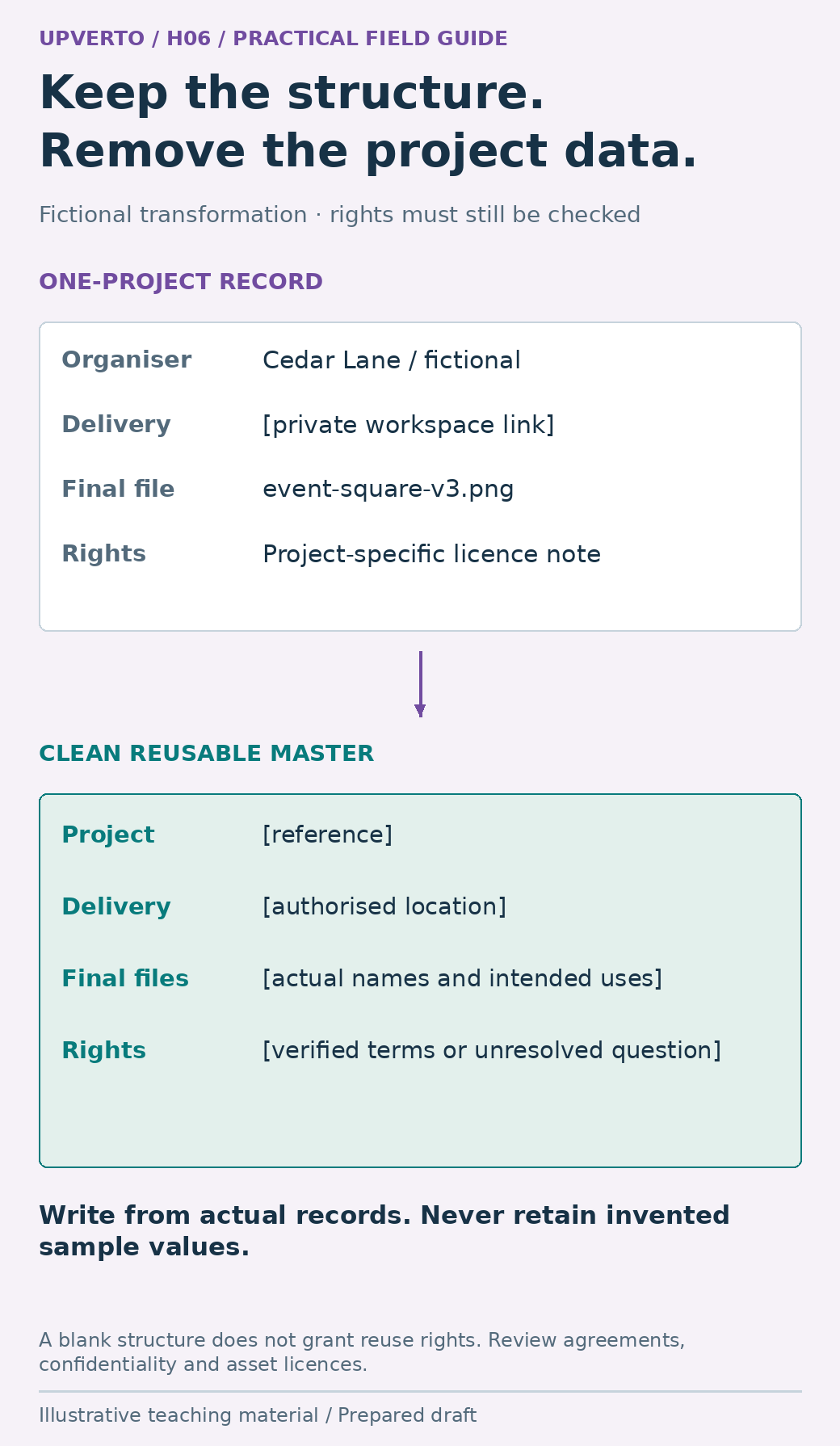
    This fictional example starts with a workshop-poster handover. The one-project record contains an organiser’s name, a private folder link, two approved export filenames and a licence note. Those details belong in that project’s delivery record. They do not belong in a general master.

    The reusable version is written from scratch as a structure: project reference, approved deliverables, final-file location, editable-source availability, rights notes, instructions, support boundary and owner. Its sample project is labelled fictional. The private link is replaced with a field called “authorised delivery location,” not with an example link that might be mistaken for a real folder.

    The process is grounded in freelance project handover. It says to inspect the final export filenames and the actual folder before filling the index. It never assumes that a file exists because a template contains its name.

    A fictional filled handover record becomes a clean master with fields for reference, authorised location, actual filenames and verified rights, while client details and private links are removed.
    Transform a project handover record into a clean reusable structure — Reuse the useful structure only after checking the basis for reuse. Use the enlarged view, then swipe or use arrow keys to inspect. View full-size infographic.
    Read the text version: Transform a project handover record into a clean reusable structure

    The fictional one-project record contains a named organiser, private delivery link, specific final filename and a project licence note. The reusable master instead has fields for project reference, authorised location, actual filenames and intended uses, and verified terms or unresolved questions. It is written from scratch as a clean structure. Agreements, confidentiality and licences still need review; removing names alone does not establish reuse rights.

    Fictional master excerpt: “For each approved deliverable, record its exact final filename, intended use and location. List editable source only when it is included in the agreement and actually provided. Record unresolved permissions before release. Leave a field marked ‘not applicable’ only with a reason.”

    This is an internal working aid, not a ready-made product to sell. If you later distribute a template, you need a separate review of the material included, permissions, instructions, support obligations and how a recipient might misunderstand it.

    Write the process around checks and exceptions

    A useful standard operating procedure explains the boundaries of a task, not only the clicks. Write it so another authorised person could understand what makes the output acceptable. Keep tool-specific instructions separate enough to update when the interface changes.

    1. Trigger: final deliverables have reached the agreed handover stage.
    2. Inputs: approved scope, current export files, known delivery permissions and the agreed recipient.
    3. Preparation: create a fresh index from the clean master; identify the project and version.
    4. Execution: fill fields from the actual files and agreement; do not leave invented sample values in place.
    5. Check: open the listed files, verify their intended use and confirm that recipient access is appropriate.
    6. Exception: if a required file, approval or permission is missing, record the blocker and send it to the named decision owner.
    7. Release: an authorised person approves the delivery action; retain the final index and version.
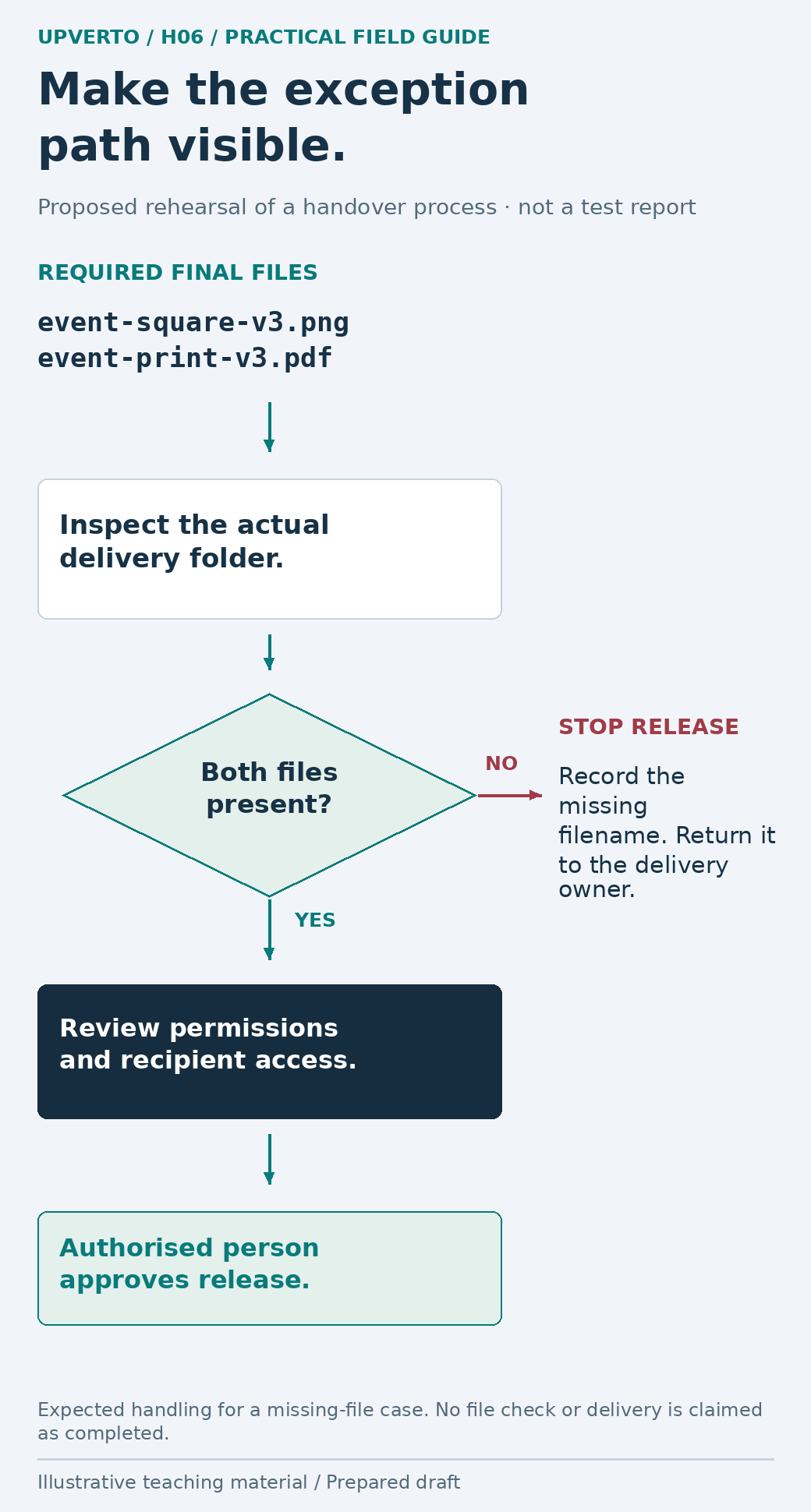
    A handover procedure checks two named fictional files. Missing either stops release and returns the filename to the delivery owner; both present leads to permissions and access review before authorised release.
    Add an explicit missing-file path to a handover procedure — A process must say what happens when an input is missing. Use the enlarged view, then swipe or use arrow keys to inspect. View full-size infographic.
    Read the text version: Add an explicit missing-file path to a handover procedure

    Proposed rehearsal: the required fictional files are event-square-v3.png and event-print-v3.pdf. Inspect the actual delivery folder. If either file is missing, stop release, record the missing filename and return the issue to the delivery owner. If both are present, continue to permission and recipient-access review before an authorised person approves release. This is expected handling, not a claim that checks or delivery occurred.

    The exception path matters. A blank “licence” field should not silently become “all rights included.” A missing export should not be replaced by an earlier file merely to complete the checklist. State the pause condition and the information needed to resume.

    Try representative cases before relying on the template

    Use harmless fictional records to rehearse the process. The following are proposed checks, not reports of tests already performed. A normal case should produce a complete index. A missing-file case should stop release and identify the missing filename. A rights-uncertain case should preserve the question and route it for a decision.

    Also test a field that does not apply. For example, a project may include final PNG exports but no editable source. The index should explain the agreed boundary rather than display an empty heading that suggests an accidental omission. Ask whether a new reader can distinguish “not included,” “not yet ready” and “not known.”

    Keep a version number, owner and change note on the master. When you fix a confusing instruction, record why. Do not silently overwrite a project’s final delivery record with a newer generic template; preserve the evidence of what was actually provided.

    Reuse checklist and automation decision

    Before adopting a reusable master, answer these questions in writing. A blank response is work to resolve, not a pass.

    • Which repeated task and output does this cover?
    • Which material is original, licensed, permitted or excluded?
    • Have client-specific data, private links and sample values been removed from the master?
    • What inputs and approvals must exist before the process begins?
    • Which check catches a plausible wrong output?
    • What stops the process, and who resolves the exception?
    • Who owns the master, and what version did this project use?

    Automation can help with a stable step, but it also repeats a wrong rule quickly. If you want to learn no code AI automation services, begin with a bounded operation using fictional or authorised data. Keep a review before external messages, publication, payments or changes that require separate authority. Sharing client information with an external service is a distinct decision; a template does not grant that permission.

    When a repeated need is real, the process can support an ongoing service. Use retain freelance clients ongoing services to define its trigger, output and review point. A documented process can save confusion without becoming a product, an agency or a source of passive income.

    Frequently asked questions

    Can I reuse something I made for a client?

    Check the agreement, confidentiality obligations, relevant rights and any third-party terms. Creating a file does not by itself settle every later use. Reuse your generic instructions only where you have a sound basis, and exclude client material while its status is unresolved. This guide does not decide ownership for a particular contract.

    What is the difference between a template and a process?

    A template provides a reusable structure, such as fields in a handover index. A process explains when to use it, where the information comes from, how to check the output and what to do with exceptions. A good structure can still produce a bad result if those decisions are missing.

    Is removing the client’s name enough?

    Often it is not. Private folder links, unusual project details, contact records, embedded metadata or distinctive artwork may still reveal information. Review the whole reusable file, including comments and sample data. A newly written fictional example is easier to separate from the project record.

    Should I automate the process immediately?

    First make the manual steps and checks reliable. Automate a narrow operation only when you understand its inputs, permissions, failure conditions and recovery. Rehearse with safe sample data and retain human review where the next action requires judgement or authority. Automation is not evidence that the result is correct.

    Can I sell the template once I have used it myself?

    Internal usefulness does not establish distribution rights or customer suitability. Review every included asset, licence and promise, and write instructions that work outside your own context. Consider the support and maintenance required. Many useful templates are best kept as internal aids rather than sold.

    How do I stop templates becoming outdated?

    Give the master an owner and version. Review it after a meaningful tool, requirement or process change, and after a real exception reveals a weakness. Preserve the project-specific record and note which version was used. Remove obsolete sample values rather than relying on memory to correct them each time.

    Sources and scope

    The worked examples, worksheets and diagrams are original fictional teaching materials. They are not reports of client results. Primary references were checked during preparation; verify current rules and account-specific features before acting.
  • How to Build Repeat Work and Ongoing Client Relationships

    How to Build Repeat Work and Ongoing Client Relationships

    Repeat work starts with a continuing need that you can serve reliably. After a useful handover, identify what will change, who owns it and what support would help. An ongoing relationship should remain understandable to both sides: defined outputs, workable communication and a clear review point. This is one part of grow a sustainable freelance business.

    Look for a recurring job, not a reason to keep billing

    Begin after the freelance project handover, when the recipient can use the completed work and any remaining issues are clear. Ask what will need attention next. The answer might be a changing workshop schedule, a repeated reporting task or a content calendar. It might also be “nothing for now,” which is a valid conclusion.

    A recurring need has a recognisable trigger and a useful outcome. “Update the approved event details when the programme changes” is easier to define than “keep improving everything.” Identify who supplies information, how often it genuinely changes and what happens if nobody acts. Do not promise monitoring, urgent response or new specialist capability simply because you delivered the original project.

    Distinguish prevention, maintenance and new production. Checking whether an agreed link still works is different from writing a new landing page. Updating supplied text is different from deciding the organisation’s legal wording. Naming the task prevents a friendly relationship from becoming an undefined support obligation.

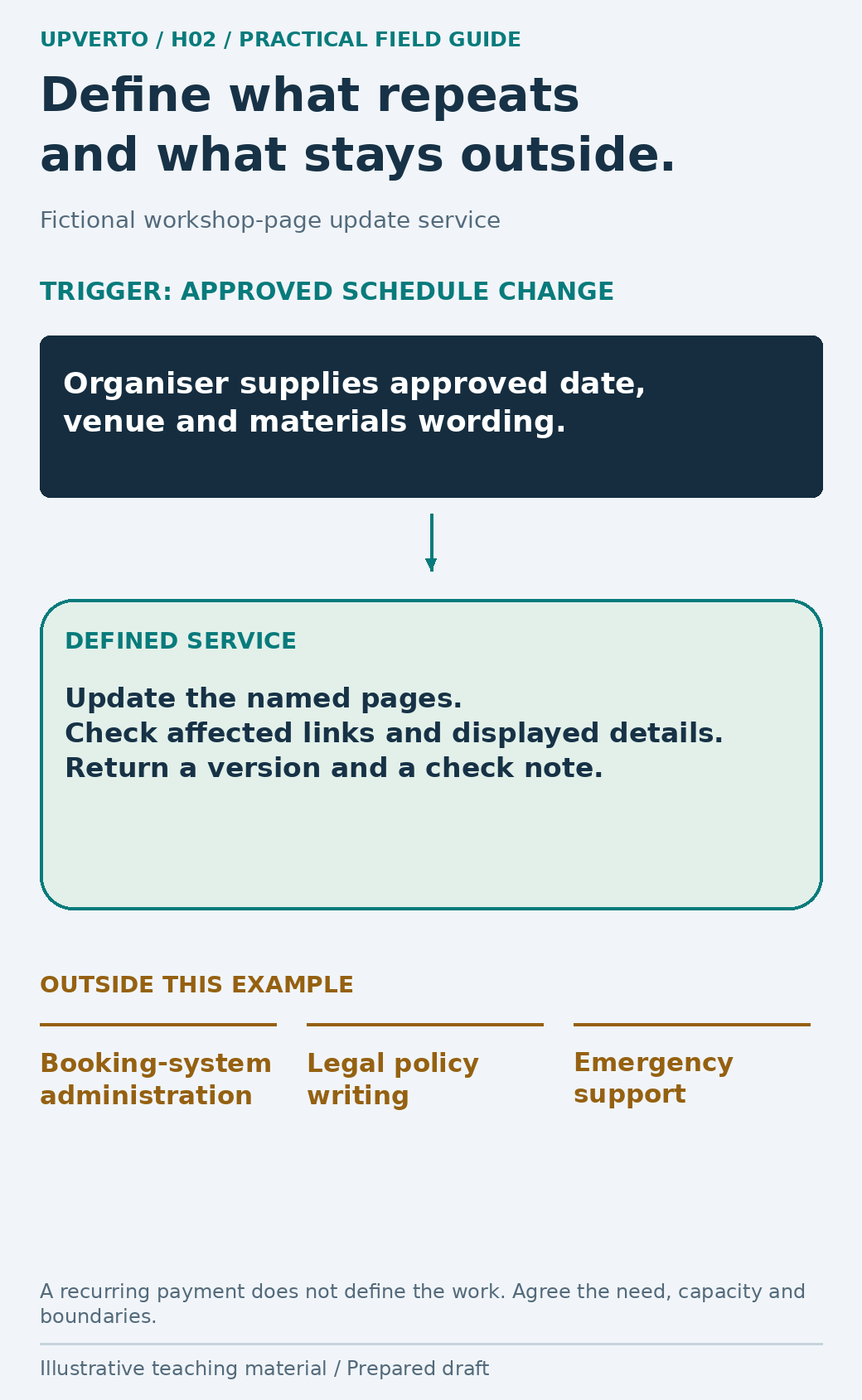
    Approved schedule changes feed a bounded named-page update service with link/detail checks, while booking-system administration, legal writing and emergency support remain outside.
    Define a recurring service from its actual trigger — Connect repeat work to a clear trigger and output. Use the enlarged view, then swipe or use arrow keys to inspect. View full-size infographic.
    Read the text version: Define a recurring service from its actual trigger

    In this fictional ongoing service, an organiser supplies approved date, venue and materials wording. The freelancer updates named pages, checks affected links and details, and returns a version and check note. The example excludes booking-system administration, legal policy writing and emergency support. Capacity, communication and payment arrangements require their own agreement.

    Make the ongoing service concrete

    BoundaryQuestion to settle
    TriggerWhat event starts the work: a scheduled review or a specific approved request?
    OutputsWhat will be supplied, in what form, and what is excluded?
    InputsWho provides approved content or data and by when?
    CapacityHow much work can be handled and how is excess demand discussed?
    CommunicationWhich channel, response expectation and decision owner apply?
    Review and exitWhen will usefulness be reviewed, and what happens when the need changes?

    The guide to hourly vs fixed price vs retainer owns the payment-model discussion. Relationship strategy comes first here: understand the need and the work before selecting a charging arrangement. A recurring payment model does not make an unclear service useful, and an informal relationship does not remove the need to agree boundaries.

    Be precise about response and resolution. Acknowledging a request within an agreed period does not guarantee that every issue will be fixed in that time. State dependencies and exceptions in language the client can understand. If you cannot support urgent incidents, do not imply an emergency service.

    Review usefulness with evidence appropriate to the task

    The GOV.UK guidance on service metrics begins with the purpose of the service and gives measurements context. A small ongoing freelance arrangement can use the same principle without adopting a large dashboard. Select evidence that shows whether the agreed work is being performed and whether it remains useful.

    For a schedule-update service, a useful record might identify approved changes received, the versions updated, checks completed and unresolved questions. That record does not prove increased attendance or revenue. For a recurring report, the important evidence may be whether the figures reconcile and the intended reader can use the report, not how many pages you produced.

    Ask the client what is helping, what creates friction and what should stop. Record specific answers rather than turning every positive comment into a testimonial. Where an outcome has not been measured or has multiple causes, describe your contribution and the observed result accurately.

    Worked example: reviewing a workshop update service

    Fictional scenario: Cedar Lane has changing workshop details. A proposed service updates supplied approved text on named pages and provides a check note. It excludes booking-system administration, legal policy writing and emergency support. The following review records are invented to demonstrate decisions; they are not evidence of a real service.

    Review periodFictional needUseful decision
    Cycle 1Four approved workshop changes suppliedUpdate the named pages and record checks
    Cycle 2One cancellation; wording not yet approvedAsk the owner for approved wording before changing the page
    Cycle 3No schedule changesReview whether the arrangement should continue unchanged, narrow or pause

    The third cycle is not automatically a failure, nor a reason to invent work. The parties might still need a defined scheduled check, or the update service might no longer be useful. The right decision depends on the agreed responsibilities and actual need. A good relationship permits that discussion without pressure.

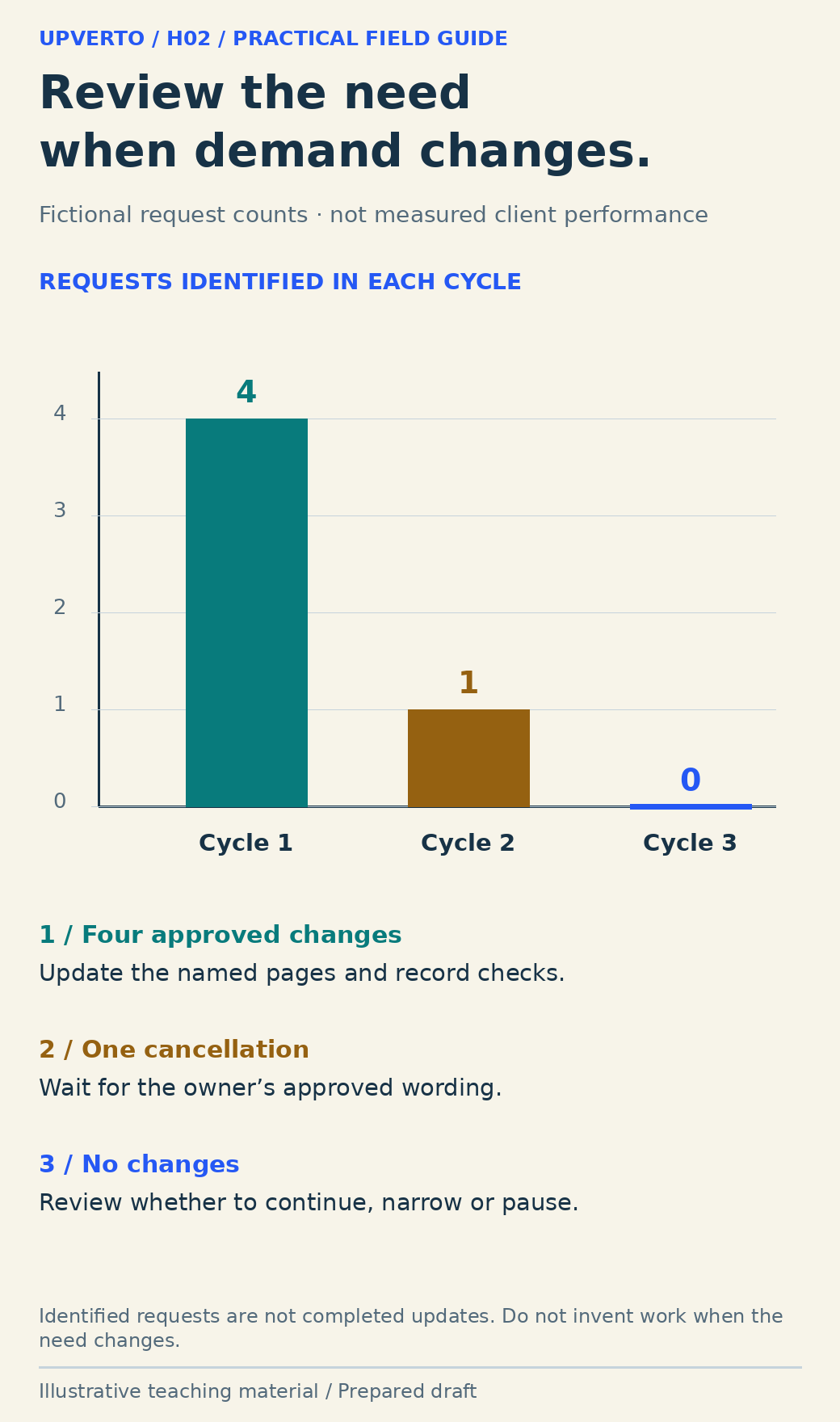
    A fictional three-cycle chart shows four approved changes, one cancellation awaiting wording and zero changes, with a different practical decision for each cycle.
    Use changing request volume to review an ongoing service — Counts describe demand in the example, not productivity or client outcomes. Use the enlarged view, then swipe or use arrow keys to inspect. View full-size infographic.
    Read the text version: Use changing request volume to review an ongoing service

    Fictional identified request counts are 4, 1 and 0 across three review cycles. Cycle 1 has four approved changes to update and check. Cycle 2 has a cancellation whose wording needs owner approval. Cycle 3 has no changes and prompts a discussion about continuing, narrowing or pausing. Identified requests are not the same as completed work, and no performance outcome is claimed.

    Copy an ongoing-service review note

    FieldWhat to record
    Continuing needThe recurring task and its trigger
    Work completedActual outputs and relevant versions
    EvidenceChecks, client observations and unresolved limitations
    Demand versus capacityRequests received, work deferred and why
    Inputs and decisionsWhat repeatedly arrives late or remains unclear
    Boundary changesNew work requested and whether it needs a separate agreement
    Next periodContinue, narrow, change, pause or end, with an owner and date

    Use the review to improve the arrangement, not merely justify its continuation. If the client repeatedly asks for work outside the service, investigate whether the offer is wrong or the boundary is unclear. If input quality causes repeated delays, consider a better intake process. If demand is lower than expected, discuss a proportionate alternative.

    Keep the client’s account and data access aligned with the continuing task. A past project does not authorise new access or reuse of confidential information. If the service pauses or ends, follow the agreed handover, access and record process so there is no unclear owner for a live responsibility.

    Invite the next conversation without pressure

    A useful invitation is specific: “The next workshop schedule changes monthly. Would it help to agree a small update process for the named pages, with approved copy supplied by the organiser?” It connects the offer to a known workflow and leaves room for the client to decline or choose another approach.

    Avoid implying that the original delivery will become unusable unless the client buys more work. Explain real dependencies honestly, including what the client can manage themselves. A relationship can remain valuable after a project ends, and a successful handover should not be weakened to create dependence.

    If the completed work supports it, ask freelance clients testimonials referrals explains how to request accurate feedback or an introduction with permission. Repeat work and referrals both depend on real experience; neither should be presented as a guaranteed result of a particular message.

    Frequently asked questions

    When should I discuss ongoing work?

    After the current delivery and remaining responsibilities are clear, or earlier when a known recurring need affects the original scope. Connect the conversation to a concrete task and avoid using unfinished work as pressure to buy more.

    Does every client need a monthly arrangement?

    No. Some needs are occasional, one-off or already covered internally. Choose an arrangement that reflects actual work and review it when demand changes. Do not invent recurring tasks solely to justify billing.

    How can I avoid promising unlimited support?

    Name the outputs, capacity, channel, response expectations and exclusions. Explain how additional work or urgent issues are handled. A friendly relationship benefits from boundaries that both sides can understand.

    What should I measure?

    Use evidence related to the service’s purpose, such as approved changes processed and checks completed. Distinguish those records from unmeasured sales or attendance outcomes. Ask the client whether the work remains useful.

    What if the client needs less work than expected?

    Review the actual need and agreement. A narrower, paused or different arrangement may be appropriate. Discuss the options clearly rather than generating unnecessary activity to preserve the original volume.

    Can I use the client’s account for a new service?

    Only with appropriate authority for the new task. Existing access does not automatically authorise expanded work or data use. Agree responsibilities, access and boundaries before proceeding.

    Sources and scope

    The worked examples, worksheets and diagrams are original fictional teaching materials. They are not reports of client results. Primary references were checked during preparation; verify current rules and account-specific features before acting.

  • How to Ask for Testimonials and Referrals Honestly

    How to Ask for Testimonials and Referrals Honestly

    A testimonial should reflect an actual person’s experience, and a referral should be an introduction they freely choose to make. Ask for accurate feedback, obtain permission for the intended use and keep unsupported outcomes out of the wording. These habits support grow a sustainable freelance business without turning a relationship into a source of invented endorsements.

    Ask after the relevant experience exists

    Complete a usable freelance project handover and address material delivery issues before asking someone to describe the work. A receipt acknowledgement is not a testimonial, and a complimentary message about your attitude is not evidence that the project achieved a commercial result.

    Invite feedback on the part the person actually experienced: clarity of communication, usefulness of the delivered files, the handover process or how you handled a particular requirement. A client can describe their own experience without estimating a revenue effect they did not measure. A practice-project reviewer can comment on the review they performed, but should not be presented as a paying client.

    Make the request optional and easy to decline. Do not link support, delivery access or future cooperation to a positive statement. If there is criticism, use it to understand the problem; do not ask the person to hide it so that you can produce a stronger marketing quote.

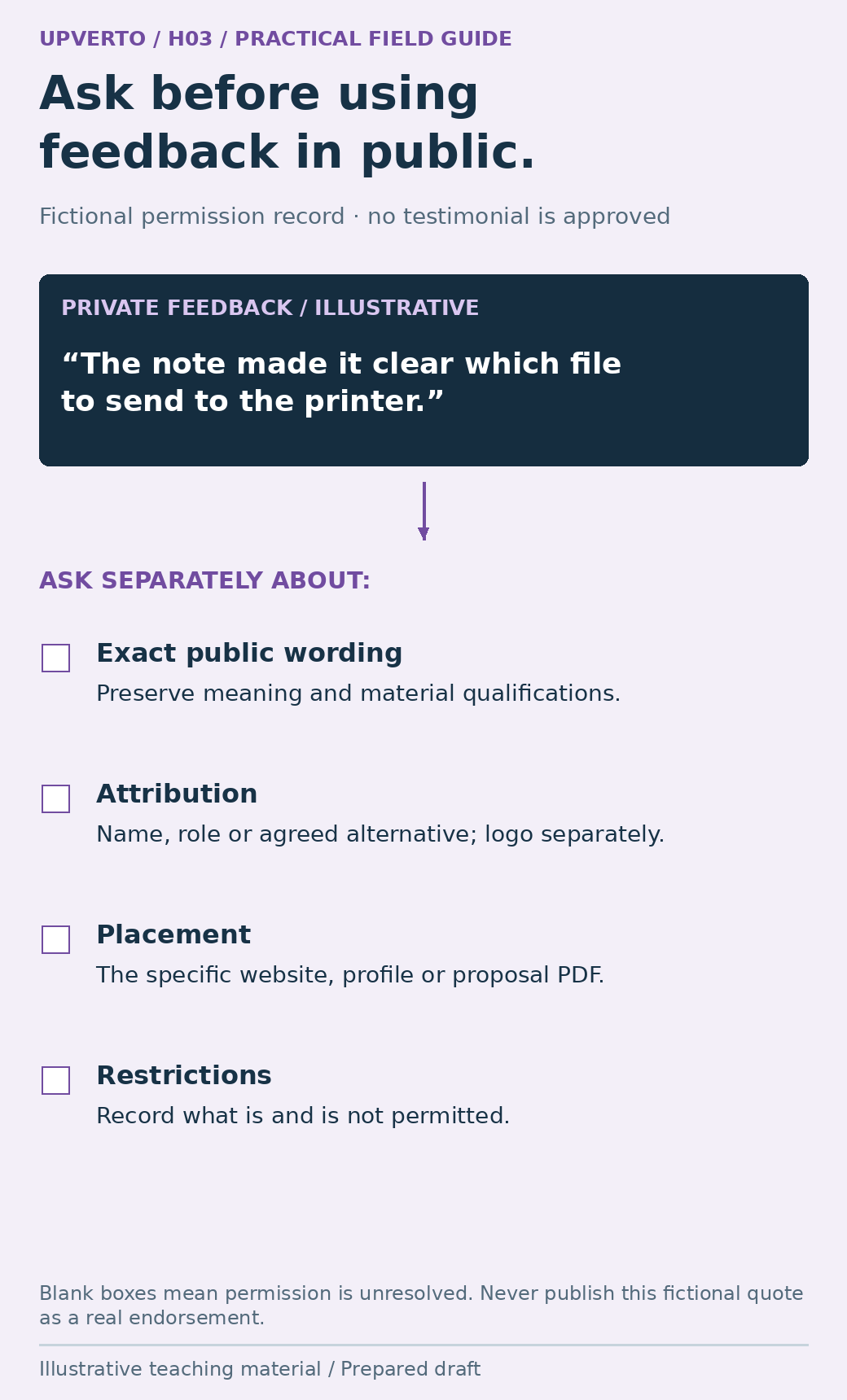
    A clearly fictional private feedback quote leads to four unchecked permissions: wording, attribution, placement and restrictions. Nothing is marked approved.
    Record exact testimonial publication permission — Request approval for the intended use rather than inferring it from a compliment. Use the enlarged view, then swipe or use arrow keys to inspect. View full-size infographic.
    Read the text version: Record exact testimonial publication permission

    The feedback shown is fictional and must never be published as a real endorsement. Receiving private feedback does not establish publication permission. Ask separately about exact wording, attribution, specific placement and restrictions. The boxes remain blank because permission is unresolved. A logo or confidential detail may require separate approval.

    Keep accuracy, permission and disclosure separate

    For the United States, the FTC’s Consumer Reviews and Testimonials Rule guidance explains restrictions on fake or misleading reviews and testimonials, including incentives conditioned on a particular review sentiment. Its guidance on soliciting reviews also discusses disclosure of incentives. These are US sources, not a complete statement of every jurisdiction’s advertising law.

    Check the requirements that apply to the intended publication and platform. Some platforms impose their own restrictions on incentives or soliciting reviews. The examples in this guide use no incentive. A genuine statement can still be misleading if you remove a material qualification, attach it to a different service or present an exceptional outcome as something everyone should expect.

    Ask permission for the actual wording, attribution and placement. Permission to receive private feedback is not permission to publish a name, logo or confidential project detail. Keep the original statement and the approved public version so the relationship between them remains clear.

    Worked example: a permission-aware request

    Fictional draft; not sent: A designer has handed over the agreed event files. The following request invites feedback without supplying an invented testimonial for the client to endorse.

    Thank you for reviewing the event-design pack. If you are comfortable sharing feedback, what was useful about the files or handover, and what could I improve?

    If you would like me to use any of your feedback publicly, I will send the exact proposed wording and ask separately about the name or role to display and the places it may appear. There is no obligation, and your answer will not affect the support already agreed.

    The request separates feedback from publication permission. It invites criticism and does not ask for a five-star rating or a revenue claim. In a real request, refer only to work the person actually received and avoid suggesting an outcome they have not independently described.

    If you need to shorten a response, preserve its meaning and material qualifications. Send the proposed edit for confirmation. Correcting a typo is different from changing “the file names were clear” into “this service transformed our business.” Do not use AI to manufacture a more impressive voice or result.

    Inspect the claim before publishing it

    Fictional source statementProposed useDecision
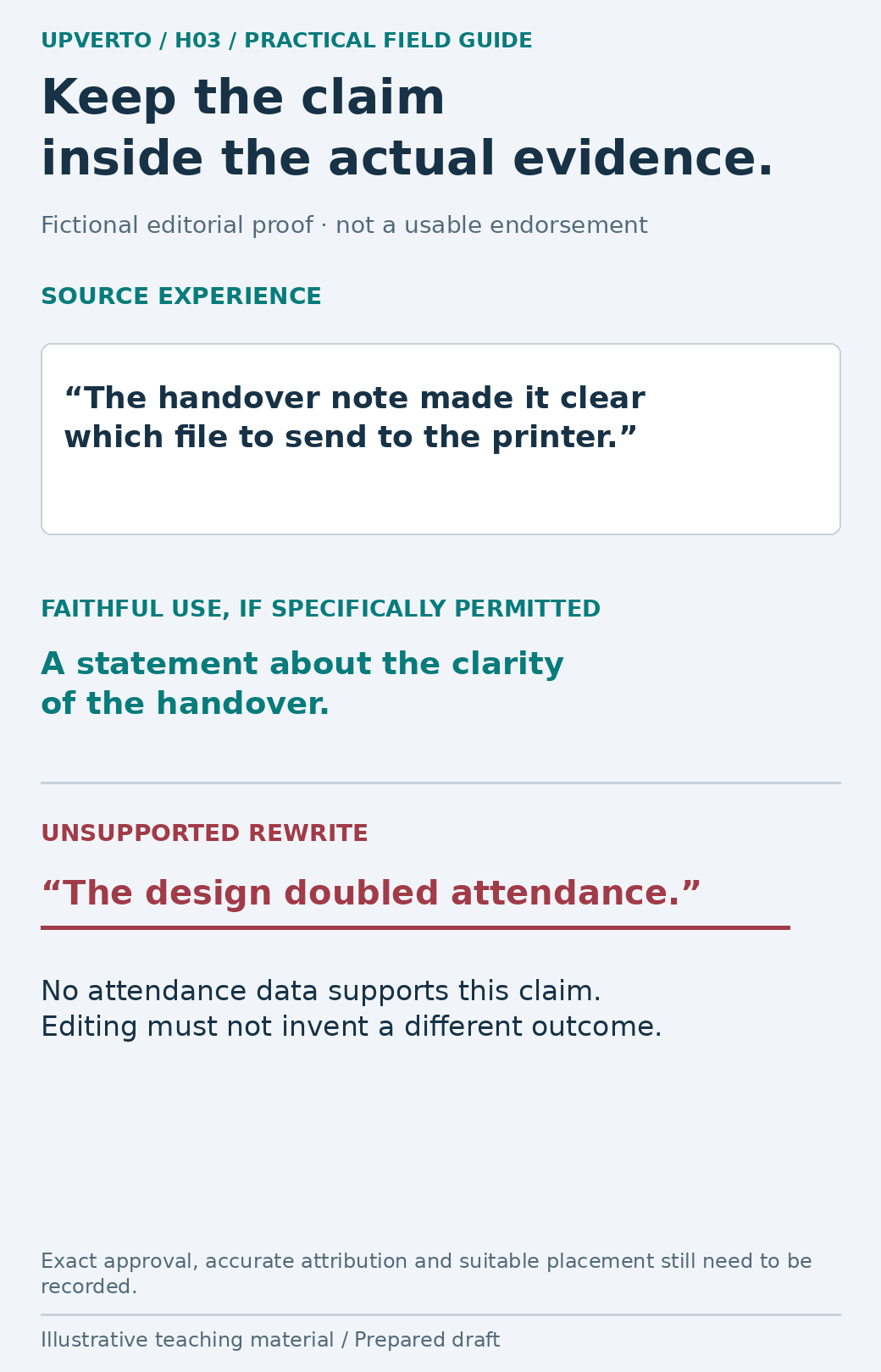
    “The note made it clear which file to send to the printer.”A quote about the handover, with approved attributionPotentially appropriate after exact permission
    “The design looked organised, but we have not used it yet.”Remove the qualification and claim a successful campaignMisleading; retain the actual limit
    No attendance data supplied“The design doubled attendance.”Unsupported; do not publish

    These statements are fictional editorial examples and must never be used as real endorsements. In your own record, keep the actual source, project, date, approved wording, attribution and permitted placement. If the approval is limited to a proposal PDF, do not silently add the quote to a public website.

    A fictional handover-clarity statement supports a statement about file use, while an invented claim that the design doubled attendance is rejected as unsupported.
    Reject a testimonial rewrite that invents a result — An edit can shorten feedback; it cannot manufacture a different experience or result. Use the enlarged view, then swipe or use arrow keys to inspect. View full-size infographic.
    Read the text version: Reject a testimonial rewrite that invents a result

    The fictional source statement concerns clarity about which file to print. If specifically permitted, its public use should preserve that meaning. Rewriting it as a claim that a design doubled attendance invents an unsupported result. Exact publication permission, attribution and placement still need to be recorded. These sample statements are not real testimonials.

    Ask for an introduction, not someone else’s private list

    A referral request should explain the kind of work you are seeking and let the person decide whether they know someone appropriate. Give them a short description they can forward. Avoid requesting access to their customer database, collecting private contact details without an appropriate basis or implying that an introduction guarantees a sale.

    Fictional referral draft: “If you know an organiser who needs a defined event-design pack from approved copy, you are welcome to forward my project page. Please ask them whether they would like an introduction before sharing their contact details. There is no need to recommend a result you have not observed.”

    When a conversation begins through that introduction, keep the relationship accurate. The guide to find freelance work through LinkedIn network explains useful professional conversations without invented familiarity. An introduction is a starting point for relevance and discovery, not proof that the project is already suitable.

    Copy this testimonial and referral permission record

    FieldWhat to retain
    Source and experienceWho gave the feedback and what work they actually experienced
    Original wordingThe unedited statement and its context
    Proposed public wordingAny shortening or edit, with material limits preserved
    AttributionName, role, organisation or agreed alternative; logo permission separately
    PlacementThe actual website, profile, PDF or other intended use
    Permission recordWhat was approved and when; any restrictions or later change request
    Claim checkWhich outcomes are supported and which must not be implied
    Referral actionWhat may be forwarded and whether an introduction is welcomed

    Use show portfolio work honestly when preparing a case study around the same work. The case study, testimonial and project evidence should agree about your contribution and the limits. A positive quotation cannot repair a misleading description elsewhere on the page.

    Review older endorsements when the service changes. A statement about a small design handover should not be repurposed as proof of a different specialist service. Handle requests to change or remove attribution through the applicable agreement, platform rules and privacy requirements. Keeping the record clear makes that conversation easier.

    Frequently asked questions

    Can I write a testimonial for the client to approve?

    You can propose a faithful shortening of feedback they actually gave, then ask them to confirm the exact wording. Do not invent praise or an outcome and ask someone to legitimise it merely by agreeing.

    May I publish a compliment from a private message?

    Ask for permission for the wording, attribution and intended placement. A private message is not automatically approval to publish a name, logo or project detail.

    Can I offer a discount for a positive review?

    Do not condition an incentive on positive sentiment. Requirements vary by jurisdiction and platform, and disclosure can also be required. The examples here use no incentives; consult current applicable rules before any alternative arrangement.

    Can feedback on a practice project become a client testimonial?

    No. Describe the relationship accurately, such as a practice-project review, and obtain permission. Do not imply the reviewer purchased a service or experienced a result they did not observe.

    What if a client gives useful criticism instead of praise?

    Thank them, investigate the issue and use it to improve the work or process. Feedback does not need to become marketing material. Do not pressure the person to replace an accurate account with a positive one.

    How should I ask for a referral?

    Describe a specific suitable task and offer a short page or note the person can forward. Let the prospective contact choose whether to engage, and do not request a private contact list or imply guaranteed results.

    Sources and scope

    The worked examples, worksheets and diagrams are original fictional teaching materials. They are not reports of client results. Primary references were checked during preparation; verify current rules and account-specific features before acting.
  • Stay Solo or Build a Small Agency? Questions to Decide

    Stay Solo or Build a Small Agency? Questions to Decide

    You can improve a freelance business without building a team. A solo practice may fit the kind of work, client relationships and life you want. A small agency may make sense when there is a repeatable delivery need and you want to take responsibility for coordinating other people’s work.

    The decision starts with the work you need to deliver, the limits you face and the responsibility you are prepared to keep. More people can increase production capacity, but they also create briefing, review, communication and payment obligations. Compare the whole arrangement before promising a larger service.

    Name the constraint before choosing a structure

    Begin with records that track freelance income costs capacity. Is the constraint too much suitable production work, unreliable inputs, underpriced scope, a skill gap or inconsistent demand? Hiring does not resolve all of these. An unclear brief can become a confusing brief shared with more people.

    Separate a temporary peak from a repeated need. If one unusual project exceeds your capacity, a narrower scope, later schedule or clearly agreed specialist collaboration may be more proportionate than changing the whole business. If demand is uncertain, do not treat every enquiry as committed work.

    Write the constraint as an observable statement: “Three accepted projects need export preparation in the same week” is more useful than “I need to scale.” Then list possible responses, including declining work, improving the process or staying solo with a more focused offer.

    Compare the responsibilities you would actually hold

    The GOV.UK service-delivery governance guidance emphasises decisions and responsibility at the appropriate level. Applied to a small freelance project, that means naming who can decide the scope, who performs the work and who checks the final delivery. The worksheet below is an original adaptation, not an agency operating standard.

    QuestionSolo practiceSmall team arrangement
    ProductionYou make the agreed outputsNamed people make defined outputs
    QualityYou check your own delivery against requirementsYou need a review and correction route across contributors
    Client communicationUsually fewer handoversAgree who communicates and who can commit to changes
    CapacityBounded by your time and skillsBounded by production, coordination, review and availability
    CostYour tools, operations and delivery costsAdd collaborator payments and coordination overhead
    ContinuityPlan for your absencePlan for dependencies and absent contributors

    Do not assume that delegating a task transfers your promise to the client. Clarify the actual arrangement and who remains accountable for delivery. Legal structure, employment status, insurance and contractual duties depend on the location and facts; this article does not prescribe a classification or hiring process.

    Worked example: six delegated hours free four lead hours

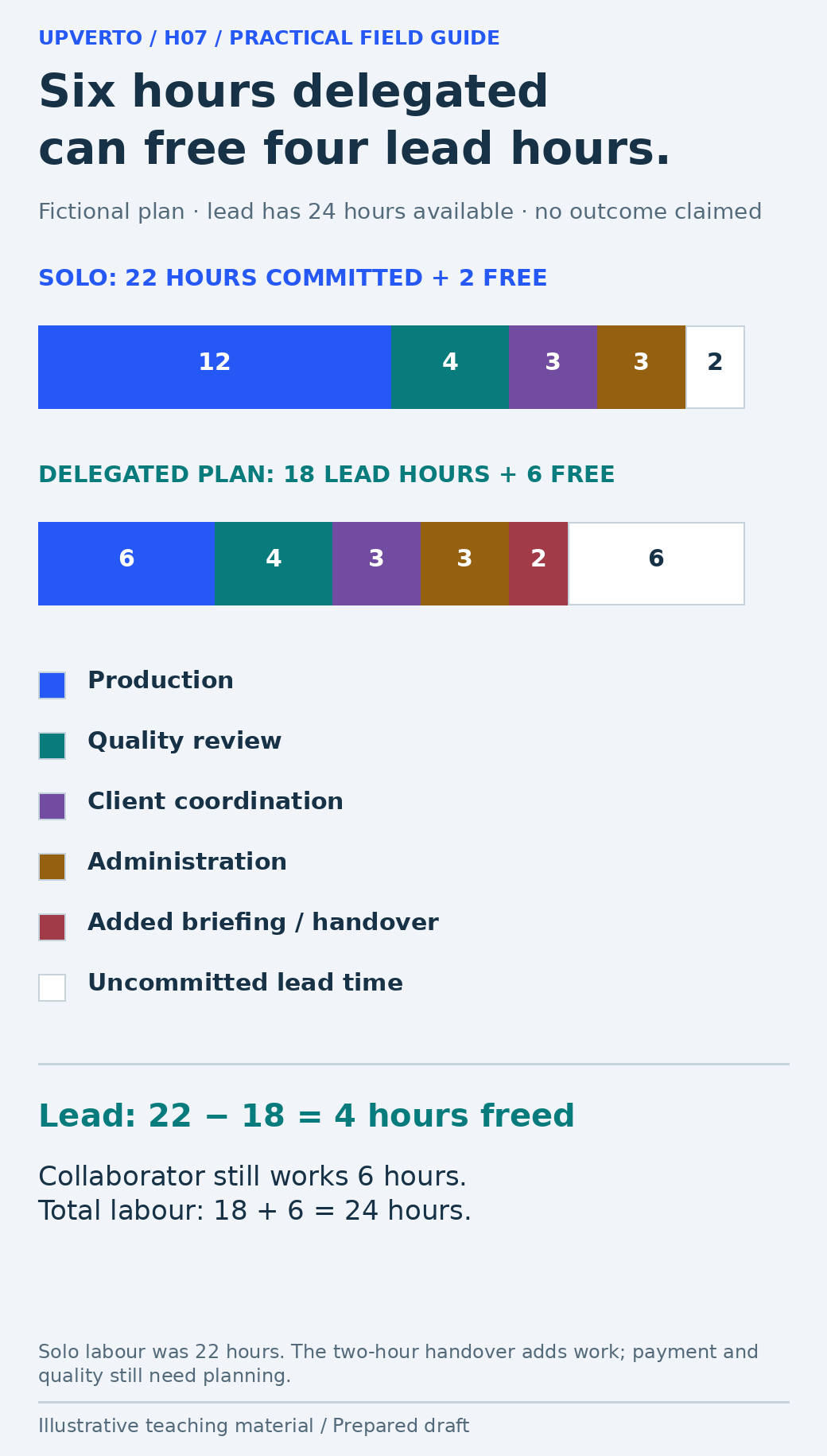
    The following is a fictional planning scenario, not a tested staffing result. A freelancer has 24 available hours in a week. The solo plan uses 12 for production, four for quality review, three for client coordination and three for administration. That is 22 hours, leaving two uncommitted.

    Suppose an authorised collaborator takes six hours of the production work. The lead now has six production hours, the same four quality hours, three coordination hours and three administration hours. Briefing and receiving the collaborator’s work adds two hours. The lead’s total becomes 18 hours, leaving six uncommitted.

    The lead gains four hours of capacity, not six: 22 − 18 = 4. The collaborator still works six hours and must be paid under the agreed arrangement. Total planned labour rises from 22 to 24 hours because the handover adds work. No revenue increase, quality improvement or profit is assumed.

    Aligned 24-hour lead-capacity bars show a solo plan with 22 committed hours and a delegated plan with 18. Six production hours move to a collaborator while two briefing hours are added.
    Count coordination overhead when evaluating delegation — Six delegated production hours free four lead hours in this fictional plan. Use the enlarged view, then swipe or use arrow keys to inspect. View full-size infographic.
    Read the text version: Count coordination overhead when evaluating delegation

    Fictional solo plan: 12 production + 4 quality review + 3 client coordination + 3 administration = 22 lead hours, with 2 of 24 uncommitted. Delegated plan: 6 production + 4 quality + 3 coordination + 3 administration + 2 added briefing/handover = 18 lead hours, with 6 uncommitted. The lead frees 4 hours. The collaborator works 6 hours, so total labour is 24 rather than 22. Payment, quality and actual coordination effort still need planning; no gain or result is guaranteed.

    This example is useful because it exposes what must be estimated. The two coordination hours could be wrong. A new collaborator may need more explanation, or a well-defined task may need less. Replace each assumption with evidence from a bounded trial before relying on it for larger commitments.

    Define one task that can be reviewed

    A delegation brief should identify the approved input, exact output, constraints, due point and acceptance check. “Help with design” leaves too much open. “Prepare the two specified export sizes from the approved source file, retain the date and venue, and return files for my review” is inspectable.

    Agree access and client permission before sharing material. The least-privilege principle in the OWASP source means access should fit the task; it does not establish that the client has authorised another person to receive information. Resolve both questions. Avoid using a shared administrator account simply because it is convenient.

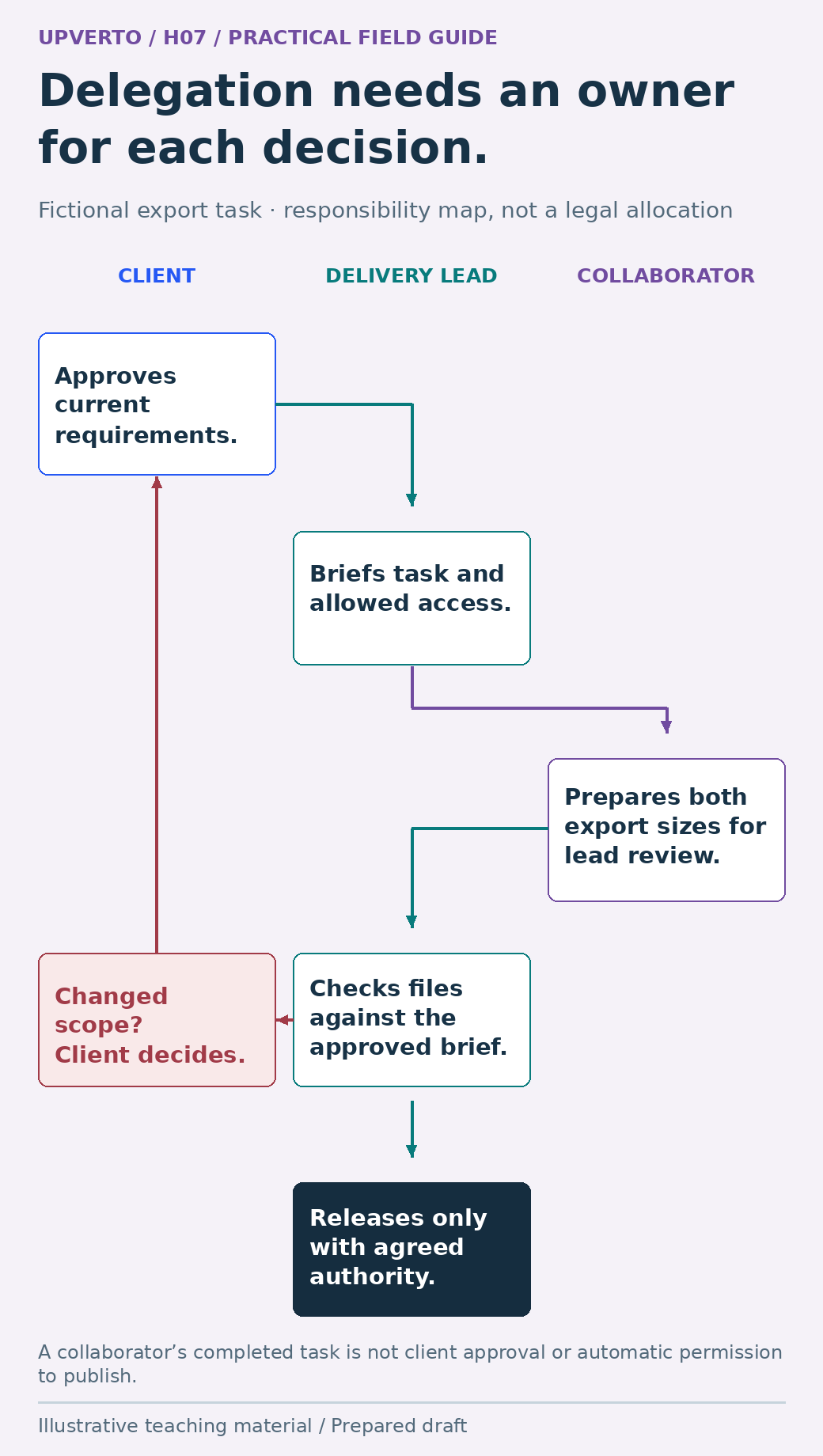
    Define what the collaborator may decide and what must come back to you. A request for a new format, a changed deadline or permission to publish should not slip through as an informal production choice. The client decision owner and the delivery lead have different roles.

    Three responsibility lanes show the client approving requirements, the lead briefing and checking, and the collaborator preparing two exports. Changed scope returns to the client; release requires agreed authority.
    Assign the decisions around a delegated export task — Define who performs the task, reviews the output and decides a scope change. Use the enlarged view, then swipe or use arrow keys to inspect. View full-size infographic.
    Read the text version: Assign the decisions around a delegated export task

    Fictional responsibility map: the client approves requirements. The delivery lead briefs the task and allowed access. The collaborator prepares two export sizes for lead review. The lead checks actual files against the approved brief. A scope change returns to the client decision owner. Release happens only with the agreed authority. This is an operational example, not a legal allocation of duties.

    Use a digital project quality checklist for the returned work. Check the actual output against the current approved requirements, record defects and allow time for correction. A reliable collaborator still needs a clear review standard; “looks fine” does not explain what was inspected.

    Complete the solo-versus-team worksheet

    Fill this in before changing the offer or promising team capacity. Use “unknown” where the evidence is missing.

    Decision fieldWrite a concrete answer
    Repeated demandWhich accepted or evidenced work would continue, and over what period?
    ConstraintWhich task exceeds your capability or realistic capacity?
    AlternativeCould scope, schedule, process or a more focused offer solve it?
    Delegated outputWhat exactly would another person return for review?
    Retained responsibilityWho approves, checks, communicates and resolves errors?
    Permission and accessWhat agreement and task-specific access are needed?
    Full costPayment, briefing, review, tools and potential rework
    ContinuityWhat happens if you or the collaborator is unavailable?
    Review pointWhat evidence would support continuing, changing or stopping?

    Compare the proposed arrangement with staying solo, not with an imaginary version where delegation has no overhead. Include whether you want to manage people. A preference for concentrated craft work is a legitimate business-design input; it is not a readiness score to overcome.

    Make a reversible next decision

    If the constraint and task are clear, consider a bounded collaboration with permissions, terms and review responsibilities settled first. Keep the test small enough to understand. Evaluate the actual output and coordination effort before offering wider capacity. Do not present a first experiment as an established agency capability.

    If the worksheet exposes uncertain demand or an unclear offer, work on those questions before adding a team. If staying solo supports your desired quality and workload, that is a complete option. The broader guide to grow a sustainable freelance business can help you connect the structure to a sustainable direction.

    Choose the next action in plain language: narrow one service, improve one handover, investigate one specialist relationship or preserve the current solo model. A business label is less useful than a clear delivery responsibility.

    Frequently asked questions

    Do I need an agency to earn more or progress?

    No particular structure guarantees earnings or progress. A solo practice can change its offer, client mix, scope or process without hiring. A team is a different set of responsibilities and costs, not an automatic next level. Choose it because a clear delivery need and your preferred role support it.

    How much time does delegation save?

    Estimate the production time removed and subtract the briefing, review, coordination and correction time added. The fictional example removes six production hours but adds two lead hours, freeing four. Actual results depend on the task, inputs, skill and working relationship; the example is not a benchmark.

    Can I share a client account with a collaborator?

    First establish permission and the appropriate access route. Use a named, task-specific account where supported and appropriate, and record when access should end. Possessing credentials does not settle authority to share information or delegate work. Resolve the agreement and access questions before the task begins.

    Who should check a collaborator’s work?

    Name a competent reviewer and an acceptance check in advance. In many lead-freelancer arrangements, the lead retains the client-facing delivery responsibility, but the actual terms matter. Inspect the returned output, allow correction time and record who can approve release rather than assuming that production completion is approval.

    Should I hire an employee or use a contractor?

    That requires a location-specific assessment of the actual relationship and obligations. Labels alone do not decide status. This guide compares operational responsibilities and does not recommend a legal classification. Consult current local official guidance and appropriate professional advice before setting up the arrangement.

    What if I only need help for one large project?

    Consider the project’s actual constraint and a bounded, properly agreed collaboration, narrower scope or revised schedule. One unusual workload does not establish recurring demand for a permanent team. Check permissions, costs, responsibilities and continuity for the chosen response, and avoid promising capacity you have not secured.

    Sources and scope

    The worked examples, worksheets and diagrams are original fictional teaching materials. They are not reports of client results. Primary references were checked during preparation; verify current rules and account-specific features before acting.
  • What to Review When Freelance Work Slows Down

    What to Review When Freelance Work Slows Down

    A quiet period can make every small decision feel urgent. Before changing your offer, buying more tools or sending a large batch of messages, review what has actually changed. Separate the state of your current commitments, cash, pipeline and service fit.

    The aim is a useful next action, not a promised turnaround date. A slower month may have several causes, and a small set of enquiries cannot prove which one dominates. A calm review is part of learning to grow a sustainable freelance business.

    Take a dated snapshot of the situation

    Start with accepted work and obligations. Which deliverables still need attention? Which payments are due under existing agreements? Which costs are already committed? Use records that track freelance income costs capacity so available cash and available time are not inferred from how busy your inbox feels.

    Then define the period you are reviewing. A count of conversations this week cannot be compared directly with proposals sent over the last six months. Record the date and keep earlier snapshots if you want to understand change. Mark incomplete data instead of filling gaps from memory.

    The SBA finance guidance is a useful general starting point for keeping money records distinct. This guide does not prescribe spending, borrowing or financial products. If you have an immediate cash problem, identify the actual obligations and appropriate help for your situation before treating new marketing as the only response.

    Separate pipeline stages by observable evidence

    A researched organisation is not automatically a prospect, a conversation is not a proposal, and a proposal is not accepted work. Give each stage an entry condition. That makes your review more informative than a single large “leads” count.

    StageEvidence neededCommon confusion
    ResearchedA dated note about a relevant organisation or needAssuming public contact details permit promotion
    Suitable to approachA credible fit and an appropriate permitted routeCounting everyone in a directory
    ConversationAn actual exchange about a potential needCounting a sent message as a reply
    Defined proposalA specific scope and decision processTreating a vague estimate as agreed work
    Accepted workThe required agreement and start conditionsAssuming silence means acceptance

    If those foundations are missing, revisit how to find freelance clients. Keep the contact approach relevant and respectful. For example, the UK ICO’s B2B marketing guidance distinguishes recipient types and the treatment of personal data; that is UK-specific guidance, not a worldwide permission to contact anyone with a business address.

    Worked example: inspect a small fictional pipeline

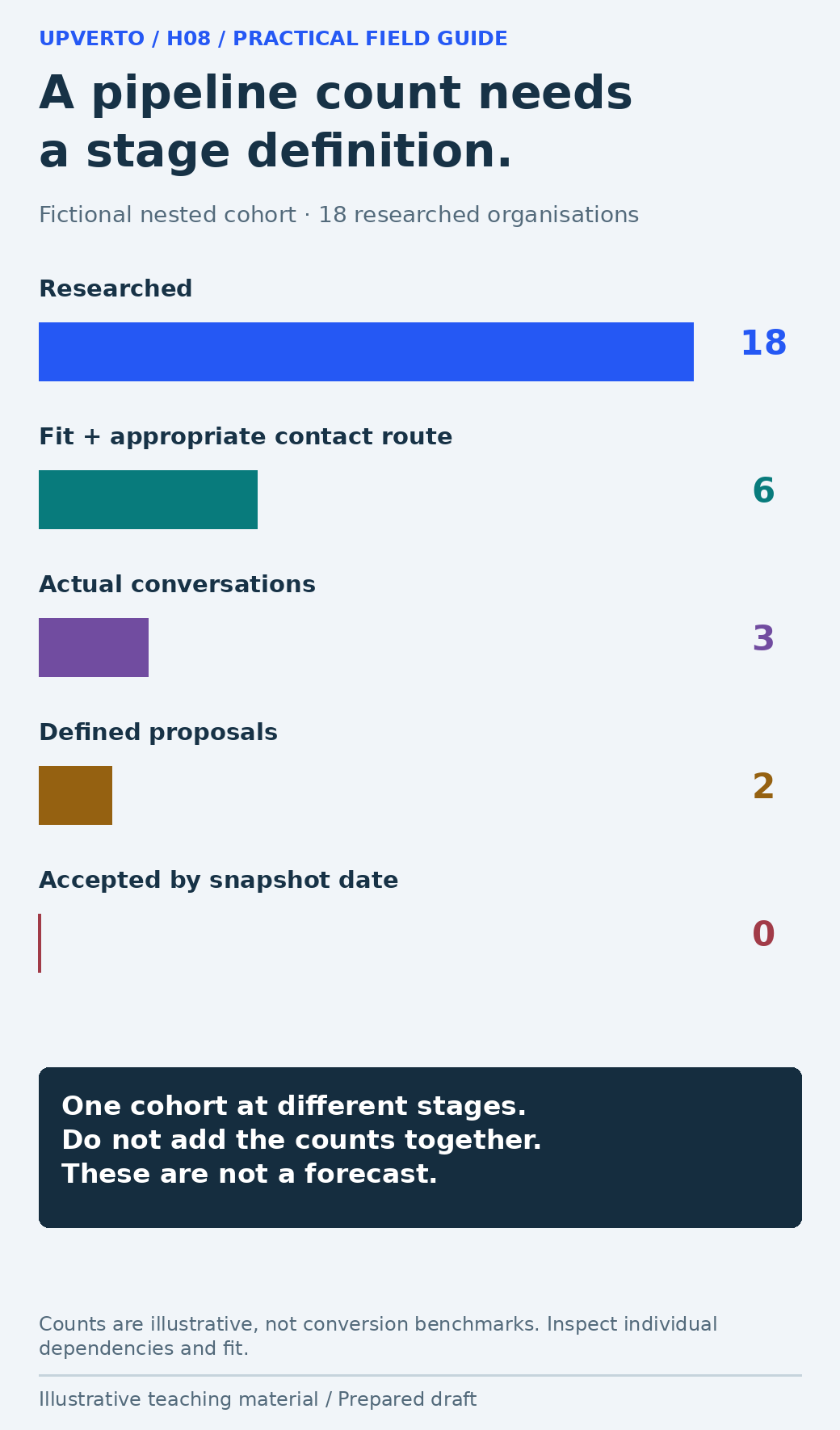
    This fictional cohort contains 18 organisations researched during a defined review period. Six met the freelancer’s fit and contact-route criteria. Three became actual conversations, two reached defined proposals and none had been accepted by the snapshot date. The counts are nested historical stages for this example, not five independent piles to add together.

    Those numbers do not establish a conversion benchmark or forecast. The two proposals need individual inspection. One is waiting for the client’s approved input; the other includes a requirement outside the freelancer’s demonstrated ability. Sending more messages would not resolve either issue by itself.

    A fictional nested cohort falls from 18 researched organisations to six appropriate prospects, three conversations, two defined proposals and zero accepted by the snapshot date.
    Define the stages in a small freelance pipeline — A stage count needs evidence, a date and a clear definition. Use the enlarged view, then swipe or use arrow keys to inspect. View full-size infographic.
    Read the text version: Define the stages in a small freelance pipeline

    Fictional historical stages within one cohort: 18 organisations researched; 6 met fit and appropriate contact-route criteria; 3 became actual conversations; 2 reached defined proposals; 0 were accepted by the snapshot date. Bars are proportional to counts. These are nested stages, not separate groups to add. The counts are neither a conversion benchmark nor a forecast; inspect the individual records.

    Fictional recordCurrent evidenceUseful next action
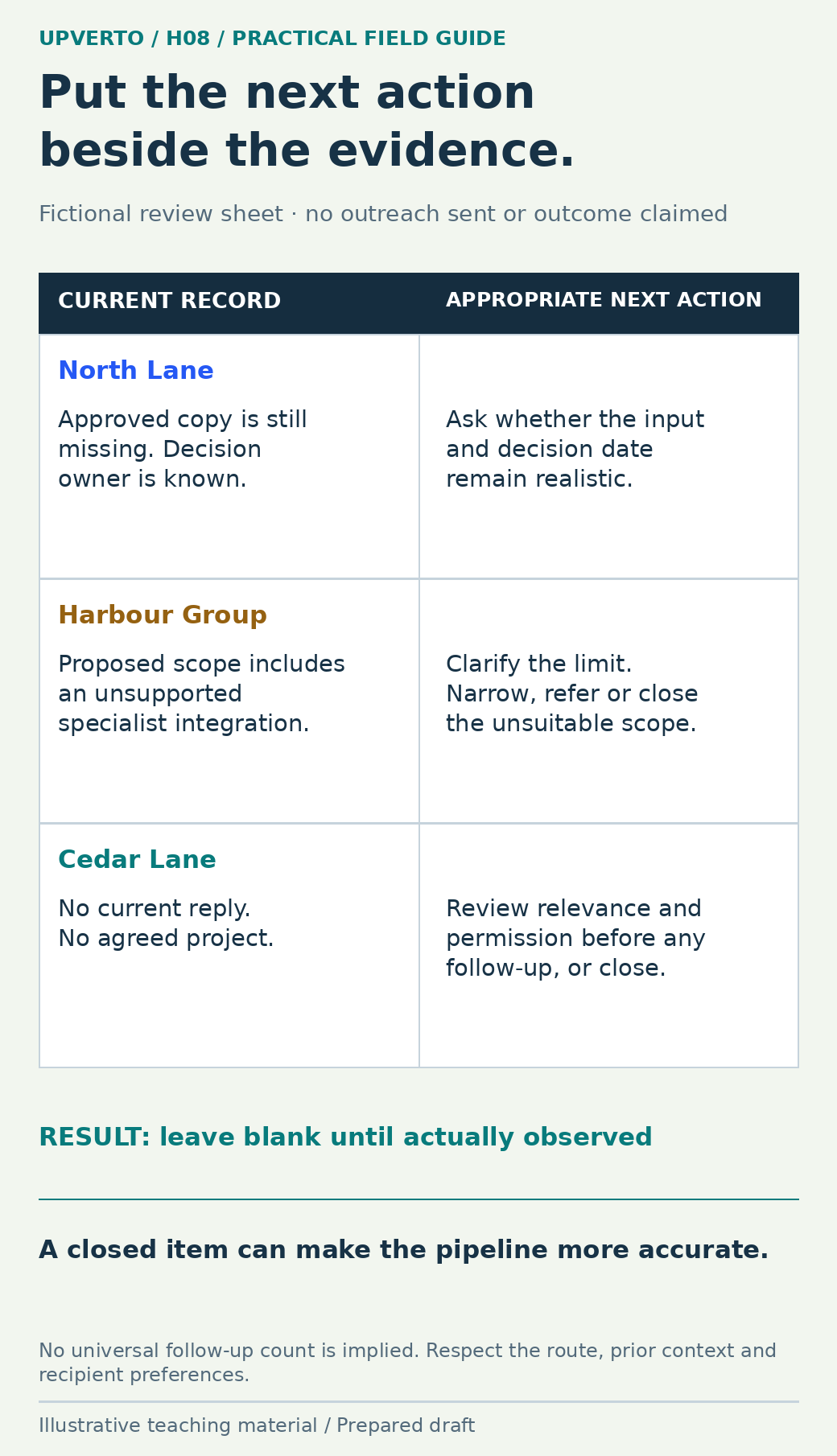
    North Lane / proposalNamed decision owner; approved copy still missingAsk whether the input and decision date are still realistic
    Harbour Group / proposalRequest includes an unsupported specialist integrationClarify the limit; narrow, refer or close the unsuitable scope
    Cedar Lane / conversationNo current reply and no agreed projectReview whether a relevant follow-up is appropriate, otherwise close the active item

    The next action is specific to the evidence. None of these records is labelled “almost won.” No business outcome is claimed, and no outreach has been sent. A closed or unsuitable item can improve the accuracy of the pipeline even though it reduces the apparent total.

    Review the offer and existing relationships

    Ask whether your current examples show the kind of work a suitable buyer needs. A portfolio can be polished yet unclear about the deliverable, audience or limits. Read recent questions and objections for precise information: “We need editable files” is more actionable than “clients do not value design.”

    The SBA market-research guidance suggests examining demand and alternatives. Applied here, compare the problem you offer to solve with what people actually described. Do not infer demand from your enthusiasm for a tool or from another freelancer’s public success story.

    Existing relationships deserve the same care. Review unfinished follow-through, agreed review points and real recurring needs. Do not invent a reason for contact or imply that a past client owes you new work. If there is a relevant question, ask it concisely through an appropriate route and respect an answer or a request to stop.

    Copy the pipeline and next-action review sheet

    Create one row per real opportunity or relationship. Keep personal information limited to what is necessary for the review and follow the relevant rules and platform terms.

    FieldWhat to write
    Snapshot date and periodThe point in time and cohort you are reviewing
    Stage and entry evidenceThe actual exchange, scope or agreement supporting the stage
    FitNeed, relevant capability and known exclusions
    Decision ownerWho can decide the next step, if known
    Open dependencyMissing input, permission, timing or unresolved scope
    Next appropriate actionA specific action, including pause or close
    Owner and review dateWho does it and when the record should be checked
    ResultWhat actually happened; leave blank until observed
    A filled fictional review sheet pairs missing approved copy with a timing question, an unsupported integration with narrowing or referral, and a nonresponse with conditional follow-up review or closure. The result remains blank.
    Translate pipeline evidence into specific next actions — Choose the action from the actual record and leave outcomes unclaimed. Use the enlarged view, then swipe or use arrow keys to inspect. View full-size infographic.
    Read the text version: Translate pipeline evidence into specific next actions

    Fictional review: North Lane has a known decision owner but missing approved copy, so ask whether the input and decision date remain realistic. Harbour Group requests an unsupported specialist integration, so clarify the limit and narrow, refer or close unsuitable scope. Cedar Lane has no current reply or agreed project, so review relevance and permission before any follow-up or close the item. The result field remains blank until observed. No outreach is sent and no outcome is claimed.

    Do not automatically recycle every “no reply” into another message. Consider relevance, past contact, the permitted route and any objection. There is no universal follow-up count or interval that makes a message welcome. Record a reason to close an item so it does not reappear merely because the list was sorted differently.

    Give your own development work a limit too. One missing portfolio example may be worth preparing; rebuilding an entire website can become a way to avoid a small, useful conversation. Choose work that answers an identified uncertainty.

    Choose a small reviewable experiment

    If the records suggest an offer-fit problem, use them to validate a freelance service idea. A bounded experiment might clarify one service description, build one relevant sample or ask a few suitable people about a specific workflow. Define what you want to learn and what evidence would change your next decision.

    If the problem is delayed inputs, resolve that dependency. If the offer repeatedly attracts work beyond your ability, narrow it or develop the required skill before promising delivery. If time is available, use part of it for a concrete improvement while preserving existing commitments and a realistic routine.

    Set a review date and compare the evidence, not your hope for the experiment. Record unchanged demand honestly. This process can improve decisions without guaranteeing new work, a particular income or a quick recovery.

    Frequently asked questions

    How long should it take to recover from a slow month?

    There is no reliable universal timetable. Demand, timing, fit, relationships and capacity differ. Use a dated review and small actions whose results you can observe. Avoid a plan that depends on new work arriving by a promised date when no agreement supports that assumption.

    Should I lower my prices immediately?

    First inspect why suitable work is not progressing. A missing decision owner, unclear scope or unsupported requirement may have little to do with price. Review costs and the offer before changing future terms. A lower price does not guarantee demand and may leave the delivery problem unresolved.

    Should I message every past client?

    Contact should have a relevant purpose, an appropriate route and respect for the recipient’s preferences and applicable rules. Review each relationship rather than treating a past transaction as permission for unlimited promotion. A genuine service review or useful question is different from an invented urgency claim.

    What does a zero in the accepted-work column mean?

    It means no items in that defined cohort had reached the stated acceptance condition by the snapshot date. It does not prove permanent failure or forecast future results. Inspect the individual records and the period. Keep proposals, pending decisions and accepted work distinct.

    Is a bigger lead list the best next step?

    Only if insufficient relevant opportunities is the evidenced constraint. A larger list will not fix unsuitable scope, missing proof, unclear decisions or late inputs. Define the stage where progress is actually blocked and choose an action that addresses it. Keep contact routes and recipient preferences in view.

    What should I do with available time?

    Protect current obligations, then select a bounded improvement tied to an identified gap: a better sample, a clearer service description, an overdue record update or targeted skill practice. Set a review point. Avoid assuming that every free hour must be filled with new software, paid promotion or repetitive outreach.

    Sources and scope

    The worked examples, worksheets and diagrams are original fictional teaching materials. They are not reports of client results. Primary references were checked during preparation; verify current rules and account-specific features before acting.
  • How to Grow a Sustainable Freelance Business

    How to Grow a Sustainable Freelance Business

    Part of How to Make Money Online with Digital Skills: A Beginner’s Roadmap.

    A sustainable freelance business depends on useful work, reliable delivery, suitable clients, and enough time and income to support the way you operate. Growth can mean better projects, clearer scope, more repeat work, or a manageable schedule. It does not have to mean taking every available assignment.

    In this guide

    This guide is for people who have begun delivering work and want to improve the business around it. If you are still preparing your first offer, start with defining a service and finding suitable clients.

    Review what your completed projects actually show

    For each project, record the agreed scope, estimated and actual effort, direct costs, payment status, revisions, and issues. Keep client feedback alongside those records, with permission and appropriate privacy controls.

    Look for patterns. You may discover that a particular deliverable takes longer than expected, that missing inputs repeatedly delay work, or that a clear onboarding checklist prevents confusion. These observations give you concrete improvements to make.

    Separate money invoiced from money received, and revenue from costs. A busy month does not automatically mean a financially healthy month. Use accounting and tax guidance appropriate to your jurisdiction for formal records and obligations.

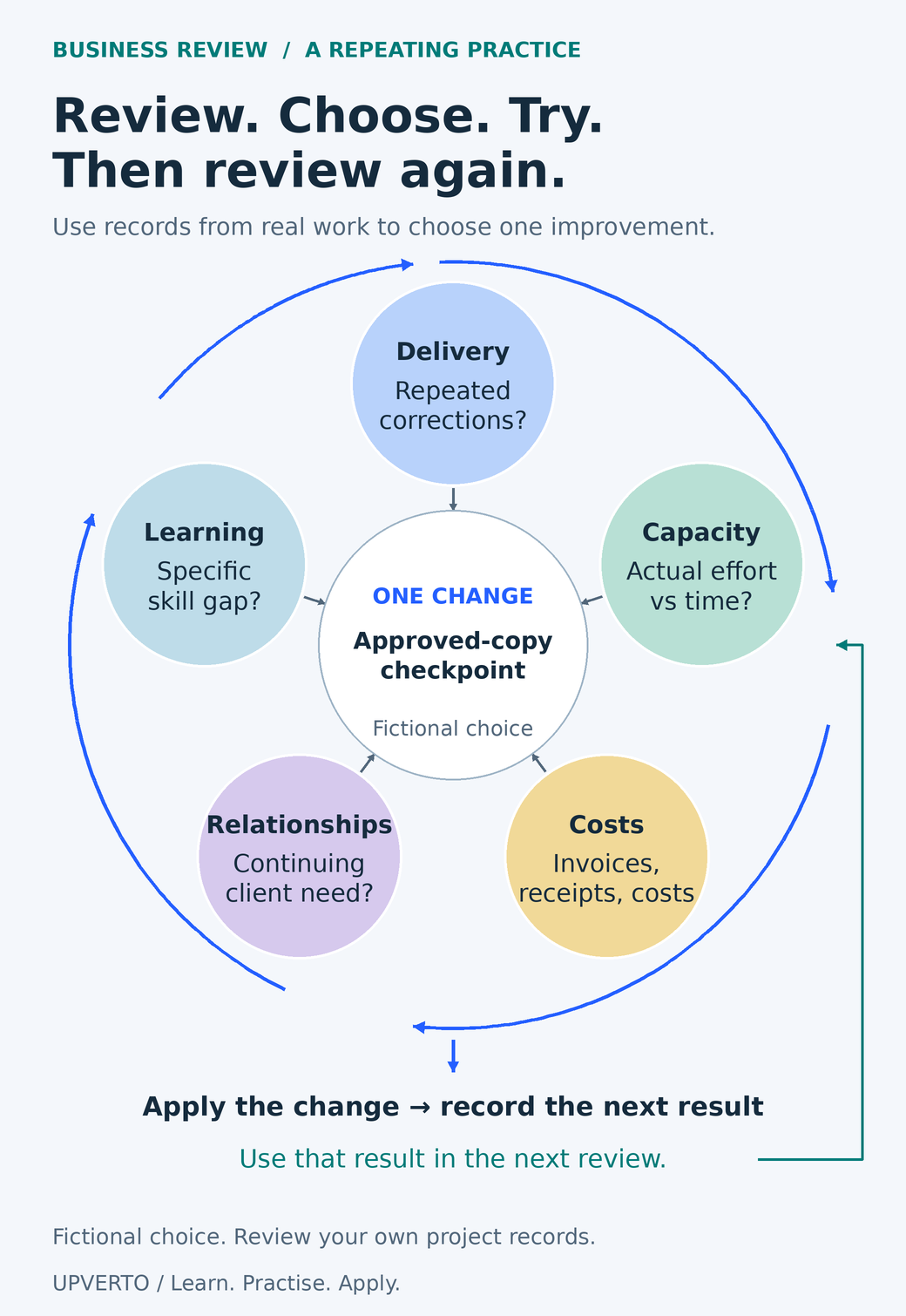
    A five-area review wheel connects delivery, capacity, costs, relationships and learning around an example approved-copy checkpoint; an outer loop returns the recorded result of applying the change to the next review.
    Turn a business review into one improvement — Review the business around the work, choose one change and bring its next observed result back into the review. Use the enlarged view, then swipe or use arrow keys to inspect details. View full-size infographic.
    Read the text version: Turn a business review into one improvement

    Use records from your own work to review five connected areas: delivery (which corrections or problems repeat), capacity (actual effort compared with available time), costs (invoices, money received and costs), relationships (a genuine continuing need), and learning (a specific skill gap).

    The centre contains a fictional choice: add an approved-copy checkpoint before production. It is an example of an improvement to test, not a reported business result. Apply the chosen change, record what happens in the next relevant project, and use that observation in the next review. The return arrow makes the review a cycle. The coloured review areas are not scores or quantitative proportions.

    Practical summary
    Four areas to review
    • Quality: does the work meet the agreed requirements?
    • Relationships: are expectations and communication clear?
    • Capacity: can you deliver within the time available?
    • Economics: do the actual costs and payment arrangements support the work?

    Develop repeat work from a continuing need

    After a successful handover, ask whether there is another relevant task or an ongoing need you can support. Connect the discussion to actual work: a recurring content schedule, a maintenance responsibility, a reporting cycle, or another defined output.

    An ongoing arrangement should specify capacity or deliverables, response expectations, review points, exclusions, and how additional work is handled. Avoid promising unlimited access or support without understanding what it could require.

    Use the package worksheet to make the arrangement clear. Continue to assess whether the work fits your ability and the client’s needs rather than assuming the first successful task covers every future request.

    Plan capacity beyond production time

    Your available time includes more than making the deliverable. Allow for enquiries, planning, communication, checking, revisions, administration, learning, and recovery from unexpected problems.

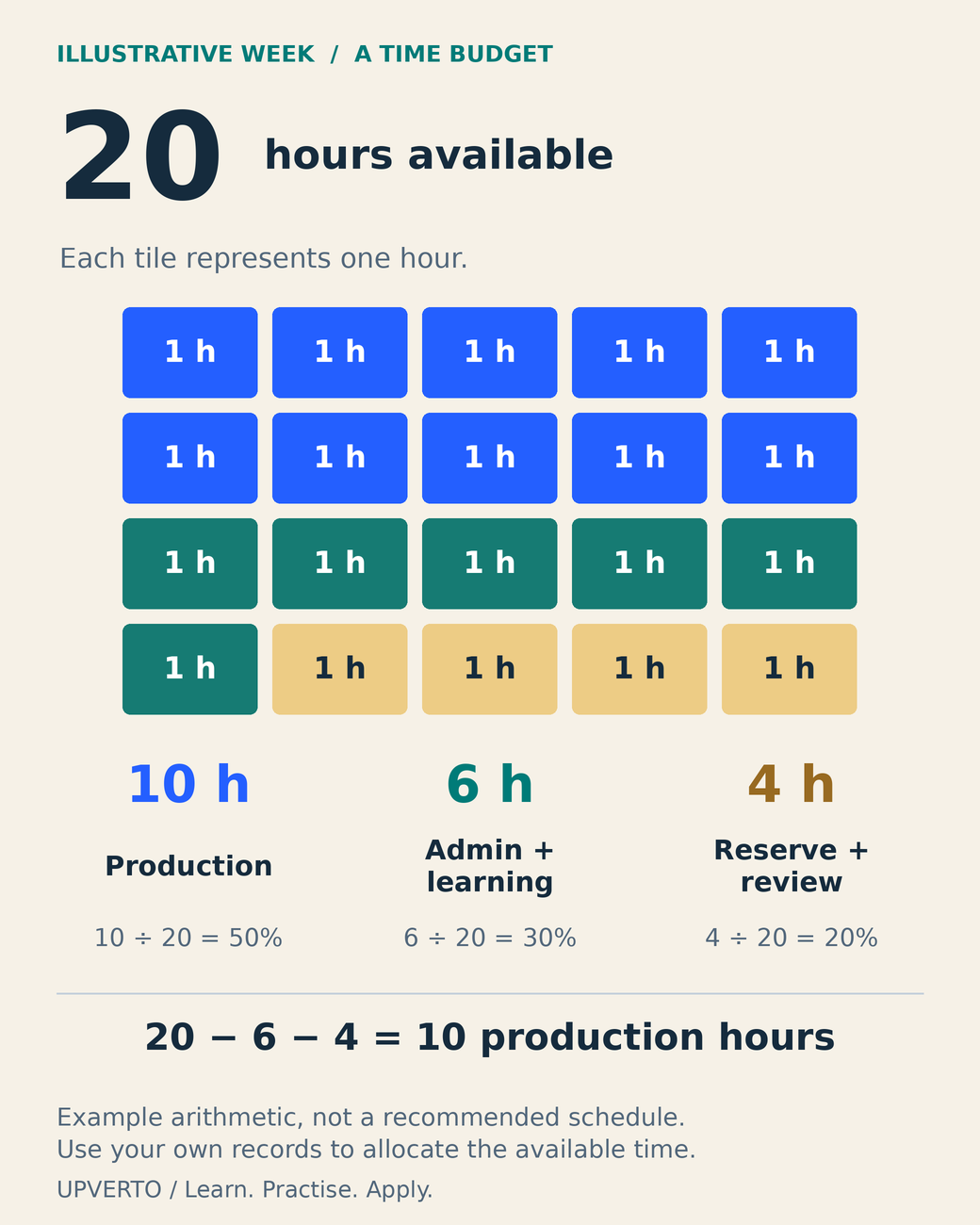
    Illustrative planning example: If you have 20 hours available in a week and reserve six for administration and learning plus four for uncertainty and review, ten hours remain for planned production. Those numbers are an example of arithmetic, not a recommended schedule. Your own records should determine the allocation.

    Before accepting new work, look at the whole delivery calendar and its dependencies. If two projects both need final review on the same day, moving a production task may not resolve the bottleneck.

    Twenty one-hour tiles show ten production hours in blue, six administration and learning hours in teal, and four reserve and review hours in amber; the labels show 50, 30 and 20 percent and the calculation 20 minus 6 minus 4 equals 10.
    Allocate the whole 20-hour budget — Count the hours and check the arithmetic in the article’s illustrative capacity example. Use the enlarged view, then swipe or use arrow keys to inspect details. View full-size infographic.
    Read the text version: Allocate the whole 20-hour budget

    The fictional weekly budget contains 20 hours in total. Each of the 20 tiles represents one hour; the grid is a unit budget, not a day-by-day timetable.

    • Production: 10 hours. 10 ÷ 20 = 0.50, or 50%.
    • Administration and learning: 6 hours. 6 ÷ 20 = 0.30, or 30%.
    • Reserve, review and unexpected problems: 4 hours. 4 ÷ 20 = 0.20, or 20%.

    The allocation totals 10 + 6 + 4 = 20 hours and 50% + 30% + 20% = 100%. Reserving six hours for administration and learning and four for uncertainty leaves 20 − 6 − 4 = 10 hours for planned production. These values illustrate the arithmetic; choose your own allocation from actual records and commitments.

    Review prices and scope using evidence

    When the work consistently takes more effort than estimated, investigate why. The brief may be too broad, the inputs may be poor, the process may need improvement, or the price may not reflect the actual service.

    Clarify scope before treating a price increase as the answer to every problem. For future engagements, explain changes in the offer and quote clearly. For existing agreements, follow the agreed terms and discuss proposed changes before applying them.

    Do not compare your price with an isolated online claim as if the services are identical. Compare the deliverables, responsibility, experience, support, channel costs, and client context. This guide provides a review process, not a universal rate recommendation.

    Make repeated work easier to perform consistently

    Create reusable structures for tasks you have actually repeated: an intake form, a brief, a file-naming convention, a check list, a delivery note, or an estimate worksheet. Review the structure after real use and remove steps that do not help.

    Keep templates free of previous clients’ confidential information. Reusing your process is different from reusing client-owned materials or disclosing another client’s work. Check ownership and permissions before carrying assets into a new engagement.

    If you automate a repeated step, test normal inputs, missing inputs, and a likely failure. Keep a way to notice the failure and recover. Automation can change the work you perform; it does not remove responsibility for the result.

    Build a reputation with accurate evidence

    When asking for a testimonial, invite the client to describe their actual experience in their own words. Obtain permission for the wording and where it will appear. Do not write a fictional quote and present it as their endorsement.

    For a case study, confirm what you may disclose and which outcomes were actually measured. Update your portfolio with useful evidence while preserving the distinction between your contribution and factors outside your control.

    A referral request should be specific and respectful: explain the kind of work you are seeking and let the client decide whether they know someone suitable. A positive relationship is not permission to contact their customers or reuse their private contact lists.

    Use a simple quarterly improvement plan

    AreaReview questionOne action to choose
    Service fitWhich tasks matched my ability and the client’s needs?Clarify or narrow one offer.
    DeliveryWhich problem repeated across projects?Improve one step in the workflow.
    CapacityWhere did actual effort exceed available time?Adjust limits, scheduling, or estimates.
    Financial recordsAre invoiced amounts, receipts, costs, and obligations recorded accurately?Resolve a record gap with suitable accounting guidance.
    RelationshipsWhich clients have a genuine continuing need?Discuss one relevant next project or arrangement.
    LearningWhich skill would remove a recurring limitation?Complete a focused learning project.
    ResilienceWhat would happen if a major project stopped?Review dependence, commitments, and the acquisition process.

    Quarterly is a suggested review rhythm. Choose a frequency that suits your volume of work and decisions. The useful part is turning records into a manageable improvement, rather than creating a report you never use.

    Decide whether help or a team would improve delivery

    Before hiring or subcontracting, identify the actual bottleneck. More people do not automatically fix unclear scope, weak demand, or inconsistent quality checks.

    If collaboration is appropriate, define responsibilities, review, communication, permissions, and payment arrangements. Confirm whether client agreements allow the proposed involvement and what information may be shared. Keep the client’s understanding of who performs the work accurate.

    Frequently asked questions

    Should I stop learning once I have clients?

    Use real delivery gaps to guide continued learning. Choose a specific improvement, practise it safely, and assess it before adding a stronger promise to your service.

    What should I do when work slows down?

    Review current commitments, records, previous enquiries, client needs, and the clarity of your offer. Identify whether the issue is demand, reach, fit, evidence, or conversion before making a major change. Avoid treating a short quiet period as proof that you need to buy a new set of tools.

    Does growing a freelance business always mean taking more projects?

    Growth can also mean clearer scope, stronger work, better-fit clients, more reliable repeat engagements or a manageable schedule. Review your actual capacity and project records before increasing volume. More assignments can create problems if the delivery process cannot support them.

    How can I turn a completed project into repeat work?

    After a useful handover, discuss a genuine continuing need that matches your ability. Define the next deliverables, response expectations and review points clearly. Do not assume that a successful first task gives you permission to access more information or expand the service automatically.

    When should I review my prices?

    Review them when your records show a change in effort, costs, responsibility or the service itself. Check whether unclear scope or an inefficient process is causing the problem. Explain future quotes clearly and follow the agreed terms when discussing changes to an existing engagement.

    When does subcontracting make sense?

    Identify the actual bottleneck and whether qualified help would improve delivery. Clarify responsibilities, review, permissions and payment arrangements, and confirm that the proposed involvement is consistent with the client agreement. Adding people will not by itself fix an unclear offer or weak quality checks.

    Improve one part of the business

    Review one completed project and choose one concrete change. It might be a clearer package, a stronger delivery checklist, a more relevant client-acquisition process, or a focused learning plan. Build growth from evidence about the work you actually do.

  • When and How to Review Your Freelance Prices

    When and How to Review Your Freelance Prices

    Review prices when the service, costs, effort or responsibility has changed enough to deserve a new decision. Use your project records to understand the cause before proposing a change. A higher price cannot by itself repair an unclear brief, repeated rework or an unrealistic schedule. This review belongs within grow a sustainable freelance business.

    Identify what has actually changed

    The initial estimation method is covered in how to price freelance work. A later review asks whether its assumptions still match the work. Compare the planned outputs, inputs, review effort, direct costs and responsibility with recent completed projects. Use comparable work rather than a single unusual job.

    Australian Government pricing guidance recommends considering costs and reviewing prices when conditions change. This guide adapts that general business principle into a project worksheet. It does not provide a market rate, a universal percentage increase or a promised income level.

    Useful triggers include a consistently wider deliverable set, higher necessary costs, more coordination, additional checking or changed support responsibilities. Better evidence and a clearer service may also affect the offer you can make. Distinguish those reasons from an isolated social-media claim that someone else charges more.

    A six-hour estimate is compared with eight recorded hours split proportionally into four production, two review, one coordination and one final checking.
    Compare estimated and recorded project effort — The difference identifies questions to investigate rather than an automatic price increase. Use the enlarged view, then swipe or use arrow keys to inspect. View full-size infographic.
    Read the text version: Compare estimated and recorded project effort

    Fictional example: the original estimate is 6 hours. Recorded time totals 8 hours: production 4, review 2, coordination 1 and checking 1. Bar lengths use the same scale. Investigate the estimate and input/process conditions before deciding on a future scope or price. These figures are not a benchmark or forecast.

    Separate price pressure from scope or process problems

    Observed patternQuestion before changing the price
    Actual effort exceeds the estimateWas the original estimate wrong, or did the work expand?
    Many review cyclesWere the acceptance conditions and final approver clear?
    Repeated missing inputsWould a better intake process reduce avoidable waiting and rework?
    Higher direct costsAre they necessary for this service and recorded accurately?
    Calendar overloadIs the problem capacity, scheduling or the service promise?
    Client needs have changedShould the offer be narrowed, redesigned or separately scoped?

    A price review can produce several legitimate outcomes: a different scope, clearer input conditions, a new delivery process, a revised quote for future work or a decision to stop offering the service. Do not assume that every difficulty requires the client to pay more for the same unresolved process.

    Use track freelance income costs capacity to obtain the records behind the discussion. Include non-production time that belongs to the project, such as coordination and checking. Avoid comparing a fee only with time spent making the visible output while ignoring the work needed to deliver it responsibly.

    Worked example: the six-hour estimate becomes eight

    Fictional arithmetic example: A defined design job was estimated at six hours and agreed at 300 monetary units. The recorded project time is eight hours: four production, two review, one coordination and one final checking. Direct external costs are 20 units. These are invented planning values, not market prices or expected earnings.

    The 300-unit fee minus 20 units of direct costs leaves 280 units before other overhead, taxes, unpaid business time and personal withdrawals. Dividing 280 by eight project hours gives 35 units per recorded project hour. That diagnostic ratio is not take-home hourly pay and is not a complete profit calculation.

    QuestionFictional findingPossible response
    Did the output expand?No additional format was addedDo not label all extra time new scope
    Where was time underestimated?Review and checking were undercountedImprove the estimate for comparable future work
    Were inputs unclear?Two unapproved copy changes caused avoidable reviewConfirm copy approval before layout
    What should change next?Future scope and estimate need revisionPrepare a clear new proposal; do not alter an existing fee silently
    A fictional fee of 300 less direct costs of 20 leaves 280; divided by eight project hours it gives 35, with overhead, taxes and unpaid business time explicitly excluded.
    Interpret a price-review ratio with its limits — The calculation is a limited diagnostic, not take-home income. Use the enlarged view, then swipe or use arrow keys to inspect. View full-size infographic.
    Read the text version: Interpret a price-review ratio with its limits

    Fictional arithmetic: 300 monetary units fee minus 20 direct external costs equals 280 before other costs. Dividing 280 by 8 recorded project hours equals 35 per recorded hour. Other overhead, taxes, unpaid business time and personal circumstances are excluded. This is not complete profit, take-home pay, a market rate or a recommended price.

    Copy a price-review worksheet

    FieldWhat to record
    Comparable serviceDeliverables, audience, input conditions and responsibility
    Previous assumptionsEstimated effort, costs, review and support
    Observed recordsActual time categories, costs and scope changes
    CauseEstimate gap, process problem, changed requirement or genuine cost change
    Proposed offerWhat stays, changes or is excluded
    Planning calculationYour own assumptions and costs, clearly distinguished from a market claim
    Capacity and fitWhether you can deliver the revised promise
    CommunicationWhich future quote or renewal is affected and what needs agreement

    If you use an internal time allowance to inform a future price, label it as your planning assumption. Include the costs and business responsibilities you actually need to cover. A spreadsheet result is not evidence that a buyer values the offer at that amount. Consider the task, alternatives and the client’s context without claiming certainty about demand.

    Review outliers separately. A one-off corrupted file or unusual emergency may not represent normal work. Conversely, a problem that repeats across several comparable projects deserves attention. Keep enough context to explain why the new assumption is more credible than the old one.

    Explain a proposed change before it applies

    For a new enquiry, quote the current defined service clearly. For an existing engagement or renewal, follow the actual agreement and discuss the proposed change before applying it. Legal requirements and contract terms vary; this guide does not prescribe a universal notice period or right to change an existing price.

    Fictional communication outline: “For the next project, I propose a package that includes the two named formats, one consolidated review stage and final export checks. My recent records show that those checks and coordination need more time than the old estimate allowed. The attached proposal states the revised fee and input conditions. Please review it before we schedule the next project; the current agreed project remains governed by its existing terms.”

    Explain the changed offer and decision without apologising for a legitimate review or inventing a scarcity claim. Give the client a clear way to accept, ask questions or decline. If you offer a smaller option, make its reduced scope explicit rather than quietly delivering less under the old description.

    Check whether the revised offer works in practice

    After using the revised scope, compare the assumptions with actual work again. Did copy approval reduce avoidable revisions? Did you allow enough checking time? Did the agreed capacity remain manageable? These observations can improve the next estimate without turning every project into a price experiment.

    For continuing work, use retain freelance clients ongoing services to discuss usefulness and boundaries at the review point. A responsible price conversation connects the fee to a clear, deliverable service. It does not guarantee acceptance, profitability or a particular level of income.

    Frequently asked questions

    How often should I raise my prices?

    There is no universal schedule or required increase. Review relevant costs, effort, responsibility and service changes at a sensible interval or when evidence changes. A review may lead to clearer scope or process improvements instead of a higher fee.

    Can I increase the price halfway through a project?

    Do not change an existing agreement unilaterally. Follow its terms and the applicable requirements. If genuinely new work is requested, explain and agree its impact through the change process before starting it.

    Does earning 35 units per project hour mean I take home 35?

    No. In the example, the ratio subtracts only direct external costs and uses recorded project hours. Other overhead, taxes, unpaid business work and personal circumstances are not included.

    What if competitors advertise much lower prices?

    Compare the actual outputs, inputs, responsibility, support and evidence rather than the number alone. You may need a different scope or customer fit. This guide does not claim that matching or exceeding another price produces work.

    Should I give every existing client a discount?

    That is a business decision within your agreement and circumstances, not a rule. Assess the defined service and costs, explain any option clearly and avoid a concession that creates an unsustainable promise.

    What if a client declines the revised offer?

    Respect the decision and discuss a genuinely smaller scope only if it would still be useful and deliverable. Do not hide exclusions or promise the full service at a price your records show you cannot responsibly support.

    Sources and scope

    The worked examples, worksheets and diagrams are original fictional teaching materials. They are not reports of client results. Primary references were checked during preparation; verify current rules and account-specific features before acting.