Category: Offer a service

  • Hourly, Fixed-Price or Retainer: Choose a Pricing Model

    Hourly, Fixed-Price or Retainer: Choose a Pricing Model

    A pricing model defines what the client is paying for: recorded effort, a specified output or an agreed recurring commitment. The model should fit the work and its uncertainty. It does not determine a fair price by itself.

    Begin with a service you can deliver, as explained in turn digital skill into freelance service. This guide compares arrangements. Use how to price freelance work for the separate task of estimating effort, costs and an actual quote.

    In this guide
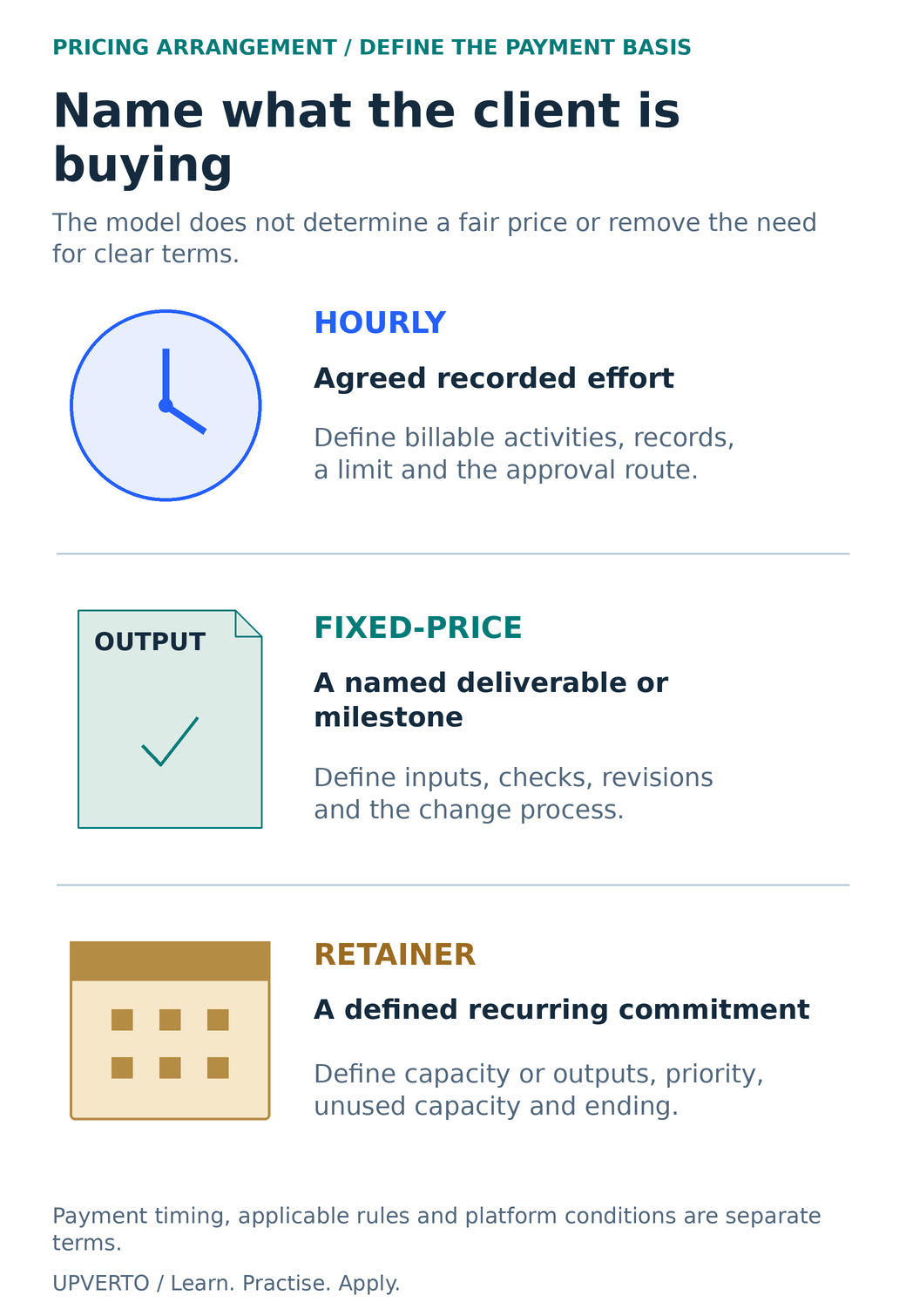
    A clock, checked output document and recurring calendar represent hourly effort, a fixed deliverable and a defined retainer commitment, each with its own agreement boundaries.
    Distinguish three payment bases — A clock, checked output document and recurring calendar represent hourly effort, a fixed deliverable and a defined retainer commitment, each with its own agreement boundaries. Use the enlarged view, then swipe or use arrow keys to inspect details. View full-size infographic.
    Read the text version: Distinguish three payment bases
    ArrangementPayment basisTerms to define
    HourlyAgreed recorded effortBillable activities, records, limit and approval route
    Fixed-priceA named deliverable or milestoneInputs, acceptance checks, revisions and changes
    RetainerDefined recurring capacity, access or outputsPeriod, priorities, unused capacity and ending

    The model does not set a fair price. Payment timing, applicable law and any platform conditions need separate consideration. A recurring fee does not automatically mean unlimited work.

    Understand what each arrangement controls

    ModelPayment basisWhat must be clearCommon ambiguity
    HourlyAgreed recorded timeRate, billable activities, records, limit and approval processAssuming every hour is automatically authorised
    Fixed-priceNamed deliverable or milestoneInputs, output, checks, revisions and change processAssuming an output price includes every related request
    RetainerDefined recurring access, capacity or outputsPeriod, included work, availability, unused capacity and endingAssuming a recurring fee means unlimited work

    Terms vary across agreements and platforms. “Retainer” can describe different arrangements, so explain the actual promise rather than relying on the label. Payment timing, deposits, invoices and legal treatment need to be specified separately for the engagement.

    A hybrid can be appropriate when the phases differ. A bounded discovery task may clarify an uncertain problem before a fixed production scope. Do not use a hybrid to obscure the total commitment or charge twice for the same work.

    Choose around what can be known before starting

    Fixed-price work is easier to discuss when the output and acceptance checks can be described. For example, two layouts from approved copy with named formats and one consolidated review can have a clear boundary. If the client cannot yet say what the source material contains, the uncertainty needs investigation before a reliable commitment.

    Hourly work can accommodate uncertain effort, but it still needs control. Agree on what counts as work, how time is recorded, when the client receives an update and what happens near a limit. A cap should trigger a conversation before it is exceeded; it should not be a surprise on an invoice.

    Recurring work needs evidence of a recurring need. A retainer may reserve a defined amount of capacity or deliver a specified set of outputs during each period. Decide how requests are prioritised, what response commitment exists and what happens to unused capacity. Never imply that payment guarantees constant availability unless that is explicitly defined and sustainable.

    Check the contract rules of the channel you use

    Platforms implement arrangements through their own systems. Upwork’s hourly and fixed-price guidance distinguishes time records and weekly limits from fixed milestones. These mechanics are examples of a provider’s current workflow, not universal rules for direct-client agreements.

    Read protection conditions separately. Upwork’s payment-protection guidance states that hourly protection has eligibility criteria and does not cover manual time or bonuses. Do not describe any arrangement as guaranteed payment simply because the platform offers a protection programme. Fixed-price work has its own requirements.

    For direct work, record the agreement and use appropriate payment and administrative processes. Local tax, employment-status, contract and consumer rules may affect the arrangement. A label such as contractor or retainer does not settle those questions across jurisdictions.

    Worked example: three different tasks, three possible arrangements

    Fictional task one: create a square announcement and printable information sheet from approved copy and permitted assets. The outputs, review round and checks are known. A fixed project or two defined milestones may fit, subject to the actual estimate and agreement.

    Fictional task two: investigate why an existing document workflow produces inconsistent exports. The cause and repair effort are unknown. A bounded hourly investigation with a stop-and-report limit may fit. The output of that phase is a diagnosis and options, not an unlimited promise to repair every issue.

    Fictional task three: a client has a genuine continuing need for small approved content updates. An illustrative monthly arrangement reserves up to twelve hours for a named set of update tasks. It specifies a request queue, response windows and what happens when capacity is used. Twelve hours is an invented example boundary, not a recommended retainer size.
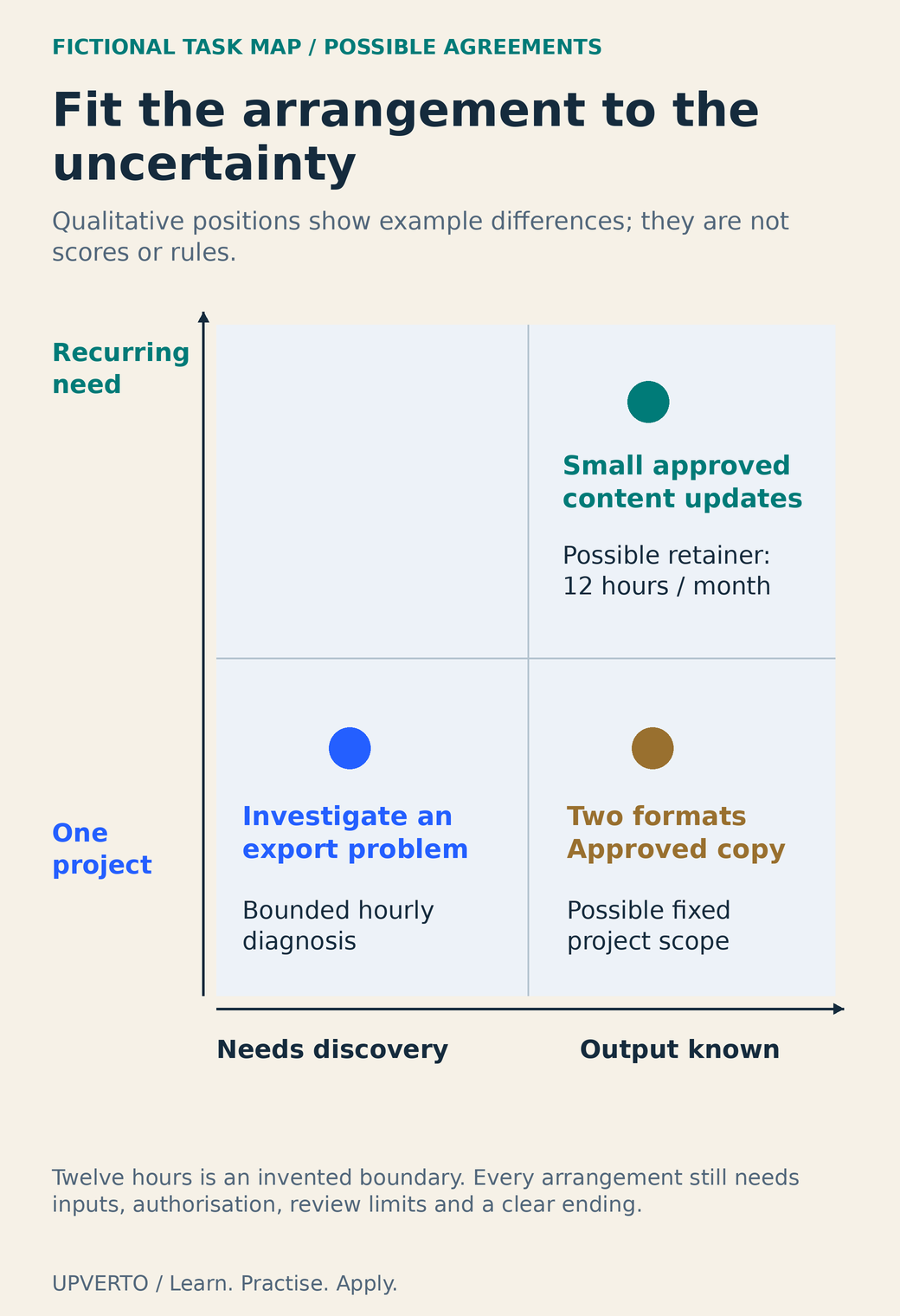
    A qualitative map places an uncertain export diagnosis, a defined two-format output and recurring small updates according to scope clarity and recurrence.
    Match three example tasks to possible arrangements — A qualitative map places an uncertain export diagnosis, a defined two-format output and recurring small updates according to scope clarity and recurrence. View full-size infographic.
    Read the text version: Match three example tasks to possible arrangements

    This fictional, non-numeric map uses two questions: does the work recur, and is the output already known? An investigation into inconsistent exports has an unknown cause and may fit a bounded hourly diagnosis. A square announcement and printable sheet from approved copy may fit a fixed scope. Genuine recurring small approved updates may fit an illustrative retainer with up to 12 hours per month. The positions are not measured scores, and these choices are not universal rules. Twelve hours is an invented teaching boundary. Each arrangement needs explicit inputs, authorisation, review limits and ending conditions.

    The third arrangement still needs decisions about unused hours, holidays, urgent requests, access, ending and out-of-scope work. If those decisions remain unwritten, the word retainer hides the uncertainty rather than resolving it.

    Use the pricing-model decision worksheet

    QuestionImplication to discuss
    Can the output and acceptance checks be defined?If yes, consider a fixed scope; if not, clarify or separate discovery.
    Can effort be recorded and authorised?If yes, hourly work may fit the uncertainty with clear limits.
    Is the need genuinely recurring?If yes, consider a bounded recurring arrangement; do not assume unlimited work.
    Who supplies inputs and decisions?Record dependencies before promising timing.
    What changes the commitment?Define review limits, extra work and the approval route.
    How does the arrangement end?Specify handover, notice or completion conditions as appropriate.

    Use estimate freelance project scope to make the underlying work concrete. Then explain the model in the proposal using ordinary words: what is included, what is measured and when another decision is needed.

    Before the client agrees, ask them to restate what they believe they are buying. If they describe unlimited support while you mean a bounded monthly allocation, correct the wording. The guide to write freelance proposal helps connect the chosen arrangement to the actual need, assumptions and next step.

    Frequently asked questions

    Is fixed-price always better for beginners?

    No. It can fit a well-defined output you can estimate, but unclear inputs or unfamiliar work can make the commitment difficult to sustain. Clarify the task or define a bounded discovery phase. Choose the arrangement from the work rather than a rule about experience level.

    Does hourly pricing mean the client has no budget control?

    It should not. Agree on billable activities, records, update points and a limit or approval threshold. Explain what happens before the limit is reached. The arrangement needs both transparent effort records and a clear route for decisions.

    Is a retainer the same as unlimited revisions?

    No. A retainer describes a recurring arrangement whose actual promise must be defined. It may cover specified outputs, capacity or availability. Revision limits, priorities, unused capacity and additional work still need explicit agreement.

    Can I combine hourly discovery with fixed production?

    Yes, if the phases and payment basis are clear and appropriate for the engagement. Explain what discovery delivers and how the production quote will be decided afterwards. Do not present the initial phase as the full project price.

    Should unused retainer hours roll over?

    That is a commercial term to agree, not an automatic rule. Consider how rollover affects future capacity and the client’s expectations. State the period, any limits and what happens at the end of the arrangement in clear language.

    Does a platform payment-protection programme cover everything?

    No. Read the current criteria for the exact contract type and workflow. Some time, transactions or circumstances may be excluded. Keep the records and submission steps the provider requires, and avoid promising a guarantee the terms do not provide.

    Sources and review notes

    Primary sources checked on 27 October 2026 (UTC). Check the current provider pages before relying on a changing feature, policy or price. Worked examples and worksheets are original teaching material; fictional examples are not evidence of client results.
  • How to Package a Freelance Service with Clear Deliverables

    How to Package a Freelance Service with Clear Deliverables

    A useful freelance service package explains what the client receives, what they must supply, how review works, and where the work ends. It turns a broad service into an agreement that can be discussed and checked.

    A package can be a single project, a repeatable task, or a defined period of support. It does not need a clever name or three pricing tiers. It needs a clear relationship between the client’s request, your work, and the deliverables.

    In this guide
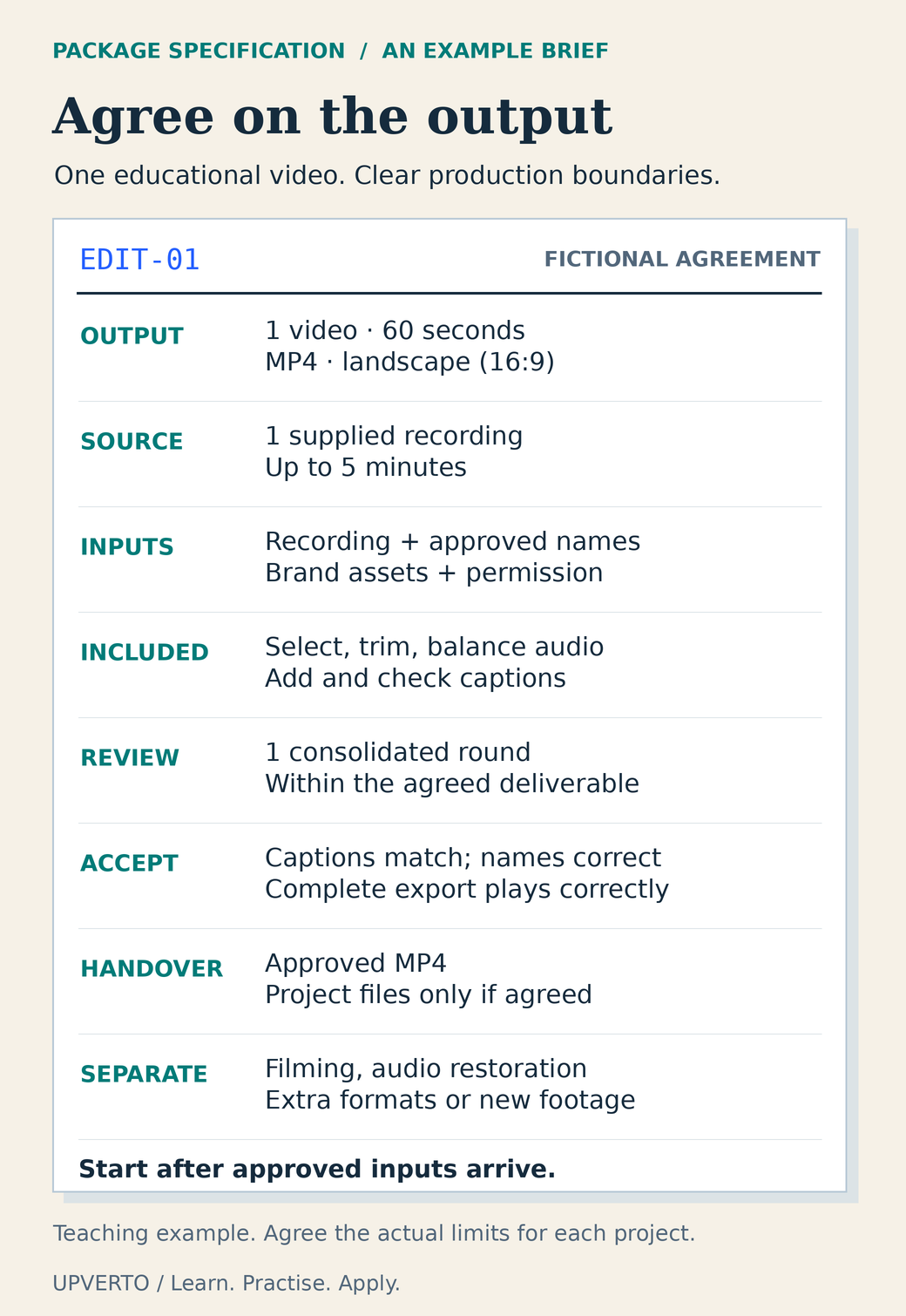
    A completed fictional editing specification separates one MP4 output, source limits, client inputs, included work, one review round, acceptance checks, handover and separately agreed work.
    Write a package someone can check — Inspect a completed fictional editing brief. Its quantities and formats are example limits to agree for a specific project. Use the enlarged view, then swipe or use arrow keys to inspect details. View full-size infographic.
    Read the text version: Write a package someone can check

    This is a fictional educational-video package, not a report of client work. The example brief specifies one 60-second landscape MP4 from one supplied recording of up to five minutes. These are illustrative limits, not platform requirements or a standard market package.

    • Client inputs: recording, approved names, brand assets and permission to use the material.
    • Included work: selection, trimming, basic sound balancing, and adding and checking captions.
    • Review: one consolidated round within the agreed deliverable.
    • Acceptance: captions match speech, names are correct, and the complete exported file plays correctly.
    • Handover: the approved MP4; project files are included only if explicitly agreed.
    • Separate work: filming, extensive audio restoration, extra formats or new footage.

    Production starts after the approved inputs arrive. Agree the actual limits, timing and commercial terms for the real project.

    Include the parts that prevent ambiguity

    PartWhat to specify
    PurposeThe task the package helps the client complete.
    DeliverablesQuantities, formats, dimensions, pages, records, or other relevant units.
    InputsApproved copy, source files, access, permissions, and decisions the client supplies.
    Included workThe activities required to produce and check those deliverables.
    ExclusionsRelated work that needs a separate agreement.
    TimingStart conditions, milestones, review windows, and dependencies.
    RevisionsWhat counts as a revision, how feedback is consolidated, and what changes the scope.
    AcceptanceObservable checks for the agreed output and the review process.
    HandoverFinal exports, source files if agreed, instructions, and any support period.
    Commercial termsThe quote, payment arrangement, and applicable terms for this engagement.

    Begin with a clear service definition. Then fill in the details appropriate to the actual work. A package worksheet is useful for discussion; it does not replace the legal or tax requirements that may apply to your particular engagement.

    Separate inputs from outputs

    Many misunderstandings begin with missing inputs. A client may expect a designer to write the copy, a video editor to find all the footage, or a website specialist to configure a service that was never mentioned.

    List the materials and decisions needed before production begins. State who supplies them and what happens if they are incomplete. If you offer to create a missing input, include that work in the scope and estimate.

    A package has a clear boundary
    • Before: approved inputs and a confirmed brief.
    • During: defined production, checks, and review.
    • After: agreed deliverables and handover.
    • Change: new requirements are discussed before extra work begins.

    Example: a short-video editing package

    Fictional teaching package: one concise educational video edited from one supplied recording. The final length, source-footage limit, aspect ratio, caption format, and export requirements are confirmed in the brief.

    • Client supplies: the recording, approved names and technical terms, brand assets, and permission to use the material.
    • Included: selection and trimming, basic sound balancing within the condition of the supplied recording, checked captions, one agreed export, and one consolidated review round.
    • Separate work: filming, scriptwriting, complex animation, extensive audio restoration, additional formats, and replacement footage.
    • Acceptance checks: the agreed message is preserved; captions match speech; names are checked; the complete export plays correctly; no unapproved material appears.
    • Handover: the approved export and any project files explicitly included in the agreement.

    The particular limits should come from the actual task and your demonstrated capability. The example does not establish a standard market package or price. Use the editing roadmap to identify the skills behind the service.

    Example: a small website-content update

    Fictional teaching package: update approved text and images on a named set of information pages in an existing WordPress site. Review the changes in a suitable draft or staging workflow before any authorised live update.

    Specify the pages, supplied content, image permissions, layout changes allowed, required backup, access arrangements, and the person approving the result. Check the affected navigation, readability, links, and any functionality the change touches.

    Separate content editing from new custom functionality, payment changes, migrations, and ongoing maintenance unless those are actually included and within your capability. The WordPress roadmap explains why a small visible edit can still involve important operational responsibilities.

    Define revisions with examples

    A revision refines the agreed work. A new requirement changes what is being produced. The distinction depends on the brief, so write examples that fit the package.

    For an event graphic, correcting a supplied venue detail within the agreed layout may be a revision. Requesting a new campaign concept or three additional formats may change the scope. If the provider made an error against the approved brief, correcting that error should not be disguised as an optional extra.

    Ask for consolidated feedback from an agreed decision-maker. Confirm which comments are approved, record the version, and explain any effect on the schedule before proceeding.

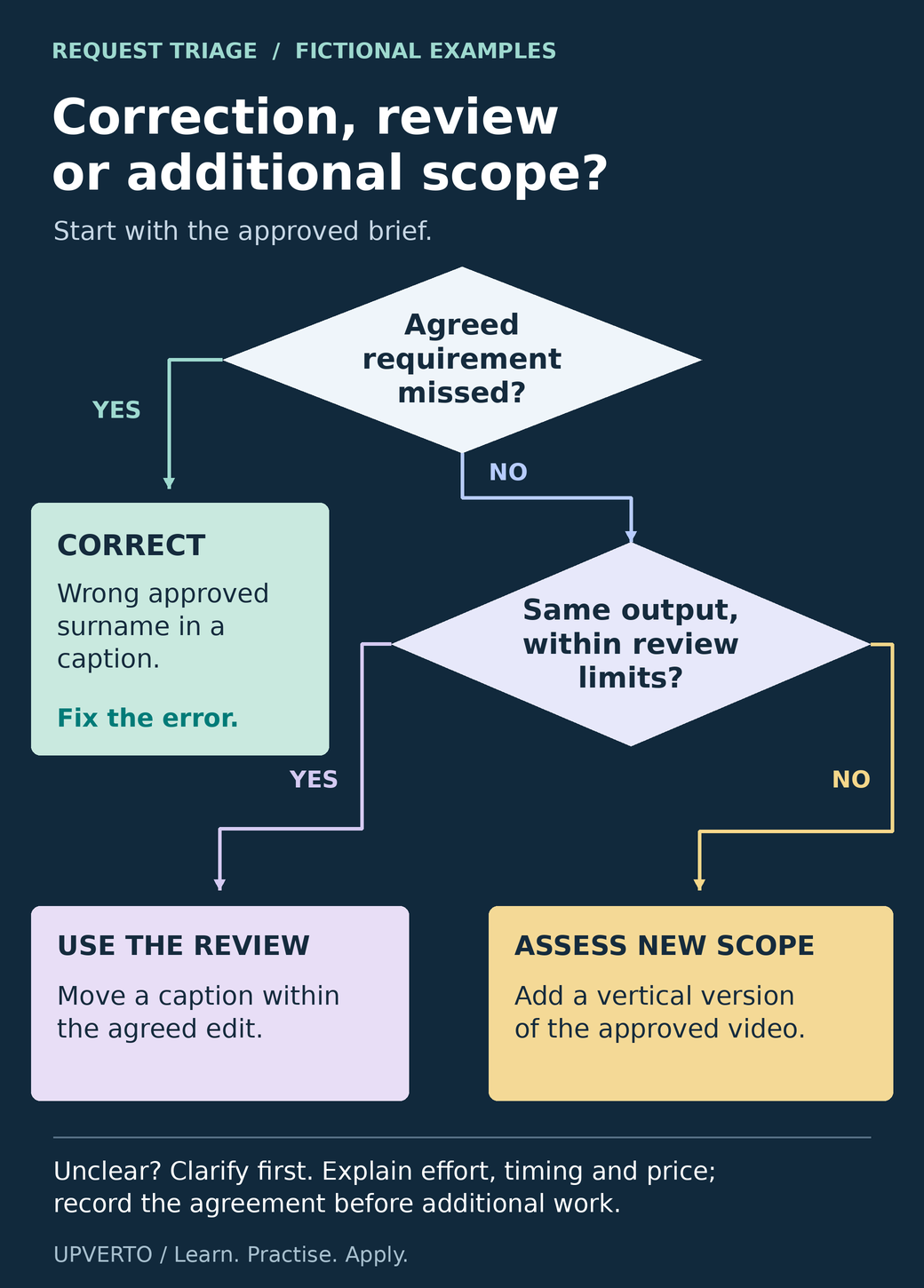
    A branching decision tree routes a missed agreed requirement to correction, an in-scope refinement to review, and an additional output to scope assessment, with a concrete caption or format example at each endpoint.
    Classify a request against the brief — Compare the request with the approved brief before deciding whether it is a correction, a review change or additional scope. Use the enlarged view, then swipe or use arrow keys to inspect details. View full-size infographic.
    Read the text version: Classify a request against the brief

    Begin by comparing the request with the approved brief and version. If an agreed requirement was missed—for example, the editor used the wrong approved surname in a caption—correct the error.

    If no agreed requirement was missed, ask whether the request changes the same deliverable within the defined review limits. Moving a caption within the agreed edit may belong to that review process.

    An additional output, such as a vertical version of a video whose agreed export was landscape, needs a scope assessment. Explain the effect on work, timing and price and record the agreement before producing the extra version. If the brief is unclear, clarify it before classifying the request. The examples guide the discussion; the actual agreement defines the boundary.

    Connect timing and price to the actual work

    A delivery estimate should state when the clock starts and what it depends on. “After receipt of approved copy and access” is clearer than a date that assumes those inputs already exist. Include time for your own checks and for the agreed client review.

    Build the quote from the work, expected effort, costs, uncertainty, and commercial arrangement. If the scope is too unclear to estimate sensibly, ask further questions or define a separate discovery task. Do not invent a low price and rely on unexpected charges to make the project workable.

    Check whether another person can understand the package

    1. Ask them to list the outputs they believe are included.
    2. Ask what they must supply before work begins.
    3. Give one revision example and one possible scope change.
    4. Ask how they would decide whether the deliverable meets the brief.
    5. Ask what happens after handover.

    If their answers differ materially from your intention, rewrite the package. This review tests clarity; it does not replace checking your ability to perform the work.

    Frequently asked questions

    Should I offer unlimited revisions?

    Only make commitments you can define and sustain. A clear review process with agreed boundaries makes effort easier to estimate. If a client needs a flexible arrangement, discuss how work is prioritised, recorded, and paid rather than leaving the commitment undefined.

    Should source files be included?

    Agree on this explicitly. A final export and an editable project are different deliverables. Consider third-party assets, licences, and the recipient’s ability to open the files before promising a particular handover.

    What should every freelance service package explain?

    Describe the client need, required inputs, exact outputs, review arrangements, acceptance checks and handover. Include exclusions and the assumptions behind timing and price. A reader should understand both what is included and which decisions still need to be agreed.

    What is the difference between a revision and new scope?

    A revision adjusts the agreed deliverable within the defined review process. A new output, a changed purpose or an additional format may create new scope. Use examples in the package and discuss the effect on effort, timing and price before doing the extra work.

    When should the delivery schedule begin?

    Define the start conditions in the agreement. These may include receiving approved source material, access and required decisions. Explain how missing inputs or delayed feedback affect the schedule so that the promised timing matches the actual workflow.

    Can one package work for every client?

    A reusable package can provide a starting structure, but check it against each request. Adjust the deliverables and assumptions when the context differs. Do not force an unsuitable project into a fixed description or quietly add responsibilities that the package does not cover.

    Use the package in a real delivery process

    Complete the worksheet for one task, verify your readiness, and connect it to a relevant portfolio sample. When a suitable client agrees, use the project workflow to manage the brief, review, checks, and handover.

  • How to Write a Service Page That Explains Your Offer Clearly

    How to Write a Service Page That Explains Your Offer Clearly

    A useful service page helps a prospective client decide whether your offer fits their task. It explains what you produce, what the client supplies, how review works and what to do next. It does not need inflated expertise claims or a promise of business results.

    Define the offer first with turn digital skill into freelance service. Then write the page around the client’s decision, using the package details you can actually support.

    In this guide
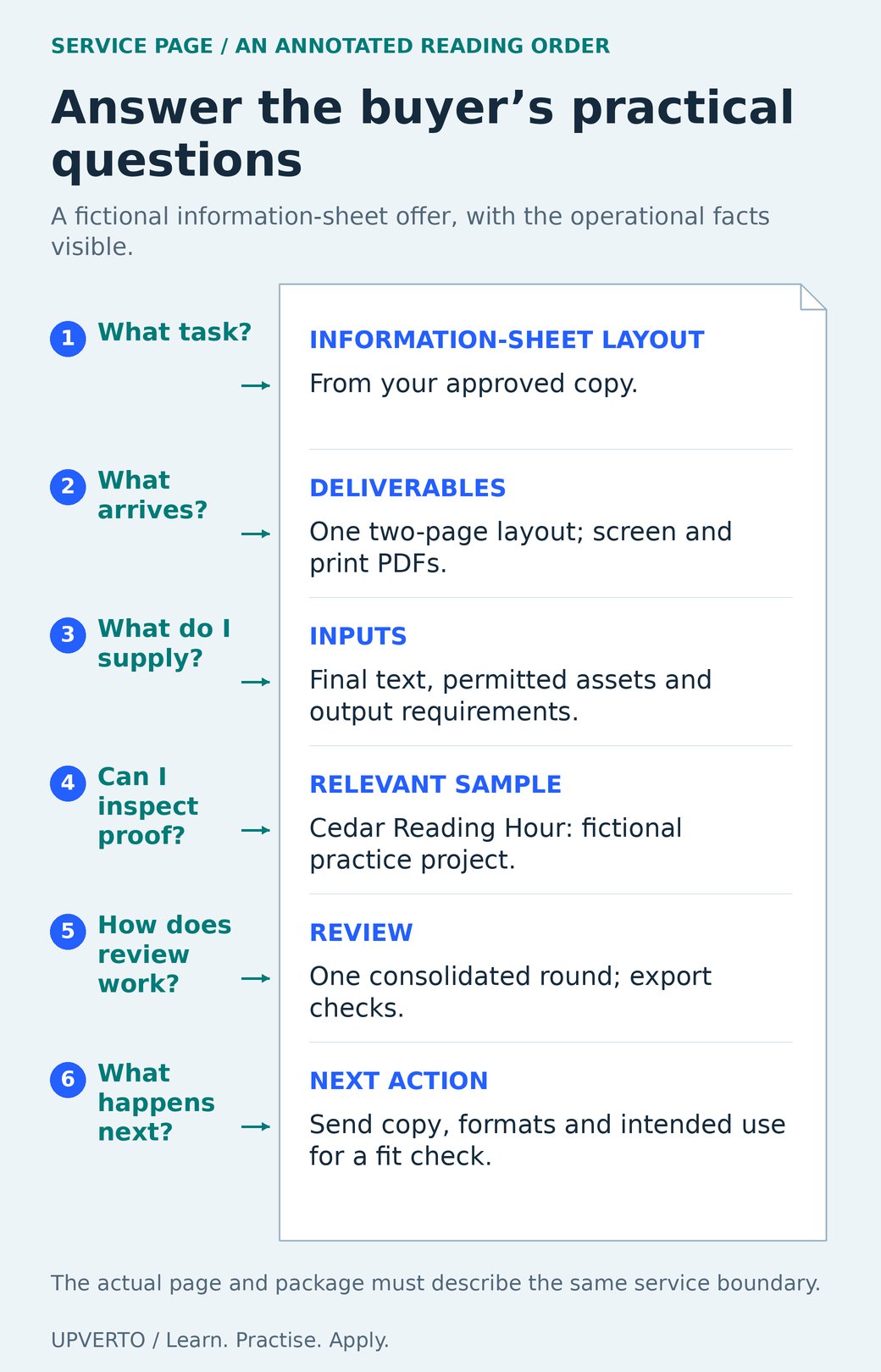
    An annotated fictional service page aligns the task, deliverables, client inputs, honest proof, review process and next action with the buyer’s corresponding questions.
    Organise a service page around six buyer questions – An annotated fictional service page aligns the task, deliverables, client inputs, honest proof, review process and next action with the buyer’s corresponding questions. Use the enlarged view, then swipe or use arrow keys to inspect details. View full-size infographic.
    Read the text version: Organise a service page around six buyer questions
    1. What task? Information-sheet layout from approved copy.
    2. What arrives? One two-page layout, a screen PDF and a print PDF with specifications agreed before production.
    3. What do I supply? Final text, permitted assets and output requirements.
    4. Can I inspect proof? A relevant Cedar Reading Hour sample labelled as a fictional practice project.
    5. How does review work? One consolidated review round and export checks.
    6. What happens next? Send the copy, required formats and intended use for a fit check.

    The example teaches structure. Real quantities and limits must match the provider’s actual package and capability.

    Answer the buyer’s questions in a useful order

    Lead with the task and the relevant audience. “Information-sheet layout from approved copy” gives a reader more to assess than “Creative solutions that transform your brand.” Follow with the outputs and a clear example of when the service fits.

    Next explain the required inputs, included work and boundaries. A client should not have to start a conversation merely to discover that you do not write the copy or that editable source files are separate. The page can remain concise while making these decisions visible.

    Then show relevant proof, describe the process and offer a proportionate next action. The reader may need to send a brief for a fit check rather than buy immediately. Match the action to the amount of uncertainty in the work.

    Use an annotated service-page outline

    SectionReader questionContent to provide
    Offer headingWhat task do you help with?Specific output and relevant context
    DeliverablesWhat will I receive?Quantity, format and agreed handover
    Inputs and scopeWhat do I supply, and what is included?Approved copy, assets, access and exclusions
    ProofCan I inspect related work?Honest sample with contribution and project label
    Process and reviewHow will the work proceed?Start conditions, feedback and acceptance checks
    Next actionHow do we establish fit?Clear enquiry route and the information needed

    Use create freelance service packages to fill in the operational details. The page is the buyer-facing explanation of the offer; it should not quietly promise a broader service than the package you intend to deliver.

    Price presentation depends on how well the scope can be standardised. If you show a starting price, make the associated scope and assumptions understandable. If you require a quote, explain the information needed to prepare it. Do not invent urgency or hide necessary charges merely to obtain an enquiry.

    Use proof that supports the exact offer

    Choose a sample that resembles the task, not simply your most decorative piece. Explain your role, the supplied inputs and the checks performed. A concept sample should remain clearly labelled as a concept. A testimonial should be authentic, permitted and presented in its proper context.

    For a fuller explanation, use write a portfolio case study. The service page can show a concise extract and a descriptive link to the evidence. Avoid a claim such as “results-driven design” if the only available evidence is a fictional layout exercise.

    Clear structure also matters for access. W3C’s writing guidance recommends meaningful headings, descriptive links and clear instructions. Apply those principles to the page: a heading should describe the offer, and a link should tell the reader what they will open. These practices help the reader navigate; they do not guarantee rankings or enquiries.

    Worked example: a bounded information-sheet service

    Fictional service-page copy: the following example demonstrates structure. Its quantities and limits are teaching assumptions, not a standard market package.

    Information-sheet layout from your approved copy

    I format a short information sheet for organisations that already have approved wording and need a clear screen and print version.

    You receive: one two-page layout, one screen PDF and one print PDF prepared to specifications agreed before production. Editable source delivery is discussed separately.

    You supply: final text, approved names and contact details, permitted images or logos, and the intended print or screen requirements.

    Included: hierarchy, spacing, image placement, one consolidated review round and checks of the exported files. Copywriting, new illustration and additional pages need a separate agreement.

    See the approach: the Cedar Reading Hour sample is a fictional practice project showing information grouping and export checks. It does not represent a client commission or measured booking result.

    Next step: send the draft copy, required formats and intended use through the enquiry form. I will confirm whether the task fits and what information is still needed before quoting or agreeing a start date.

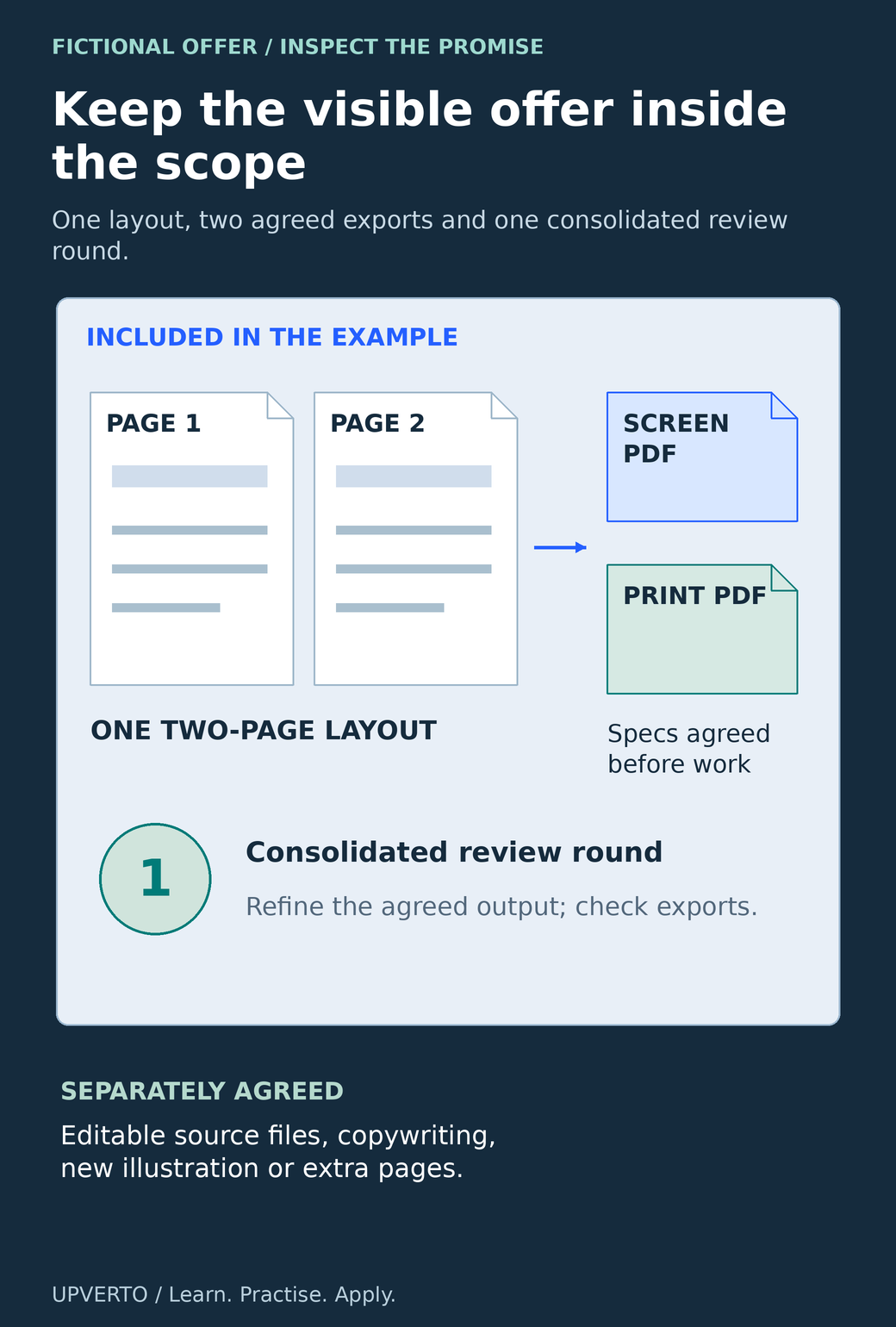
    A bounded deliverable diagram shows one two-page layout flowing to screen and print PDFs, with one review round inside the example scope and additional tasks outside it.
    Check that a service-page promise fits its package – A bounded deliverable diagram shows one two-page layout flowing to screen and print PDFs, with one review round inside the example scope and additional tasks outside it. Use the enlarged view, then swipe or use arrow keys to inspect details. View full-size infographic.
    Read the text version: Check that a service-page promise fits its package

    The fictional service-page package includes one two-page layout, one screen PDF and one print PDF prepared to specifications agreed before production. One consolidated review round and export checks are included. Editable source delivery is discussed separately. Copywriting, new illustration and extra pages need a separate agreement. Check that the visible page copy describes these same boundaries. A labelled concept sample demonstrates layout decisions; it does not supply a testimonial or prove a business outcome.

    The copy answers practical questions without claiming that layout alone will increase sales. A real page should replace the teaching assumptions with a service the provider can reliably perform, including the actual review and handover arrangements.

    Review the page as an offer, not an article

    Ask someone to list what they believe is included, what they must supply and what happens after they enquire. If they expect copywriting or unlimited revisions, revise the wording. If they cannot find the sample or the next action, repair that path before adding more explanatory text.

    CheckEvidence
    Offer matches the actual capabilityA defined task and a checked relevant sample
    Scope is understandableOutputs, inputs, exclusions and revision boundary
    Claims are supportedHonest labels, permitted proof and no invented outcomes
    Next action worksCorrect form, link or permitted platform route
    Page is usableReadable layout, meaningful headings and accessible instructions

    Test the actual contact route with harmless data where authorised, including confirmation and error messages. Do not collect information you do not need for a fit check. A brief may be enough initially; passwords, financial details and private source files should not be requested through an unsuitable public form.

    Once the page is clear, use find freelance prospects and write outreach to approach appropriate opportunities. Keep the offer aligned with the work you are ready to deliver, and update the page when your scope, process or evidence changes.

    Frequently asked questions

    Should a service page teach the whole skill?

    No. Its main job is to explain the offer and help a buyer assess fit. Link to useful educational material where relevant, but keep deliverables, inputs, proof and the next action easy to find. Long background explanations can obscure the practical agreement.

    Do I need three packages?

    Only if three meaningful scopes help the buyer choose and you can deliver each one. A single well-defined offer can be clearer. Do not create artificial tiers that differ only in vague labels or hide essential work in an unexpected upgrade.

    Can I use a concept project as proof?

    Yes, if it is labelled clearly and demonstrates the relevant task. Explain your role and checks. Do not present it as a commissioned project, testimonial or measured business result, and keep the label visible in the service-page extract.

    Should I publish a price or ask people to enquire?

    Choose according to how clearly the scope can be standardised. A displayed price needs an understandable included scope and assumptions. A quote-based offer should explain what information is needed. Neither approach justifies hiding necessary charges or promising an unverified timeline.

    What should the enquiry form ask first?

    Ask for the task, intended use, required outputs, available source material and a suitable contact route. Keep the request proportionate. Do not ask for account passwords or sensitive client records merely to decide whether the project fits.

    How can I tell whether the page is clear?

    Give a reader a concrete task: explain the deliverable, identify what they must supply and find the next step. Compare their interpretation with your actual package. Record and fix misunderstandings, rather than relying only on compliments about the design.

    Sources and review notes

    Primary sources checked on 27 October 2026 (UTC). Check the current provider pages before relying on a changing feature, policy or price. Worked examples and worksheets are original teaching material; fictional examples are not evidence of client results.
  • How to Estimate a Project and Set Revision Limits

    How to Estimate a Project and Set Revision Limits

    A useful project estimate includes the work needed to understand, produce, review, check and hand over the deliverable. It also states the assumptions that make the estimate possible. A production-only guess can miss the tasks that determine whether delivery is reliable.

    Start with a defined service using turn digital skill into freelance service. Then turn the client’s request into observable outputs, required inputs and a review process before committing to time or price.

    In this guide
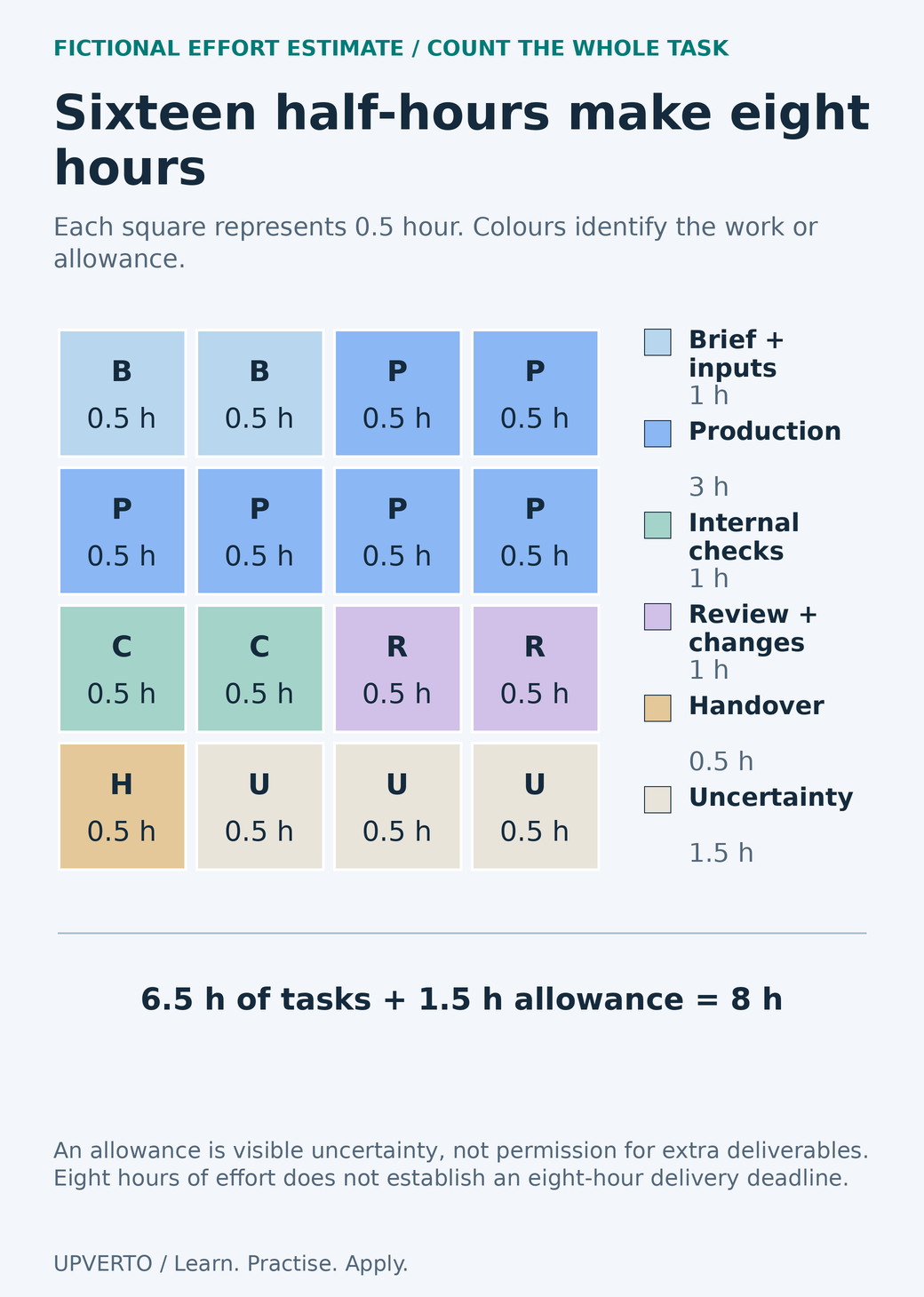
    Sixteen equal half-hour squares show one hour of brief work, three of production, one of checks, one of review, half an hour of handover and one and a half hours of uncertainty.
    Inspect every half-hour in a fictional project estimate – Sixteen equal half-hour squares show one hour of brief work, three of production, one of checks, one of review, half an hour of handover and one and a half hours of uncertainty. Use the enlarged view, then swipe or use arrow keys to inspect details. View full-size infographic.
    Read the text version: Inspect every half-hour in a fictional project estimate
    Work or allowanceHoursHalf-hour squares
    Brief and inputs12
    Production36
    Internal checks12
    Review and agreed changes12
    Handover0.51
    Explicit uncertainty allowance1.53

    The task estimate is 6.5 hours; adding 1.5 hours gives 8 planned hours, represented by 16 equal half-hour squares. These are invented teaching inputs. The allowance does not authorise extra outputs. Effort and elapsed delivery time are different because inputs and feedback can create dependencies.

    Translate the request into deliverables and checks

    “Make a professional brochure” leaves several decisions unresolved: page count, audience, supplied copy, images, print requirements, editable files and approval. Write the output in units the client can understand, and ask what conditions will show that it meets the brief.

    The GOV.UK user-story guidance describes acceptance criteria as outcomes used to check whether a need has been met. For a small service, the same practical idea can become plain-language checks: approved text is present, specified formats open correctly and the agreed contact details match the source. You do not need to import an entire project-management system to write a clear check.

    Use create freelance service packages for the broader agreement structure and write project brief acceptance criteria for the detailed brief. The estimate should refer to the same outputs, so the package, quote and checks do not describe different projects.

    Break down effort and identify dependencies

    Work areaQuestions before estimating
    Brief and inputsIs the copy approved? Are files usable? Who supplies missing material?
    ProductionWhich operations, formats and quantities are required?
    Internal checksWhat must you inspect before the client sees a draft?
    Client reviewWho consolidates feedback, and how many rounds are included?
    RevisionsWhat changes fit the agreed output, and what would create new work?
    HandoverWhich exports, source files, dependencies and instructions are included?
    UncertaintyWhich assumptions could fail, and how will you respond?

    Use your own comparable records when available. If you have never completed the task, run a small practice or define a separate investigation instead of presenting a precise-looking guess as experience. A range can communicate uncertainty better than an unsupported exact number, but it still needs assumptions.

    Distinguish effort from elapsed time. Six hours of work may require several days because approved copy, access or feedback is only available at particular times. State when production begins and how delayed inputs affect the schedule.

    Worked example: two versions of an event sheet

    Fictional estimate: a learner is planning one two-page information layout, a screen PDF and a print PDF. Approved copy and permitted assets are supplied. The print specifications are confirmed in advance. The following hours are invented teaching inputs, not market benchmarks or a promise about your work.

    TaskHours
    Confirm brief and inspect inputs1
    Build layout and adapt the outputs3
    Internal copy and export checks1
    One consolidated review and agreed revisions1
    Handover and dependency notes0.5
    Explicit uncertainty allowance1.5

    The task estimate is 1 + 3 + 1 + 1 + 0.5 = 6.5 hours. With the stated allowance, planned capacity is 6.5 + 1.5 = 8 hours. The allowance is visible; it does not authorise extra deliverables or disguise work you already know is missing.

    The schedule also depends on a client review window. If the client asks for a third format or replaces the approved copy, the learner reassesses the scope before promising that the original estimate still applies. If the source files reveal an unanticipated problem, the learner explains the observation and options.

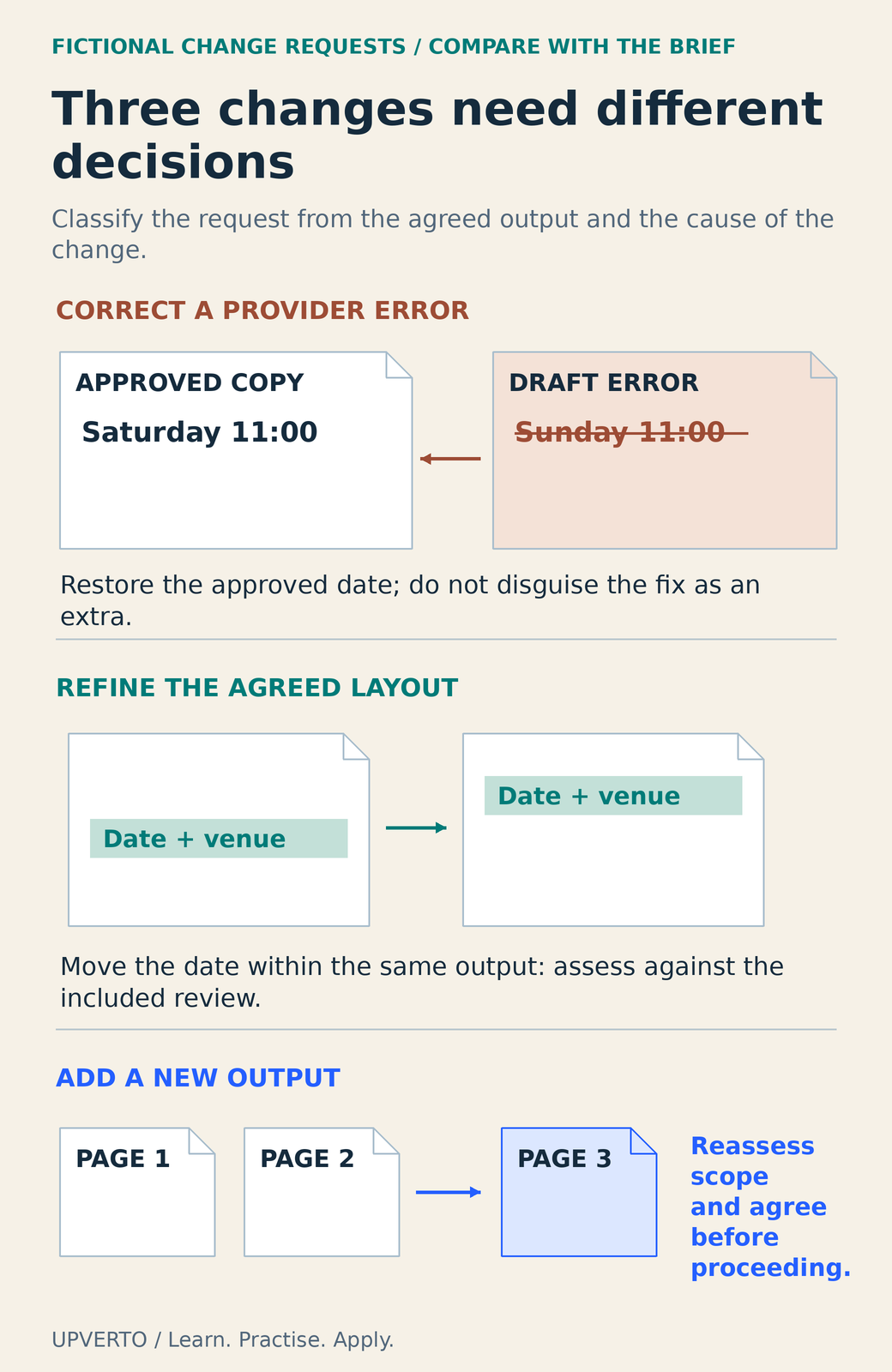
    Three actual document examples show restoring an approved date after a provider error, moving existing date information within a layout, and adding a third page to a two-page output.
    Distinguish correction, refinement and additional scope – Three actual document examples show restoring an approved date after a provider error, moving existing date information within a layout, and adding a third page to a two-page output. Use the enlarged view, then swipe or use arrow keys to inspect details. View full-size infographic.
    Read the text version: Distinguish correction, refinement and additional scope
    1. Correction: the approved copy says Saturday at 11:00, but the draft says Sunday. Restore the approved wording. A provider error should not be disguised as a paid optional revision.
    2. Refinement: move the existing date and venue higher within the same agreed layout. Assess whether this fits the defined review round.
    3. Additional scope: add a third page to an agreed two-page output. Reassess the work and obtain agreement before proceeding.

    These are fictional examples. The actual brief, cause of the change and agreed review boundaries determine the next conversation.

    Define a review round with examples

    A round should have a clear trigger and collection method: the client receives a named draft, one decision-maker gathers approved comments and the provider applies changes within the agreed deliverable. State how the client should distinguish corrections, preferences and new requests.

    For the event sheet, moving the date within the agreed layout may fit the included review. Adding a new page or an extra language version changes the output. Correcting your own error against the approved text is a correction you should make; it should not be disguised as a paid optional extra.

    Do not rely on a bare phrase such as “two revisions” without explaining what it covers. Two tiny spelling changes and two completely new concepts are different work. If the client needs flexible ongoing iteration, choose an arrangement that records and approves that effort rather than making an unlimited promise inside a fixed scope.

    Discuss these boundaries before work begins. When a change arrives during delivery, record what changed and confirm any effect on the estimate before proceeding.

    Complete the scope and revision worksheet

    FieldEntry to agree
    Outputs and acceptanceQuantity, format, purpose and observable checks
    Client inputsApproved source material, access, rights and decision-maker
    Task estimateProduction, checking, review and handover effort
    Assumptions and uncertaintyWhat is known, what is unverified and how it affects the estimate
    Review definitionNamed draft, consolidated comments and included changes
    ExclusionsConcrete extra outputs or responsibilities requiring another agreement
    Schedule dependenciesStart conditions, feedback windows and decision points

    Before sending the estimate, read the brief as if you were the client. Could someone reasonably expect work you have excluded? Are source files mentioned in one place and missing in another? Correct the wording while the project is still easy to adjust.

    If important questions remain, use freelance discovery call questions to resolve the uncertainty. A useful estimate is not the most confident-looking number; it is the clearest account of the work, assumptions and next decision.

    Frequently asked questions

    Should I estimate only the time spent making the output?

    No. Include brief clarification, input inspection, checks, agreed review, revisions and handover. These tasks are part of delivery. Keep uncertainty visible rather than assuming that every non-production activity will fit into unplanned spare time.

    Is an eight-hour estimate the same as next-day delivery?

    No. Effort and elapsed time are different. The schedule may depend on approved inputs, access and client feedback. State the start conditions and review windows so the promised timing reflects the actual dependencies.

    How many revisions should I include?

    Choose a boundary that fits the task and the arrangement, then explain what a round means. There is no universal number. Use concrete examples of included refinements and additional scope, and identify the person who consolidates approved feedback.

    Should fixing my own mistake count as an extra revision?

    An error against the approved brief should be corrected. Do not use a revision limit to disguise that correction as an optional extra. Distinguish it from a client changing an approved requirement or requesting another deliverable.

    What if the client cannot provide complete inputs?

    Identify the missing material and its effect before promising production. You may define a separate discovery or preparation task, reduce the scope or wait for approval. Do not silently assume that writing copy, sourcing assets or repairing files is included.

    How can I estimate a task I have never completed?

    Run a small representative practice or a bounded investigation and record the effort and problems. Be explicit about uncertainty. Avoid presenting a precise quote as a demonstrated estimate when it depends on learning an unfamiliar technique during the client project.

    Sources and review notes

    Primary sources checked on 27 October 2026 (UTC). Check the current provider pages before relying on a changing feature, policy or price. Worked examples and worksheets are original teaching material; fictional examples are not evidence of client results.
  • How to Validate a Service Idea Before Buying More Tools

    How to Validate a Service Idea Before Buying More Tools

    Before buying another tool, find out whether the service solves a specific problem for someone who can act on it. A useful validation exercise examines recent behaviour, current workarounds and the fit of a small demonstration. It does not turn a compliment into a sale.

    Start with a service hypothesis from turn digital skill into freelance service. Keep the first investigation small enough that you can change direction without relying on the idea being correct.

    In this guide
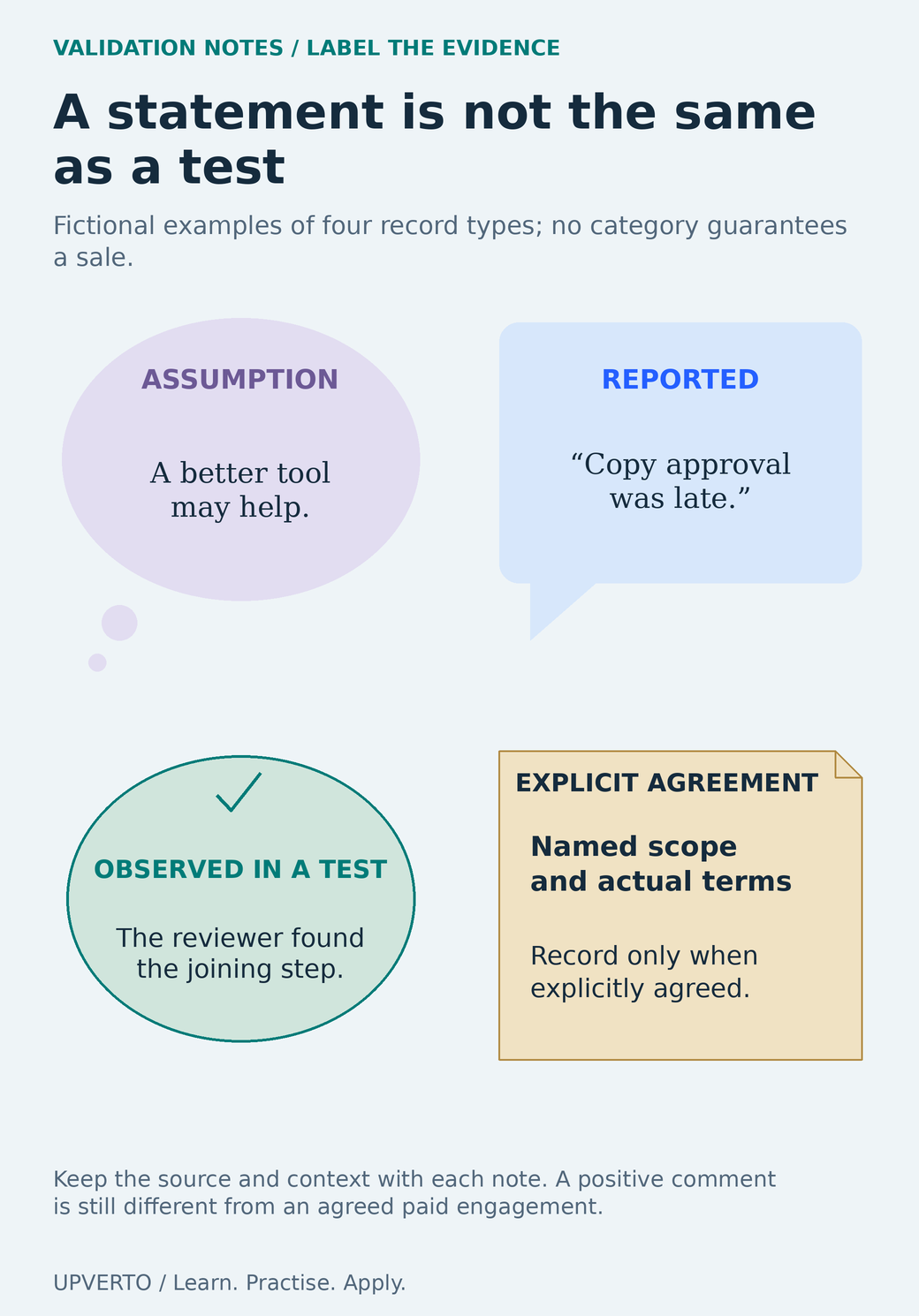
    Four different graphic forms distinguish an assumption, a reported experience, an observed test behaviour and an explicit commercial agreement.
    Label assumptions, reports, observations and agreements – Four different graphic forms distinguish an assumption, a reported experience, an observed test behaviour and an explicit commercial agreement. Use the enlarged view, then swipe or use arrow keys to inspect details. View full-size infographic.
    Read the text version: Label assumptions, reports, observations and agreements
    Record typeFictional example or criterion
    AssumptionA better tool may help.
    Reported experienceA person says copy approval was late.
    Observed behaviourDuring a test, the reviewer finds the joining step.
    Explicit agreementRecord a commercial commitment only when actual scope and terms have been agreed.

    These categories are not a mandatory sequence or a guarantee of a sale. Preserve who said or did what, the context and what remains uncertain. A compliment does not by itself establish a paid engagement.

    Write an assumption that can be challenged

    “Small organisations need design” is too broad. A more useful assumption is: “People coordinating recurring community sessions spend time reformatting approved information for print and screen, and some may want help with that defined task.” It identifies a person, a process and an uncertainty.

    Separate what you know from what you infer. You may have observed a confusing information sheet, but you do not yet know whether the organisation sees it as a problem, who controls the budget or whether an existing volunteer handles it. Use check demand for digital skills to inspect actual tasks without treating public listings as proof that every buyer needs your offer.

    Decide what evidence would change your mind. If people already have a reliable process, the proposed service may not be useful. If the problem is late approval of copy, a more powerful design tool may not address the cause.

    Ask about a recent real task

    Invite an appropriate person to a short conversation and explain that you are learning about the process, not conducting a disguised sales pitch. Ask permission before recording. The GOV.UK interview guide recommends neutral questions, specific experiences and follow-ups. Its method is useful here; the examples below are an original adaptation to a small service investigation.

    QuestionWhat it helps reveal
    Tell me about the last time you prepared this information.A real process rather than an imagined preference
    Who supplied the wording and approved it?Inputs and decision dependencies
    Which part needed extra effort or rework?A specific friction worth investigating
    What did you use or do instead?Existing alternatives and workarounds
    Who decides whether outside help is appropriate?The route to a decision
    What would you need to inspect before considering help?Evidence and constraints for a useful next step

    Avoid leading questions such as “Wouldn’t a professional redesign save you hours?” They place the desired answer inside the question. Do not promise a time saving, result or service capability you have not demonstrated.

    Build the smallest demonstration that answers the uncertainty

    Use invented or authorised material to show one relevant operation. If the question is whether information can be adapted to two formats, create a small print-and-screen example. You do not need to buy an entire automation system or build a complete website to investigate that question.

    Ask the person to inspect or use the demonstration. Can they find the information? Does it fit their actual approval process? Which input is missing? A reaction such as “looks nice” is weaker evidence than a specific explanation of how the output would or would not fit the task.

    Keep confidentiality and consent proportionate. The GOV.UK research-data guidance links collection and use to the permission obtained. Do not collect private files merely because they might be interesting, and do not publish a participant’s words as a testimonial without the appropriate permission.

    Worked example: the tool was not the main uncertainty

    Fictional investigation: Asha considers buying a premium layout subscription to offer event-sheet formatting. She speaks with an imaginary community-session coordinator about the most recent event. The coordinator describes late copy approval and uncertainty about the final venue name; the existing tool can already export the required formats.

    Asha records the observation without turning it into a universal market conclusion. Her initial assumption was that better layout tools were the central need. The conversation suggests that approval and input organisation may matter more in this particular workflow.

    She creates a fictional two-format example using a tool she already has and adds a brief approval checkpoint. The coordinator can identify how the checkpoint would fit, but has not agreed to purchase anything. Asha’s next action is to investigate who approves the copy and whether the defined support task is useful, not to record a sale.

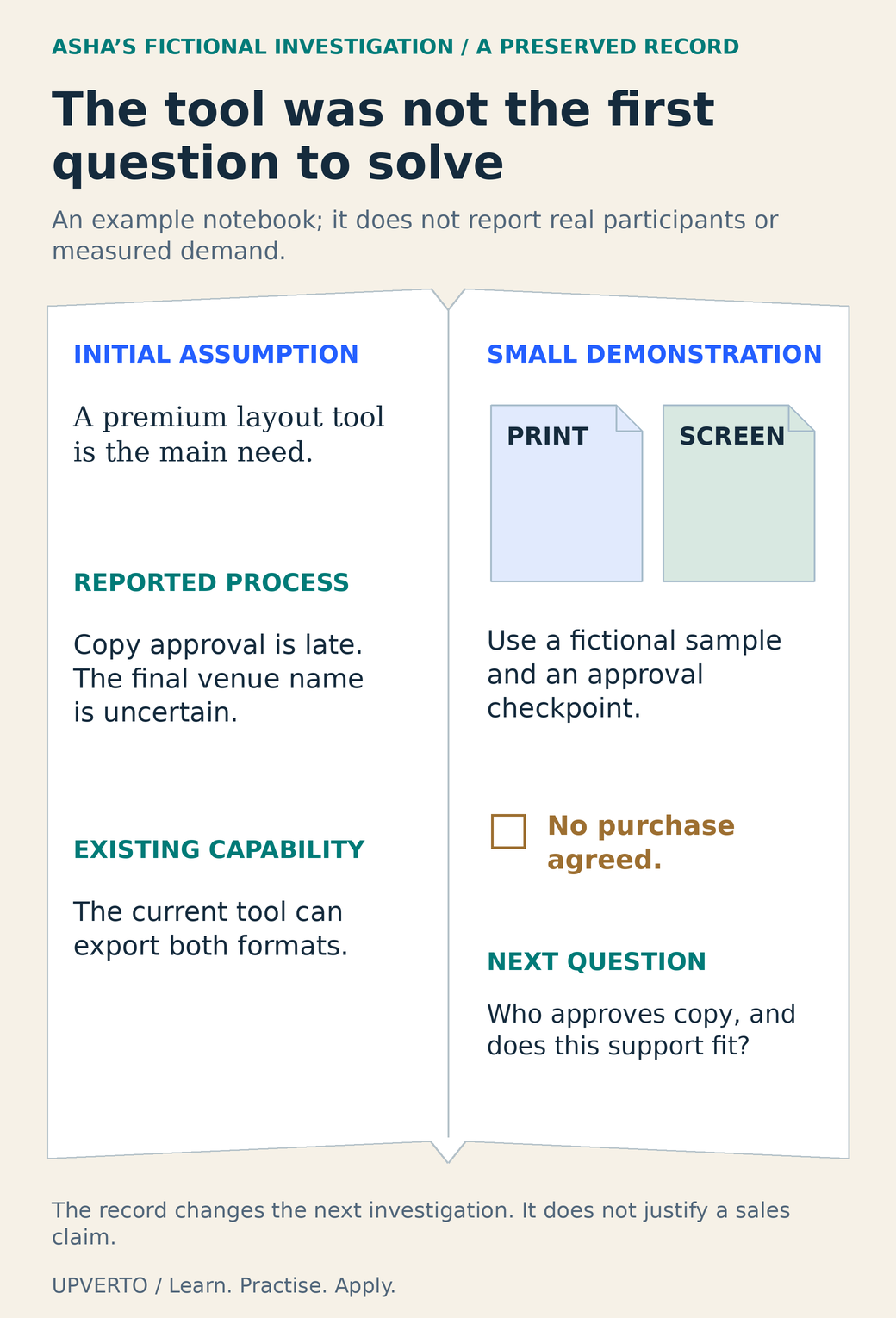
    An open notebook records Asha’s tool assumption, reported approval friction, existing export capability, a small demonstration and the absence of a purchase agreement.
    Preserve what a fictional service investigation actually supports – An open notebook records Asha’s tool assumption, reported approval friction, existing export capability, a small demonstration and the absence of a purchase agreement. Use the enlarged view, then swipe or use arrow keys to inspect details. View full-size infographic.
    Read the text version: Preserve what a fictional service investigation actually supports

    In the fictional example, Asha initially assumes a premium layout tool is the main need. The imaginary coordinator reports late copy approval and uncertainty about the final venue name. The current tool already exports the required formats. Asha therefore creates a fictional print-and-screen sample with an approval checkpoint using a tool she already has. The coordinator can identify how the checkpoint would fit but has not agreed to purchase. The next question concerns who approves the copy and whether the bounded support task is useful. This is a teaching record, not a real study, a representative market finding or a sale.

    This example does not report real research participants or measured demand. It demonstrates how a log can preserve the difference between an assumption, a statement, an observation and a commercial commitment.

    Use the interview and observation log

    FieldWhat to record
    Service assumptionPerson, task, problem and proposed help
    Recent exampleThe actual occasion described, without unnecessary personal data
    Current workaroundTools, people and process already used
    Observed or reported frictionExact issue; distinguish what you saw from what you were told
    Demonstration resultWhat the person could inspect, use or question
    Evidence limitSmall sample, unknown decision authority or untested requirement
    Next decisionContinue investigation, narrow the service, defer spending or stop

    Review several relevant observations before making a broad claim, while recognising that a small informal investigation is not a representative market study. Look for differences as well as repeated themes. A service that suits one organisation may be inappropriate for another with different resources or responsibilities.

    Use choose freelance client niche to refine who the offer is for. When the task becomes concrete, use create freelance service packages to define inputs, outputs and review. Buy a tool only when a verified delivery requirement and a manageable cost justify it. Interest, a meeting or a promising comment remains distinct from an agreed paid engagement.

    Frequently asked questions

    How many interviews prove that a service will sell?

    No fixed small number proves that. Conversations reveal needs, language and constraints, but they can be unrepresentative and do not guarantee purchases. Record what each interaction supports and what remains uncertain, then choose a proportionate next test.

    Should I ask whether someone would buy my idea?

    You can discuss fit, but hypothetical willingness is limited evidence. Ask about a recent task, the current workaround and who makes the decision. If the person expresses interest, clarify the next concrete step without recording it as an agreed sale.

    Do I need paid software for a demonstration?

    Only if the specific demonstration cannot be made appropriately with your existing permitted tools. Use a small fictional or authorised example first. A tool purchase should address a verified requirement, not substitute for understanding the buyer’s process.

    Can I offer a free trial to validate the service?

    A bounded demonstration can be useful if expectations, permissions and the ending are clear. Avoid providing an undefined amount of unpaid production work. State what the exercise tests and do not imply that participation commits either person to a later purchase.

    What if everyone says the idea sounds good?

    Look for concrete evidence beyond politeness: a recent problem, a current workaround, relevant constraints and an appropriate decision route. Ask what would make the service unsuitable. Positive comments alone do not establish urgency, budget or a willingness to enter an agreement.

    When should I stop investigating an idea?

    Stop or change direction when the evidence repeatedly contradicts the problem assumption, the task exceeds your capability or the costs and responsibilities do not fit. Keep the learning record so you can explain the decision. Continuing to spend is not required to justify earlier effort.

    Sources and review notes

    Primary sources checked on 27 October 2026 (UTC). Check the current provider pages before relying on a changing feature, policy or price. Worked examples and worksheets are original teaching material; fictional examples are not evidence of client results.
  • How to Choose a Client Niche for Your Freelance Service

    How to Choose a Client Niche for Your Freelance Service

    A client niche is a group of buyers whose situation and needs you can understand well enough to serve. It is not simply an industry label attached to a skill. “Websites for businesses” says little about the work. “Updating workshop information pages for small training providers” identifies a buyer, recurring information and a possible bounded task.

    In this guide

    The guide to turn digital skill into freelance service explains the wider move from capability to an offer. This page helps you choose which buyers to investigate. The shortlist is a research decision, not a claim that a particular group will hire you.

    Separate buyer choice from skill choice

    A skill describes work you can do: editing video, cleaning data or building a page. A buyer group describes who might need that work and under which conditions. The same skill can serve different groups with different inputs, vocabulary, approval processes and risks.

    If the skill itself is still unclear, use which digital skill should I learn. Once you have a small capability to demonstrate, ask who has a task it could support. Avoid choosing a niche solely because someone claims it pays well. You need accessible evidence of the problem and a realistic way to understand the buyer.

    For a first shortlist, specify the organisation type, responsible person, task and relevant constraint. “Community workshop coordinator who needs accurate session pages before each new schedule” is more useful than “education.” It also suggests questions about who supplies dates, approves changes and maintains the page.

    Gather evidence before creating a persona

    The SBA’s market-research guidance encourages investigating customers, demand and alternatives. Begin with public information you can inspect, actual briefs and appropriate direct research. Record the source and date. A fictional persona is a design aid, not evidence that real buyers think or behave as described.

    Use check demand for digital skills to build a dated research log. Distinguish an observed issue from your interpretation. A page with an old date is observable; the claim that the owner urgently wants to pay someone to fix it requires further evidence. The organisation may have a different priority, an existing provider or a reason for the current page.

    When speaking with potential buyers through an appropriate, authorised channel, ask about their process and recent examples. Avoid presenting your preferred solution as a fact about their needs. Ask who handles the task now, what makes it difficult and what would make a change worthwhile.

    Build a small buyer-and-problem shortlist

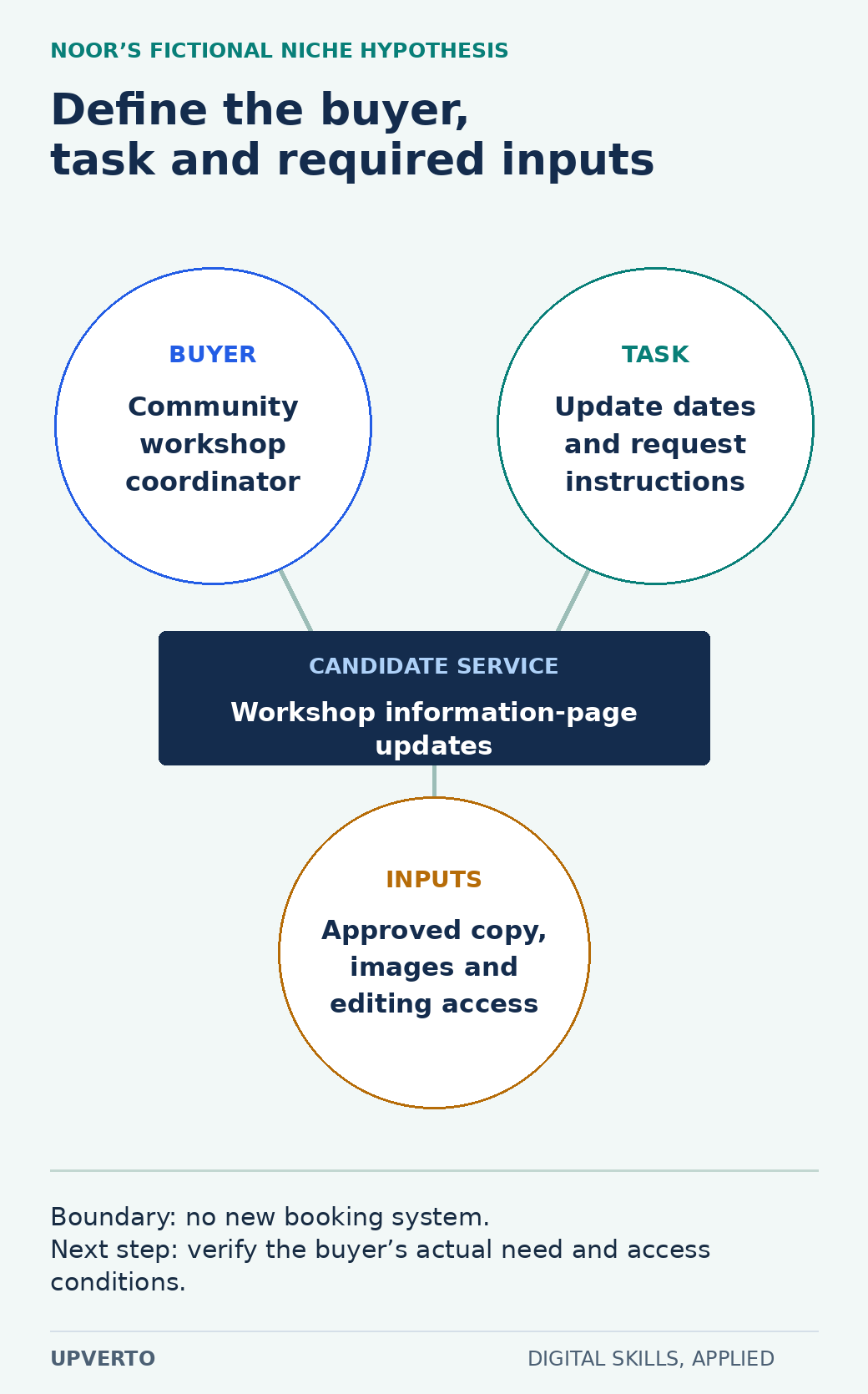
    Three circular fields identify a community workshop coordinator, information updates and approved inputs, connected to a proposed workshop-page service with a no-booking-system boundary.
    Define a client niche as a buyer, task and input relationship — These fictional assumptions define what Noor should investigate; they do not prove that buyers want to outsource the task. Use the enlarged view, then swipe or use arrow keys to inspect details. View full-size infographic.
    Read the text version: Define a client niche as a buyer, task and input relationship

    Noor’s candidate niche combines a buyer, a task and feasible inputs: a community workshop coordinator; current dates and request instructions; approved copy, images and authorised access. The proposed service updates information pages and excludes a new booking system. The next research step is to verify the real need, owner and access conditions.

    The fictional freelancer Noor can update informational web pages from approved copy and check links and narrow-screen layout. She is considering three invented buyer groups. The entries below are assumptions supplied for a learning exercise, not findings from real interviews.

    Candidate buyerPossible taskAccess or evidence to investigateBoundary
    Community workshop providersUpdate session details and request instructionsWho owns the schedule and approves page changes?No booking-system development in the initial offer
    Independent retailersUpdate opening hours and service informationWho supplies current details and controls the website?No checkout, inventory or payment changes
    Member associationsPrepare public event pages from an approved briefHow many people review content, and what is the cycle?No private member data or account access work

    Each group could be worth investigating, but the worksheet does not prove demand. Noor chooses workshop providers for her next research round because the task closely matches her sample and the required information is relatively easy to define. She still needs to verify the buyer’s actual problem and access conditions.

    Compare fit without inventing a precision score

    Use four questions: can I understand the task, can I demonstrate the deliverable, can I reach appropriate evidence or people, and can I handle the responsibility? Mark each answer as supported, uncertain or outside current ability. Explain the reason in a sentence.

    A group with a clear task but inaccessible decision makers may require more research. A group with accessible contacts but sensitive systems may be unsuitable for your current offer. A group with frequent visible updates may already have an effective internal process. Avoid assuming that apparent activity automatically creates outsourced demand.

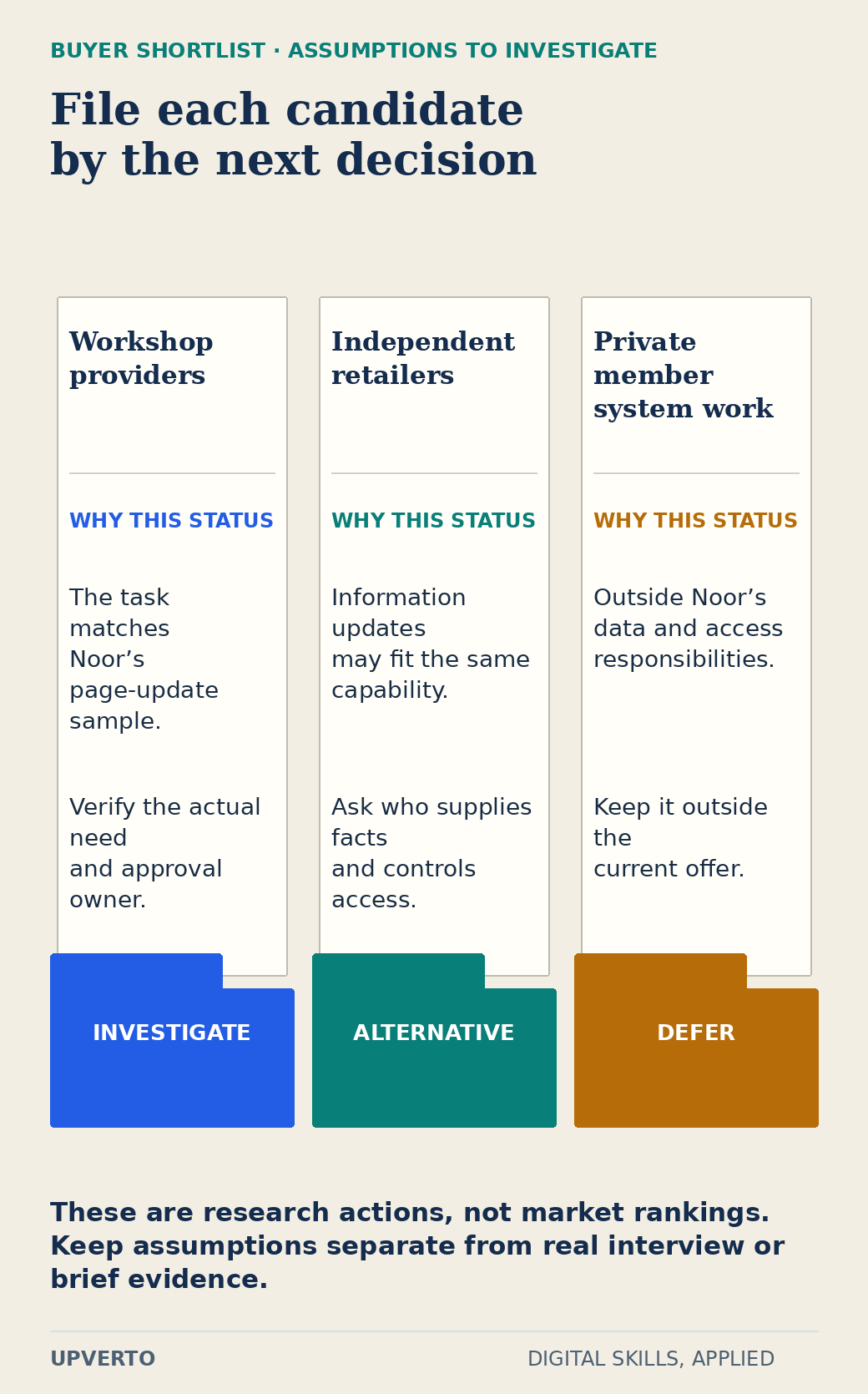
    Three research folders classify workshop providers for investigation, retail information updates as an alternative, and private member-system work for deferral, each with a reason and next question.
    Turn a niche shortlist into three conditional next actions — The fictional shortlist is conditional. The deferred item is private member-system work, not every possible public-page task for an association. Use the enlarged view, then swipe or use arrow keys to inspect details. View full-size infographic.
    Read the text version: Turn a niche shortlist into three conditional next actions
    Candidate or work typeDecisionReason and next step
    Workshop providersInvestigate firstThe task matches Noor’s sample. Verify actual need and the approval owner.
    Retail information updatesKeep as an alternativeMay fit the same capability. Ask who supplies facts and controls access.
    Private member-system workDeferOutside demonstrated data and access responsibilities. Keep it outside the current offer.

    These are research actions based on fictional assumptions, not demand findings or market rankings.

    Noor’s fictional decision is conditional: “Investigate workshop page updates first. Keep retail information updates as an alternative. Defer member-system work because it falls outside my demonstrated access and data responsibilities.” This is a practical next step, not a permanent identity or a market ranking.

    Ask questions that reveal the real work

    Prepare a short research guide. Ask the buyer to describe the last time the information changed, where the input came from, who approved it and what happened when something was wrong. Ask which parts are routine and which require judgment. These questions are more useful than asking whether they “would like a better website.”

    Investigate the existing alternative. The buyer may do the task personally, use a staff member, retain an agency or leave the information unchanged. Your offer would need to fit that situation. Do not assume the only competitor is another freelancer with the same title.

    Keep notes factual and proportionate. If a person describes one difficult update, do not report that all organisations in the group share the same problem. Seek patterns across relevant evidence and record contradictory observations. A good niche decision can be to stop investigating a group whose needs do not fit.

    Use the buyer-and-problem worksheet

    For each candidate, record: buyer group; responsible role; recurring task; trigger; required inputs; finished output; current alternative; evidence source and date; access constraints; responsibility limits; missing information; and next research action.

    • Write the task in a way the buyer would recognise.
    • Attach an actual source or mark the entry as an assumption.
    • Connect the task to a sample you can show.
    • Identify who can approve the work and provide access.
    • Separate routine updates from systems or specialist advice you cannot support.
    • State what evidence would make you continue or reject the candidate.

    Keep the shortlist small enough to investigate. Three well-defined candidates can be more useful than a spreadsheet of fifty industries with unsupported income estimates. The worksheet should reduce uncertainty about the work, not create an impressive-looking list.

    Test the service idea before committing to the label

    Use the guide to validate a freelance service idea for the next step: a bounded test of the buyer problem and proposed deliverable. You may discover that the group needs a different task, that approval is more complex than expected or that your current sample is not relevant enough.

    Adjust the offer or choose another candidate based on that evidence. You do not need to change your entire skill direction because one group is unsuitable. Buyer choice is a focused hypothesis you can revise as you understand the work more accurately.

    Frequently asked questions

    Do I need to choose one niche before learning a skill?

    No. A small skill trial can come first. Once you can demonstrate a useful task, investigate buyer groups that might need it. Avoid building an elaborate niche identity without understanding the work you would deliver.

    Is an industry name enough to define a niche?

    Usually it needs more detail. Add the responsible buyer, the task, the trigger and relevant constraints. Two organisations in the same industry can have very different needs and approval processes.

    Can a visible website problem prove that someone will pay?

    No. It shows an observable condition, not the owner’s priority, budget or willingness to outsource. Use it as a question for research and keep your interpretation separate from the evidence.

    Should I choose the niche with the highest advertised budgets?

    Budget claims alone do not show fit, access, scope, costs or completed payment. Compare the actual task and responsibility with your ability, then investigate the buyer’s situation. Do not treat a large advertised amount as guaranteed profit.

    What if I know people in a different industry from my portfolio sample?

    Access can help you learn, but check whether your sample demonstrates the relevant task. You may adapt a clearly fictional project to that context while preserving honest claims about your experience.

    When should I stop researching a candidate group?

    Stop or defer it when evidence shows that the task is outside your ability, access is impractical, the need is not present or the responsibility is unsuitable. Record the reason and move to the next focused hypothesis.

  • How to Price Freelance Work: Costs, Time, Scope and Risk

    How to Price Freelance Work: Costs, Time, Scope and Risk

    A freelance price should be connected to the work, your costs and the uncertainty you are accepting. Copying another person’s rate does not reveal whether their scope, expenses or capacity resemble yours. Build an estimate you can explain, then decide whether a particular quote makes sense for the buyer and your business.

    In this guide

    The guide to turn digital skill into freelance service covers the broader service decision. Before pricing, use create freelance service packages to define the inputs, deliverables and review boundary. An unclear package produces an unclear estimate, even when the arithmetic is correct.

    Describe the work before attaching a number

    List the deliverables, required client inputs, acceptance checks and included revisions. Identify what is outside scope. A page update using approved copy is different from researching, writing, designing and building the page. A “small change” can contain several different responsibilities.

    Break the work into preparation, production, checking, communication, revisions and handover. Include the time needed to make the result usable by the client. If access, data quality or requirements are uncertain, investigate first or make the assumption explicit. Do not disguise an unknown as a precise hour estimate.

    The SBA’s cost-planning guidance distinguishes one-time and recurring expenses. Use that distinction to identify relevant software, equipment, connectivity and other operating costs. Check current amounts for your actual situation. Taxes, local obligations and business accounting need appropriate treatment; the example below does not calculate them for you.

    Estimate a planning floor using realistic capacity

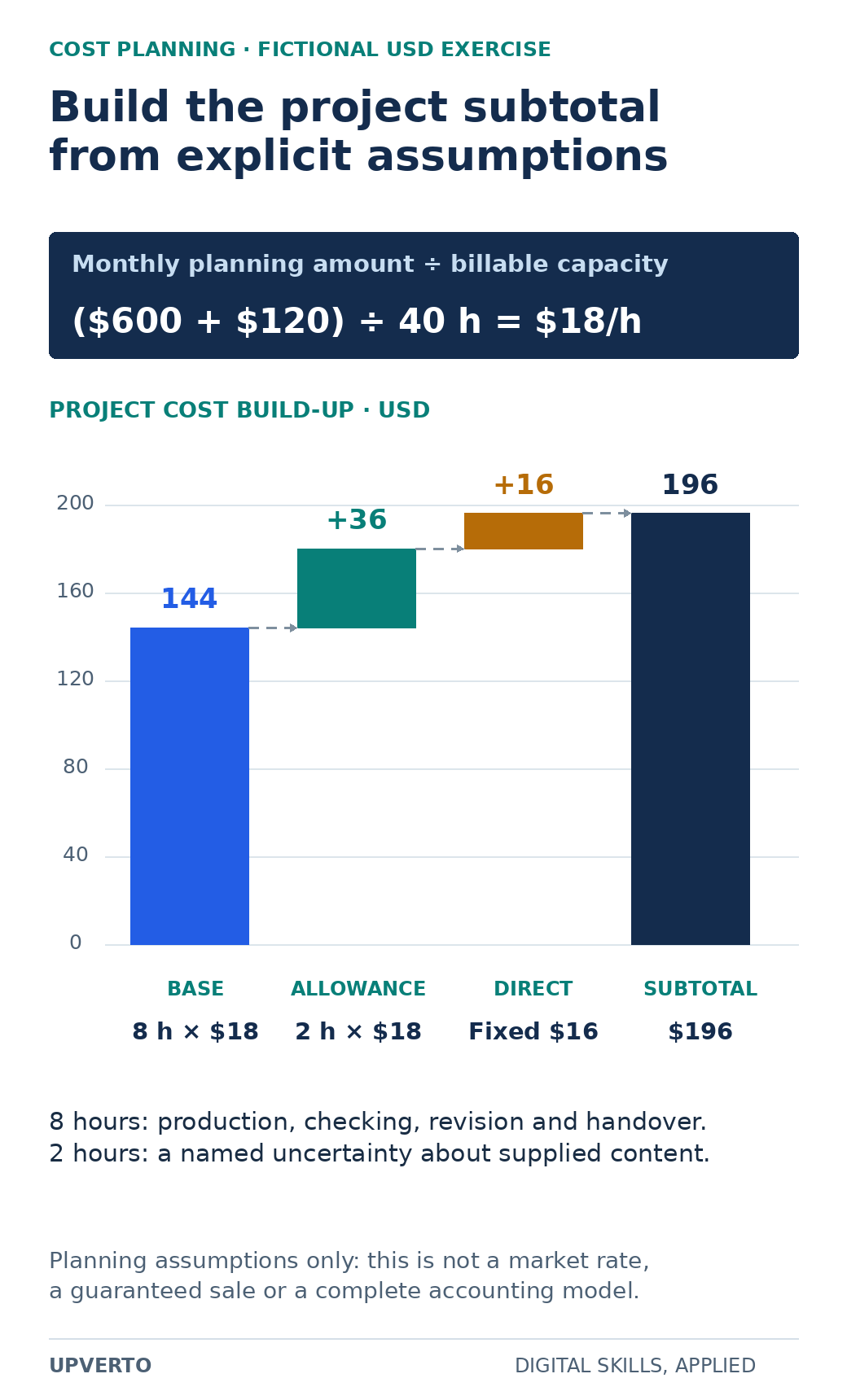
    The fictional freelancer Amir works in USD for this exercise. He sets a monthly personal-compensation planning target of USD 600 and allocates USD 120 of business overhead. He estimates 40 billable hours for the month after allowing time for learning, administration and finding work.

    The planning amount is (600 + 120) ÷ 40 = USD 18 per billable hour. This is an internal planning assumption, not a market rate, wage recommendation or guarantee that forty hours will be sold. If only thirty hours are realistically billable, the same monthly amount would require USD 24 per hour before project-specific costs.

    Do not divide by every hour you are awake or available. Some working time will not be billable, and some capacity may remain unused. Review your assumption against actual records over time. The guide to track freelance income costs capacity addresses that wider record-keeping task.

    Worked example: estimate one bounded project

    A monthly planning equation establishes USD 18 per billable hour; an accurate waterfall adds USD 144 base effort, USD 36 uncertainty allowance and USD 16 direct cost to a USD 196 subtotal.
    Reconcile a fictional project cost subtotal — The illustrative planning floor depends on assumed costs, billable capacity and bounded scope. It does not recommend a universal price. Use the enlarged view, then swipe or use arrow keys to inspect details. View full-size infographic.
    Read the text version: Reconcile a fictional project cost subtotal

    Fictional monthly assumptions: USD 600 personal-compensation planning target plus USD 120 overhead, divided by 40 billable hours, equals USD 18 per billable hour.

    Project componentCalculationUSD
    Base effort8 hours ×18144
    Named uncertainty allowance2 hours ×1836
    Project-specific direct costFixed invented amount16
    Planning subtotal144+36+16196

    This is neither a market rate nor a complete accounting model; no sale or earnings are promised.

    Amir’s fictional project is a small information-page update from approved copy and assets. The estimate is five hours of production, one hour of checking, one hour for the included revision round and one hour of preparation and handover. That is eight hours. A further two hours are reserved for identified uncertainty about the supplied content.

    Planning componentCalculationUSD
    Base effort8 hours × 18144
    Uncertainty allowance2 hours × 1836
    Project-specific costInvented fixed cost16
    Cost-planning subtotal144 + 36 + 16196

    The two-hour allowance is tied to a named uncertainty. It is not permission to accept unlimited changes. If the client adds new pages or asks for writing work, revisit scope. If the unknown could be much larger, a separate discovery task may be more appropriate than an arbitrary percentage.

    Account for a fee on the quoted amount correctly

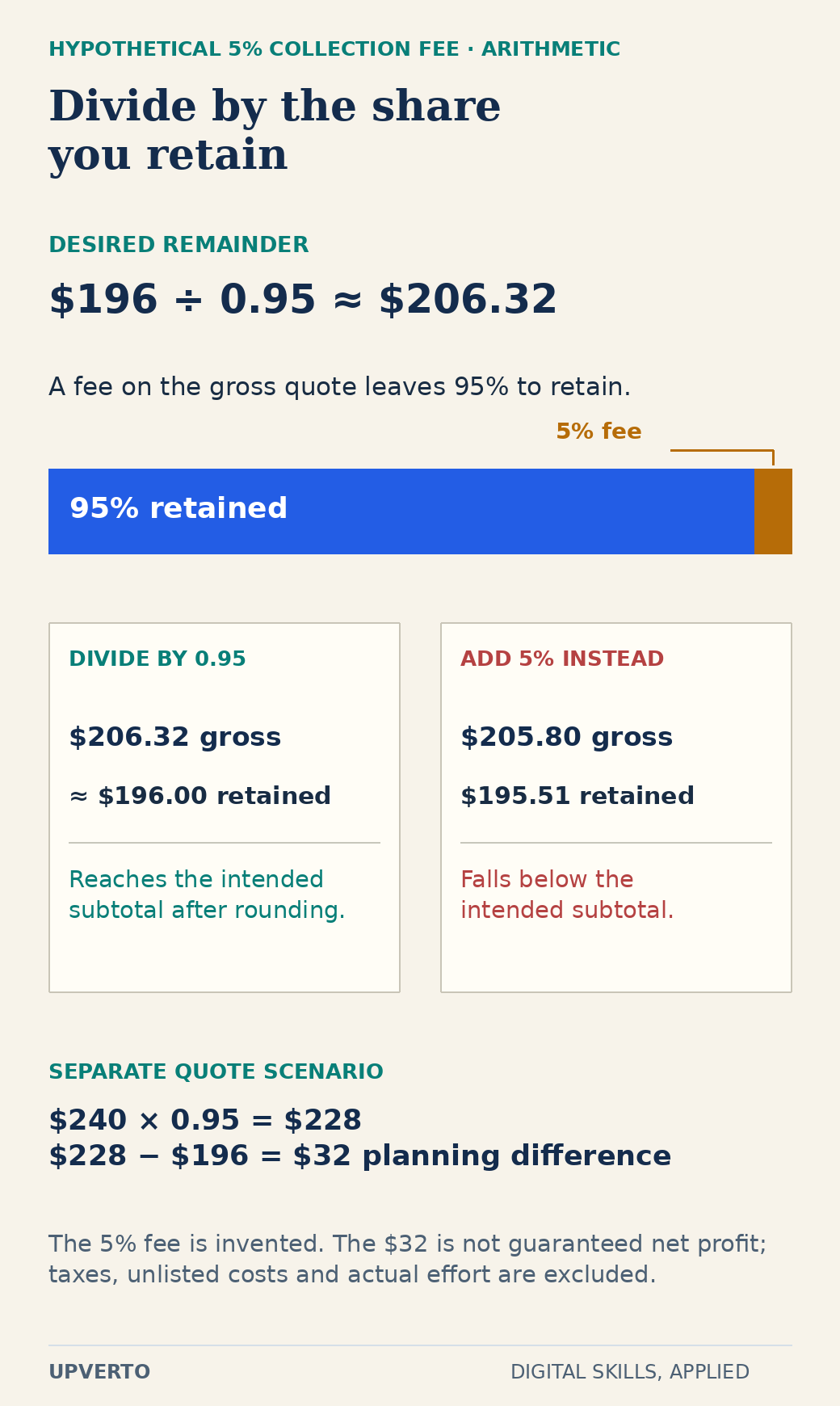
    Suppose, purely for arithmetic practice, a collection fee is 5% of the gross quoted amount. This is an invented assumption, not a current fee for any platform. To retain USD 196 after that fee, divide by 0.95: 196 ÷ 0.95 ≈ USD 206.32, rounded to cents.

    An exact 95/5 bar and two receipts contrast dividing USD 196 by 0.95 with adding 5%; a separate USD 240 quote leaves a USD 32 planning difference after the stated fee and subtotal.
    Check the denominator for a fee on the gross quote — The fee is a fictional assumption. Real fees and tax treatment require the current rules; the planning difference is not a profit guarantee. Use the enlarged view, then swipe or use arrow keys to inspect details. View full-size infographic.
    Read the text version: Check the denominator for a fee on the gross quote

    If a hypothetical fee is 5% of the gross quote,95% remains. To retain USD 196, calculate 196/0.95≈USD 206.32. Adding 5% instead gives USD 205.80; after the hypothetical fee it leaves USD 195.51, below the target.

    Separate scenario: USD 240×0.95=USD 228. Subtracting the USD 196 planning subtotal leaves USD 32. This planning difference excludes taxes, unlisted costs and variation in actual effort; it is not guaranteed net profit.

    Adding 5% to the subtotal would give USD 205.80. After a 5% fee on that amount, the remainder is USD 195.51, which is below the intended subtotal. The denominator matters because the fee is charged on the final amount. Real fees may have fixed components, tiers, currency conversion or tax treatment; use the actual current rules.

    For a separate quote scenario, Amir considers USD 240. Under the same hypothetical 5% fee, the remainder is USD 228. Subtracting the USD 196 cost-planning subtotal leaves USD 32. Call this a planning difference, not a guaranteed net profit: the model excludes taxes and any unlisted costs, and actual effort may differ.

    The SBA’s break-even calculator illustrates how fixed costs and contribution relate in a business model. The project worksheet is a simpler, explicit planning exercise. Its purpose is to expose assumptions, not to replace accounting or establish what a buyer will pay.

    Review the quote as a decision

    A cost floor is not automatically the correct quote. Consider the buyer’s problem, the value and suitability of the deliverable, your alternatives, the market evidence available and the responsibility you would accept. If the buyer’s budget cannot support the agreed work, reduce scope, change the delivery approach or decline rather than quietly relying on unpaid effort.

    Explain the proposed deliverables and assumptions in the quote. Name the currency, payment arrangement, revision boundary and conditions that require a change. Do not expose unnecessary personal financial detail; the client needs to understand what they receive and the commercial terms, not every internal calculation.

    Separate the pricing method from the billing arrangement. Hourly work, fixed-price projects and retainers allocate uncertainty differently. Use hourly vs fixed price vs retainer to compare those arrangements after you understand the task and estimate.

    Use the price-estimation worksheet

    Record: currency; monthly planning needs; allocated overhead; realistic billable capacity; project tasks and hours; direct costs; named uncertainties; fee assumptions and date checked; exclusions; proposed quote; and review date. Keep the calculation separate from the final quote document.

    • Check that every task in the scope appears in the estimate.
    • Include checking, communication, revisions and handover where required.
    • Distinguish one-time project costs from overhead already allocated.
    • Avoid counting the same cost twice.
    • Recalculate any percentage fee on the amount it actually applies to.
    • Test a longer-effort scenario and decide whether the risk is acceptable.
    • After delivery, compare actual time and costs with the estimate.

    If the project takes twelve hours instead of the planned ten including the allowance, the model changes. Record why: a poor estimate, missing input, a defect you needed to correct or added scope. Those causes suggest different improvements. Increasing every future quote without understanding the reason may not solve the underlying problem.

    Improve the estimate with actual evidence

    Keep a small record of estimates and actual delivery. Over time, it can reveal which tasks you routinely undercount and which assumptions need clarification. Do not use another freelancer’s success story as a substitute for your own capacity and cost evidence.

    The immediate next step is to complete the worksheet for one clearly defined sample service. Label every invented amount and unresolved condition. You can then review a concrete estimate rather than choosing a price because it sounds professional.

    Frequently asked questions

    Is USD 18 per hour a recommended freelance rate?

    No. It is the result of fictional monthly planning assumptions in this exercise. Your costs, capacity, location, responsibilities and market conditions may differ. The method helps expose assumptions; it does not set a universal rate.

    Should I charge only for production time?

    Include the work required to deliver the agreed result, such as preparation, checking, communication, included revisions and handover. Otherwise the estimate may omit substantial effort even when the visible production task is small.

    Why divide by 0.95 for a 5% fee?

    In the example, you retain 95% of the gross quote. Dividing the desired remainder by 0.95 finds the gross amount needed. Adding 5% to the remainder applies the percentage to a different base.

    Is the USD 32 difference guaranteed profit?

    No. It is a planning difference under explicit fictional assumptions. Actual time, unlisted costs, taxes and other conditions can change the result. Do not describe the simplified worksheet as a complete accounting calculation.

    What if the client cannot afford the estimate?

    Discuss a smaller deliverable, different priorities or a different arrangement if suitable. Keep the scope honest. Do not accept the same responsibility while assuming that unlimited unpaid work will make the numbers fit.

    How should I handle uncertain requirements?

    Clarify them before quoting where possible. Use a defined allowance only for a bounded uncertainty, or propose a separate discovery stage. State which changes require a revised scope and price.

  • How to Turn a Digital Skill into a Freelance Service

    How to Turn a Digital Skill into a Freelance Service

    Part of How to Make Money Online with Digital Skills: A Beginner’s Roadmap.

    Turn a digital skill into a freelance service by connecting something you can do reliably to a specific buyer’s problem and a clear deliverable. Then define the inputs, limits, review process, and checks that make the work understandable to both sides.

    In this guide

    A skill describes your capability. A service describes the work a client can hire you to complete. Learning to use a design application is a capability. Preparing an agreed set of event graphics from supplied text is one possible service.

    Connect the skill, problem, and deliverable

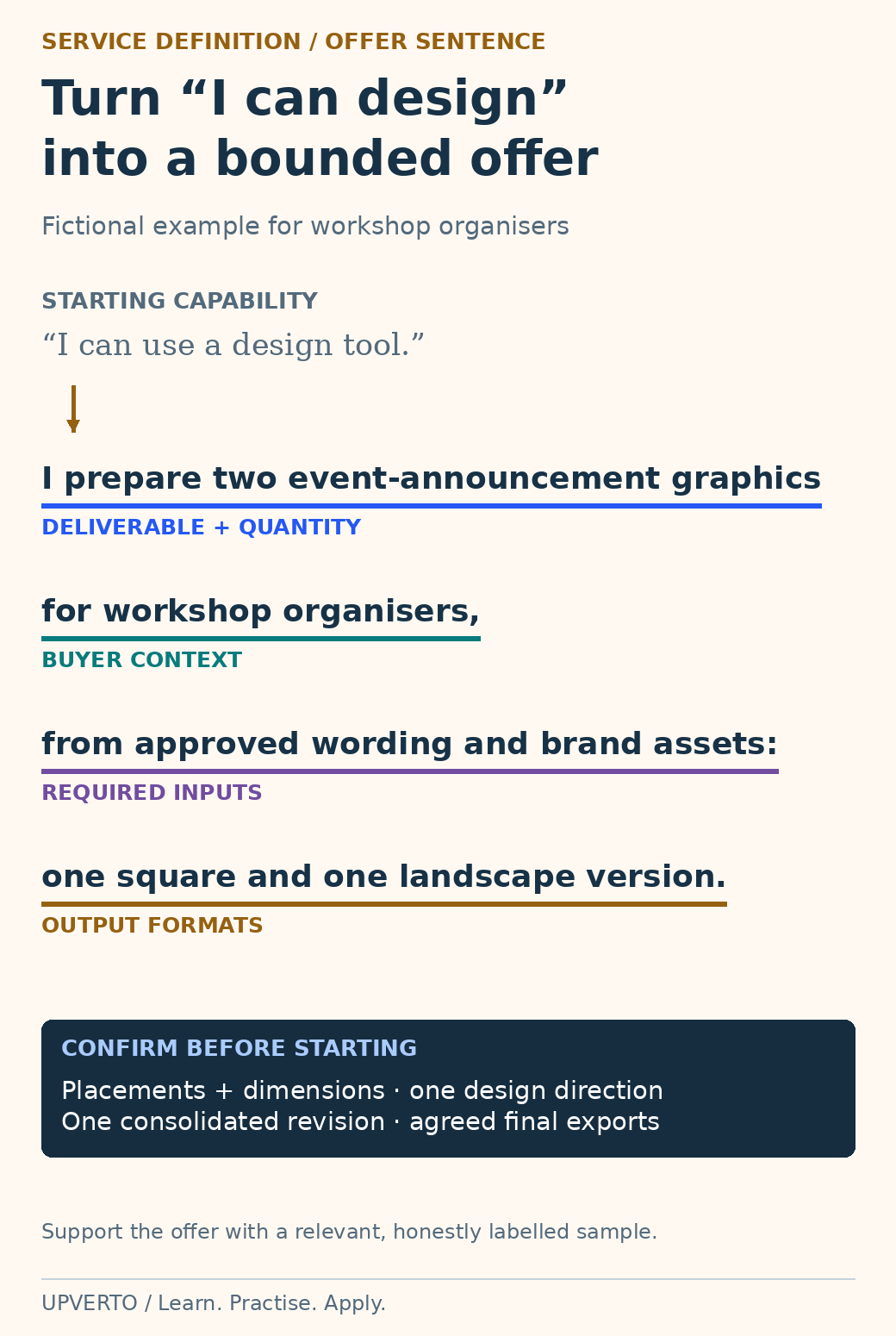
    A broad design-tool capability becomes a fictional offer for two event-announcement graphics. Colour underlines identify deliverable, buyer, approved inputs and square/landscape formats, followed by review conditions.
    Construct an offer from concrete parts — Read the offer as a specific promise: who it serves, what is delivered, what must be supplied, and which conditions are confirmed first. Use the enlarged view, then swipe or use arrow keys to inspect details. View full-size infographic.
    Read the text version: Construct an offer from concrete parts

    A broad capability such as “I can use a design tool” does not yet specify a client service.

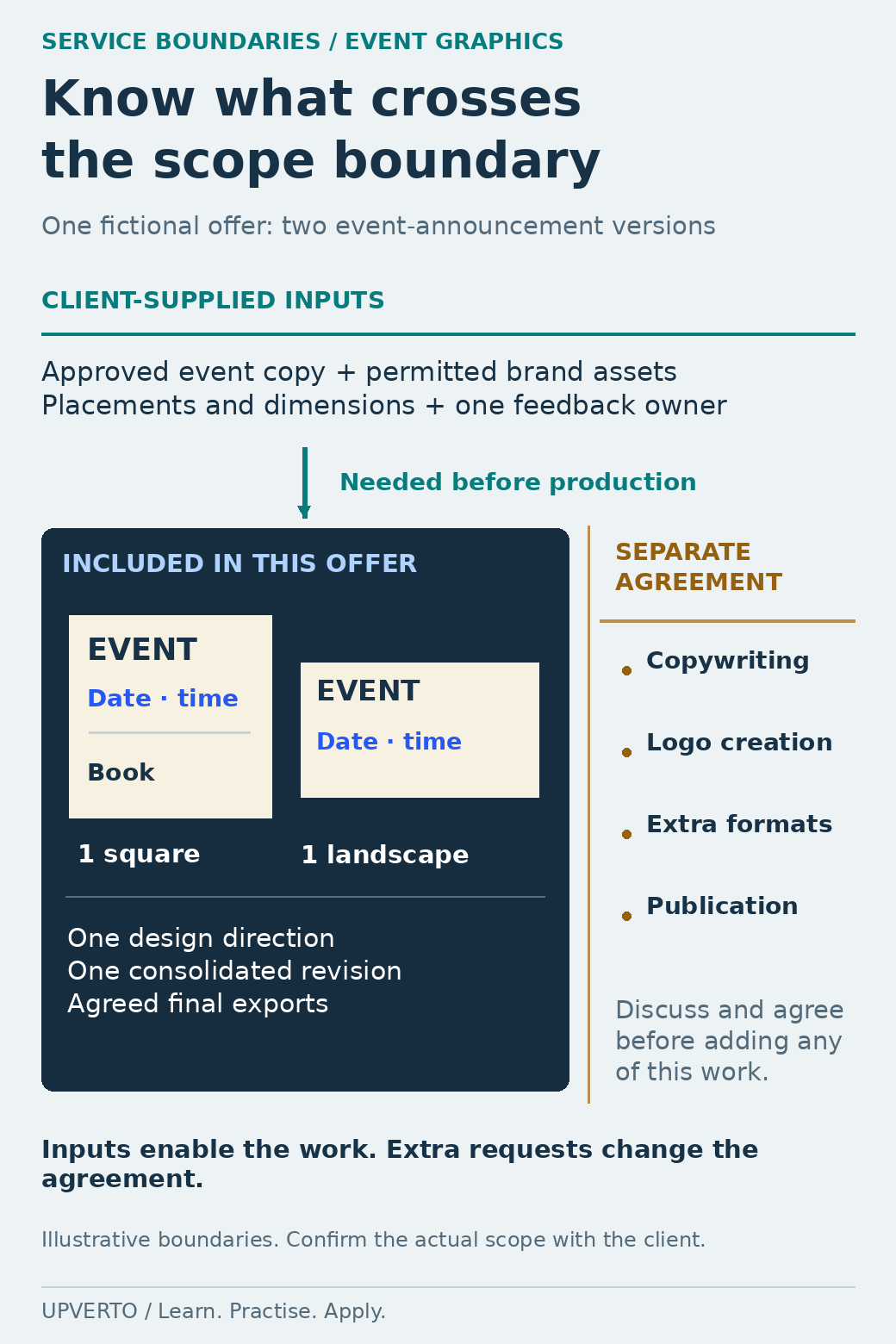
    I prepare two event-announcement graphics for workshop organisers, from approved wording and brand assets: one square and one landscape version.

    • Deliverable and quantity: two event-announcement graphics.
    • Buyer context: workshop organisers.
    • Required inputs: approved wording and permitted brand assets.
    • Output formats: one square and one landscape version.

    In this fictional example, placements and dimensions are agreed before starting. The offer includes one design direction, one consolidated revision round and the agreed final exports. A relevant honestly labelled sample should support the provider’s ability to deliver the task. No commercial result is promised.

    Practical summary
    From capability to an offer
    • Skill: what you can perform and check.
    • Buyer: who has a relevant task to complete.
    • Problem: what currently needs attention.
    • Deliverable: the work you will provide.
    • Conditions: the inputs and boundaries that make delivery possible.

    For example, a small training provider may have recorded a useful explanation but need it edited into a concise video. The service can specify the edit, captions, export format, and review process. It should not promise that the video will produce a certain number of sales or views.

    Start from your demonstrated ability. The readiness checklist helps you identify the scope you can support. If you are still deciding what to learn, use the skill-selection guide before building an offer around a tool you have barely used.

    Examples across different skills

    SkillA possible defined serviceImportant boundary
    Graphic designPrepare a specified set of event graphics from approved copy and assets.Brand strategy, copywriting, and extra formats need explicit agreement.
    Video editingEdit supplied footage into an agreed video with checked captions.Filming, advanced restoration, or new animation may be separate work.
    WordPressUpdate an agreed group of information pages and test the affected navigation.Live-system access, backups, forms, and functionality must be understood.
    Virtual assistanceOrganise a defined set of records and document a repeatable intake procedure.Confidentiality, permissions, and decisions that require approval must be clear.
    SEOReview an agreed set of pages and provide prioritised recommendations with evidence.An audit is different from implementation, and neither guarantees rankings.

    These are illustrative offers, not an instruction to sell them before practising. Each one needs a suitable brief and evidence. The relevant roadmaps explain the learning: design, editing, WordPress, virtual assistance, and SEO.

    Choose a buyer context you can understand

    You do not need to declare a permanent niche immediately. Choose a context that makes your offer concrete enough to test. “Small workshop organisers who already have event details and need clear graphics” is easier to investigate than “anyone who needs design.”

    Look at actual requests, existing workflows, and conversations you are authorised to have. Record what you observed and what remains an assumption. A business with an unattractive website does not automatically want to buy a replacement; it may have different priorities or constraints.

    Ask how the task is handled now, what causes difficulty, who approves it, and what a useful completed result would look like. This helps you refine the service without inventing a need.

    Define an output you can control

    Separate the client’s business goal from your deliverable. A client may want more enquiries. Your agreed work may be a clearer service page, a tested contact route, and a documented handover. You can verify those outputs; you cannot automatically claim responsibility for every factor affecting enquiries.

    Define quantities, formats, source-material limits, and review points where they matter. “A short video” leaves major questions unanswered. “One edited video from the agreed source material, in one specified format, with one consolidated review round” is more useful, provided the details are completed before work begins.

    Use the service-package guide for the full specification. It includes inputs, exclusions, revisions, and acceptance checks.

    Attach evidence that matches the offer

    Choose a sample showing a similar task and similar constraints. Explain its status and your contribution. A concept project can demonstrate your decisions without pretending to be a paid client result.

    If your current portfolio does not support the service, build a relevant practice project first. Then present it using the portfolio guide. This can also reveal hidden steps that should be included in the offer, such as file preparation or client review.

    Estimate the work before choosing a price

    Break the work into understanding the brief, preparing inputs, production, quality checks, communication, revisions, and handover. Use your practice record to estimate the effort. Include the costs that actually apply to the project and distinguish recurring business costs from one-off purchases.

    A fixed price requires sufficiently clear scope. An hourly arrangement still requires clear tasks, reporting, and limits. An ongoing arrangement needs a defined capacity or set of outputs. The choice should fit the work and the agreement.

    This guide does not prescribe a market rate. Check current channel fees, applicable taxes, payment arrangements, and contractual requirements for your situation before quoting. If you need jurisdiction-specific legal or tax advice, use an appropriately qualified source.

    A service-boundary map directs approved copy, assets and decisions into a bounded two-graphic deliverable area. Copywriting, logo creation, extra formats and publication remain outside for separate agreement.
    Map included work, client inputs and extra scope — Use the boundaries to discuss a real request. Supplied inputs, included outputs and additional work have different responsibilities. Use the enlarged view, then swipe or use arrow keys to inspect details. View full-size infographic.
    Read the text version: Map included work, client inputs and extra scope

    This map uses the article’s fictional event-graphics offer.

    Client-supplied or approved inputs
    Final event wording, permitted brand assets and images, confirmed placements and dimensions, and one person responsible for feedback.
    Included work
    Two announcement versions: one square and one landscape. One design direction, one consolidated revision round and the agreed final exports are included in the example.
    Separate agreement
    Copywriting, logo creation, extra formats and publication are outside the example’s scope unless separately discussed and agreed.

    The input arrow means those materials and decisions enable production. The marked boundary separates the defined deliverables from additional responsibility. Confirm the actual scope, permissions and review terms with the client rather than treating this example as a universal package.

    Write a one-page service definition

    FieldYour answer
    Buyer and taskI help [buyer] complete [specific task].
    Reason it mattersThe task addresses [observed problem or clearly labelled assumption].
    DeliverableThe client receives [named outputs and formats].
    InputsThe client supplies or approves [materials, access, and decisions].
    LimitsThe service includes [scope] and excludes [separate work].
    ProcessBrief → production → agreed review → checks → handover.
    EvidenceLink to a relevant sample and explain its status.
    EstimateRecord effort, costs, assumptions, and uncertainties before quoting.
    Next conversationAsk a question that establishes whether the actual request fits.

    Worked example: an event-graphics service

    Fictional offer: “I prepare two event-announcement graphics from your approved wording and brand assets: one square version and one landscape version. We confirm the placements and dimensions before work begins. The package includes one design direction, one consolidated revision round, and the agreed final exports.”

    The provider then lists what is needed: final event details, logo files with permission to use them, approved images, and one person responsible for feedback. Copywriting, logo creation, additional versions, and publication are separate unless agreed.

    A relevant concept sample demonstrates hierarchy, readability, and adaptation between formats. The provider’s estimate includes time to check the event details, prepare both versions, review feedback, and inspect exports. No invented revenue result is needed to explain the service.

    Test whether people understand the offer

    Show the definition to someone who can reasonably assess the problem. Ask what they think they would receive, what they would need to supply, and what remains unclear. Their response can expose ambiguity before you make a promise.

    When discussing a real opportunity, use the client’s actual requirements to refine the scope. Avoid giving away a full unpaid production project as a test. A short, relevant sample or a properly agreed small engagement can provide evidence without leaving the terms uncertain.

    Frequently asked questions

    Should I offer everything I am learning?

    Offer work supported by your evidence and delivery process. You can list broader learning interests elsewhere, but a client-facing service should make clear what you can currently complete.

    Do I need three package tiers?

    No. Begin with a clear service. Add options when they reflect real differences in scope, complexity, or support. Extra tiers do not fix an unclear underlying offer.

    What is the difference between a skill and a service?

    A skill describes what you can do. A service explains how you will apply that ability to a particular need, with defined deliverables and conditions. For example, editing ability becomes a clearer offer when it specifies the source material, finished video and review process.

    How narrow should my first service be?

    Make it specific enough that a suitable client can understand the output and you can estimate and check the work. Include the important boundaries. You can expand later when your evidence and delivery process support additional responsibilities.

    Can I offer a service based on practice projects?

    Practice work can demonstrate relevant ability when its status is clear. Explain what the sample proves and assess whether you can repeat the complete workflow under the proposed conditions. Do not imply paid-client experience or accept responsibilities that the sample does not support.

    How can I test whether my offer is clear?

    Ask someone to explain back who the service is for, what they would receive and what they would need to provide. Note the questions they cannot answer. Improve the wording and scope before adding packages, promotions or stronger promises.

    Make the offer ready for a useful conversation

    Complete your one-page definition and the package worksheet, then choose one relevant sample. Use the client-finding guide to identify suitable opportunities and the delivery guide to prepare for the work that follows.